P&G Interactive Assessment – Free Practice Test Questions (2026)
Updated: June 2026 | Verified against current P&G assessment format
The P&G online assessment is a mandatory screening process that all Procter & Gamble candidates must complete. This game-based evaluation serves as a critical filter. The assessment is divided into two phases:
1. The PEAK challenges personality assessments
2. The Interactive Assessment cognitive challenges (SWITCH, GRID and DIGIT)
This page offers a free sneak peek and practice into the key topics and question styles you’re likely to encounter, helping you start your preparation with confidence. Our adaptive and interactive practice tests are deliberately harder than the real assessment, so when you sit for the actual exam, it will feel significantly easier.
*The P&G Interactive Assessment is a gamified cognitive screening suite powered by Aon’s smartPredict platform, consisting of the Switch, Grid, and Digit challenges. These assessments utilize an adaptive algorithm that adjusts question difficulty in real-time based on your performance, measuring mental agility, spatial memory, and numerical proficiency under strict time constraints.

The P&G online assessment (also called the interactive assessment or candidate test) is a timed, game-style screening test. It includes logic, memory, numeracy, and personality sections.
The P&G assessment is known for its difficulty. In fact, over 70% of candidates don’t make it past this stage. But preparation makes a difference.
Statistical analysis indicates that targeted simulation training increases P&G pass rates by 2.6x. This improvement is attributed to reduced cognitive load during the high-pressure Digit Challenge and Switch Challenge segments
This section will help you break down each part of the test and practice effectively, so you walk in confident—not surprised.
Before diving into the free practice questions, we recommend watching the video below to better understand the test structure and how to pass-
The best way to prepare for the P&G interactive assessment and PEAK Performance Assessment, is to practice questions in the same format as the actual test. This will enable you to both experience the challenging test format with questions getting progressively more difficult while time runs out, and to learn how to answer questions quickly and effectively under the tight time limit.
JobTestPrep’s P&G PrepPack includes high-fidelity simulations of the Switch Challenge, Grid Challenge, and Digit Challenge, mirroring the official Aon/Cut-e testing environment.
It includes:
Additionally, get Switch Challenge and Digit Challenge PrepPacks for a discounted price.
The Switch Challenge questions in the P&G assessment test contain four symbols that change their order according to an operator. Your task is to transform the input shape sequence (numbered from left to right) into the output shape sequence using a four-digit operator.
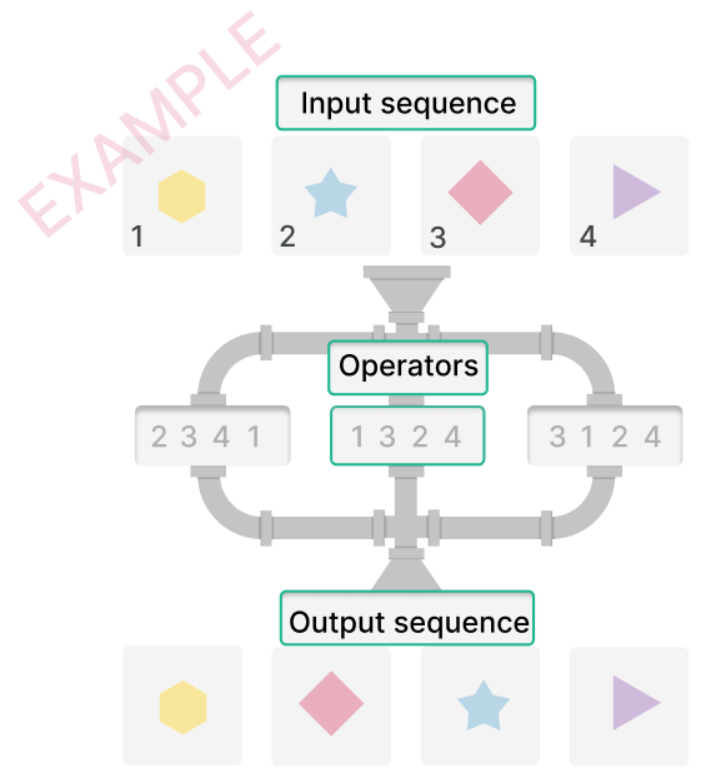
Each digit in the operator corresponds to the previous position of each shape before it was altered. The new order of the shapes' positions aligns with the digits in the operator. For each question, you'll choose one or more operators that match the changes in the shape order.
The top sequence, using one of the three operators, turns into the bottom sequence
What is the correct operator?
The top sequence, using one of the three operators, turns into the bottom sequence
What is the correct operator?
Learn more about the P&G Switch challenge with our full guide
The Switch Challenge is a **logic sequencing game** that tests your pattern recognition under time pressure. You'll see four symbols (shapes like triangles, stars, hexagons, and rhombuses) that change position according to numerical operators.
**Key mechanics:**
- **6-minute time limit** with 15-20+ questions
- Questions get **progressively harder** as you answer correctly (adaptive algorithm)
- Each "operator" (like 3142) tells you how to reorder the shapes
- You must identify which operator transforms the top sequence into the bottom sequence
**Why it's difficult:** The test deliberately overloads your short-term memory by forcing you to mentally track 4 moving objects simultaneously. Most candidates see their accuracy drop after question 8-10 when the difficulty spikes.
**Pass rate:** Less than 20% of candidates successfully complete this section on their first attempt without preparation.
The Switch Challenge is specifically designed to overload your short-term memory, and with the stressful time limit, you can easily become overwhelmed. The best way to prepare for this test is by practicing a test as close as possible to the actual P&G Switch Challenge questions, with the same time limit and varied questions that become progressively harder. For this purpose, we have created exclusive interactive P&G practice tests, simulating the exact same test format.
Boost your chances and save! Get the Procter & Gamble Assessment Test Practice and enjoy a discount on the Switch Challenge Preparation.
In each round, you will be presented with a memorization question followed by a spatial orientation question. The memorization question requires you to memorize the location of a colored dot on a grid. The spatial orientation question requires you to determine whether two grids of dots are identical, rotated, or mirrored. The Grid Challenge is a timed test, and the difficulty of the questions increases as you progress. Take a look at the following video to better understand the test and then try answering the questions below.
Before proceeding to the question, observe the hidden picture for 30 seconds and remember which dot is marked red. You will need this for a future question.
Symmetry: these types of questions will contain two grids with a line dividing between them. You have to determine whether the grids are symmetrical or not, such as the following.
Is the image symmetrical?
Before proceeding to the question, observe the hidden picture for 30 seconds and remember which dot is marked red. You will need this for a future question.
Rotation: For these questions, you need to determine whether the right and left grids are identical, only rotated.
Are the images identical but rotated?
Before proceeding to the question, observe the hidden picture for 30 seconds and remember which dot is marked red. You will need this for a future question.
Combination: Each question will contain three grids and you must determine whether the bottom grid is the "result" of the combination of the two top grids.
Is this correct?
Now is the time to recall those hidden images. Observe the grid:
Where on the grid and in which order did the dots appear?

Learn more about the interactive Grid Challenge.
The Grid Challenge is a tough nut, especially with the timing and increasing difficulty. Your best way to overcome this obstacle will be to create strategies and practice repetitively. Our Procter and Gamble Assessment Test Practice will let you practice as much as you need on infinite different rounds, offering the best practice.
The Grid Challenge tests spatial memory and visual pattern recognition through a dual-task format. Each round alternates between:
Key mechanics:
Why it's difficult: Your brain must simultaneously process NEW visual information while retaining OLD memory data. This creates cognitive interference that causes most candidates to forget locations by round 3.
What P&G is testing: Your ability to handle multiple priorities under pressure—a core skill in fast-paced brand management and supply chain roles where you're juggling several projects simultaneously.
Strategy tip: Use chunking techniques—group dots by quadrant or create mental "landmarks" rather than trying to remember individual coordinates.


Once you pass the online assessment, the next step is one or more structured interviews. These are typically competency-based and may be conducted via video or in person, depending on location and role.
What to Expect
Common P&G Interview Questions
How to Prepare
P&G also expects candidates to reflect its stated Values & Principles - Integrity, Leadership, Ownership, Passion for Winning, and Trust - throughout the hiring process. These are broader company values rather than the specific behavioral factors your interview answers are scored against, but they're worth keeping in mind when framing your "why P&G" answers.
Want More?
Check out our full P&G Interview Prep for:
Most candidates who pass both assessments are invited to 1-2 rounds of interviews, whether by video call or in person, depending on location. Learn more about the P&G Interview Questions and how to prepare for them, or go straight to our AI-powered P&G Interview Prep to start practicing.
Sharpen your sales skills with our P&G Virtual Job Preview!

P&G offers several entry points for students and graduates, each with unique eligibility and competitive selection.
Internships
Tip: Apply early, highlight leadership skills, and prep for the assessment ASAP
Graduate Schemes
Tip: Strong assessment + interview = direct offer into the scheme
Student Programs
P&G uses its assessment test not only for experienced professionals but also for entry-level and grad positions. You can find out more on their grad scheme website.
If you have any questions left, we will be happy to help. Feel free to contact us at: c.serv@jobtestprep.com

Less than 20% of candidates pass the combined PEAK Performance + Interactive Online Assessment on their first attempt. The Switch, Grid, and Digit Challenges are specifically designed to filter out 70-80% of applicants before they reach interviews. Candidates who complete targeted practice simulations with timed, adaptive repetition significantly improve their speed and pattern recognition - the two skills the assessment is designed to test under pressure.
Immediately—even before applying. Here's why: You'll typically receive your test invitation within 24-72 hours of submitting your application. Most candidates discover the test difficulty too late and fail. Our recommendation: Complete at least 50-100 practice rounds BEFORE applying so you're ready the moment the invitation arrives and can take advantage of the optimal 48-72 hour testing window.
There are no “right” or “wrong” answers, but some responses are more aligned with what P&G looks for. It’s still a screening tool, so poor alignment may result in disqualification.
If you fail the P&G assessment, you cannot reapply for 12 months. This means missing P&G's entire hiring cycle for that year. With P&G's June 2025 announcement of 7,000 job cuts (6% workforce reduction) alongside continued graduate hiring, competition for remaining positions is fiercer than ever. The cooldown period makes your first attempt critical—you literally cannot afford to fail.
The full assessment takes 40–60 minutes. Each interactive game (Switch, Grid, Digit) lasts about 5–6 minutes. The PEAK Performance section is untimed but typically takes around 20 minutes.
Yes - P&G's hiring process includes aptitude-style cognitive challenges as part of its Interactive Assessment. The Switch, Grid, and Digit Challenges measure logical reasoning, spatial memory, and numerical speed under strict time limits, making them functionally equivalent to traditional aptitude tests. The key difference is format: P&G's version is gamified and adaptive, powered by Aon's smartPredict platform, rather than a static written test. Candidates also complete the PEAK Performance Assessment, which evaluates personality, values alignment, and situational judgment. Together, the two stages screen out over 70% of applicants before interviews.
The math required for the P&G Digit Challenge is elementary - addition, subtraction, multiplication, and division with single or double-digit numbers. No algebra, fractions, or advanced formulas are tested. The challenge is not the complexity of the calculations but the speed: you have 5 minutes to solve as many equations as possible, with each answer window lasting roughly 5-10 seconds. Candidates who struggle typically do so because of time pressure, not mathematical difficulty. Practicing mental arithmetic drills until basic calculations feel automatic is more effective than studying math concepts.