How to Become an Elevator Mechanic: Complete 2026 Guide
Updated September 15, 2026
Thinking about a career as an elevator mechanic? Elevator mechanics (also called elevator constructors or elevator technicians) install, maintain, and repair the equipment that keeps millions of people moving safely between floors every day. It is one of the highest-paying skilled trades in the country, and you do not need a college degree to get there.
To become an elevator mechanic, you must:
Apply for an elevator mechanic apprenticeship, either through the union (IUEC/NEIEP) or a non-union employer.
Pass the EIAT (Elevator Industry Aptitude Test) and tool assessment.
Pass an interview and get ranked on a hiring list.
Complete a four-year apprenticeship and, in most states, obtain a license.
This guide walks through every stage of how to become an elevator technician, from your first application to your first day on the job, plus what the role pays and what it is really like.
Elevator mechanics assemble, install, maintain, repair, and modernize elevators, escalators, dumbwaiters, and moving walkways. The role blends electrical work, hydraulics, and mechanical troubleshooting, and it carries real responsibility since the equipment moves people every day.
Most people enter the trade through a four-year, paid elevator mechanic apprenticeship rather than a degree program. The two main routes are:
Both routes lead to the same day-to-day work, but they differ in how you apply, how you train, and how you get paid along the way.
Before you go further, it helps to know who's who. Here are four terms you'll see throughout this process:
| Entity | Stands for | What it means for you |
| IUEC | International Union of Elevator Constructors | The union representing elevator mechanics, helpers, and apprentices since 1901. This is who you join once your apprenticeship is complete. |
| NEIEP | National Elevator Industry Educational Program | Runs your apprenticeship from application to graduation: recruitment, the EIAT exam, the tool assessment, and your classroom instruction. |
| Locals | Region Union Chapters | Your regional union chapter. Recruitment windows, interviews, and hiring lists all happen at this level, which is why timing varies by city. |
| JAC | Joint Apprenticeship Committee | The two-person panel (one union, one employer) that interviews and scores you after the EIAT |
To apply for an elevator apprenticeship through NEIEP, you must meet these baseline elevator apprentice requirements:
Non-union employers generally ask for the same basics (age, diploma or GED, work authorization) but set their own hiring process on top of that, so requirements can vary by company. Either way, most people become an elevator mechanic with no experience in the trade beforehand, so do not let a lack of background hold you back from applying.
Nobody expects you to arrive with elevator experience, but a few skills consistently help applicants during recruitment and on the job:
Both paths train you to become a licensed elevator mechanic, but they get you there differently. If you are trying to work out how to join the elevator union versus going non-union, here is how the two paths compare.
| Union (IUEC / NEIEP) | Non-Union / Merit Shop | |
| How you apply | Apply during a Local's recruitment window (opens roughly every two years) through NEIEP | Apply directly to an elevator company or contractor whenever they are hiring |
| Entry test | Must pass the EIAT, tool assessment, and interview | Varies by employer, some use their own screening, others hire on experience or referral |
| Training structure | Standardized NEIEP curriculum: 8,000 hours of on-the-job learning plus 576 hours of related classroom instruction | Employer-run or state-approved apprenticeship, structure and hours vary by company |
| Pay progression | Set percentage of the mechanic rate at each stage, the same nationwide | Set by the individual employer, can vary widely |
| Benefits | Pension, health insurance, and annuity contributions under a collective bargaining agreement, kicking in after your first 2,000 hours | Varies by employer, benefits are not standardized |
| Job security | Union protections mean you can generally only be dismissed for just cause | Typically at-will employment, like most non-union jobs |
| Portability | Union card is recognized across IUEC signatory employers nationwide | Experience and standing usually apply to that specific employer |
| Waiting period | You are ranked on a hiring list after your interview and wait to be called | No ranked list, hiring depends on the employer's needs |
Neither path is objectively better for everyone. The union route offers standardized training, portability, and strong benefits, but comes with an application cycle and a ranked waiting list. The non-union route can mean a faster start, since you are applying directly to an employer, but pay, training quality, and benefits depend entirely on that employer.
If you are already working for a non-union or merit shop company and want to learn how to join the elevator union instead, NEIEP and the IUEC both have recruitment and outreach pages that walk through the switch.

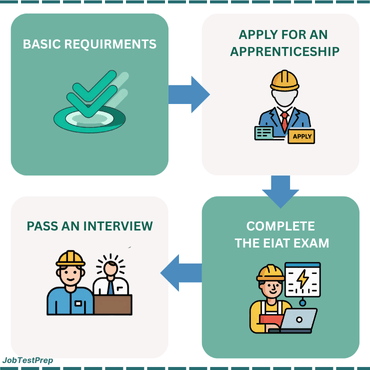
If you are applying through the union route, here is how the IUEC apprenticeship application process runs:
Once your application is accepted, your Local Area Coordinator will invite you, by email through iCIMS, to sit for the Elevator Industry Aptitude Test (EIAT).
According to the NEIEP-approved study guide, the EIAT contains 100 questions split across three areas:
You need a score of 70% or higher to pass. The EIAT is scored pass/fail, so there is no separate tiered ranking at this stage, your test result simply determines whether you move on to the tool assessment and interview.
After the written exam, you will complete the EIAT tool assessment, where you identify common hand tools and demonstrate basic measurement reading. This is scored separately from the EIAT, but your tool assessment result carries forward and counts toward your final interview score, so it is worth preparing for specifically rather than treating it as an afterthought.
Our Elevator PrepPack™ covers all three EIAT sections plus tool recognition and interview preparation. You can also try our free EIAT practice test to get a feel for the question types before committing to full preparation.
If you pass the EIAT, you move on to an interview with two members of the Joint Apprenticeship Committee (JAC), one representing the IUEC and one representing the employer side. Interviews generally run 15 to 20 minutes.
Because the questions and rubric are standardized, preparation matters. Highlighting relevant experience, mechanical knowledge, and any trade-related coursework or certifications (OSHA 10 or OSHA 30, for example) can help you stand out.
Read more: NEIEP Interview Questions.
After your interview, you are assigned a score and placed on a ranked hiring list for your Local. Employers with open apprentice positions hire off this list in ranked order as they need workers.
Your apprenticeship begins with a 12-month probationary period, during which your reliability and work ethic are closely evaluated. Completing this first year earns you full initiation into the union, if you are on the union route.
This four-year, paid structure is the core of how to become an elevator mechanic, regardless of which entry route brought you here.
On your first day as an elevator mechanic apprentice, you should arrive prepared to be a "sponge," meaning you should listen and observe far more than you talk. Your primary goal is to take initiative and show that you are eager to learn and work hard.
As an apprentice in the elevator trade, you will generally be placed into one of four primary departments: New Installation, Modernization, Repair, or Service. While you may have a preference for where you start, apprentices rarely get a choice in their initial placement; the union or company will assign you based on their current needs.
The different job types you may encounter include:
This is where the majority of new apprentices begin their careers.
Modernization is often considered an excellent place to gain a wide range of knowledge.
The repair department is often attached to the service department.
Service is generally reserved for more experienced workers, and it is rare for new apprentices (helpers) to be placed here.
During the NEIEP apprenticeship program, also called the IUEC apprenticeship, you will go through 8,000 hours of on-the-job learning (OJL) and 576 hours of Related Instruction (additional theoretical and practical courses).
Licensing is usually the last formal step in how to become an elevator technician, once your apprenticeship hours and any state exam are complete.
Most states require some form of elevator mechanic licensing or certification, though the specific requirements, exams, and fees vary significantly from state to state. A few states handle licensing at the local level, or do not require a state license at all.
Common building blocks across licensing states include:
Beyond state licenses, two widely recognized industry credentials are worth knowing about:
Because licensing rules change and vary by jurisdiction, check your specific state's licensing or labor department before you rely on any requirement listed here.
According to the U.S. Bureau of Labor Statistics' Occupational Employment and Wage Statistics program (May 2025 release), elevator and escalator installers and repairers earn a median annual wage of $109,910, among the highest of any skilled trade tracked by the BLS, but how much does an apprentice elevator mechanic make?
The IUEC defines a progressively increasing pay scale for apprentices as follows:
Mechanic rates vary by state and region, so your actual apprentice pay will depend on where you work. Get a free elevator apprentice salary by state PDF for estimated figures in your area.
Fringe benefits under a union collective bargaining agreement typically begin once you complete your first 2,000 hours (usually around one year), and hours from your probationary period count toward this total.
This pay ceiling, reached without a four-year degree, is a big part of why so many people ask how do you become an elevator mechanic in the first place.
Elevator mechanic work suits people who want strong pay and job security without a four-year degree, and who do not mind an unconventional entry process. Before you invest years in how to become an elevator mechanic, review the elevator apprentice requirements in Section 2 and consider these questions honestly:
If those trade-offs sound reasonable to you, the pay, demand, and long-term stability of this trade make it worth a serious look.
Most elevator mechanics start with no prior industry experience. You apply for an elevator mechanic apprenticeship, either through NEIEP and the IUEC or directly with a non-union elevator company, and you learn the trade through paid, on-the-job training combined with classroom instruction.
Yes. NEIEP does not publish an exemption for applicants with prior mechanical or elevator experience. Everyone entering the apprenticeship through the standard recruitment process takes the EIAT.
Elevator technicians install, maintain, and repair elevator components such as doors, cables, motors, and control systems. They diagnose and troubleshoot operational issues and perform routine and scheduled maintenance on elevators and other vertical transportation systems.
The Certified Elevator Technician (CET) credential from the National Association of Elevator Contractors (NAEC) is widely recognized. CET-certified professionals assemble, install, repair, and maintain electric and hydraulic elevators, escalators, freight elevators, passenger elevators, and dumbwaiters.
Elevator supervisors and mechanics-in-charge tend to earn the most within the trade, building on the strong base pay already common among licensed elevator mechanics.
Neither route is universally better. The union path offers standardized pay progression, portable credentials, and collectively bargained benefits, but includes an application cycle and a ranked waiting list. The non-union path can mean a faster start with a single employer, but pay, training, and benefits depend on that employer.
Start exploring the elevator apprentice requirements, then decide between the union and non-union routes. From there, the fastest path is applying as soon as a recruitment or job opening appears, since delays in this trade usually happen while waiting for the next application window or hiring list, not during the apprenticeship itself.
Watch the NEIEP recruitment page for your area, since each IUEC Local opens a new recruitment roughly every two years. Once a window opens, submit your application, then pass the EIAT, tool assessment, and interview. There is no way to join outside of an active recruitment window, so checking often is the biggest factor in timing.