Practice for the NAV Canada Online Test - Your Ticket into Canadian Air Traffic Control
Last Updated: September 17th, 2026
If you wish to become an air traffic controller with NAV Canada, you'll need to pass the NAV Canada test, a multi-stage selection process that begins with two cognitive assessments, and you'll need to score better than most other candidates to be shortlisted.
Passing these tests is a critical, non-negotiable step: it's how NAV Canada decides who moves forward to the assessment centre and, ultimately, who gets a seat in ATC training — you cannot start training without clearing them first.
This page gives you NAV Canada test practice for both stages, drawn directly from NAV Canada's own published selection process.
One Month's Access to:

As in the USA, Canada also has a shortage in air traffic controllers.
Working for NAV Canada is therefore an attractive prospect for many who seek a stable and lucrative career in Canadian air traffic control.
Becoming an employee, however, takes time and patience, as the organization requires going through a highly competitive selection process, followed by a long training period.
On this page, we focus on the selection process and its two cognitive exams:

The first is a 30-minute online test which includes four sections. Together, they assess cognitive abilities under a tight time limit.
This stage is also called the "Online Assessment", as opposed to the next, "In-person Assessment" (also known as FEAST). Its purpose is to shortlist applicants, avoiding the need to handle a massive volume of applicants traveling to take the in-person stage.
This means this section will be the most selective part of the process. It also means no unique ATC knowledge is required. Instead, you are measured for:
Failing the NAV Canada online assessment means you will have to wait one year before reapplying!
During this stage, candidates are required to visit one of the ATC centres where the exam is taken in-person. During roughly six hours, you will take two tests simulating specific abilities essential for air traffic controllers:
The FEAST I format is entirely different from the NAV Canada online assessment, and involves more challenging memory and multitasking games, as well as complex questions that require strong visual-spatial abilities.
In the part, you will likely spend most of the time in front of a computer. Questions in this section will test cognitive abilities expected of ATCs, such as memory, spatial reasoning, and attention. After you have completed this, you will move on to FEAST Part 2, that covers several air traffic simulations.
This section is primarily focused on what you will be required to do as an air traffic control personnel. Thus, you will be answering questions that focus on dynamic radar, multi-control, mathematical notions, and strip display management. This section of the test is considered to be very challenging with a relatively low pass rate.
*please note that our PrepPack™ now includes the full preparation for FEAST I, with FEAST II simulations coming soon.
If you have passed ATC stage 2, you are among the rare few who do! next, you'll be sent either a pre-recorded interview or an invitation for a phone interview. If you pass, you'll be invited to an in-person interview with the NAV CANADA training manager in their area of specialty.
If you are applying to the ATC position in Montreal, part of the assessment will be conducted in French. However, past ATC applicants have admitted that this section was not very difficult.
ATC applicants in Canada begin their journey by applying online. Once you complete the application, you will receive an email inviting you to participate in a NAV Canada online assessment, also given to maintenance technician applicants and pre-board screening officers. In most cases, the invitation is sent within a few days of the application.
The test includes four sections taken in your preferred order:
This challenging section assesses your ability to identify patterns.
⌛ You will have 6 minutes to complete as many questions as possible.
The task: In each question, you will be presented with matrices containing different symbols. First, determine which rule the two grids on the left follow, and then choose the two grids on the right that follow that rule.
Here is an example of inductive reasoning questions in the online ATC test:
Choose the two grids that follow the rule.

The questions’ difficulty level increases throughout the test, and it will be more challenging to identify the governing rule, especially in a time limit of only 6 minutes.
This logic test assesses your ability to learn rules and apply them correctly.
⌛ You will have 6 minutes to complete as many questions as possible.
The task: An array of up to five different symbols will be presented to you, along with a question mark in the middle. You will be asked to replace the question mark with the symbol that fits in that cell so that each shape only appears once in each row and once in each column.
Here is an example of deductive reasoning questions in the online ATC test:
What symbol should appear in place of the question mark?
The shape missing from the third row is the X- therefore, the answer is X.
Each symbol can appear only once in a row or a column. Thus, you have to pay extra attention to the location of every symbol and the number of times it spears in the grid.
This challenging test section measures your orientation skills.
⌛ You will have 3 minutes to answer as many questions as possible.
The Task: You will be presented with an aircraft dashboard that has a gyrocompass showing the flight direction, and a radio compass showing the location of a non-directional beacon. Your task here is to determine the position and course of the aircraft (relative to the beacon).

*Source - JobTestPrep Nav Canada ATC practice test.
Because the RBI indicates where the beacon is relative to the flight direction, to identify the aircraft's direction relative to the beacon, you must mentally rotate the radar according to the flight direction (shown on the GYRO). In the example above, the aircraft is flying west and is also located in the west (relative to the beacon).
This task is extremely difficult to perform quickly and accurately. When you practice visualizing the presented information and getting as many correct responses as possible in a given time, you will be much more likely to succeed on the actual Nav Canada online test.
Check also our YouTube video explaining Gyro and RBI test
This ATC test is a variation of classic attention assessment, in which you are asked to click "correct" each time you see a specific image, and "incorrect" when you see a different image.
⌛ This test lasts for about 2 minutes, during which you have to remain highly concentrated and react quickly and accurately.
The following questions simulate parts of the FEAST I exam, as part of the NAV Canada practice test you can find in our PrePack™:
Observe the following gauges, try to commit them to memory as best you can:
This section checks how well you can picture a flat shape becoming a solid object. Take a look at the unfolded cube below:
Which of the four possible options represent the cube in its folded form?
The correct answer is (D). Why?
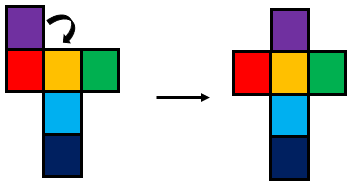
Answer (A) is incorrect because the red and dark blue facets are on opposite sides and can’t touch.
Answer (B) is incorrect because the purple and light blue facets are on opposite sides and can’t touch.
Answer (D) is incorrect because in the unfolded cube when the red facet it above the light blue facet, the green facet is to the left of the red facet and not to its right like in cube (D).
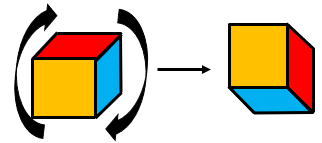
Instead of trying to fold the whole cube at once in your head, pick one face as your "anchor" and work out only its immediate neighbors first: which faces touch it, and which face ends up directly opposite it (opposite faces on a cube's net are never adjacent once folded, so you can eliminate any answer that shows two "opposite" faces touching).
Build the rest of the cube outward from there rather than trying to visualize the full fold in one step.
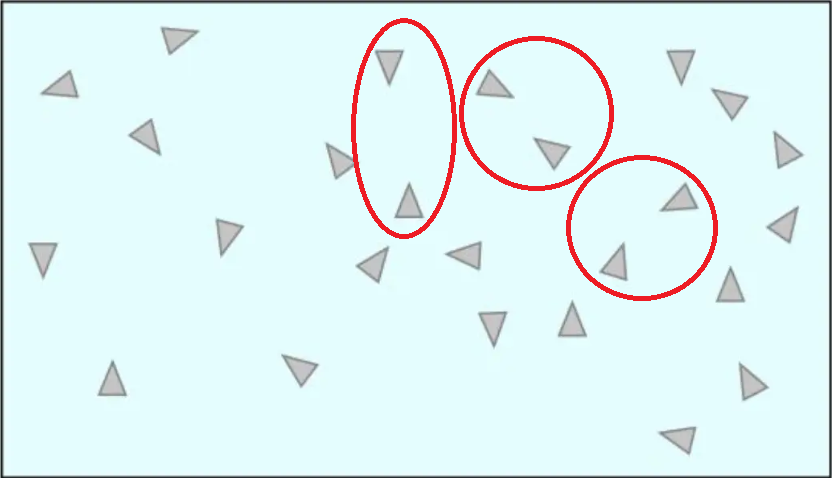
Determine whether there is a pair of triangles facing each other in a conflicting path.
Answer: B. No conflict
This may feel counterintuitive, as certain pairs of triangles do appear to be headed for collision:
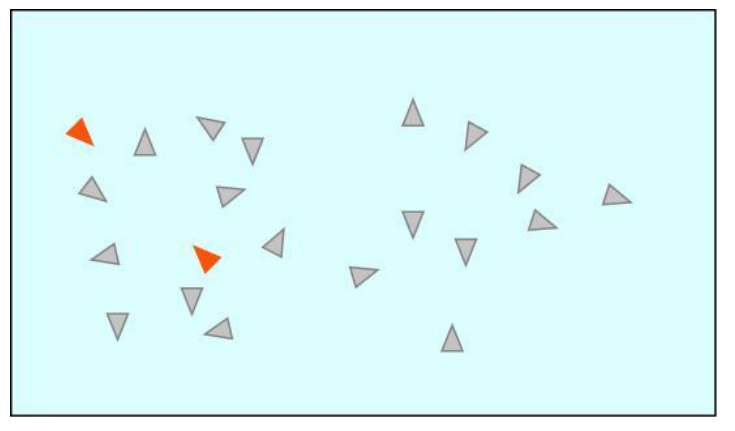
However, the FEAST definition for conflicting paths is any two aircraft in a headed for a direct, head-on collision, like this:
What is this test trying to assess?
Spotting genuine conflicts, and ruling out false alarms as quickly as possible is the core job of an air traffic controller.
On a radar screen, aircraft constantly appear to be on crossing paths without actually being on a collision course, and a controller who reacts to every visual near-miss would be useless under real traffic volume.
This task tests that exact judgment: scanning a busy, cluttered field, applying a precise rule for what actually counts as a conflict, and doing it in seconds, not minutes. Candidates who can't reliably tell true conflicts from visual noise under time pressure would struggle with the split-second, high-stakes calls the job demands every day.
Even though this may look easy, on the actual test, you will have 5-7 seconds per question. Scanning the whole screen and making a decision within that time is no easy task. Practising these questions helps cut down the time it takes to scan and recognise whether there is a conflict.
This test measures your visual perception and ability to quickly recognise potential conflicts ahead, a crucial ability for Air Traffic Controllers. Note that the actual FEAST test design and procedure may differ slightly.
Here is a sample of a different type of question, in which you'll need to determine the location of a certain shape in relation to the presented character. The character could be placed in different orientations, so you'll have to picture the shape as the character sees it.
Where is the square in relation to the character?
The correct answer is C. Why?
This figure's perspective is one where mirroring applies, meaning whatever side you see a shape on is the opposite of the person's actual side.
The square appears on your right as you look at the image. Because this perspective mirrors, that flips: the square is actually above the person's left hand.
How to work through it:
There are four possible perspectives to the person in this test:
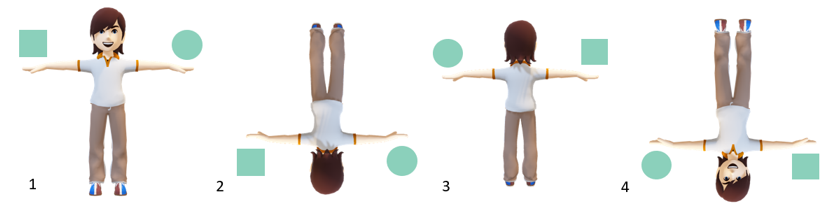
Perspectives number 1 and 2 (as in our sample question) are more difficult because the person’s perspective is the opposite of yours. For example, the circle is above the person’s left hand, but you see it on the right side.
Perspectives number 3 and 4 are easier because the man’s perspective is the same as yours. When you look at your screen, you look forward like the man in perspective number three does. The circle is above his left hand, and you see the circle on the left side.
To understand perspective number four, you can imagine the person is lying on their back (and is at the same position you will be if you would lie down now) meaning when the circle is above his right hand, you see it on the right side.
This question might seem easy at first sight. In fact, if you had enough time, you could probably answer 100% of these questions correctly.
However, you'll only have less than 2 SECONDS to answer questions in this section.
In our NAV Canada + FEAST PrepPack™ bundle you'll have 2 sets of spatial reasoning tests, each with 40 questions to complete in 60 seconds.
With the images changing so quickly, that's a pretty tough challenge. So, make sure you are super concentrated when starting this test.
Remember the first image on this page? Try to recall which of these images appeared in it:
The challenge in this task is remembering its details. To do that fast enough, try to repeat the numbers the pointers point at. If the pointers point at a scale mark with no number on it, look at the closest number and try to memorise it.
Look at the following diagram and answer
Which will be the penultimate flight to land?
A similar memory test only with distracting math questions. You will be presented with 12 symbols you have to memorize. Then, you'll be given 15 simple math questions. After determining if the answer to each math drill is true or false, you'll be asked to recall the exact symbols presented beforehand.
This memorization task requires remembering auditory information. Specifically, you'll be asked to listen to an audio recording with a number embedded in a sentence. You will then be asked to select the correct number that you heard in the sentence out of four possible options. Sounds easy? this number can be as high as 9,000,000.
Several more test sections examine your ability to remain highly attentive, react fast, and split your attention between several tasks:
Unfortunately, passing all stages throughout the hiring process does not guarantee you make it to the ATC training program. All candidates who pass enter an applicant pool, from which top applicants are then selected to proceed to the training program.
Offers are sent out roughly 4 months in advance of the course start date; that is when you will be notified if you have been selected.
After passing the NAV Canada online assessment test, you may need to wait several weeks or even months before being invited to the ATC assessment centre, which has specific dates set by NAV Canada. These assessments are usually conducted one to two times a year.
The NAV Canada online assessment uses unfamiliar question types, abstract reasoning, spatial orientation, and timed logic tasks that most people haven't seen since school aptitude tests, if ever. The same goes for the in-person test (commonly known in the aviation industry as FEAST) that candidates take later in the process. Without a proper NAV Canada assessment test practice, you end up spending valuable test time figuring out the format instead of answering the questions in the bets possible way.
Preparing in advance means you walk in already knowing what to expect, so you can focus on solving, not guessing.
Our PrepPack™ gives you real NAV Canada test practice modeled on the actual format, timing, and difficulty of both stages, with full explanations so you understand why an answer is right, not just that it is.
It's offered in three plans, so you can match your prep to where you are in the process:
As of NAV Canada’s current union pay range:
• Training salary: starts at $58,606, rising to $61,337 after one year
• Licensed tower controller: $104,258 to $207,450
• Licensed area control centre (ACC) controller: $143,513 to $207,450
Controllers can also receive additional premiums based on location, holidays, and shifts.