Talogy Assessment Tests Guide (2026)
Last updated: October 21, 2026 | Trusted by thousands worldwide.
You've just been sent a Talogy assessment, and now you want to know exactly what you're walking into. But you're not alone. Every year, thousands of candidates across the US and globally complete Talogy tests for job applications, promotions, leadership development, and professional certifications.
Talogy LLC is a global talent management and psychometric assessment provider that helps employers measure cognitive ability, personality traits, leadership potential, and job-related skills, predicting real workplace performance beyond what CVs and interviews reveal.
This guide covers everything you need to know. Whether you’re facing a Talogy Caliper assessment, a Talogy Cubiks-based test, or a PSI Talent assessment, you’ll find a clear breakdown of what each involves and what to expect.

A Talogy assessment is a scientifically developed evaluation used by employers to measure how well a candidate's abilities, behaviors, and motivations align with a specific role.
Built on decades of industrial and organizational psychology research, Talogy tests are structured to provide objective, data-driven insights into cognitive ability, personality traits and motivation, workplace behaviors and decision-making, and, in some cases, technical or job-specific skills.
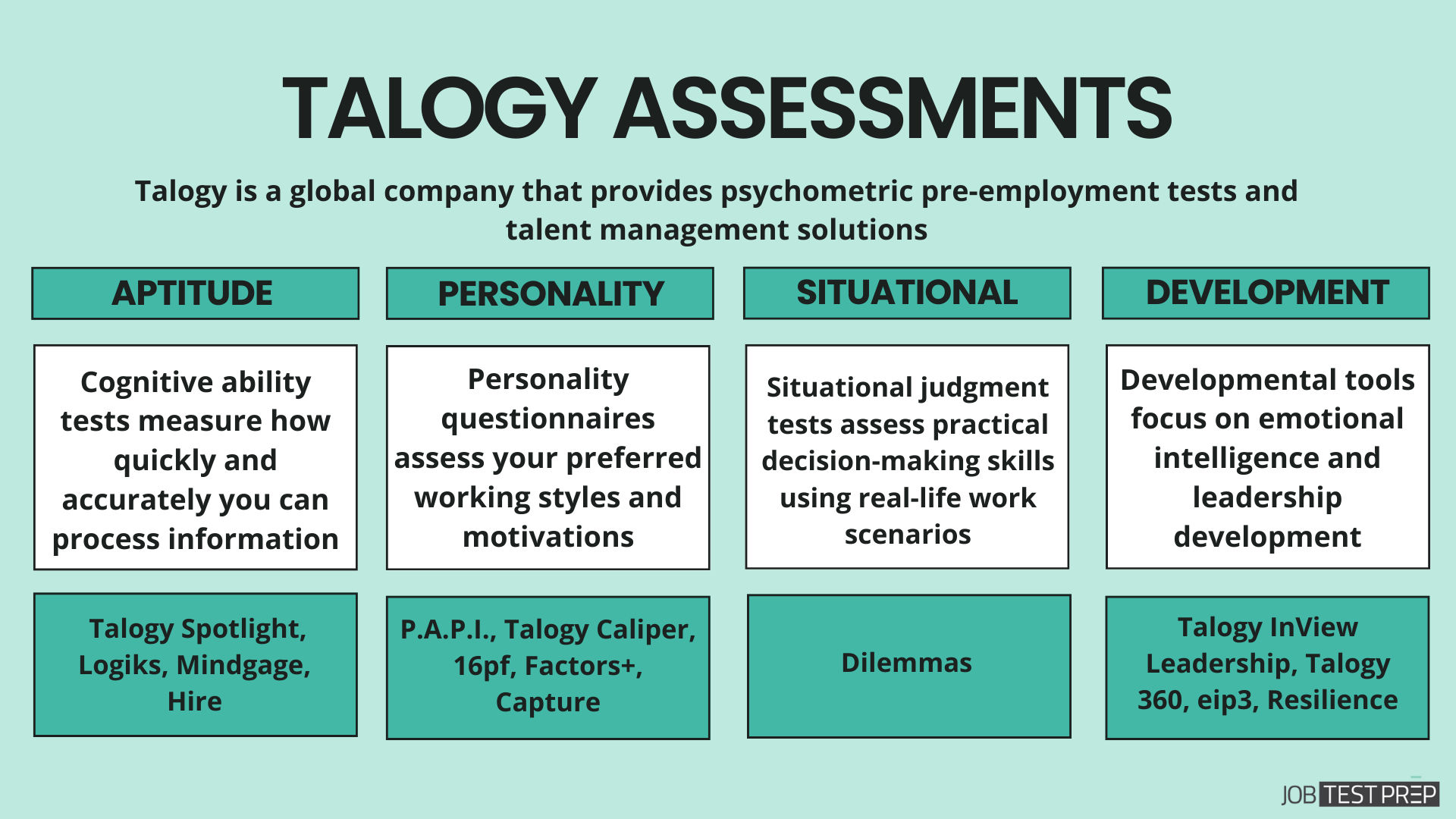
While there are dozens of Talogy assessments, most US tests typically fall into three main categories:
Many Talogy assessments are role-specific and benchmarked against job success models, so your profile is measured against what predicts success in similar roles.
Because results are benchmark-based rather than pass/fail, preparation is less about memorizing Talogy assessment answers and more about understanding format, improving reasoning speed, and maintaining consistency in personality-based sections. This is why practice is key.
Let's take a look at the three main categories of US-based Talogy assessments.
The Caliper Profile is one of Talogy's most widely used personality-based hiring tools in the US, particularly for leadership, management, and sales roles.
Unlike traditional timed aptitude tests, Caliper focuses on behavioral tendencies and motivation. Employers use it to evaluate how candidates approach decision-making, handle pressure, communicate with others, and sustain performance over time.
The assessment includes a mix of multiple-choice statements and "most like me / least like me" comparisons. There are no right or wrong answers and, instead, the test analyzes patterns and consistency across responses.
One of Caliper's distinguishing features is its Job Model and Fit-Score system, which compares your results against performance benchmarks developed for specific roles. This means your profile is evaluated based on what predicts success for that job, and not against other applicants directly.
Preparation for the Talogy Caliper assessment should focus on understanding the competencies required for your target role and ensuring your responses are thoughtful and consistent.
Learn how the Caliper Profile works and how to answer questions authentically while best matching job requirements with our dedicated PrepPack.
Many candidates still encounter assessments branded as Cubiks, but following 2019 - 2022 company mergers and acquisitions, these tools have now been fully integrated under Talogy.
These Talogy tests remain widely used across corporate hiring programs and graduate recruitment since they combine personality insights with different types of ability tests in a flexible way.
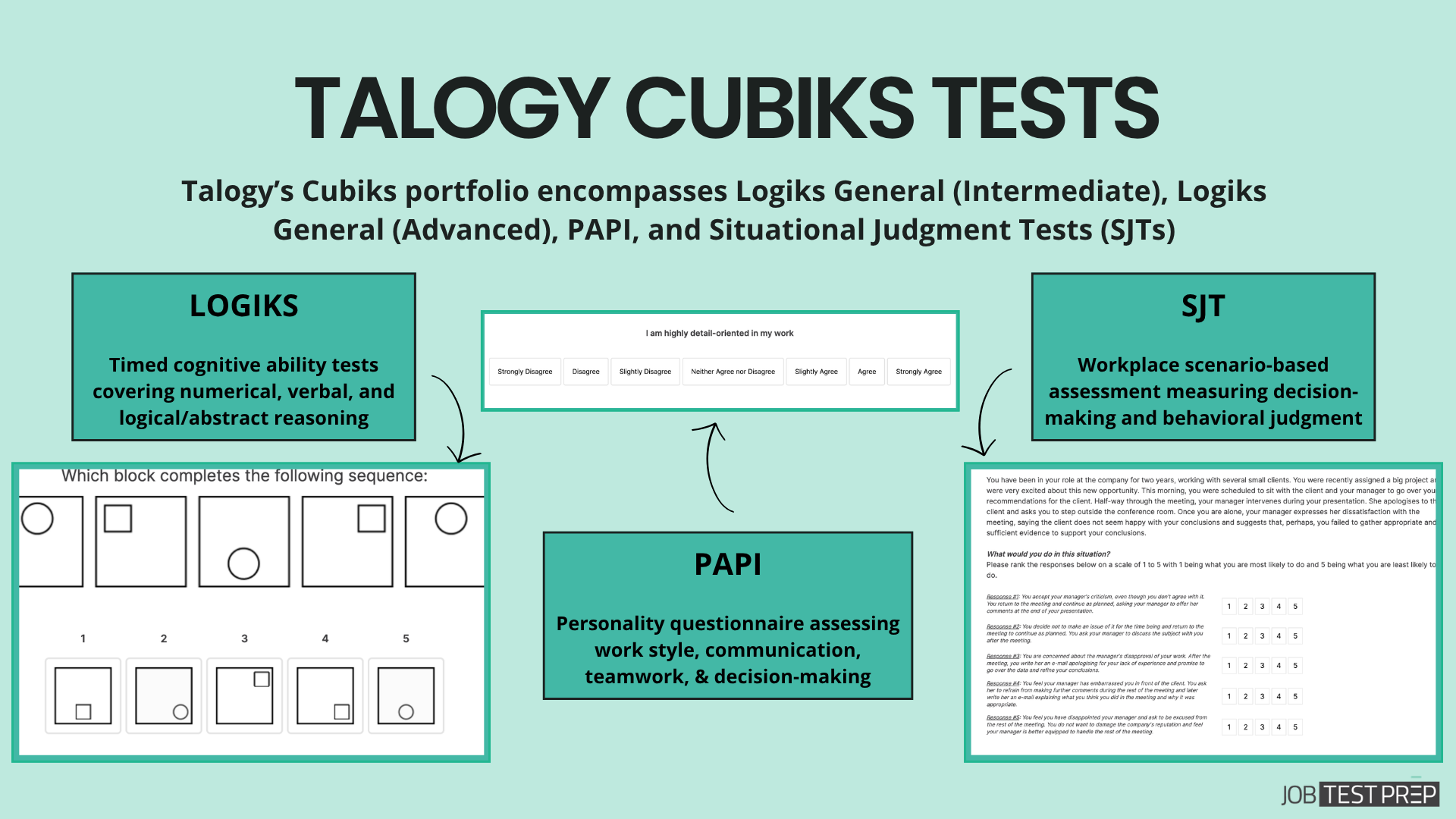
Cubiks assessments often combine several components:
Success on Cubiks-based Talogy assessments comes down to understanding what each section measures and practicing under realistic conditions.
Our individual PrepPacks cover the full Cubiks portfolio, or get everything in one place with our All-Inclusive PrepPack, covering Logiks, PAPI, and SJT.
Master expert strategies for the Logiks abstract, verbal, and numerical tests, as well as PAPI and SJT assessments, with our dedicated All-Inclusive Cubiks PrepPack.
PSI Talent Management is one of the businesses Talogy was formed from in 2022, and its PSI True Talent platform is now part of Talogy’s TalogyTech ecosystem. This is separate from PSI Services, the company behind licensing and certification exams, which was sold to ETS in January 2024.
PSI tests tend to be the most ability-focused and technically demanding of the three Talogy assessments we're highlighting.
These are commonly used in industries where precision, compliance, and technical accuracy are critical, including healthcare, aviation, engineering, law enforcement, and public safety.
The most common Talogy PSI assessments include:
Unlike personality-based tools, PSI assessments are typically timed and objectively scored, and your performance will depend on both accuracy and speed. Because PSI assessments are used for roles where safety and precision matter, they're designed to be highly reliable and difficult to fake.
For test-takers, preparation is both essential and straightforward. Since the exams follow a structured format, practicing sample questions under timed conditions, building familiarity with the style, and working on solving problems quickly under pressure can meaningfully improve results.
There are dozens of different PSI tests, but the Firefighter Selection Test is popular. Prepare ahead of time with our designated PrepPack.
Beyond Caliper, Cubiks, and PSI, Talogy LLC offers a wide portfolio of additional assessments used in hiring, leadership development, and internal talent programs. These tools are often tailored to specific industries, seniority levels, or organizational levels.
Other notable Talogy assessments and solutions in the US include:
While these tools may be less common in early-stage hiring, they frequently appear in promotion processes, assessment centers, and structured development programs, and focus on skills such as emotional intelligence, leadership potential, and workplace resilience traits.
Preparation becomes much more effective once you know which type of Talogy assessment you're taking.
To prepare effectively:
Structured preparation helps reduce anxiety, improve speed, and ensure you perform at your true ability level.
Our Talogy practice tests are developed by assessment experts and designed to mirror real Talogy test formats and conditions. That means you’ll practice the same types of questions, under similar time constraints, so there are no surprises on test day.
Explore all our Talogy preparation opportunities:
Want to see real Talogy assessment examples before you commit? Visit our free Talogy Cubiks practice page or free Talogy Caliper practice page to try sample questions firsthand.
Get preparation opportunities for three Talogy assessments - Logiks, PAPI, and the Dilemmas SJT - with our Talogy Cubiks All-Inclusive PrepPack.

Talogy LLC is the US entity of Talogy, providing talent assessment and development solutions to employers. Talogy is privately owned by Lifelong Learner Holdings LLC (LLH).
Talogy provides assessment, leadership development, and talent management solutions across multiple industries and global markets.
Cubiks was acquired by PSI in 2019 and then integrated into Talogy in 2022. Many Cubiks assessments are now delivered under the Talogy brand.
As a result, candidates preparing for older Cubiks tests may find that similar assessment formats and question styles now appear within modern Talogy assessments.
Talogy Tech refers to Talogy’s digital testing platform used to deliver assessments securely online, sometimes with proctoring features.
A TalogyTech assessment may include cognitive tests, personality questionnaires, or role-specific assessments delivered through a single platform depending on the employer's recruitment process.
The Talogy proctor console generally refers to the administrative tools used to manage supervised TalogyTech assessments, not a standalone candidate-facing product. Proctors and administrators may use it to launch assessments, monitor test sessions, and verify candidate activity. If you see this term during a hiring process, the employer is usually using a monitored testing environment for security and identity verification.
Difficulty depends on the specific test. Ability-based assessments can be challenging due to time pressure, while personality tests require consistency and self-awareness.
Candidates often find numerical and logical reasoning sections of a Talogy test more demanding because performance depends on both accuracy and time management.
Talogy assessment scoring depends on the specific test type. Cognitive and ability-based tests (such as numerical, verbal, or logical reasoning) are typically scored on accuracy and, in some cases, speed, and results may be converted into percentile rankings against a benchmark group. Personality-based assessments, such as the Talogy Caliper assessment or PAPI, are not pass or fail. Instead, responses are analyzed for patterns, consistency, and alignment with role-specific success profiles.
"Delta" is not an official Talogy scoring term. If an invitation from an employer led you here, the assessment name in that email (for example, Logiks, PAPI, or Caliper) tells you which format to prepare for. Whatever the test, results are benchmarked against what the employer needs for the role, not against a universal pass mark.
There is no universal passing score for a Talogy assessment. Employers set their own benchmarks depending on the role.
A good score therefore varies significantly between industries, seniority levels, and job functions.
For ability-based tests, falling significantly below the required benchmark may prevent progression to the next hiring stage. However, personality and behavioral assessments are not pass / fail. They determine fit and alignment rather than eliminating candidates on a single score.
Many Talogy assessments are benchmarked against role requirements, so there’s rarely a universal cut-off score. A candidate may not progress in one hiring process but could suit a different position.
Employers typically receive a detailed report rather than just a raw score. This may include percentile rankings, competency breakdowns, and alignment indicators. In personality-based tests, employers often review behavioral profiles instead of numerical scores.
Depending on the assessment type, reports may also include profile comparisons and benchmark data used to support hiring decisions.
Searching for terms like "talogy assessment answers pdf," "talogytech assessment answers pdf free download," or "talogy assessment answers" often turns up unreliable or outdated materials. Official tests are role-specific and frequently updated, so any leaked answer key is unlikely to reflect what you'll actually face.
Memorizing answers is also far less effective than structured practice, since employers use secure platforms and vary questions by role. Using realistic Talogy assessment practice materials and reviewing genuine Talogy assessment examples builds the familiarity and timing instincts that memorized answers can't.
That's exactly what our dedicated Talogy PrepPacks are built for - realistic, in-depth practice questions and detailed explanations so you develop the actual skills needed to perform well, not a list of answers that may not match your test.
SHL and Talogy are both major providers of psychometric testing, but they use different assessment platforms, test formats, and reporting models. SHL is widely known for cognitive ability, personality, and situational judgment tests, while Talogy offers assessments such as Logiks, PAPI, and Caliper. For candidates, the main difference is test format, so it’s best to use provider-specific practice materials where possible.
Founded by David Meshulam in 1992, JobTestPrep has helped thousands of candidates navigate competitive assessments, including candidates preparing for popular Talogy assessments like Caliper, Cubiks, Logiks, and P.A.P.I., as well as PSI tests. With over 220 preparation courses and one million candidates supported worldwide, we offer professionally designed PrepPacks alongside advanced AI-driven tools, all regularly updated to reflect the latest test formats. Together, these resources help candidates across the US and globally strengthen their applications, improve their performance, and achieve outstanding results.