Free Pre-Apprenticeship Practice Test Questions and Answers
A trade or union apprenticeship typically requires passing an aptitude test before you're accepted into the program. These tests are administered by the union, Joint Apprenticeship and Training Committee (JATC), or employer running the apprenticeship, and they're used to screen candidates before the paid on-the-job training and classroom instruction begins. According to the U.S. Department of Labor's official apprenticeship.gov, a registered apprenticeship combines on-the-job training with related classroom instruction, leading to a nationally recognized credential. While the exact format depends on the trade and the local administering it, most apprenticeship exams cover a similar core: math, reading comprehension, mechanical reasoning, and spatial or abstract reasoning.
On this page, you'll find free sample questions for the most common trade and union apprenticeship exams, including the Electrician (IBEW) Aptitude Test, Pipefitter Apprentice Exam, Plumbers Union Aptitude Test, and tests for Sheet Metal, Ironworker, Millwright, Carpenter, Boilermaker, Heavy Equipment Operator, Machinist, Mechanic, and Welder apprenticeships. Each set of questions mirrors the structure and difficulty of the real exam, so you'll know what to expect on test day. If you're ready to prepare in full, explore our trade-specific practice courses below, or check out our general apprenticeship preparation course if you're not yet sure which test applies to you.


A trade apprenticeship test, also known as an apprenticeship aptitude test or trade aptitude test, is a screening exam used by unions, Joint Apprenticeship and Training Committees (JATCs), and employers to evaluate whether an applicant has the math, reading, and mechanical skills needed to succeed in a specific apprenticeship program. It's typically the first formal step in the application process, taken before an interview is scheduled.
Most trade apprenticeship tests aren't mandated nationally; rather, each local union or JATC decides whether to require one as part of its own selection process, per the U.S. Department of Labor's sample apprenticeship selection procedures. In practice, however, the vast majority of trade and union apprenticeship programs, from electrician and pipefitter to plumber and sheet metal, do require one, since apprenticeship positions are limited and competition for them is high.
The apprenticeship assessment test exists to protect both the applicant and the program. Because an apprenticeship combines paid, hands-on training with classroom instruction over several years, sponsors use the test to confirm that candidates can handle the technical material before investing in their training. For the applicant, passing the apprenticeship entrance exam is what moves a submitted application into an actual interview and, eventually, a position in the program.
While the name and exact format vary (you may see it called a union apprenticeship test, an apprentice test, or simply an apprenticeship exam), most cover a similar core skill set: math, reading comprehension, and mechanical or spatial reasoning. The specific sections tested, and how they're weighted, depend on the trade and the local administering the exam, as outlined for each program below.

Below, you'll find free sample questions covering the most common trade and union apprenticeship exams, organized by trade so you can jump straight to the test that applies to you. Each set is modeled on the actual format and difficulty of the real exam, including the same subject areas and question types you'll face on test day.
To get the most out of the practice questions, treat them as a timed simulation rather than a casual quiz. Work through each set without pausing and only check your answers once you've finished, since this is the best way to see where your starting score stands before you begin focused preparation. If you get a question wrong, read the explanation before moving on. Understanding why an answer is correct is what actually improves your score, not just seeing the right choice.
Keep in mind that free sample questions are a starting point, not a complete substitute for full preparation. They're useful for identifying your weaker areas, for example mechanical reasoning versus reading comprehension, so you know where to focus your study time. If you find you need more structured practice, each trade section below links to a full preparation course built specifically for that exam.

The Electrical Apprenticeship Test (IBEW) is built around advanced math and reading comprehension. This sample question checks your ability to factor and simplify a polynomial expression, a core algebra skill tested throughout the exam. To approach it, look for a recognizable algebraic pattern in the expression before trying to multiply anything out by hand, and work through the simplification one step at a time rather than estimating the result.

Method A
Remember that:
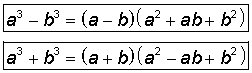
Simplify and reduce if possible:
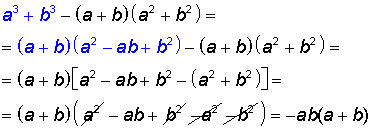
Method B
If you do not remember the formula of sum of cubes, you can open the parentheses and simplify:
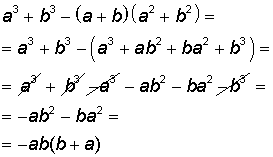
The correct answer is A.
If you chose any other answer, review the solution and the use of formulas.
This is just one of the many question types you'll face on the real Electrical Apprenticeship Test. A full, structured course covers all the IBEW test's math and reading comprehension question types, with detailed explanations and performance tracking, so you walk into test day knowing exactly what to expect.

The EIAT is split into three sections: Math, Verbal Reasoning, and Mechanical Aptitude. This question checks mechanical aptitude specifically, your ability to trace how motion transfers through a system of connected gears. To approach it, follow the rotation direction through each gear one connection at a time, keeping in mind that two gears which mesh directly will always turn in opposite directions, while gears sharing the same axle turn together.
In which direction does the woman have to turn the handle so that the cylinder will rotate in the direction shown in the diagram below?
This is just one of the many question types you'll face on the real Elevator Industry Aptitude Test. A full, structured course covers all three EIAT sections, Math, Verbal Reasoning, and Mechanical Aptitude, with detailed explanations and performance tracking, so you walk into test day knowing exactly what to expect.

The Pipefitter test covers four areas: Reading Comprehension, Figure Visualization (Spatial Reasoning), Mechanical Ability, and Math. This question checks spatial reasoning, specifically your ability to recognize a mirrored version of a shape. To approach it, picture the original shape being flipped across a vertical line, like a reflection in a mirror, rather than simply looking for an identical, unflipped copy among the choices.
Choose the shape that mirrors that shape below:

The correct shape is:

This is just one of the many question types you'll face on the real Pipefitter Apprentice Exam. A full, structured course covers all four tested areas, Reading Comprehension, Figure Visualization, Mechanical Ability, and Math, with detailed explanations and performance tracking, so you walk into test day knowing exactly what to expect.

The Ironworker Apprentice exam combines Basic and Advanced Math (number series, algebra, word problems, and geometry) with Reading Comprehension. This question checks your ability to apply and rearrange a given formula to solve a word problem. To approach it, write the formula down first and isolate the variable you're solving for algebraically before plugging in any numbers, then work through the arithmetic in small, careful steps.
Please choose the correct answer. If none of the options is the correct answer please choose answer choice e, "N".

If Antimony melts at 1,625.67 degrees Rankine, at what Celsius temperature will it melt?
The formula for calculating degrees Rankine is:
Degrees Rankine = (degrees Celsius + 273.15) x 1.8
Isolate the 'Celsius degrees' in the formula:
1. Divide both sides of the equation by 1.8
Degrees Rankine/1.8 = (degrees Celsius + 273.15) x 1.8/1.8
Degrees Rankine/1.8 = degrees Celsius + 273.15
2. Subtract 273.15 from both sides of the equation:
(Degrees Rankine/1.8) - 273.15 = degrees Celsius + 273.15 - 273.15
(Degrees Rankine/1.8) - 273.15 = degrees Celsius
Degrees Celsius = (Degrees Rankine/1.8) - 273.15
Insert the given data:
Antimony's melting point = 1,625.67 degrees Rankine.
Degrees Celsius = (1,625.67/1.8) - 273.15 = 903.15 - 273.15 = 630
Solving tip: When dividing two decimals might be easier to turn them into integers by multiplying both the nominator and denominator by a shared multiplication of 10 (i.e. 10, 100, 1000 etc.), e.g.:
100*1,625.67/100*1.8
162,567/180
Use long division:

=> 903 + a remainder of 27 = 903 + 27/180 = 903 + 3/20
In order to convert the fraction 3/20 into a decimal we can manipulate the fraction to our advantage, using familiar fractions.
The first, easiest possibility is expanding the fraction, turning it to a fraction of a 10's denominator (i.e. 10,100,1,000 etc.). In this case, multiply both the nominator and denominator of 3/20 by 5:
5*3/5*20 = 15/100 = 0.15
903 + 3/20 = 903 + 0.15 = 903.15
A second possibility is manipulating a fraction, by using fractions whose decimal equivalents are well known and are easy to use e.g.: 1/2 (0.5), 1/4 (0.25) etc.
3/20 = (1*3)/(2*10) = (1/2)*(3/10) = 0.5*0.3 = 0.15
903 + 3/20 = 903 + 0.15 = 903.15
Now, we can return to our formula and compute the final answer:
Degrees Celsius = 903.15 - 273.15 = 630
The correct answer is C.
This is just one of the many question types you'll face on the real Ironworker Apprentice Exam. A full, structured course covers both Basic and Advanced Math, along with Reading Comprehension, with detailed explanations and performance tracking, so you walk into test day knowing exactly what to expect.

The Millwright Apprentice exam covers Math, Verbal Reasoning, Mechanical Aptitude, and Spatial Reasoning. This question checks mechanical aptitude, specifically your ability to identify a class of lever based on how a tool is used. To approach it, locate the fulcrum, the point where force is applied, and the load in the image, then compare that arrangement to the standard definitions of first, second, and third class levers rather than judging by the tool's appearance alone.
The following tool is an example of a:

The tool presented in this image is a crowbar. A crowbar provides leverage for separating close-fitting objects, for example – opening crates and extracting nails. It is an example of a first class lever: the crowbar's fulcrum allows its operator to apply force in order to separate adjacent objects. A seesaw and a boat's paddle are also good examples of first class lever.


The correct answer is A.
This is just one of the many question types you'll face on the real Millwright Apprentice Exam. A full, structured course covers Math, Verbal Reasoning, Mechanical Aptitude, and Spatial Reasoning, with detailed explanations and performance tracking, so you walk into test day knowing exactly what to expect.

The Sheet Metal Apprenticeship Test has four sections: Math, Spatial Aptitude, Mechanical Aptitude, and Abstract Reasoning. This question checks spatial aptitude, specifically your ability to visualize how a flat net folds into a three-dimensional shape. To approach it, mentally fold the net one panel at a time and track which faces end up next to each other, then eliminate any answer choice with the wrong number or shape of faces before comparing what's left.
Choose the figure that matches the following net.

This is just one of the many question types you'll face on the real Sheet Metal Apprenticeship Test. A full, structured course covers all four sections, Math, Spatial Aptitude, Mechanical Aptitude, and Abstract Reasoning, with detailed explanations and performance tracking, so you walk into test day knowing exactly what to expect.

The Heavy Equipment Operator test measures Mechanical Reasoning, Reading Comprehension, and Mathematical skills, and is typically the entry step before you're accepted into a heavy equipment operator training program. Many heavy equipment operator classes and apprenticeship programs require passing this test before operator schooling begins. This question checks mechanical reasoning, specifically how pressure and altitude affect the volume of a gas. To approach it, identify which quantities in the scenario stay constant and which one changes as altitude increases, then reason through the relationship between them rather than relying on gut instinct.
Danny received a bunch of colorful helium balloons for his birthday. One of the balloons was not attached properly and flew away.
Assuming the temperature remains constant, what will be the volume of the balloon at a very high altitude?
This is just one of the many question types you'll face on the real Heavy Equipment Operator exam. A full, structured course covers Mechanical Reasoning, Reading Comprehension, and Mathematical skills, with detailed explanations and performance tracking, so you walk into test day knowing exactly what to expect.
The plumbing apprenticeship aptitude test, also known as the Plumber Apprentice exam, covers six topics: Reading, Numerical Computation, Numerical Reasoning, Folding, Problem Solving, and Mechanical Comprehension, and is required for entry into most plumbing apprenticeship programs. This question checks numerical computation, specifically dividing a number by a decimal. To approach it, shift the decimal point the same number of places in both numbers until you're dividing by a whole number, then carry out the division. For more information on how to become a plumber, click here.
Calculate: 4186 : 0.001
This is just one of the many question types you'll face on the real Plumber Apprentice Exam. A full, structured course covers all six tested topics, Reading, Numerical Computation, Numerical Reasoning, Folding, Problem Solving, and Mechanical Comprehension, with detailed explanations and performance tracking, so you walk into test day knowing exactly what to expect.
Looking to ace your apprenticeship test and stand out from the competition? Our general apprentice preparation program covers every essential sub-section of apprentice tests, including Reading Comprehension, Numerical, Spatial, and Mechanical Reasoning, even if none of the specific trades above match the one you're applying for.
A trade apprenticeship is a paid, structured career path that combines on-the-job training with classroom instruction, allowing you to earn a wage while learning a skilled trade under the direct supervision of an experienced professional. Unlike a standard entry-level job, it follows a defined training path with a set endpoint: completing the program results in a nationally recognized credential that certifies you as a fully qualified tradesperson.
Getting in usually starts with an application to the union, employer, or Joint Apprenticeship and Training Committee (JATC) sponsoring the program, often followed by an aptitude test and an interview. For trades governed by a national body, such as plumbers and pipefitters under the United Association, you'll apply through your nearest UA local chapter, since each local runs its own apprenticeship program and selection process. Once accepted, you're paired with a journeyperson, an experienced, certified tradesperson who directly supervises your work and teaches you the practical skills of the trade on real job sites. According to federal apprenticeship regulations (29 CFR Part 29), a registered apprenticeship requires a minimum of 2,000 hours of on-the-job training per year, supplemented by at least 144 hours of related classroom instruction covering the technical knowledge behind the trade.
Most trade apprenticeships last between one and six years, depending on the trade and the complexity of the skills involved, with many building-trade programs (electrician, plumber, pipefitter) running around four to five years. Apprentices are paid from day one, and wages typically increase on a set schedule as you progress through the program, usually calculated as a rising percentage of the full journeyperson's wage. By the time you complete the apprenticeship,
Apprentices can join at any age. Most registered apprenticeship programs set a minimum starting age of 16, making apprenticeships a realistic path for recent high school graduates, career changers, and adults re-entering the workforce alike.
Most registered apprenticeships last between one and six years, depending on the trade, though the majority run three to four years. According to apprenticeship.gov, the exact length depends on the skills required for that specific occupation.
Apprentices are paid from day one, not just after completing the program. Wages typically start as a percentage of the full journeyperson's rate and increase on a set schedule as you progress, so your pay rises throughout the apprenticeship as your skills do.
The U.S. Department of Labor's Apprenticeship Finder lets you search registered apprenticeship programs and paid openings by city, state, and occupation, so you can find options near you in any trade.
Taking a labor union aptitude test is one of the requirements of participating in a union apprenticeship program.
Here are some examples of such programs:
You can find more information in the following link.
An apprenticeship is a paid, multi-year training program where you learn a trade under an experienced professional and finish with a certificate or credential. An internship is typically unpaid or low-paid, shorter in length, and done by students or recent graduates to gain early exposure to a field, such as marketing, healthcare, or non-profit work, rather than to earn a trade credential.
Trade schools and apprenticeship sponsors typically use a general aptitude test to screen applicants before admission, covering reading comprehension, math, and mechanical or spatial reasoning. The specific test varies by school or program, so it's worth confirming directly with the sponsor which one you'll be given.