 Free CCAT Practice Test and Guide | Simulate 50 Questions in 15 Minutes
Last Updated: May 11th, 2026 | Trusted by over 10,400 Candidates

David Meshulam


What Is the Criteria Cognitive Aptitude Test?
The Criteria Cognitive Aptitude Test (CCAT) is a common pre-employment assessment that measures cognitive skills like problem-solving, learning speed, and critical thinking. The test's most notable feature is its strict time limit.
CCAT is administered online via Criteria's testing platform, Criteria On Demand.

Test Time:
15 minutes

Number of Questions:
50

Goal:
Answer as many questions correctly as you can

Question Types:
Numerical, Verbal, spatial, & Logical

Calculator:
Not allowed

Draft Paper:
Allowed

CCAT Practice Test Questions

This free practice exam mirrors the CCAT’s structure, difficulty level, and time pressure.
It features samples from all four question categories (Numerical, Verbal, Spatial, Logical) to help you gain a more accurate idea of what the real exam is like.
Take This Test Interactively
You can scroll down to solve sample questions at your leisure. For a more realistic simulation, complete with a running timer, take our interactive simulation.

Sample Numerical Reasoning (Math) Questions
The actual test (as well as this CCAT practice test) begins with three numerical questions.
To answer correctly, you must possess a foundational understanding of mathematical principles such as basic algebra, arithmetic, and fractions. Here are just a few examples:

Many candidates get anxious about solving math problems, and that's understandable. It might help you to know that Criteria actually refers to this category as "Math & Logic", not numerical reasoning. It's not really about how deep your knowledge of math is; it's about problem-solving. The questions just happen to contain numbers.
The best way to excel on these questions is to familiarize yourself with math shortcuts and tricks that can help you skip the calculations and get straight to the problem-solving.

CCAT Sample Spatial Reasoning Questions
There are four spatial “Next in Series” questions on the CCAT. Each one contains a sequence that follows a specific pattern. Your goal is to identify which figure comes next in the series.
Use these two practice questions to get a feel for how it works.
Easy Question
Observe the following sequence:
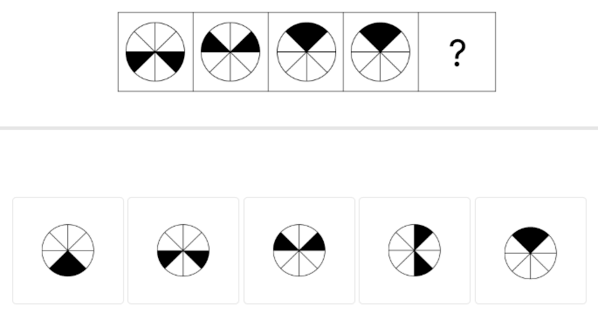
Which of the following boxes should replace the question mark to complete the pattern?
The answer is C
From this starting point, in each subsequent step of the sequence, the left black triangle moves one position clockwise, while the right black triangle moves one position counterclockwise. See the image below for reference:

Easy Question
Observe the following sequence:
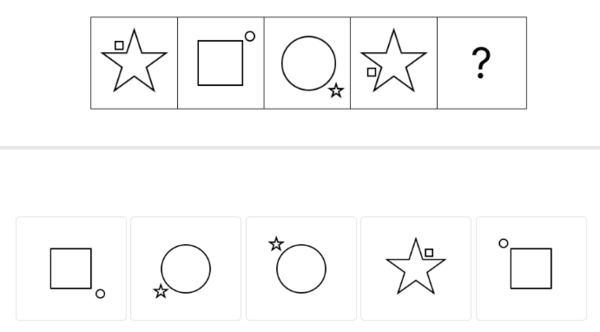
Which of the following boxes should replace the question mark to complete the pattern?
Easy Question
Observe the following sequence:
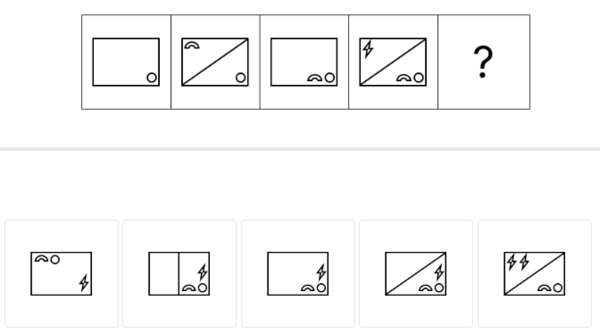
Which of the following boxes should replace the question mark to complete the pattern?
Intermediate Question
Observe the following sequence:
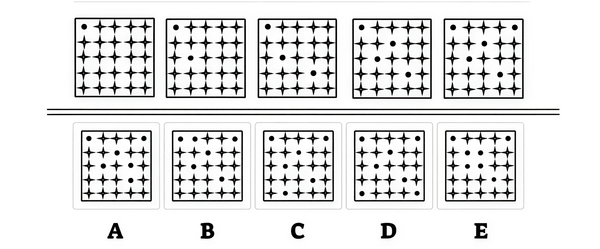
Which of the following boxes should be next?
The correct answer is A
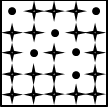
The logic: each step, one four-hand star disappears and a black dot is added instead. The location of change is always three stars away from the last change: two steps vertically and one step horizontally, or two steps horizontally and one step vertically – the same as the knight's movement in Chess. In the fifth step a black dot is added in the upper right corner, therefore, the correct answer is 1, as the new dot is located one step left and two steps down.

Solving tip: Answers 4 and 5 are disqualified easily for having more than six dots. In inductive reasoning questions, you can very often disqualify some of the answers without understanding the complete logic of the question. Doing that will maximize your chances of guessing correctly in cases where you do not.
Advanced Question
Observe the following sequence:
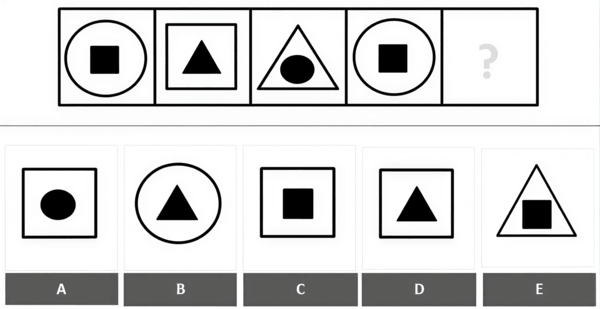
Which of the following boxes should replace the question mark to complete the pattern?
Tips for “Next in Series” Questions:
- Form a Hypothesis: Look at 2–3 frames to spot how objects change.
- Verify It: Ensure the pattern holds for the entire sequence.
- Eliminate Distractors: If the pattern fits, discard any clearly incorrect answers.
- Check Answer Choices if Stuck: Sometimes focusing on a single element (like a shape’s rotation) helps quickly rule out incorrect options.
- If you run out of practice, you can use other ubiquitous tests of abstract reasoning, like the Raven's Progressive Matrices Test.

CCAT Sample Verbal Reasoning Questions
The next batch of questions is taken from the 18 Verbal questions you'll get on the CCAT assessment:
Analogy Questions
Tips for Analogy Questions:
- Turn analogies into sentences: Even if they’re not written that way, this helps you spot the relationship.
- Learn the 8 relationship types: Synonyms, antonyms, cause/effect, degree of intensity, category, descriptive connections, processes, and functions.
- Pay attention to order: The right relationship in reverse is still wrong.
Sentence Completion Questions
Many of the CCAT verbal questions rely heavily on English vocabulary, which is tough to improve quickly. However, with practice, you can still answer many questions correctly by using context clues and reasoning skills—even if you’re unsure of some words’ meanings.

CCAT Sample Logical Reasoning Questions
Syllogisms

Our CCAT Preparation Course
The CCAT is designed to be selective, which means difficult. However, raw skill is not all it measures. The scores are affected by prep time, prep quality, and testing anxiety.
That's why our pack gives you:
• 6 complete simulations in exact CCAT format with progressively harder questions
• 20 partial simulations targeting specific question types to address weak areas
• 4 video guides and 5 interactive guides with theory and success tips
• Complete solutions and explanations for all questions
• A unique time-management section to master the exam's toughest challenge: the time limit
What Our Customers Say
More About the CCAT Test
Here's a test overview to help you understand what you're being evaluated for and how to prepare.
What makes CCAT challenging and how to beat it
The CCAT is challenging for three main reasons:
- Strict Time Limit: You have 15 minutes to answer 50 questions—about 18 seconds per question. Rushing leads to errors; going too slowly results in unfinished questions.
Crucially, you cannot skip questions and return to them later. If you are stuck, guessing is better than losing precious time. - Relative Scoring System: Your score is compared to other candidates. The average is 24/50, but top roles often require 35+ (top 20% of test-takers).
- Personal Weakness Areas: Questions follow a fixed order: numerical (16–17 questions, ~34%), verbal (17 questions, ~34%), spatial orientation (11 questions, ~22%), and logical (5–6 questions, ~10%). Weakness in one area can drag down your score.
Here's a visual breakdown of the question types:

Numerical Reasoning
16-17 questions
34% of the exam
Types: number series, word problems, algebra

Verbal Reasoning
17 questions
34% of the exam
Types: analogies, sentence completion, antonyms

Spatial Reasoning
11 questions
22% of the exam
Types: shape series, odd one out, matrices

Logical Reasoning
5-6 questions
10% of the exam
Types: syllogisms, seating arrangements
To overcome these:
- Precision Practice: Use questions mirroring the real test to build accuracy (key to success).
- Adaptive Learning: Identify weaknesses (e.g., via a diagnostic test) and focus there first—start easy, then advance.
- Level-Based Practice: Include beginner, intermediate, and advanced questions in all areas to push beyond average scores.
Scoring 35+ requires answering correctly in under 20 seconds per question, focusing on weaknesses, and practicing at real difficulty levels.
Take a Deep Dive With Our CCAT Blog Articles
CCAT Test Tips: Top Five Time-Savers for Your Exam
- Skip Tough Questions Fast: If a question takes over 10 seconds, mark it and move on to maintain pace.
- Master Mental Math: Practice quick calculations (e.g., percentages, fractions) to speed up Numerical questions.
- Learn Analogy Patterns: Memorize common relationships (e.g., synonyms: Big is to Large as Small is to Tiny; cause/effect: Rain is to Wet as Fire is to Hot) to solve Verbal questions in under 15 seconds.
- Use Elimination for Spatial: Quickly rule out incorrect shapes or patterns to narrow down options.
- Prioritize Accuracy in Logic: Take a moment to read syllogisms carefully, as errors here are costly.

FAQS
Cognitive tests are a type of psychometric assessment - an aptitude test. They are, fundamentally, an assessment of your mental abilities. These can include problem-solving, logical reasoning, and abstract thinking.
Modern aptitude tests are designed to be culturally unbiased. That is, they try to minimize their reliance on culture-specific knowledge or skills, focusing instead on pure logic.
There are numerous cognitive ability tests that differ in question type, difficulty, and format – leading tests include Cognify, PI, & P&G.
On Demand is Criteria Corp's online platform where candidates take their tests. You can find out more about the CCAT On-Demand Assessment on our dedicated page.
Compared to other job-related tests, the CCAT is known to be challenging. It gets harder as you progress through the questions. The math questions need quick thinking and strong analysis skills. People who've taken the CCAT and other tests like the Wonderlic and PI find the CCAT the most demanding.
Although the passing score on the Criteria Cognitive Aptitude Test largely depends on the position you are applying for, there are certain scores that will substantially increase the probability that you pass.
Answering 31 questions correctly (this number is known as your raw score) will typically put you above the top 20th percentile score of those who took the CCAT, and this is considered a relatively good score.
A raw score of forty questions right out of 50 will put you among the top percentile scores of any list of candidates, and give you an excellent chance of landing the job.
For more information on this subject, visit our CCAT scores page.
All of the 50 questions on the CCAT are multiple-choice. There are no open-ended questions on the CCAT.
Everyone receives similar question types, but they usually differ in their content as Criteria has a huge question bank. The questions' order is almost identical across all CCAT tests, with minor possible differences.
Employers, mainly in North America, often pick the CCAT for hiring. It helps streamline the recruitment process by reducing costs and identifying candidates adept at critical thinking, problem-solving, quick learning, and applying new information.
The downside of using a test like this is the impersonal experience candidates often feel, but since testing is a growing practice in the market, most companies feel they can afford it, given the benefits.
Yes, there's a longer CCAT version giving you 22 minutes instead of 15, which is about 50% more time. This is available for those who aren't native English speakers or have a medical condition that requires more time.
To receive this accommodation, contact HR at your recruiting company and inquire about your eligibility.
If English is not your native language, contact the employer or recruiter who sent you the CCAT invitation and explain your situation. Criteria allows their clients control over deadlines and extensions.
No, you cannot use a calculator on the CCAT Exam. The test is designed to measure candidates' ability to think on their feet, and this includes identifying creative shortcuts for mental calculations, without relying on a calculator.
You are allowed a piece of draft paper and a writing utensil. In fact, it's encouraged to use these tools. Visual thinking is a valid problem-solving strategy, and sketching the problems can often serve as a catalyst for identifying the solutions.
There are no negative markings for wrong answers on the CCAT. Your score is made up of the number of correct answers you get. A wrong answer simply isn't counted. This means guessing when a question is too difficult or taking up too much time is not only okay, but a valid strategy.
It is ultimately up to the hiring company whether a retest is allowed. Usually, the answer will be n, but an exception could be made under unique circumstances. If your reason for needing a retest is a technical issue, you should contact Criteria Support through the testing platform.
It can be, but it is not always live-proctored. Criteria offers AI proctoring that can capture images, screen/audio samples, and flag suspicious behavior, and says candidates are informed before monitoring begins. In many cases, the first at-home CCAT is not proctored, but some employers may require a proctored verification session later.
The exact cutoff is usually employer-specific, so the best source is the recruiter or hiring company. Criteria’s score reports include a raw score and percentile, and when a job association is set, the report/platform can show a suggested score range for that position or job family. Criteria also says the CCAT includes custom score ranges for many positions.
Several employers use the CCAT in their hiring process, including Pennymac Aptean, Cvent, Finastra, Granicus, PowerSchool, TIBCO, Vertafore, Xactly, Infoblox, Mitratech, Ping Identity, and Relias Learning. For specific details on each, check out our guide on the Vista Equity Partners Exam.
Although the CCAT measures cognitive abilities closely related to IQ, it is not an IQ test and will not provide an IQ score.
The UCAT is a shorter test by Criteria Corp focusing on math, logic, and visual reasoning without the verbal section found in the CCAT. Click to see more info on the UCAT.
Criteria, the provider of the Criteria Cognitive Aptitude Test provider, is one of the world's leading test providers, with over 1500 companies in 18 countries using their assessments. From the U.S. Marine Corps to private equity companies, Criteria's pre-employment testing is used in assessing candidates for an infinite variety of employers and positions.
Explore this video for CCAT sample questions and time-saving strategies.
Customer reviews
4.7
★
★
★
★
★
Based on 328 reviews
wonderful
Truly an awesome and comprehensive prep guide, really helped me out.
love the detailed explanations
fine
It’s very helpful
...
JobTestPrep's CCAT Course:

More CCAT Resources:


