 Free CCAT practice test: 50 questions in 15 minutes
By David Meshulam, Founder of JobTestPrep · Updated August 26, 2026
Jump straight into the free full-length simulation, or start with what the CCAT is and work through the sample questions type by type.

What is the Criteria Cognitive Aptitude Test?
The Criteria Cognitive Aptitude Test (CCAT) is a pre-employment cognitive ability test that employers use to gauge problem solving, learning speed, and critical thinking. You answer up to 50 questions in 15 minutes, without a calculator, and the three areas alternate throughout the test.
 15 minutes: total time for the whole test
 50 questions: as many as you can answer
 Cognitive ability: problem solving, learning speed, critical thinking
 Three areas: math and logic, verbal ability, spatial reasoning
 No calculator: none of the questions need one
 Scratch paper: allowed, and worth using
CCAT can stand for other things too, from children’s ability tests to medical terms; this page covers the Criteria hiring test used in recruitment. The test is administered online on Criteria’s On Demand Assessment platform.

Take the free CCAT practice test
The fastest way to find out where you stand is to experience the CCAT format: 50 questions against a running 15-minute timer, in the same flow the test itself follows. Every question type on the CCAT appears in this simulation, and nothing that is not on the test.
The screen keeps three things in view while you work: the countdown for the whole test, your running score against the simulation’s passing mark of 80, and which question you are on. Every answer is marked right or wrong straight away. At the end you get your score, every question marked as correct, incorrect, or unanswered, and the full solution and the explanation for each one.
This is what the simulation looks like from the inside:
Knowing where you stand is one thing, closing the gaps is another. Each question type has its own section below, one question at a time, with a full explanation and an optional 18-second timer, the pace that 50 questions in 15 minutes leaves you.

CCAT math and logic questions
Math and logic is the largest of the three areas Criteria measures, and the test opens with it. Despite the name, almost nothing here is advanced mathematics: you get word problems, percentages, series, comparisons and short logical statements, all solvable by hand if you know which shortcut applies. With the biggest share of the test and shortcuts that can be learned, this is where preparation pays off most. The twelve most common question types are shown below.
Percentage calculation
Start timer
0:18
Nora is one fourth the age of her grandfather, and 30% younger than her brother. If Nora’s brother is 30 years old, how old is Nora’s grandfather?
 The twelve most common types: the one above and the eleven below. Open any of them to try the question with its 18-second timer, then read the explanation for the strategy that solves it in time.
Start timer
0:18
Assume the first two statements are true.
Earrings and piercings are allowed at “Sacred Jar” high school, but only for students who are 17 or older, or for those who supply a parent’s written permission.
Maria is 17 years old, but she does not have her parents’ permission.
Third statement: Maria can attend school while wearing earrings and piercings.
Start timer
0:18
If eggs cost $4 per box (containing a dozen eggs), how much would it cost to buy 32 eggs?
*You can purchase eggs only in egg boxes.
Start timer
0:18
Everything in a hardware store is on sale at 40% off. A customer buys four items and pays $180 in total. What was the average price of the four items before the sale?
Start timer
0:18
The table below displays the total costs and sale prices of five products. Of the five products, which is considered most profitable?
| Product | Total cost per unit | Sale price per unit | ||
|---|---|---|---|---|
| Manufacture | Service (monthly) | Other | ||
| Bared 120 | 236 | 37 | 95 | 920 |
| Bared 260 | 268 | 37 | 96 | 802 |
| Bared 450 | 320 | 38 | 130 | 1,010 |
| Calir XC | 425 | 63 | 243 | 1,280 |
| Calir XR | 432 | 57 | 256 | 894 |
Start timer
0:18
Dave is five years older than Jonathan; Jonathan is twice the age of Alice, and Alice is a fifth of Jean’s age. Jean is 10 years old. How old is Dave?
Start timer
0:18
Which of the following is the smallest value?
Start timer
0:18
What would be the next group of letters in the following series?
ceg ... dfh ... egi ... fhj ?
Start timer
0:18
What would be the next number in the following series?
7 ... 12 ... 2 ... 17 ... -3 ... ?
The answer is D, 22.
The series looks erratic because two simple series are woven into one. Read every second number instead of every number: 7, 2, -3 falls by five each step, and 12, 17 rises by five each step. The question mark belongs to the rising strand, so it is 17 plus 5.
If you would rather work with the gaps, they run +5, -10, +15, -20, growing by five and flipping sign every step, which makes the next gap +25, and -3 plus 25 is 22 again.
Now look at what the wrong answers are made of: -8 continues the falling strand, which is where you land if you find the two strands and then forget to check which one the question mark sits in; -23 repeats the last gap unchanged, and -28 lets the gap grow to 25 but keeps its sign, so both miss the flip; and 27 takes two rising steps from 17 because two positions have passed, when the strand has moved only once. Finding the two strands is only half the work, and checking which one the question mark sits in is the other half.
The habit worth keeping: when a series swings up and down, stop reading it as one series. Alternating direction is the signature of two interleaved ones, and splitting them turns one hard question into two easy ones.
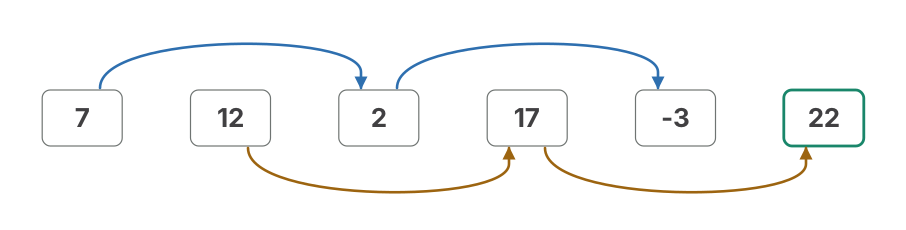
Two series in one. The upper arcs fall by five, the lower arcs rise by five, and the question mark sits on the rising strand.
Start timer
0:18
A toy factory has three machines that wrap all the toys in boxes. All three machines work at the same rate and finish wrapping 720 toys in 48 hours, for which the factory earns $5,760. If a fourth machine with the same rate was to be added, how much more would the factory earn on average, than its original average hourly earnings?
Start timer
0:18
The sum of 4 numbers is smaller than 64 but greater than 36. Which of the following could NOT be the average (arithmetic mean) of these four numbers?
Start timer
0:18
616 is 70% of what number?
 Tip: Train yourself to move the decimal point and to convert between fractions and decimals on paper. Most CCAT math questions are built so that one simplification replaces a whole calculation. See the full CCAT prep.
Other kinds of math question turn up as well, among them probability, ratios, combinations and longer logic puzzles. The item pool is large and rotates, so treat any list of types, including this one, as a map rather than a full inventory.
The second area asks a different question: how precisely you handle language when the clock is running.

CCAT verbal ability questions
Verbal ability is the second largest area. It is not a reading test in which you work through a passage and answer questions on it. What it measures is how quickly you see relationships between words, how well you read a sentence for its logic rather than its topic, and, in a small set of questions, how carefully you compare strings of text character by character.
Sentence completion, single blank
Start timer
0:18
Electronic information and automated systems are essential to _______ all major federal operations.
Five types, covering all this area measures: the one above and the four below. Open any of them to try the question with its 18-second timer, then read the explanation for the strategy that solves it in time.
Start timer
0:18
WATER is to ISLAND as...
Start timer
0:18
How many of the five items in the left hand column are exactly the same as the corresponding entry in the right hand column?
| Left column | Right column |
|---|---|
| CA Transit Bureau | CA Transit Bureau |
| 1997 Premium FreePass tickets | 1997 Premium Free-Pass tickets |
| San Francisco 12,256 | San Fransisco 12,256 |
| Los Angeles 16,265 | Los Angeles 16,265 |
| San Diego 2,556 | San Diego 2,566 |
Start timer
0:18
Jenny’s ________ and common sense served as a(n) ________ to the people around her.
Start timer
0:18
Choose the word that is most nearly OPPOSITE to the word in the capital letters.
CONCISE
Tip: Turn every analogy into a sentence. “Decrease is the opposite of increase” instantly exposes which answer pair carries the same relationship, and in the same order.
That is two of the three areas Criteria measures. The third drops words and numbers entirely.

CCAT spatial reasoning questions
Spatial reasoning is the smallest and the most self-contained of the three areas: eleven questions built on just three structures. Each shows figures that follow a hidden rule, and your job is to find it fast. No vocabulary and no arithmetic helps you here, which makes it a clean measure of how quickly someone picks up an unfamiliar pattern. The figures come in two flavors, geometric shapes and grids of small symbols, and the rules behind them work the same way in both.
Next in series
Start timer
0:18
Observe the following sequence: which of the following boxes should replace the question mark to complete the pattern?
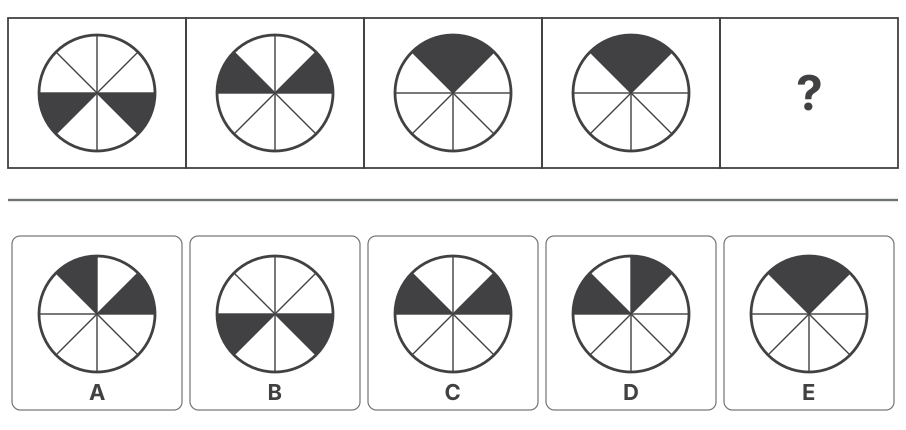
The answer is C.
Track the two black wedges separately instead of looking at the shape they form together. Each step, the wedge on the left moves one eighth clockwise and the wedge on the right moves one eighth counterclockwise, so the two travel toward each other. They meet at the top, which is why two frames in the middle of the sequence look the same, then they pass each other and separate again, ending as a symmetric pair in the upper half.
The habit worth keeping: when a figure has two moving parts, follow one of them at a time, then come back for the other; two of the options here are what you get if you stop after the first. A combined shape that grows and shrinks looks unpredictable; two simple rotations do not.

Follow one wedge at a time. The blue arrows show the wedge that moves clockwise, the amber arrows the one that moves counterclockwise; in the two middle frames they meet at the top and then pass each other.
Three structures build the whole area: the one above and the two below. Open any of them to try the question with its 18-second timer, then read the explanation for the strategy that solves it in time.
Start timer
0:18
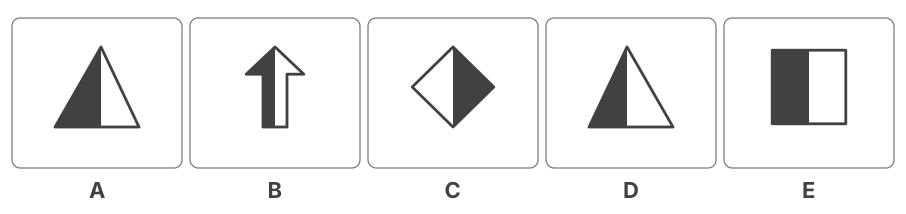
Choose the odd one out.
Start timer
0:18
Which of the following boxes should replace the question mark?
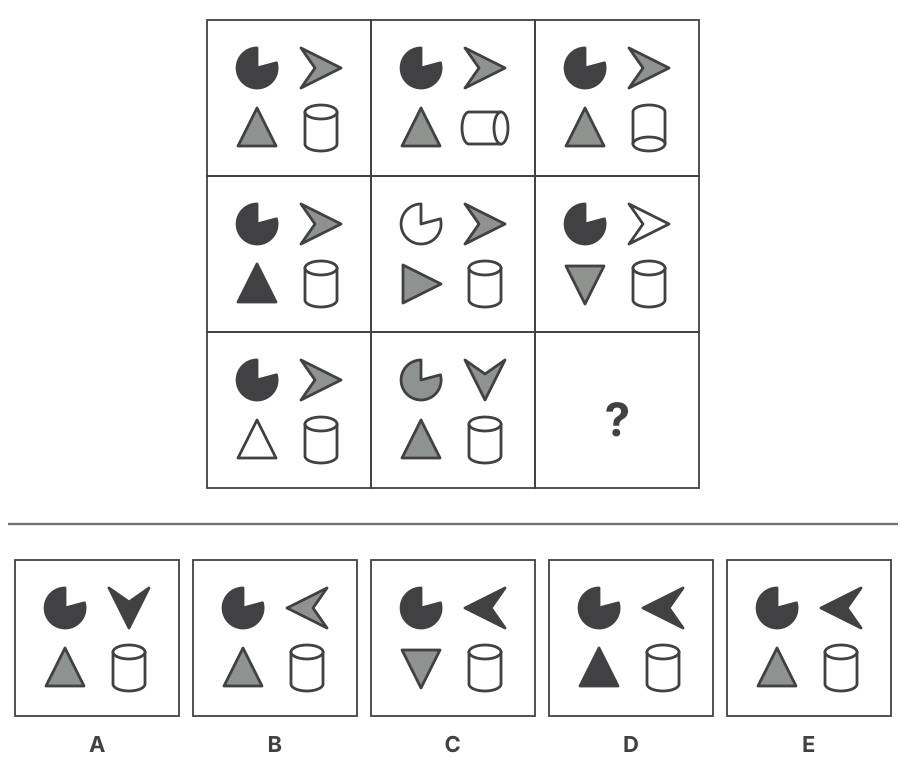
Tip: Form a hypothesis from the first two or three frames, then verify it against the whole sequence before you look at the answers. Checking the answers first costs time on distractors.
That is all three areas. In addition to focused training in the areas where your weaknesses lie, there are some general tips that will help you keep up with the tight time constraints.

CCAT test tips
Seven strategic tips that will help you do better overall, even if you cannot answer every question correctly.
- Start fast, then slow down. The questions become more difficult as the test progresses, so the early questions are where speed pays off most.
- Never camp on one question. The test’s own instruction is to select an answer and move on when unsure, and Criteria’s advice is to guess after more than a minute on any problem. With an average of under 20 seconds per question, one stubborn minute costs you three questions.
- Expect not to finish. Criteria itself states that less than 1 percent of candidates answer all 50 questions. Finishing is not the goal; answering as many as possible correctly is.
- Guess rather than skip. Wrong answers cost nothing, so a blank is the only way to waste a question.
- Train with scratch paper and without a calculator. That is the setup on test day, so it should be your practice setup too.
- Read precisely. A large share of avoidable errors comes from answering the question you expected instead of the question that is asked.
- Play to your strengths. Criteria’s own advice: bank the points in your strong categories quickly and give the saved seconds to the questions that need them.
Explore this video for CCAT sample questions and time-saving strategies.

How hard is the CCAT?
The CCAT is hard for three reasons. First, the pace: 50 questions in 15 minutes leaves under 20 seconds each. Second, the flow: once you submit an answer you cannot return to a question, so every decision is final. Third, the bar: there is no universal pass mark, because each employer sets its own benchmark for the role.
It helps to know how the test unfolds. The CCAT does not run in labeled sections, but it does move through the three areas in blocks, and that block order holds from one version of the test to the next: it opens with math, switches to a run of figures, then a longer stretch of word questions, back to figures, into a math block that ends with the logical statements, then the attention-to-detail questions, matrices, and from there it alternates between math and verbal blocks to the finish. What changes between versions is which particular question type fills a given slot, and almost all of that variation sits in the math blocks. So the shape of the test is predictable even though the questions never are, and that is exactly why broad practice beats cramming one category: our free test above covers every question type on the test.
Criteria measures three areas, and they are not evenly weighted: math and logic carries a little under half of the questions, verbal ability about a third, and spatial reasoning the remaining fifth. Your score report shows a separate percentile for each of them.
On scoring, the honest anchors are these: in Criteria’s official sample score report, a raw score of 24 out of 50 corresponds to the 50th percentile, and 24 is also the median in Criteria’s current norm data. Whether a given score is good depends entirely on the employer’s benchmark for the role. For the full picture of raw scores, percentiles, and typical ranges, see our complete CCAT scores guide.
If the simulation showed you where you stand, this is how you move the needle before test day.
The CCAT Adaptive PrepPack™ builds a personal study plan around your test date and adjusts it to every answer you give, so you spend your prep time where your score can actually grow. Its full-length simulations run the same 50-questions-in-15-minutes format as the CCAT.
You start with a short partial simulation that maps your strengths and the areas that need work. Adaptive learning sessions then raise the difficulty as you answer correctly and keep returning to the topics that cost you the most. As your test date approaches, the plan moves to full-length simulations, each followed by a detailed report.

CCAT FAQs
Retakes at the same employer are that employer’s call; Criteria publishes no fixed waiting period. Applying somewhere else always means a fresh test, because results stay confidential to the company that administered them. If you want a second attempt at the same company, ask the recruiter directly.
Accommodations for documented disabilities exist, and they are arranged before the test through the employer and the testing platform, not requested afterward. If you need one, contact the hiring company as soon as you receive the invitation. The Job Accommodation Network (JAN) is a useful external resource for framing the request.
Three habits carry most of it: answer fast at the start while the questions are easier, guess and move on whenever a question passes the one-minute mark, and never leave blanks, since wrong answers cost nothing. Timed practice makes these habits automatic, which is the point of the free simulation on this page.
The test itself is the same across roles: 50 questions, 15 minutes, mixed types. What changes is the benchmark. Each employer sets its own expected score range per position, so the identical raw score can be strong for one role and short for another.
A CCAT report shows three things: your raw score, meaning how many of the 50 questions you answered correctly, your overall percentile compared with other test takers, and separate percentile sub-scores for the three categories, spatial reasoning, verbal ability, and math and logic. For score tables and typical ranges by position, see our CCAT scores guide.
No. Your raw score counts correct answers only, and an incorrect answer scores the same as a blank one. That is why guessing on every question you cannot solve is always the right strategy on this test.
Calculators are not allowed on the CCAT, but scratch paper is. Practicing that exact setup matters: the math questions are designed to be solvable by hand, and pen and paper are usually faster than mental arithmetic under pressure.
Not formally. The CCAT measures cognitive aptitude, meaning problem solving, learning ability, and critical thinking, which overlaps with what IQ tests measure, but it produces an employer-facing percentile rather than an IQ score, and it is normed against working adults and job applicants, not the general population.
According to feedback from our customers, Crossover, Revolut, and Vista Equity Partners are among the employers most frequently sending candidates to the CCAT. Many other companies use it as well, typically as an early screening step. Our overview of companies using the CCAT covers the best-known processes.
The CCAT is made by Criteria Corp, a US assessment company, and is administered online through Criteria’s On Demand Assessment platform. Employers send candidates an invitation link; the test then runs in the browser, with no software installation required.


