CCAT Math Shortcuts | How to Improve Your Time on Math & Logic Questions
Published: May 11th, 2026
The CCAT Math and Logic question category accounts for about a third of the exam's 50-question battery, distributed evenly throughout the test.
Many candidates we spoke to were particularly anxious about the numerical questions. They were often worried that, in the years since high school, their mathematical acuity might have declined. However, the Math and Logic category isn't about deep knowledge of mathematical concepts. It's actually more about how well you can reason about problems that happen to be quantitative.
Using mathematical shortcuts to simplify calculations can be very helpful, as it makes it easier to focus on the more important aspect of the test: problem-solving.
Let's review some useful math shortcuts you can use on your CCAT.
The CCAT is a 50-question online assessment that enforces a 15-minute time constraint to measure candidates' ability to problem-solve under stress.
Of these 50 questions, about a third are classified as "math and logic" by Criteria, the company that published the test. The other question types are verbal, logical, and spatial.
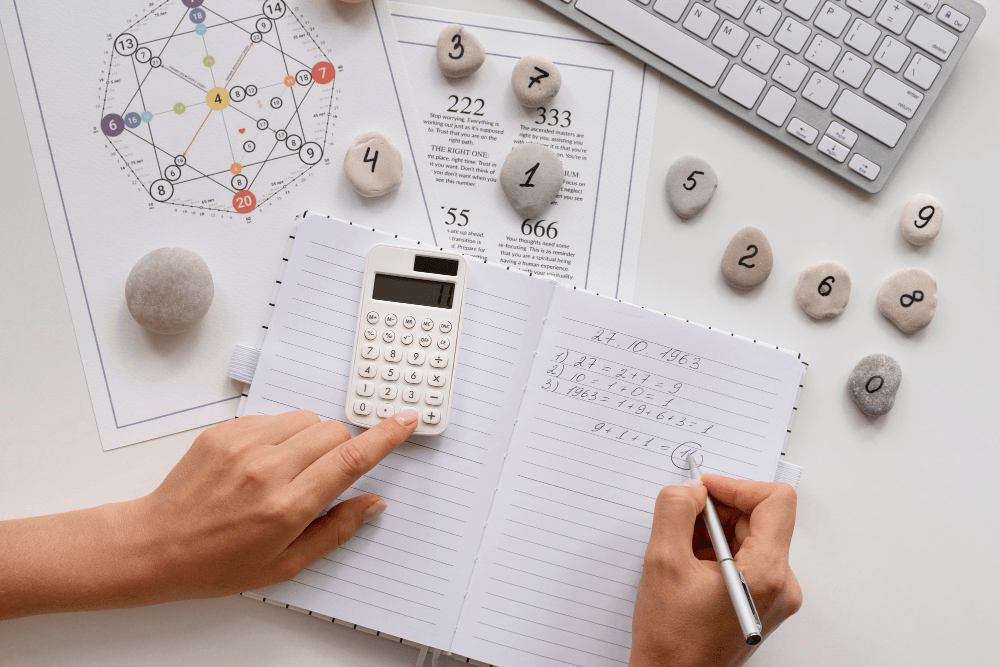
The choice to use math in a pre-employment exam may be puzzling to some: are job candidates expected to dig up long-forgotten memories of quadratic equations and trigonometric functions?
Hardly.
The numerical section of the exam is actually a problem-solving test, just like the other three sections. No complex mathematical procedures are needed, which is why calculators are not allowed. Yes, familiarity with percentages and averages is definitely needed, but the skills the test is looking for go beyond just knowing how to do math.
Having several simple math tricks up your sleeve can be very helpful.
So let's go over some of the most useful math tricks and shortcuts for the CCAT. More are available on our complete CCAT Prep Course.
Percentages need no introduction, because their usage spans far beyond the math class.
You can answer almost every percentage problem by remembering that the percentage is equal to the part divided by the whole, times 100.
So, if your part is 5 and your whole is 20, that's (5/20) x 100, which is 25%.
Here are some math shortcuts to use for percentage problems:

Certain percentages reflect simple fractions with 1 as the numerator:
How can this be helpful?
When you divide a number by a fraction, it's the same as multiplying by its reciprocal, or opposite fraction.
So, if you're asked: "30 is 20% of what number?", instead of dividing by 1⁄5, you can simply multiply by 5⁄1, which is just 5.
So the answer is: 30 X 5 = 150
Many word problems can be described as "decrease questions" in which a number decreases by a certain percentage. For example:
Ticket sales drop 55% from $2000. What is their new value?
For questions like this, your first instinct may be to calculate 55% of $2000, then subtract it from the original price. However, it's usually faster to solve for the remainder.
In this case, since the price lost 55% of its value, the new value is equal to 45% of $2000.
The rest of the problem is simple. 10% of 2000 is 200 (move the decimal point one place to the left). 5% is half of that, which is 100.
So 45% is 10% + 10% + 10% + 10% + 5%, which is (200 X 4) + 100, or $900.
Sometimes, you might be asked to find the difference or sum of two percentages. For example:
A country has a population of 5,000,000. 5% of the population are programmers. 4% of the population are Python programmers. How many of the country's programmers are not Python programmers?
You can get to the answer by individually finding 5% and 5% of 5,000,000 and subtracting them, but since both these percentages are of the same whole, you can shorten the path by finding the percentage-point difference first.
5% of 5,000,000 vs. 4% of 5,000,000 differs by 1% of 5,000,000, which is 50,000.

An average is the colloquial name for what mathematicians call "the arithmetic mean". They're meant to represent the center point of a group of numbers.
To find the average of a group, add up all the individual numbers, then divide by the number of numbers.
So, to find the average of 5, 7, and 9, we first add the numbers. 5 + 7 + 9 = 21. Since there are 3 numbers in the group, we'll divide by 3 to get 7.
Here are some tricks for questions that involve averages:
Since you know the average is equal to sum / number of items, a lot of questions become easier when you immediately look for the sum. For example:
Three numbers average 17. If two numbers are 12 and 19, what is the third?
If three numbers average 17, their sum is equal to 17 X 3, which is 51.
Now that you have the total, the question becomes simple. 12 and 19 are 31 together. To get the total up to 51, the missing number has to be 51 - 31 = 20.
Some questions will tell you an average, then inform you of a change to one of the numbers, and ask you for the new average.
This can be a bit daunting, as you now have to recalculate the average. But here's the thing: you don't really. When one value increases or decreases, you can use a shortcut. For example:
If three albums average 23 photos and one album gains 6 photos, what is the new average?
We know that the sum, or total, increases by 6 photos. That 6 has to be spread across 3 albums, so the average will actually increase by 6 / 3 = 2.
The new average is therefore 23 + 2 = 25.

Number series questions often look harder than they are because candidates try to find a complicated rule. In many CCAT-style sequence questions, the pattern is based on one of several common structures.
The fastest approach is to check the most common patterns first.
Example:
4, 9, 14, 19, 24, ?
Each number increases by 5.
Answer: 29
This is the simplest sequence type. Always check it first.
Example:
7, 10, 15, 22, 31, ?
Look at the differences:
10 − 7 = 3
15 − 10 = 5
22 − 15 = 7
31 − 22 = 9
The gaps are increasing by 2:
+3, +5, +7, +9
So the next gap is +11.
31 + 11 = 42
This is one of the most common sequence shortcuts. Instead of looking at the numbers themselves, look at the gaps between them.
Example:
3, 6, 12, 24, 48, ?
Each number is multiplied by 2.
Answer: 96
This is common when the numbers grow quickly. If the sequence rises much faster than simple addition, check multiplication.
Some sequences combine two operations.
Example:
2, 5, 11, 23, 47, ?
Each number is multiplied by 2, then 1 is added:
2 × 2 + 1 = 5
5 × 2 + 1 = 11
11 × 2 + 1 = 23
23 × 2 + 1 = 47
So:
47 × 2 + 1 = 95
When multiplication alone almost works but not exactly, check whether the sequence adds or subtracts a small number afterward.
You'll often see patterns where:
Since CCAT is a multiple-choice test, the answer choices can be helpful, because you do not always need to calculate the exact answer from scratch. You can often eliminate impossible answers first, then calculate only enough to choose between the remaining options.
For example:
A store sold 2,000 tickets last year. This year, sales decreased by 55%. How many tickets were sold this year?
Answer choices:
A. 900
B. 1,100
C. 1,450
D. 3,100
A 55% decrease means the store kept only 45% of the original amount. So the answer must be less than half of 2,000, meaning less than 1,000.
That immediately eliminates:
So even before calculating, 900 is the only reasonable answer.
Math and logic questions on the CCAT don't require you to be a mathematician — they require you to be a smart, efficient problem-solver. The shortcuts covered in this article are designed to do exactly that: help you cut through the noise, avoid common traps, and reach the right answer faster.
The key is to internalize these patterns before test day, so that when you're under the clock, you're not figuring out the approach — you're just executing it. Recognize 25% as a quarter. Turn averages into totals. Check the gaps before the numbers. Eliminate impossible answers before you calculate.
With roughly 18 seconds per question, every second counts. Candidates who perform best on the CCAT aren't necessarily the ones who know the most math — they're the ones who know which mental shortcut to reach for, and when.
Practice these techniques until they're second nature, and you'll walk into the test with one less thing to worry about.

David has over 30 years of experience in the test prep industry, specializing in personality, behavioral, and Situational Judgment tests. He has led the development of most of our preparation courses in these areas.