Power & Utility Company Test Prep: Find Your Employer's Exam (EEI, AIR & Non-Technical)
Power and utility companies use standardized pre-employment assessments to screen and rank entry-level candidates for field, technical, and customer-facing roles. Depending on the employer, the exam is developed by the Edison Electric Institute (EEI), administered through a trade program such as the Electrical Training Alliance, or run independently by the company or a third-party testing vendor. Most of these assessments cover the same core skill areas:
These exams don't test electrical or utility-specific knowledge - they measure the general aptitude needed to succeed on the job and in training. Your score typically determines your rank on the hiring list, which is why preparing in advance matters.
Applying to a power or utility company but not sure which test you'll be facing? This page covers the assessments used across the industry, organized by test type and by company, so you can quickly find what applies to your situation.

Investor-owned electric companies serve nearly 250 million Americans and operate in all 50 states and the District of Columbia. Collectively, the electric power industry supports millions of jobs across the country, spanning everything from small regional utilities to Fortune 500 holding companies with tens of thousands of employees.
These companies typically hire across several broad categories:
Because grid work is safety-critical and often unionized - many field roles are staffed through the International Brotherhood of Electrical Workers (IBEW) - these companies rely on standardized testing to screen candidates before they ever set foot in the field or the plant.
The tests exist because the job itself carries real risk and real consequences: a lineman works at height around high voltage, a plant operator manages equipment that keeps power flowing to hospitals and homes, and a dispatcher's decisions affect grid reliability in real time. None of these roles are things you can learn only in an interview - they require reliable cognitive and mechanical aptitude, which is exactly what these assessments are designed to measure. Your test score typically determines your rank on the hiring list, so a strong score can be the difference between an offer and a rejection.
Compensation reflects that responsibility. According to the U.S. Bureau of Labor Statistics, electrical power-line installers and repairers earn a median annual wage of $92,560, across roughly 127,400 jobs nationally - a field projected to grow 7% through 2034. Power plant operators, distributors, and dispatchers earn a median of $103,600 annually, though this occupation is projected to decline 10% through 2034 as automation and plant consolidation reduce headcount.
Beyond base pay, many field and plant roles at investor-owned utilities come with union-negotiated benefits: employer-sponsored health coverage, pension or retirement matching, and structured overtime pay - particularly valuable during storm response, when linemen are often called in for extended emergency shifts.
The Edison Electric Institute (EEI) is the trade association representing nearly all investor-owned electric utilities in the US. Rather than each company building its own pre-employment exam from scratch, EEI develops and maintains a shared battery of standardized tests that member utilities use to screen and rank candidates - which is why the same test names show up across dozens of different power companies nationwide.
The EEI battery isn't one single test - it's a family of assessments, each built for a different job category:
Utilities use this shared system because it's standardized, validated against the actual demands of the job, and lets them screen large applicant pools consistently and defensibly. Among the companies covered on this page, American Electric Power (AEP), Georgia Power, Tennessee Valley Authority (TVA), Exelon, Dominion Energy, Florida Power & Light (FPL), Baltimore Gas and Electric (BGE), FirstEnergy, Duke Energy, Southern California Edison (SCE), Central Hudson, Entergy, DTE Energy, Eversource, PSEG, Con Edison, PECO, ComEd, and National Grid all use some version of the EEI battery. Beyond this list, the same tests are used across most of EEI's investor-owned utility members nationwide, so if your employer isn't listed here, there's a good chance it still relies on this same test family.
Below, you'll find sample questions covering the four most common EEI assessments: CAST, POSS/MASS, TECH, and SOPD - so you can get a feel for what to expect on test day and see where your current skills stand before deciding how much more practice you need.
CAST (Construction and Skilled Trades) is the EEI test used for line worker, construction, and skilled trades positions - the people who build and maintain the physical power grid. A core part of CAST is mechanical aptitude, which measures your ability to understand how physical and electrical systems work without needing prior training.
Electrical circuit questions like the one below show a simple circuit diagram and ask you to trace the path of current - which components are connected, which are broken, and what happens when a switch changes state. The key is to trace the circuit one connection at a time rather than trying to see the whole picture at once: follow the wire from the power source, through each switch and junction, and stop the moment the path is broken.
Observe the following electrical circuit

If the electrical switch is turned on, which light bulb will light up?
Electrical circuit questions on the real CAST exam range from simple single-loop circuits like this one to multi-switch, multi-path systems that require you to track several possible routes at once - and you'll typically have well under a minute per question. Our CAST Practice includes circuit questions built to be harder than what you'll see on test day, so the real exam feels manageable by comparison.
POSS (Plant Operator Selection System) and MASS (Maintenance Aptitude Selection System) are the EEI tests used for power plant operator, maintenance, and technician roles - positions responsible for running and maintaining the equipment that generates electricity. Mathematical usage questions test whether you can correctly apply a given formula under pressure, not whether you've memorized it.
You'll usually be given the formula directly, as with a temperature conversion. The skill being tested is careful substitution and calculation - plug the known value into the correct place in the formula, work through the arithmetic step by step, and double-check your decimal placement before selecting an answer.
Please choose the correct answer. If none of the options is the correct answer please choose answer choice e, "N".
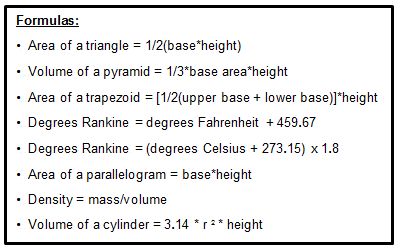
If iron melts at 1,538 degrees Celsius, at what Rankine temperature will it melt?
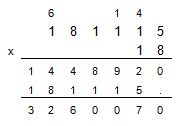
Formula-based questions like this one are common throughout POSS and MASS, covering conversions, ratios, and basic algebra - the difficulty comes from doing accurate math quickly, not from complex concepts. Our POSS/MASS Practice is timed more tightly than the real test, so you build the speed and accuracy the actual exam demands.
SOPD (System Operator/Power Dispatcher) is the EEI test used for system operator and power dispatcher roles - positions responsible for monitoring and controlling the flow of electricity across the grid. Reading comprehension questions test whether you can accurately extract technical information from a passage, since dispatchers regularly work from written procedures and technical documentation.
You'll be given a short technical passage - often describing a system or process, like a power reactor - followed by a question that asks you to identify which statement it actually supports. Read the passage first without rushing, then check each answer choice directly against the text rather than relying on general knowledge or assumptions about how the system "should" work.
The purpose of this exam is to assess your ability to read and understand basic scientific reading materials. Please note that the question must be answered based on the provided information in the passage. Refrain from answering based on prior knowledge or any information not specifically provided in the passage. Select the best option from the provided choices.

Nuclear power provides 12% of the world's electricity and 20% of the electricity consumed in the US. There are over 100 nuclear reactors operating around the US. Some states generate the majority of their electricity from nuclear power.
Nuclear energy is environment friendly since it does not emit greenhouse gases. In addition, it is a stable and economical resource. The cost of electricity production by means of nuclear power became over the years lower than production by many other available resources, such as coal and natural gas.
Nuclear plants generate electricity by boiling water into steam; the steam then turn turbines which activate an electricity generator. Nuclear plants differ from other fossil-fueled power plants in what serves as a heat source to turn water into steam. Nuclear plants do not burn fuel; instead, they use a process called "fission". During the fission process, an atom (in this case, uranium) splits into smaller parts releasing neutrons from its nucleus. These neutrons hit other atoms and cause them to split as well; thus, creating a self-sustaining chain reaction which releases an enormous amount of heat.
Currently, there are two types of nuclear reactors in the US: pressurized water reactor (PWR) and boiling water reactor (BWR).
The PWR maintains water under pressure so that it heats, but prevent if from boiling. The heated water is pumped through a steam generator, where it transfers its thermal energy to a secondary system where steam is generated and flows to turbines which, in turn, spin an electric generator that produces electricity. The water from the reactor and the water that is turned into steam are in separate systems and do not mix.
In the BWR, the water flows upward through the core, where it is heated by fission and allowed to boil in the reactor vessel. The water then turns into steam which is carried by pipes to spin the turbine, which drives the generator to produce electricity.
In PWRs and BWRs. the steam is turned back into water for reuse. In addition, the water serves both as a coolant and as a moderator, to slow neutrons.
Despite the elegancy and evident efficiency of the nuclear method, many wonder why we need it when we can harness renewable energy sources like the wind and the sun. The answer, others may argue, is that nuclear power is able to reliably supply a sustainable amount of electricity in every hour of every day of the year; hence, it is an important resource for meeting with the ever-increasing demand for electricity.
What is true about the water used in the PWR?
SOPD reading comprehension passages are typically dense and technical, and the answer choices are written to be easy to mix up if you're skimming rather than reading closely. Our SOPD Practice uses longer, more technically demanding passages than the real exam, so the actual test reads faster and clearer by comparison.
TECH is the EEI test used for technician-track positions, covering the practical and technical skills needed to maintain and troubleshoot utility equipment. Diagram interpretation questions test your ability to read a technical drawing or schematic and pull out a specific piece of information from it - a skill technicians rely on daily when working from equipment manuals and wiring diagrams.
These questions typically show a diagram and ask you to count, identify, or trace a specific element within it. Approach them methodically: identify exactly what the question is asking you to find first, then scan the diagram systematically - left to right, top to bottom - rather than jumping around, so you don't miss or double-count an element.

How many high-voltage electricity poles are there in sections through which the drainage canal passes?
The correct answer is C.
To solve this question, it will be best to look for each element separately. First, we will write down the sections in which the sewage line passes (A1, B1, C1, D1, C3, D3). Then, we will count the high-voltage electricity pole in each section and sum the result.
A1 = 3, B1 = 2, C1 = 8, D1 = 0, C3 = 0, D3 = 0.
Total = 3 + 2 + 8 = 13.
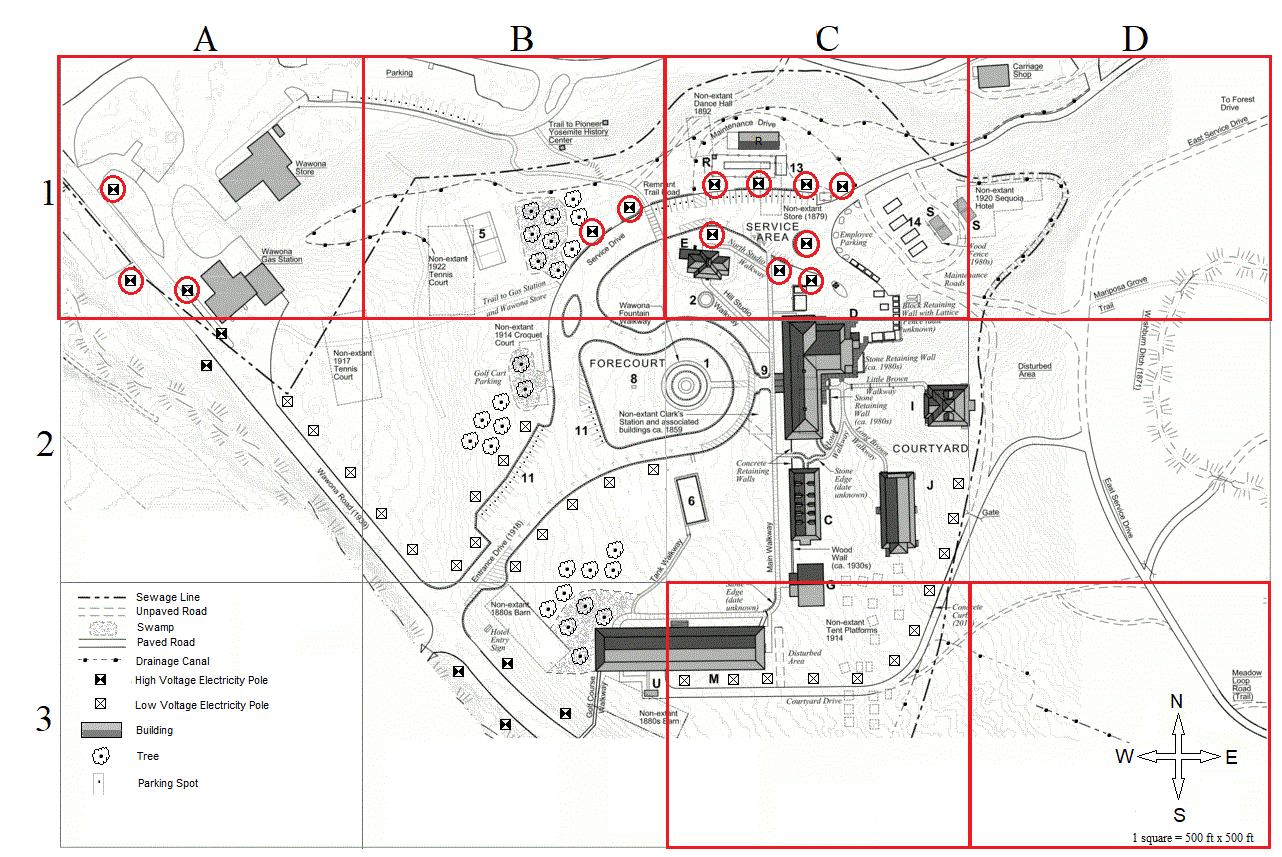
Diagram questions on the real TECH exam can involve more complex, multi-part schematics than this example, and it's easy to lose count under time pressure. Our TECH Practice uses denser, more detailed diagrams than the real test, so you walk in already comfortable with the format.
The Electrical Training Alliance Aptitude Test - historically known as the AIR Test, after the American Institutes for Research (AIR), the organization that originally developed and validated it - is the entry exam for electrical apprenticeship programs run through the electrical training ALLIANCE (formerly the National Joint Apprenticeship and Training Committee, or NJATC).
Unlike the EEI battery, this test isn't administered by an individual power company. It's the standard screening exam used by local Joint Apprenticeship and Training Committees (JATCs) affiliated with the International Brotherhood of Electrical Workers (IBEW) and the National Electrical Contractors Association (NECA) to select candidates for Inside Wireman and Outside Lineman apprenticeships. In other words, you're not testing into one utility - you're testing into the trade itself, and from there you may end up working for any number of utilities or contractors.
The exam covers three areas:
Below, you'll find sample questions covering the three core AIR test areas - algebra, reading comprehension, and mathematical usage - so you know what to expect and where your skills currently stand.
Algebra questions on the AIR test often present a graph and ask you to identify which equation it represents - a skill that translates directly to reading wiring diagrams and technical schematics on the job. Rather than trying to recall equations from memory, work backward from the graph: note where the line crosses the axes and its direction, then test each answer choice against what you can see. A line through the origin, for instance, rules out any equation with a fixed non-zero value.
Which of the following equations represents this graph?
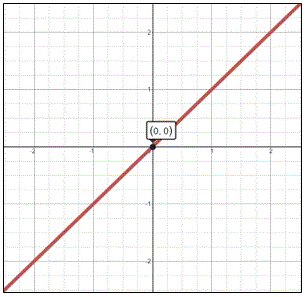
The correct answer is (D).
Check each answer to find the function that fits the sketch.
Answer (A): means the value of y is zero for every value of x. The y value of the graph in the problem is not always zero, therefore, this is not the correct function. The graph of
  looks like this: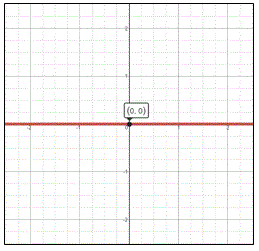
Answer (B): means the value of x is zero for every value of y. The x value of the graph in the problem is not always zero, therefore, this is not the correct answer. The graph of
  looks like this: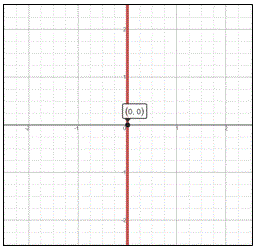
Answer C:
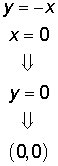
Find intersection point with y axis, (i.e.  ):
):
This function is crossing the origin, like the function in the problem.
Next check the slope:
The function  is from the form of
  , where
  is the slope and
  is the intersection with the y axis.
Given that  means that
  and
and  , the function is "going down." In the problem, the function is "going up." You can check it mathematically by substituting two points into a linear slope equation:
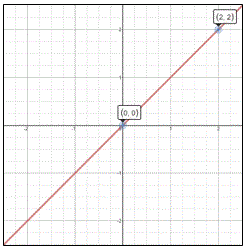
Substitute two points: 
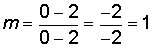
Hence the slope is  and not
  ; therefore, this is not the correct answer.
The function  looks like this: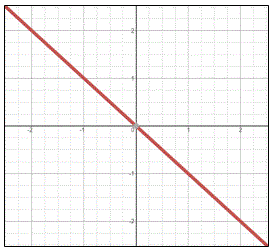
Answer (D):
Find intersection point with y axis, i.e  :
: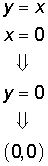
This function crosses the origin like the function in the problem. Next check the slope:
The function  is also from the form of
  , where
  is the slope and
  is the intersection with the y axis.
Given that  ,
,  and
and  , the function is "going up," and this is the correct answer.
Accordingly, the correct answer is (D).
Reading comprehension on the AIR test uses a True/False/Cannot Say format: you're given a passage and a statement, and asked whether the statement is definitely supported, definitely contradicted, or simply not addressed by the text. This format trips people up because "Cannot Say" isn't the same as "unlikely" - it applies whenever the passage doesn't give you enough information to confirm or deny the statement, even if the statement sounds reasonable. The approach is to check the statement word by word against exactly what the passage says, not what it implies or what seems logical.
Throughout Europe, the three most prevalent ways of punishing an individual for a drug possession offence are warning, fine and suspended prison sentence; with the exception of a few countries, community work orders are rarely used. Those convicted of supply offences are more likely to receive a prison sentence. Notwithstanding, certain offenders receive long sentences and these are often brought up in public debate. Considerable differences between countries exist regarding where to draw the line between users as individuals needing treatment, and traffickers needing criminal punishment as deterrence. Each country’s criminal justice system recognises some people as sick, and thus tries to divert them to treatment, while punishing others.
A person caught possessing drugs could face a warning, a fine, or a suspended prison sentence – depending on the country where the arrest takes place.
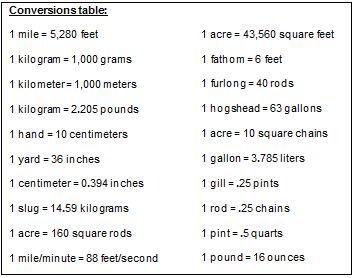
Mathematical usage questions test your ability to apply a set of given values or rates to solve a real-world problem - here, converting between units of weight using a supplied conversion table. The skill isn't memorizing conversion factors, since they're provided; it's chaining several conversions together correctly without losing track of a step. Working through a multi-step conversion like this, it helps to convert one unit at a time in sequence rather than trying to combine steps, and to double-check that your final unit matches what the question is actually asking for.
Please choose the correct answer. If none of the options is the correct answer please choose answer choice e, "N".
Ready to practice further?
Our AIR Test Prep Course covers algebra, reading comprehension, and mathematical usage in depth, with more practice questions than you'll find here. While it's built around TVA's hiring process, the AIR test itself is standardized across the trade - so this course works just as well if you're applying through any other utility, contractor, or local IBEW/NECA apprenticeship program that uses the AIR test.

Not every position at a power or utility company goes through the EEI or AIR battery. Customer service, clerical, financial, and engineering roles are typically screened with a broader general aptitude assessment instead - and if you're not yet sure which category your role falls into, this is also a safe place to start.
Below are sample questions covering three of the core skill areas used in this type of assessment: English comprehension, tables and graphs, and spatial reasoning.
English comprehension questions present a passage and ask you to evaluate whether a specific statement is supported by it, contradicted by it, or not addressed at all - similar in format to the reading comprehension you'd see elsewhere, but typically covering general workplace or safety-related topics rather than technical systems. The approach is the same: locate the exact sentence in the passage that relates to the statement, and judge it strictly against what's written rather than what seems reasonable or likely.
OCCUPATIONAL HEAT EXPOSURE
When a person works in a hot environment, the body must get rid of excess heat to maintain a stable internal temperature. It does this mainly through circulating blood to the skin and through sweating. When the air temperature is warm, cooling of the body becomes more difficult. When this happens, the body continues to store heat, and the person begins to lose concentration and has difficulty focusing on a task. Excessive exposure to heat requires immediate medical attention.
Difficulty in cooling makes it hard to focus.
Tables and graphs questions test whether you can accurately pull numbers from a chart or dataset and perform a simple calculation with them - a skill directly relevant to financial, administrative, and reporting roles. These questions often involve several data points that all need to be combined, so the main risk isn't the math itself but missing or double-counting one of the values. Work through the data systematically, listing out each relevant figure before adding, rather than trying to total them by eye.
What is the total number of people who depart from Paris to Barcelona by train?
In order to answer this question we need to calculate the number of occupied seats in each train and then sum up all the data to arrive at the correct answer: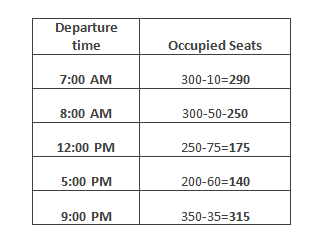
Total number of people who depart from Paris to Barcelona on train: 290+250+175+140+325= 1170.
Spatial reasoning questions test your ability to mentally manipulate and visualize objects - here, identifying what shadow a 3D shape would cast from a given angle. While this skill is often associated with field and technical roles, it also appears in general aptitude batteries because it measures logical, methodical thinking independent of any specific job knowledge. Look for the shape's symmetry first, since a symmetrical object often rules out several answer choices immediately before you need to visualize the full shadow.
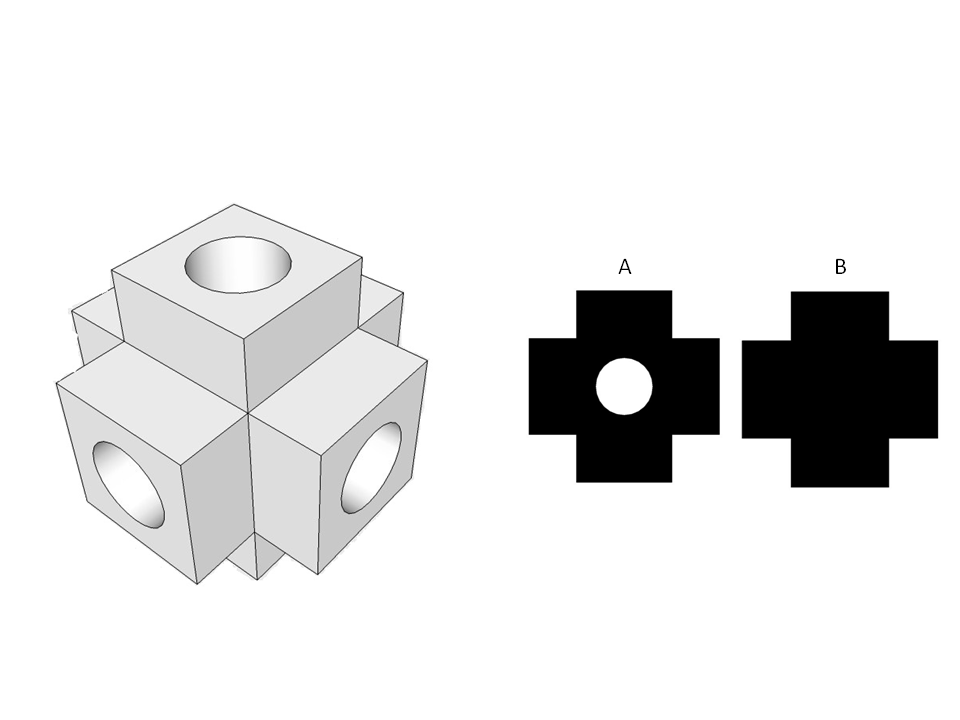
Which of the shadows on the right can result from casting light on one of the 3D-shape’s sides?
Start Preparing For Your Test
Our Utilities & Energy Careers Preparation course covers English comprehension, tables and graphs, spatial reasoning and aptitude, mechanical aptitude, trades math, inductive and deductive reasoning, and situational judgment and personality profiling in full - along with interview preparation and study guides. It's built to cover the full range of non-technical and general-aptitude roles across the power and utility industry, so it's a strong choice whether or not you've confirmed your exact test yet.
Below is a directory of the major power and utility companies operating in the US, from investor-owned giants like Southern Company and Duke Energy to regional providers like Central Hudson. Each entry covers the company's size, where it operates, the types of roles it hires for, and which test path applies - the EEI battery, the AIR test, or a company-specific PrepPack. Click a company to expand its details and jump straight to the right practice section or product page.

Start with the company section above and look up your employer - most power and utility companies use either the EEI battery or the AIR test, and we've noted which applies to each. If you're not sure, or your specific role is customer service, clerical, financial, or engineering rather than field or technical, the general aptitude assessment covered in our Utilities & Energy Careers Preparation is the safer starting point. When in doubt, contact your HR representative and ask directly which assessment you'll be taking - they can usually tell you the exact name.
Pass rates for pre-employment utility and power company assessments are typically lower than most people expect, since these tests are designed to rank and filter a large applicant pool rather than simply confirm baseline competence. The content itself, mechanical reasoning, spatial orientation, reading comprehension, and math, isn't advanced, but the time pressure is real: most sections give you well under a minute per question. Candidates who walk in without practicing the specific question formats tend to lose time reorienting themselves mid-test, which is usually what separates a passing score from a failing one.
Each PrepPack is built around the specific test it targets, with practice questions organized by subject area, full explanations for every answer (not just what's correct, but why), timed practice simulations that mirror the real test's format and pressure, and study guides covering the underlying concepts. The goal is to take you from "I don't know this format" to "I've already seen this format dozens of times" before you sit down for the real thing.
Free PDFs circulating online are often outdated, incomplete, or based on a different (sometimes unrelated) test entirely, since anyone can upload a document and label it however they want, with no way to verify it reflects the current exam. AI tools have a similar problem from a different angle: general-purpose AI wasn't built or verified against the actual EEI, AIR, or company-specific test blueprints, so it can generate plausible-looking practice questions that don't match the real format, the real difficulty curve, or the real answer logic, and it can't tell you when it's wrong. Our PrepPacks are built from verified, test-specific content and reviewed for accuracy, which matters most on a test where your score determines your rank on the hiring list.
This depends on how comfortable you already are with the subject areas being tested, but most candidates benefit from at least one to two weeks of focused practice rather than cramming the night before. Since your score often determines your rank on the hiring list rather than a simple pass/fail, the goal isn't minimum competence, it's scoring as high above the passing line as you can, which takes repeated practice under timed conditions rather than a single read-through.
Yes, our practice questions are modeled closely on the real test's format, subject areas, and time constraints, and in several sections, deliberately made somewhat harder than what you'll actually face. The reasoning is straightforward: if you're used to a tougher version in practice, the real test feels more manageable and less rushed on the day that actually counts.