 Fire Departments in Canada: Hiring, Training & Salaries Work (2026)
Updated: May, 2026
Not many careers combine genuine public service with a stable career and a six-figure salary. Firefighting in Canada is one of them - and for the right candidate, it's worth the effort to get in.
Canada has more than 3,000 fire departments, but full-time career hiring is concentrated in roughly 50 municipal services. Each sets its own qualifications, runs its own recruitment cycle, and uses its own exam. Getting hired is competitive and credential-specific - the path looks very different depending on which province and department you're targeting.
This article covers what hiring, training, salaries, and written testing actually look like across Canada's fire services - so you can identify the right department for your situation and go in prepared.

Is Firefighting in Canada a Stable Career?
"Firefighting sits at an unusual intersection: it is physically demanding, genuinely dangerous, and one of the most structurally stable careers in the Canadian public sector. The stability it offers isn't just financial - it comes from working within one of the most structured and respected institutions in Canadian public life.
That said, the financial picture is strong. First-year firefighters in Toronto and Vancouver earn between $72,000 and $90,000. At the top of Calgary's and Edmonton's pay grids, career firefighters exceed $136,000. Add a defined-benefit pension, comprehensive benefits, and a shift schedule built around 24-hour blocks with extended time off - and it becomes clear why competition for these positions is fierce.
What is the Structure of Canada's Fire Services?
Fire service jurisdiction in Canada is municipal and provincial - there is no federal fire department and no countrywide hiring list. Each city or town runs its own service, sets its own qualifications, and posts its own recruitments. Provinces sit above that, setting training and certification standards that departments must follow.
Departments come in three forms. Career departments employ full-time paid firefighters and are concentrated in cities with populations above roughly 50,000. Composite departments mix career and volunteer staff. Volunteer departments cover most of rural Canada, where the work is still paid by the hour or by call.
The scale is worth understanding. Canada has more than 3,000 fire departments, but full-time career hiring is concentrated in roughly 50 municipal services. Exam format, certification requirements, and hiring timelines all differ by department - a candidate prepared for Toronto is not automatically prepared for Calgary.
Canada's Fire Departments by Province and City
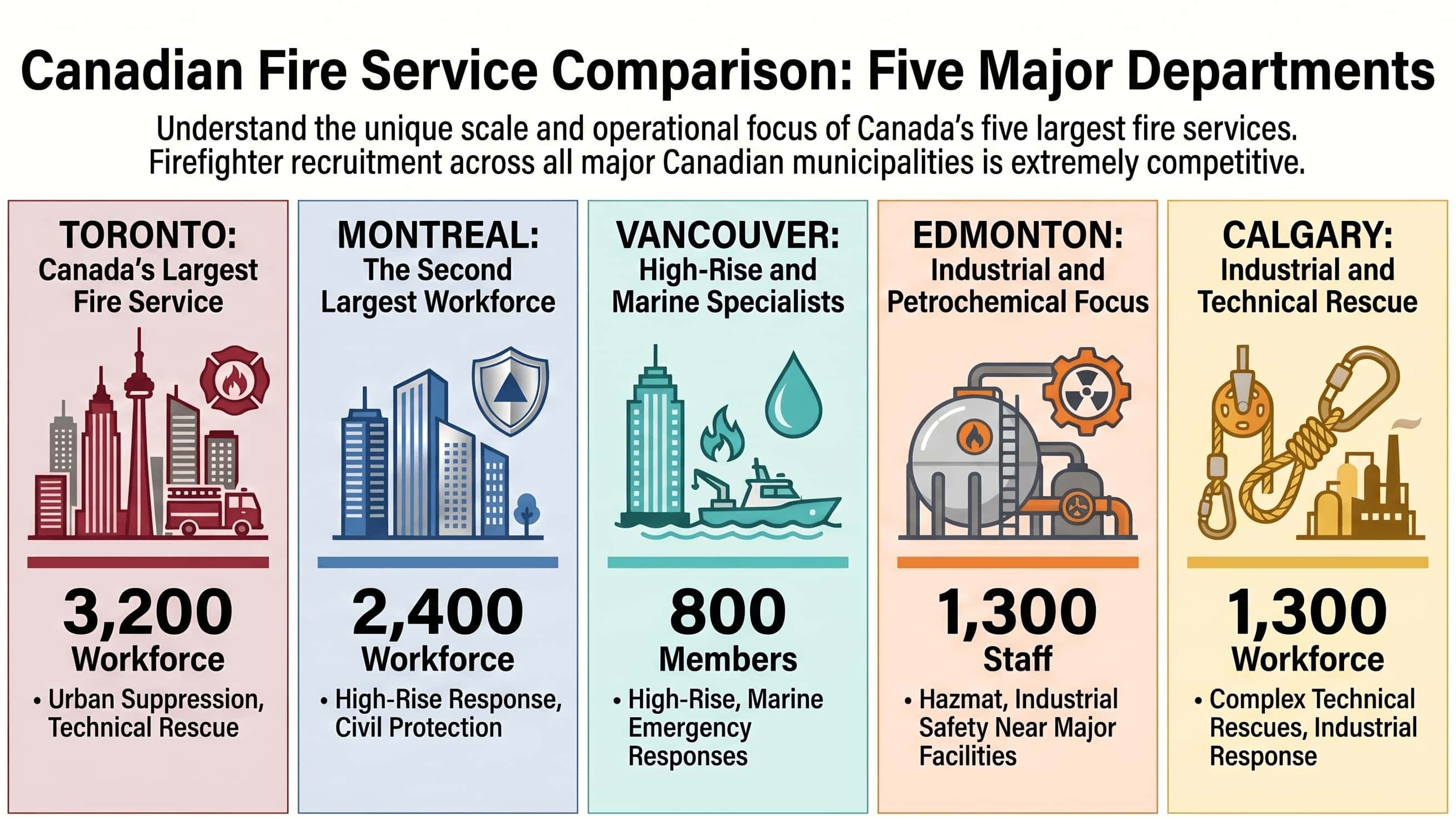
The sections below cover Canada's five largest municipal fire services, grouped by province. Every figure below should be confirmed against the department's current hiring notice before you rely on it - workforce numbers, salaries, and exam formats are updated by departments on their own schedules.

Ontario
Ontario effectively requires a pre-service college diploma before you apply to a career department. The one-year pre-service firefighter program is offered at colleges including Seneca, Humber, Lambton, and George Brown, and programs must be recognized by the Office of the Fire Marshal. Ontario has over 400 fire departments, but only around 50 offer full-time career positions.
Ontario's defining feature is centralized testing. Major departments - Toronto among them - require candidates to hold OFAI Candidate Testing Services (CTS) certificates before applying. CTS is a multi-stage process: the FACT aptitude test at Stage One, then hearing, vision, and an encapsulated treadmill test at Stage Two, then physical aptitude and technical skills assessments at Stage Three. French is not required except in francophone communities in Northern and Eastern Ontario.

Toronto Fire Department - City Spotlight
Toronto Fire Services is the largest municipal fire service in Canada and the fifth largest in North America, operating 84 stations across the city with over 3,200 uniformed and civilian personnel.
|
Workforce size |
Around 3,200 firefighters - the largest municipal fire service in Canada. |
|
Territory & stations |
City of Toronto; 84 fire stations plus eight support facilities. |
|
Mission type |
Urban structural fire suppression, technical rescue, hazmat, and medical first response - often first on scene before paramedics. Responds to well over 100,000 emergency incidents a year. |
|
Salary |
Entry-level rate of $34.09/hour (2024 collective agreement, IAFF Local 3888); approximately $74,000-$76,000 annually at entry. Total compensation for senior firefighters reaches approximately $105,000-$115,000 at the top of the grid. |
|
Benefits |
OMERS defined-benefit pension, extended health, dental, and paramedical coverage. |
|
Hiring process |
Open competition on irregular cycles - not annual. Application, OFAI CTS verification, panel interview, conditional job offer, then medical and psychological clearance, background check, and recruit school. |
|
Written exam |
OFAI FACT (Firefighter Aptitude and Character Test) - Stage One of the CTS process. |
|
Physical exam |
OFAI FPAT (Firefighter Physical Aptitude Job-Related Tests) - Stage Three of CTS. |
|
Other requirements |
Ontario Class D licence with Z endorsement, NFPA 1001 Level I & II from a recognized Ontario post-secondary institution, and Emergency Medical Responder (EMR) certification. |
|
Notable |
Toronto receives thousands of applications per cycle. CTS certificate currency rules differ by stage - Stage Two and the FPAT must be valid at the posting closing date, while the Stage One FACT certificate can be expired. |
|
Sources |
Toronto Fire Services - Careers; Operations Firefighter requirements; OFAI. |
British Columbia
In British Columbia, certification is technically voluntary at the provincial level, but the major departments require it in practice. Vancouver's official qualifications page lists completion of NFPA 1001 Level I & II - with IFSAC or Pro Board seals - as a required qualification at the time you apply. The Justice Institute of BC (JIBC) is the best-known provincial training route, though NFPA 1001 from other accredited academies is also accepted.
Career positions in BC concentrate in Metro Vancouver, the Fraser Valley, and on Vancouver Island. Exam formats vary by department - some use NTN FireTEAM, while Vancouver runs its own selection process - so confirm the format from each hiring notice.

Vancouver Fire Department - City Spotlight
Vancouver Fire Rescue Services (VFRS) operates 20 fire halls and employs more than 850 staff across fire suppression, pre-hospital care, hazardous materials response, marine rescue, and technical rescue.
|
Workforce size |
Around 800 employees across 20 firehalls, with a training academy and two fire prevention offices. |
|
Territory |
City of Vancouver - a dense urban core where high-rise response is a significant part of the workload. |
|
Mission type |
Structural fire, high-rise response, technical rescue, hazmat, motor vehicle accidents, marine response, and medical calls. |
|
Salary |
Senior firefighter total compensation lands roughly in the $105,000-$110,000 range. |
|
Benefits |
Municipal Pension Plan - the employer contributes over 14% and the employee around 11% - plus extended health and dental. |
|
Hiring process |
Open competition. Application, the VFRS Ride-Along program as part of selection, panel interview, then medical, psychological, and background checks, followed by recruit academy. |
|
Written exam |
A firefighter cognitive assessment - confirm the specific format from each VFRS hiring notice. |
|
Physical exam |
A department-specific physical assessment, not CPAT - confirm from each hiring notice. |
|
Other requirements |
High school transcripts, NFPA 1001 Level I & II with IFSAC or Pro Board seals, and a current driver's abstract. Vision and hearing must meet NFPA 1582. |
|
Notable |
A residency restriction applies at the time of hire: members must live within defined Lower Mainland boundaries because of the on-call nature of the work. VFRS emphasizes diversity recruitment. |
|
Sources |
Vancouver Fire Rescue - Join; VFRS - Required qualifications. |
Alberta
Alberta does not mandate a pre-service college credential, but NFPA 1001 Level I & II plus post-secondary education is strongly preferred and puts applicants at a real disadvantage without it. NFPA certification is typically earned through NAIT in Edmonton or SAIT in Calgary. Alberta's oil-sector economy also creates distinct industrial and wildland-interface fire risk, especially in the north.
The two major departments use different aptitude tests, which is the single most important thing for an Alberta applicant to get right. Calgary uses the National Testing Network (NTN); Edmonton uses an aptitude test built on CPS HR materials. CPAT-style physical testing is standard at both.

Calgary Fire Department - City Spotlight
The Calgary Fire Department (CFD) is one of Canada's fastest-growing services, with over 1,500 firefighters currently on staff and projected to reach nearly 1,700 by end of 2026.
|
Workforce size |
Over 1,500 firefighters currently; projected to reach ~1,700 by end of 2026; 43 fire stations |
|
Territory |
City of Calgary |
|
Mission type |
Fire suppression, emergency medical response, motor vehicle collisions, hazardous materials, technical rescue, community engagement |
|
Salary |
Approximately $95,000/year average; top of pay grid well above $130,000 |
|
Benefits |
City of Calgary pension, health and dental coverage, paid leave |
|
Hiring process |
Application → NTN aptitude test → Personal History Statement → polygraph → CPAT → references → medical → psychological → conditional offer |
|
Written exam |
National Testing Network (NTN) FireTEAM — online, video-based, two-part exam; candidates arrange and pay independently (~$65 USD) before file review begins |
|
Physical exam |
CPAT (Candidate Physical Ability Test) — eight-event timed circuit |
|
Other requirements |
Eligible to work in Canada; high school diploma or equivalent; no criminal activity in past 3 years; valid Alberta Class 5 licence (non-GDL); fewer than 6 demerit points |
|
Application window |
June 1–30 only — one fixed annual window, no exceptions |
|
Notable |
CFD received over 2,700 applications in its most recent cycle while graduating 119 firefighters — a hire rate under 5%. The NTN exam must be completed before your file is reviewed; do not wait for the window to open before scheduling it. |
|
Sources |
Calgary Fire Department - Recruitment; CFD recruitment intake announcement. |

Edmonton Fire Department - City Spotlight
Edmonton Fire Rescue Services (EFRS) is a large department committed to diverse hiring and 24/7 emergency coverage across the city. Salary rates reflect the collective agreement finalized in September 2025.
|
Workforce size |
Around 1,300 full-time employees including firefighters, dispatchers, and support staff; about 31 stations. |
|
Territory |
City of Edmonton, including proximity to major petrochemical facilities. Responds to roughly 95,000 calls a year. |
|
Mission type |
Structural fire, industrial response, technical rescue, hazmat, and emergency medical response. |
|
Salary |
The posted firefighter range is roughly $36.45-$62.48/hour (about $79,900-$137,000 annually) across the pay steps. |
|
Benefits |
LAPP pension, plus health and dental coverage. |
|
Hiring process |
Applications accepted January 1-31 only - a strict annual window. The process runs about eight months: aptitude test, physical fitness test, interview, psychological assessment, station visit and ride-along, background check, and medical, followed by recruit school. |
|
Written exam |
An EFRS aptitude test built on CPS HR materials, testing literacy, numeracy, and mechanical reasoning. It accounts for 40% of a candidate's overall score. |
|
Physical exam |
A pass/fail physical fitness test administered by the University of Alberta's Faculty of Kinesiology - a treadmill test followed by six job-simulation stations. |
|
Other requirements |
High school diploma or higher, Canadian citizenship / permanent residency / valid open work permit, a recognized medical certification (AFA, MFR, EMR, or higher), and a City Driver's permit. |
|
Notable |
The January-only application window is easy to miss - mark it. Edmonton's industrial context means hazmat and industrial rescue training feature more prominently than in most Canadian cities. |
|
Sources |
Edmonton Fire Rescue - Recruitment; EFRS Recruitment Program FAQ. |
Quebec
French fluency is a firm requirement across Quebec fire services, not a preference. Quebec's certification path also differs from the rest of Canada. The Ecole nationale des pompiers du Quebec (ENPQ) sets provincial training standards, and the credential required depends on the size of the municipality. Foreign credentials must go through a comparative evaluation before they are considered.
Montreal dominates the Quebec market, with other career departments in Quebec City, Laval, and Longueuil. For Montreal specifically, the bar is higher than an ENPQ certificate alone - see the profile below.

Service de securite incendie de Montreal (SIM) - City Spotlight
The SIM is the fire service for Canada's second-largest city - and the most structurally distinct of the five departments covered here.
|
Workforce size |
More than 2,800 employees including roughly 2,400 firefighters; about 67 fire stations. The SIM is the largest fire service in Quebec and the second largest in Canada. |
|
Territory |
The Island of Montreal - dense urban, residential, commercial, and industrial. |
|
Mission type |
Structural fire, high-rise response, technical rescue, hazmat, medical first response, civil protection, and fire prevention and public education. |
|
Salary |
Recruit pay starts in the low $60,000s, with senior firefighter total compensation reaching roughly $95,000-$100,000. |
|
Benefits |
Quebec municipal pension, provincial health coverage (RAMQ), three weeks of vacation on hiring, and supplemental benefits. |
|
Hiring process |
Recruitment competitions are posted on the city website in French. Eligibility check, cognitive and situational evaluation, oral interview, a two-part physical fitness test, then medical and background checks and a conditional offer. |
|
Written exam |
An SIM firefighter cognitive and situational evaluation, conducted in French, assessing interpersonal communication, teamwork, and situational judgment. |
|
Physical exam |
An SIM two-part test, not CPAT: Part 1 is an eliminatory cardiovascular capacity assessment; Part 2 is an eliminatory set of timed, job-related physical tasks. |
|
Certification & licence |
For a municipality of Montreal's size, candidates must have completed the integrated fire-safety training - the DEP in Intervention en securite incendie (one year) plus the DEC in Techniques de securite incendie (two years). A valid Class 4A driver's licence is required. |
|
Notable |
French fluency is non-negotiable. There is no residency requirement within city limits. |
|
Sources |
Experience Real Test Questions
Try our free firefighter exam simulations and get a feel of the real test ->
How to Pick the Right Fire Department for Your Application?
The differences between departments aren't cosmetic - they change your preparation strategy before you write a single word of your application. Four factors determine where you should focus first.
1. The exam is not standardized - prepare for a named test, not a generic one.
Toronto uses the OFAI FACT test. Southwestern Ontario departments use the CPS exam. Calgary uses the NTN FireTEAM. Edmonton administers its own cognitive aptitude assessment without naming a specific vendor. Montreal uses a psychometric personality inventory rather than a traditional aptitude exam. Where a department doesn't disclose its provider, prepare across core areas: reading comprehension, math reasoning, mechanical aptitude, and situational judgment.
2. Application windows are narrow and unforgiving.
Calgary accepts applications only between June 1-30. Edmonton's intake is historically in January. Toronto posts on irregular cycles with no fixed annual date. Identify your target department's window and work backward - certifications, NTN scheduling, and supporting documents all need to be in place before the window opens, not after.
3. Certification requirements are not uniform.
Ontario expects a pre-service diploma and NFPA 1001 before application to competitive departments. VFRS requires NFPA 1001 at hire if not held at application. Calgary doesn't require NFPA 1001 to apply at all. Montreal requires the three-year DEP-plus-DEC credential - an entirely separate framework from NFPA standards.
4. Geography is a hard gate at some departments.
Vancouver requires Lower Mainland residency at hire. Montreal doesn't restrict residency. These rules determine whether a department is even an option before any exam does.
One common mistake: candidates prepare for a generic "firefighter exam" without confirming which test their target department uses. Calgary uses NTN FireTEAM - a video-based format that feels nothing like a paper-based aptitude test. Preparing with general study guides before facing NTN on test day puts you at a genuine disadvantage.

"What we consistently see with candidates who perform well on the CPS is that they prepared for the reasoning behind each answer - not just the correct answer itself. The situational judgment section in particular has no obvious right answer the way math or reading comprehension does. Candidates who understood the logic the exam was looking for going in found the real test familiar. Those who didn't were often caught off guard."
- Yedidia Lixenberg, JobTestPrep's Firefighting Exam Preparation Expert
The Written Firefighter Exam - What Canadian Fire Departments Actually Test?
The firefighter aptitude test is not a firefighting knowledge test. It is a cognitive aptitude assessment. No prior firefighting experience is required or tested.
Once you know which department you are targeting, the written exam is the part you can start preparing for immediately - long before a recruitment window opens.
Across the major Canadian tests, the abilities measured are consistent: reading comprehension, mathematical reasoning, mechanical aptitude, spatial and map reading, and a situational judgment or character component. What the publishers are really probing is whether you can absorb written procedures and reason under time pressure, and whether your judgment and reliability fit a crew. The format and emphasis differ from test to test - which is why preparation has to be test-specific.
The two tests that dominate Canadian hiring differ most meaningfully in what a passing result actually means:
FACT/OFAI is used across central Ontario by Toronto, Brampton, and 100+ other departments. It covers reading ability, mathematical reasoning, map reading, writing ability, and personal characteristics across 110 multiple-choice questions. Critically, it is pass/fail - no score is reported. Retake cooldowns are 15 days after a first failure and 30 days for each subsequent attempt. A pass certificate is valid for 24 months and costs $75.
CPS is administered through Firefighter Services Ontario for southwestern Ontario departments and is used by fire departments across other Canadian provinces and the US. It covers reading comprehension, oral comprehension, arithmetic reasoning, maps and diagrams, mechanical reasoning, and situational judgment across 100 questions in two hours. Unlike FACT, it is a scored test - a passing score of 70 is typically required, but candidates aiming to rank competitively should target significantly higher.
Match your preparation to your department's exam:
- Toronto / OFAI FACT - FACT/OFAI prep
- Departments using CPS - CPS Firefighter prep course
- Departments using Ergometrics FireTEAM - NTN FireTEAM test prep
- Departments using Gledhill Shaw - Gledhill Shaw exam prep
- Departments using NFST - National Firefighter Selection Test prep
Both the FACT and CPS are timed - and at competitive departments like Toronto and Calgary, passing the minimum threshold is rarely enough to advance. Ranking high enough to get hired is a different standard.
Ready to Apply? Start With the Department, Not the Job Title
The most useful move an aspiring Canadian firefighter can make is to stop researching “firefighting” in general and start researching one department in particular. Pick your target department. Note its application window, its certification requirements, and the specific exam it uses. Then build toward that - the credential it asks for, the fitness its physical test demands, and focused practice on its written exam. Candidates who get hired are almost always the ones who prepared for a named department, not a general idea of the job.
Common Questions
Realistically, two to four years from decision to fully employed. A pre-service program or NFPA 1001 certification takes six months to one year. The application process at competitive departments takes six to eighteen months. A probationary period follows hire, typically twelve to eighteen months. Edmonton Fire Rescue Services states its recruitment process alone takes approximately eight months to complete.
It depends on which province and department you're targeting. In Ontario, NFPA 1001 Level I & II from an OFM-recognized college is required before applying to Toronto and most major departments - the one-year pre-service program at colleges like Humber, Seneca, or George Brown is the standard route. In BC, NFPA 1001 with IFSAC or ProBoard seals is required at hire at VFRS and most career departments. In Alberta, Calgary and Edmonton do not require NFPA 1001 to apply, though holding it strengthens your file. In Quebec, the DEP-plus-DEC credential is legally mandatory for SIM Montreal - a three-year French-language pathway with no NFPA 1001 component.
A department-run probationary academy follows hire, typically running 12 to 18 months. Edmonton's recruit academy runs four months, with recruits paid as employees throughout. After the academy, new hires enter a probationary period before receiving full status. The full timeline from application to fully employed firefighter is typically two to four years.
Not always as a legal requirement, but it is practically expected at most competitive Ontario and BC departments. Toronto requires NFPA 1001 Level I & II from an OFM-recognized institution. Calgary doesn't require NFPA 1001 to apply. Montreal requires its own DEP-plus-DEC credential. Check each department's current minimum qualifications directly before assuming what applies to your target.
No prior firefighting experience is required or expected for entry-level exams - they are designed to assess aptitude, not job knowledge. The math tested is practical rather than advanced: arithmetic, basic algebra, ratios, and the kind of numerical reasoning used in real firefighting tasks like calculating hose pressure or reading gauges. Mechanical aptitude questions test logical reasoning about how physical systems work, not technical training. What matters is accuracy under time pressure, not academic background. Candidates from trades, administration, military, and unrelated fields pass these exams regularly - the differentiator is focused preparation for the specific format, not what you did before applying.
Most departments require legal entitlement to work in Canada. Some require Canadian citizenship rather than permanent residency - requirements vary and can change. French fluency is a practical requirement for SIM Montreal, where both the training pathway and workplace are French-language. Newcomers with credentials from outside Canada may need an educational credential assessment (IQAS, WES, or equivalent). For immigration pathway information, see IRCC.
Highly competitive at major city departments. The Calgary Fire Department received over 2,700 applications in its most recent cycle while graduating 119 firefighters - a hire rate under 5%. The written aptitude exam is typically the first elimination stage. Physical standards are pass/fail at most departments and are the same for all candidates.
The CPAT (Candidate Physical Ability Test) is the most widely referenced standard and is used by Calgary, among others. It is an eight-event timed circuit designed to simulate job-related physical demands. SIM Montreal uses its own two-part physical evaluation: a cardiovascular capacity test followed by a timed practical exercise circuit. Toronto uses the OFAI physical aptitude test (FPAT) at Stage Three of CTS.
All career fire departments in Canada are legally open to all qualified candidates. Toronto, Vancouver, and Calgary all have active diversity recruitment initiatives. Physical standards are the same for all candidates.
Yedidia, Firefighting Exams Expert

Yedidia Lixenberg is JobTestPrep's Firefighting Exam Preparation Expert, specializing in cognitive assessment design and test-taking strategy for public safety hiring processes. He has helped thousands of candidates prepare for the FACT, CPS, and NTN FireTEAM exams used by fire departments across Canada and the United States.
Jump to:


