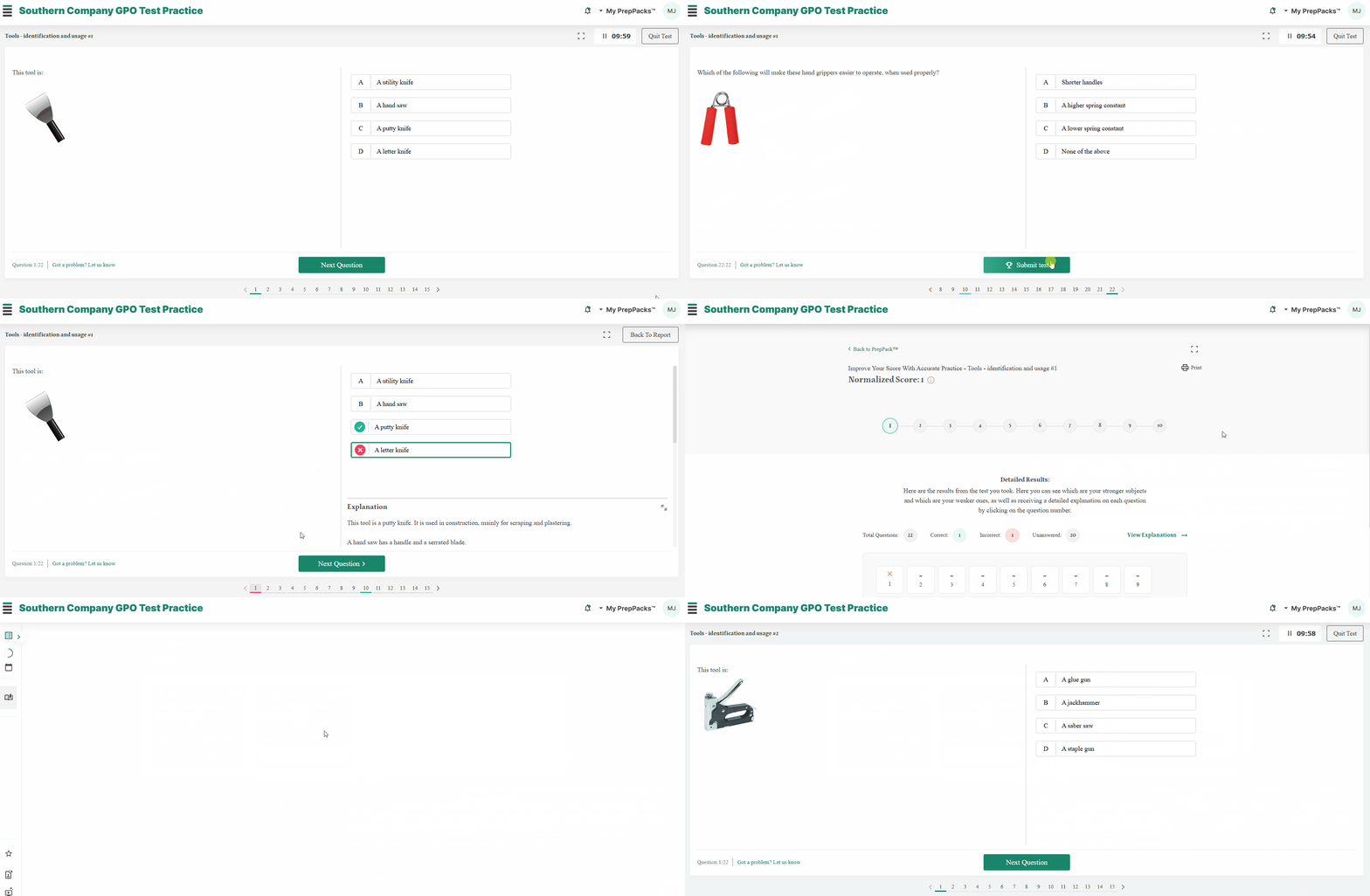
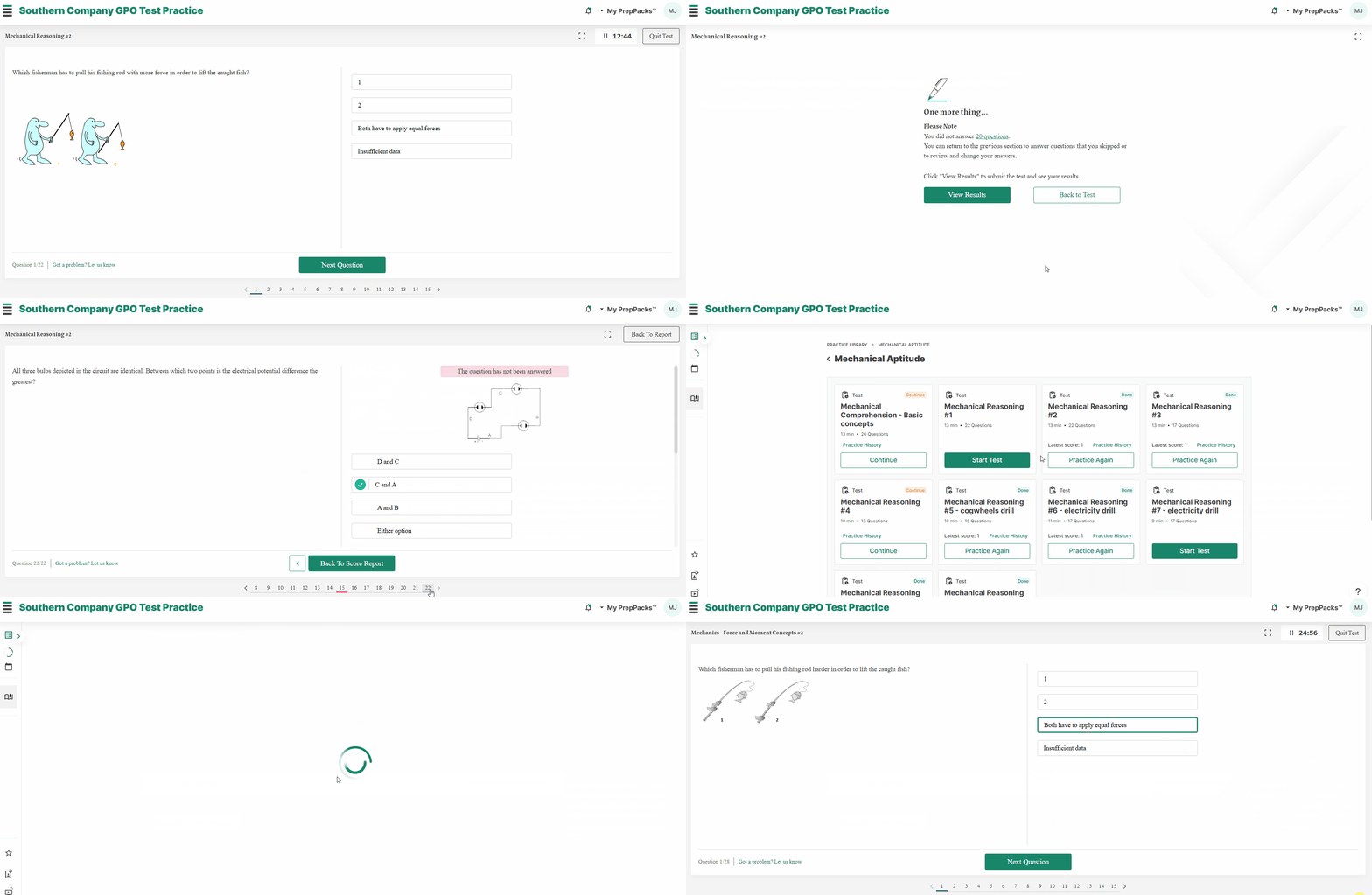
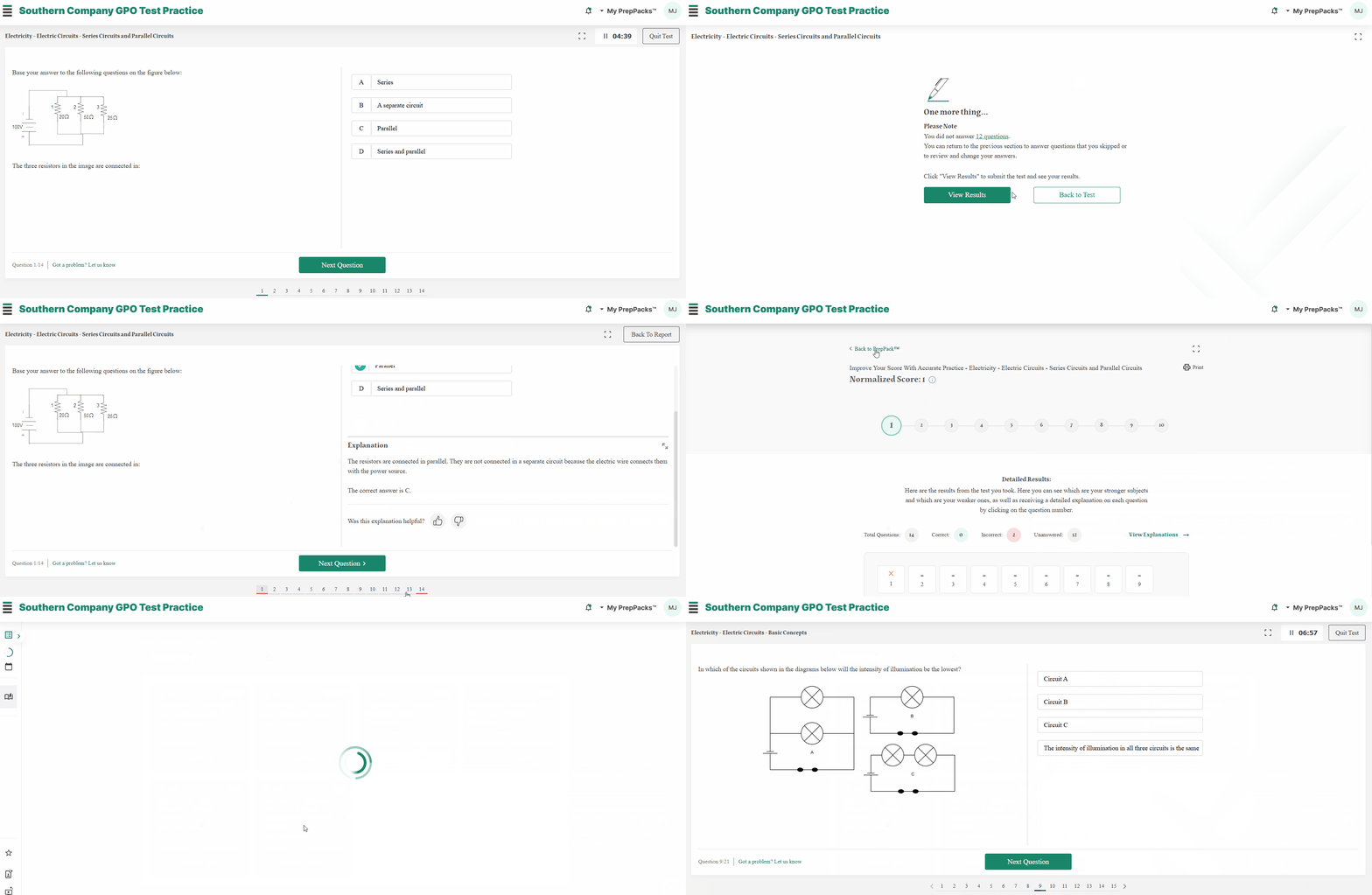
Prepare for Southern Company's General Plant Operator Test
The GPO Test (General Plant Operator test, including the GPO3 test) is the pre-employment test Southern Company uses to select General Plant Operator candidates at Georgia Power and Operations Technician candidates at Southern Power. Passing it qualifies you to be considered for the next hiring stage.
Try our free GPO sample questions, a sample from our complete PrepPack with answer explanations and extra practice.
1-Month Access
The GPO Test (General Plant Operator test) is a multiple-choice pre-employment test used by Georgia Power, a Southern Company subsidiary, to screen applicants for General Plant Operator positions. The GPO guide also covers Southern Power's Operations Technician positions. Southern Company publishes study guides for both the GPO test and the GPO3 test, and some job postings call the test GPO 2.0.
The test measures your knowledge and your ability to apply concepts, terms, and principles related to the electrical, operations, and mechanical tasks that a General Plant Operator performs. Southern Company's study guides list about two dozen competencies. Electrical topics include electrical theory (series, parallel, and series-parallel circuits), troubleshooting, test equipment, print reading, plant electrical equipment, and electrical applications such as batteries, protective devices, solenoids, diodes, transformers, and motors. Operations topics include general power plant operation, boilers, turbines, generators, hydroelectric plants, and plant auxiliaries. Mechanical topics include mechanical applications, hand and power tools, precision measurement, rigging and hoisting, millwright work, equipment lubrication, and mechanical prints and drawings. Safety topics include lockout/tag-out and clearance procedures, general plant safety, and fire prevention. The GPO guide also lists hydraulics and pneumatics, which the GPO3 guide doesn't.
The test is multiple choice, and some questions refer to figures such as diagrams, schematics, drawings, and charts. It lasts approximately 8 hours, with breaks provided. Some questions require calculations, and calculators are permitted and provided. Some questions also use formulas, and a list of formulas is provided during the test, so you don't need to memorize them. Southern Company doesn't publish the number of questions or a passing score.
The questions come in several types: definitions of terms, how two concepts or measurements relate, interpreting a situation or problem to find what is happening or what is wrong, calculating amounts, measurements, or electrical values, and how-to questions about performing a task. Because the questions emphasize understanding the subjects along with the ability to apply them, working through problems matters more than memorizing facts.

This area measures your knowledge of electricity and your ability to apply it in a power plant. Topics include electrical theory (symbols, formulas, and series, parallel, and series-parallel circuits), troubleshooting, test equipment, print reading, and electrical applications and plant equipment such as batteries, protective devices, solenoids, diodes, relay protection, motors, and transformers. You may need to read a circuit diagram or relay logic drawing and work out an electrical value, such as current.
This area measures your knowledge of how a power plant runs. Topics include general plant operation (equipment such as valves, the substances used to generate electricity such as steam and gases, and unit start-up and shut-down procedures), boilers, steam and gas turbines, generators, hydroelectric plants, and plant auxiliaries such as the pumps and motors that run the boiler and turbine systems.

This area measures your knowledge of basic mechanical principles and of the tools and work used to maintain plant equipment. Topics include mechanical applications and troubleshooting, hand and power tools, precision measurement (including reading inside and outside micrometers), mechanical prints and drawings, rigging and hoisting, millwright work on pumps, belt drives, bearings, couplings, and valves, and equipment lubrication. The GPO guide also lists hydraulics and pneumatics.

This area measures your knowledge of working safely around plant equipment. Topics include lockout/tag-out, clearance, and isolation procedures for safely removing equipment from service and returning it, the terms used to describe isolation (such as breakers), general plant safety including proper tool use and personal protective equipment, and fire prevention, including the classes of fire and the extinguisher used for each.

The real GPO test lasts approximately 8 hours, with breaks, and covers electrical, plant operations, and mechanical knowledge in one sitting. The three questions below sample the electrical, mechanical, and hand tool areas covered in our PrepPack. Work through them the way you would on test day: read each question and any diagram carefully, since questions can ask for a definition, a principle, or a calculation. A calculator and a list of formulas are provided on the real test, so focus on knowing which formula applies and how to use it.
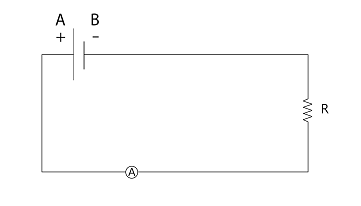
This question tests your basic electrical comprehension by asking you to determine the roles of terminals in a circuit based on the direction of current flow.
Which of the tools above are used for processing metal?
An anode and a cathode are the two electrodes of a polarized electrical device:
By standard physical convention, electric current flows from the positive (+) terminal of a power source, through the external circuit, and back into the negative (-) terminal.
Step-by-Step Solution:
This question evaluates your ability to interpret visual measurements accurately and overcome common visual distortions in trade-related diagrams.
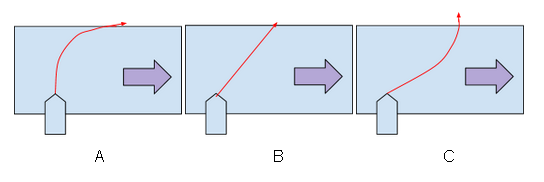
A boat drifts down a river which flows at a constant velocity. The boat accelerates at a constant rate. Which of the following diagrams describes the course of the boat?
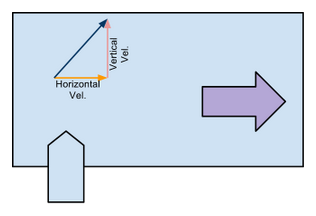
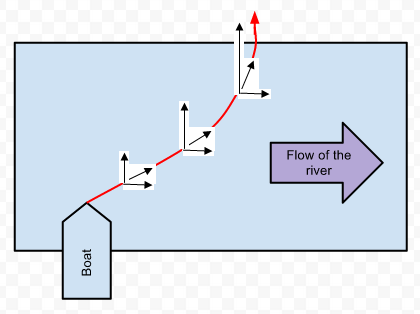
Trades math and measurement reading tests often present 3D objects angled or projected onto a 2D ruler grid. To solve these correctly, focus on grid alignment rather than visual perspective.
Step-by-Step Solution:

This question assesses your knowledge of hand tools, their names, and their specific mechanical applications in electrical and maintenance work.
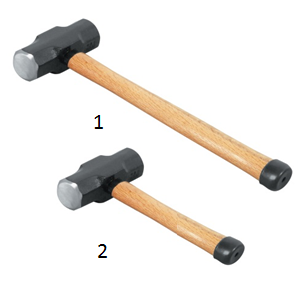
Which of the following sledgehammers would require more effort in demolition work?
Identifying common workshop and electrical tools by sight and knowing their proper applications is essential for trade assessments. Below is a breakdown of the tools shown in the image:
How to Solve Tool Identification Questions:
The questions above are a sample of what to expect, but the real GPO test runs approximately 8 hours with breaks and covers about two dozen competencies, so knowing the fundamentals topic by topic matters. Our PrepPack includes 25 practice tests and 5 study guides on electrical theory, mechanical aptitude, and hand tools, with answer explanations, so you can build up each topic before test day.
We've created a comprehensive GPO PrepPack designed to help you succeed. It includes 25 practice tests and 5 study guides on electrical theory, mechanical aptitude, and hand tools, with multiple-choice questions, diagrams, and answer explanations, like the real test. Your latest scores and practice history show which topics need more work, so you can focus on your weaker areas and feel confident and ready on test day.
Why preparation matters: The GPO test lasts approximately 8 hours and covers about two dozen competencies across electrical, operations, and mechanical topics, and Southern Company doesn't publish a passing score or the number of questions. A calculator and a list of formulas are provided, so the challenge is knowing the concepts and which formula applies. Our practice tests build that knowledge topic by topic, with answer explanations that show how each problem is solved, so the questions on test day feel familiar.

Using our GPO PrepPack, you get:
Southern Company's study guides name Georgia Power's General Plant Operator (GPO) positions as the jobs that use the GPO test, and the GPO guide also names Southern Power's Operations Technician positions. Recent postings list the GPO3 test for General Plant Operator roles at Georgia Power's combined cycle and combustion turbine plants, such as Plant McDonough in Atlanta and Plant McIntosh in Rincon. These are full-time, union-covered operations and maintenance roles.
General Plant Operators are also called Operations and Maintenance Technicians. They operate, monitor, troubleshoot, and repair a plant's electrical, instrumentation, and mechanical equipment. A typical day includes thorough operator rounds to evaluate equipment conditions and hazards, condition reports for any deficiencies, procedures and checklists for unit start-ups and shutdowns, maintenance records in a computer-based work order system, and support for planned outages through system walk downs and documentation. The postings also list a plant maintenance rotation and system ownership assignments, and they require strong mechanical and electrical aptitude and the ability to troubleshoot and repair electrical and mechanical equipment.
The work happens in demanding conditions. GPOs must be able to work in confined spaces, extreme heat and cold, indoors and outdoors, around loud noise, and in places reached only by vertical ladders or catwalks, including climbing up to 100 feet, while wearing personal protective equipment such as safety glasses, hard hats, respirators, steel toe shoes, gloves, and hearing protection. The role requires supporting a 24/7 shift schedule that includes overtime, holiday, and back shift work. Georgia Power's postings require a high school diploma or equivalent, prefer a two-year technical degree or equivalent military training, require industrial maintenance and troubleshooting experience, and list five or more years as desired.
These are union-covered roles, and each posting states the starting pay. Recent Georgia Power postings listed $8,654 per month ($103,848 a year) at Plant McDonough and $51.92 per hour (about $108,000 a year) at Plant McIntosh.
Southern Company's benefits summary lists the following, and notes that for employees covered by a collective bargaining agreement, certain benefits may not apply or may differ under the agreement:
The GPO 2.0 and GPO3 tests are both used for General Plant Operator positions. Postings from 2023 named the GPO 2.0 test, introduced under testing standards that took effect January 1, 2019, and recent postings name the GPO3 test, which is sometimes typed GP03. Southern Company publishes a study guide for each, and they list the same competencies, except that the GPO guide also lists hydraulics and pneumatics.
The GPO test lasts approximately 8 hours, with breaks provided, according to Southern Company's study guides for both the GPO and GPO3 tests. Plan for a full day.
Southern Company doesn't publish the number of questions or a breakdown by topic. Its study guides state only that the test is multiple choice, lasts approximately 8 hours with breaks, and covers about two dozen competencies.
Yes. Southern Company's guides describe the GPO and GPO3 tests as multiple choice. Some questions refer to figures such as diagrams, schematics, drawings, and charts, and some require calculations.
It depends on your background. Southern Company doesn't publish pass rates, but the test is long, at about 8 hours, and covers about two dozen competencies across electrical, operations, and mechanical topics. Georgia Power's postings require industrial maintenance and troubleshooting experience and prefer a two-year technical degree or equivalent military training, so candidates with that background will find the content more familiar. If you don't have it, spend extra time on electrical theory, mechanical principles, and how a power plant operates.
Southern Company doesn't publish a passing score. Candidates retrieve their results through Southern Company's employment test results line, and qualified results stay valid until the position requirements or the test change.
Yes. The GPO3 guide says an online calculator is available during the test, and the GPO guide says calculators are permitted and provided. A list of formulas is also provided, so you don't need to memorize them. Even so, you need to know which formula applies to each problem, so practice choosing and using them.
After a recruiter selects you to test, you receive an invitation by email and use it to schedule a proctored test session. GPO testing is multiple choice and lasts approximately 8 hours, with breaks provided. Some questions show diagrams, schematics, drawings, or charts, and some require calculations, with a calculator and a list of formulas provided. You can retrieve your results afterward through Southern Company's employment test results line. For the full application steps, see our Southern Company hiring process guide.
To retake the test, you must apply for a new position that requires it and be selected and invited by email. If you qualified but weren't selected, your results stay valid until the position requirements or the test change.
No, we don't recommend practicing with AI-generated tests. Tools such as ChatGPT can't see the real GPO test, because Southern Company doesn't publish its questions beyond sample items. They work from limited public information, which is how they end up inventing topics, miscalculating answers, or mixing GPO content with other plant operator exams, and you can't tell which questions to trust. Our GPO PrepPack is designed and prepared by human experts who have taken the real Southern Company exam, and it includes 25 practice tests and 5 study guides on electrical theory, mechanical aptitude, and hand tools, with answer explanations. JobTestPrep has prepared candidates for employer tests since 1992.
No, we don't recommend practicing with free PDFs. They're often copies of older materials, and you can't confirm who wrote them or whether they match the current test. For example, an older Southern Company study guide from around 2014 still circulates online and describes separate electrical, operations, and mechanical tests, while the current guides describe one test of approximately 8 hours. Free PDFs also tend to offer a limited number of questions, with no timed practice and no way to track your progress. Southern Company's own study guides are worth reading for the topic list, but they aren't a full practice set. Our GPO PrepPack is designed and prepared by human experts who have taken the real Southern Company exam, and it includes 25 practice tests and 5 study guides with answer explanations.
Start with Southern Company's free GPO3 study guide, which lists the competencies the test covers and the types of questions. Then practice each area: electrical theory and circuits, mechanical principles and hand tools, and plant operations such as boilers, turbines, generators, and hydro. Our free sample questions give you 3 questions with explanations, and the GPO PrepPack adds 25 practice tests and 5 study guides on electrical theory, mechanical aptitude, and hand tools.
After completing your payment, you will receive two emails: a payment receipt and a login link with your account details. Once you log in and reset your password, you will have instant, unlimited access to your PrepPack.
You can start practicing immediately with tailored questions and detailed explanations, tracking your performance along the way. Your progress is saved, allowing you to revisit previous attempts as many times as you like. If you need more time, you can extend your subscription by contacting c.serv@jobtestprep.com.