


SKAT Electrical Practice Test & Prep Course
 SKAT Electrical Practice Test & Prep Course
Updated: October 2026
The SKAT Electrician Test (officially SKAT - Electrical) is the pre-employment test Southern Company uses to select Apprentice Electrician and Apprentice Rotating Equipment Repairman candidates at Georgia Power. Passing it qualifies you to be considered for the next hiring stage.
- The test has 4 sections: Electrical Knowledge, Hand Tools and Power Tools, Rule Reading, and Tools and Precision Measurement. It is multiple choice, takes approximately 2 hours, and permits calculators.
- Southern Company doesn't publish a passing score, and to retake the test, you must apply for a new position that requires it.
- Our PrepPack™ includes 12 practice tests with 358 questions and 2 study guides covering all 4 sections.
Try our free SKAT Electrician sample questions, a sample from our complete PrepPack™ with answer explanations and extra practice.
1-Month Access
- 1 Precision measuring tools knowledge test
- 1 Tools identification and usage practice test
- 2 Measurement reading, calculation and conversion practice tests
- 3 Additional measurement reading tests
- 5 Additional electrical and mechanical practice tests
- 2 Mechanical and electrical study guides
- Money back guarantee – see terms and conditions


What is the SKAT Electrician Test?
The SKAT Electrician Test, officially the SKAT Electrical test, is a multiple-choice pre-employment test used by Georgia Power, a Southern Company subsidiary, to screen applicants for Apprentice Electrician and Apprentice Rotating Equipment Repairman positions. For Apprentice Electrician roles, candidates must also qualify on the Construction and Skilled Trades (CAST) test, and some postings require passing it first.
The test checks the basic knowledge and skills that new apprentices need from their first day. Southern Company's study guide explains that Georgia Power's job experts identified the content as critical for new hires, and that the questions emphasize understanding each subject along with the ability to apply it. That matches what the jobs require: Georgia Power's postings for Apprentice Electricians list basic transformer theory, wiring diagrams and control schematics, electrical symbols and formulas, AC and DC theory, hand and power tools, and the use of precision measuring tools, including Vernier and standard scales.
The test has 4 sections: Electrical Knowledge, Hand Tools and Power Tools, Rule Reading, and Tools and Precision Measurement. It lasts approximately 2 hours, and some questions refer to figures such as diagrams, schematics, drawings, and charts. Some questions require calculations, and calculators are permitted and provided, along with a formula sheet. Southern Company doesn't publish the number of questions or a passing score.
The questions come in several types: definitions of terms, how two concepts or measurements relate, interpreting a job situation to find what is happening or what is wrong, calculating electrical values or measurements, how-to questions about job tasks, and applying concepts on the job. In practice, that means naming a component from its description, identifying a tool from a picture, and working out a measurement from a ruler or a diagram, so understanding the material matters more than memorizing facts.
What are the Sections of SKAT?

Electrical Knowledge
This section measures your understanding of basic electrical theory and your ability to apply it on the job. Topics include symbols and formulas, series and parallel direct current (DC) circuits, wiring diagrams, transformers, troubleshooting, and alternating current (AC). Some questions ask you to define basic terms, such as what a switch does in a circuit, and some refer to diagrams, schematics, or charts.
Hand Tools and Power Tools
This section measures your ability to identify the basic hand tools and devices used in construction, maintenance, and repair, and to know what they are used for. You're shown a picture of a tool and choose its correct name from the multiple-choice answers, for example telling wire strippers apart from wire snips or needle nose pliers.
Rule Reading
This section measures your ability to read a standard measuring tape or ruler and make calculations with what you read. You're shown rulers with arrows pointing to specific marks, asked to add or subtract the indicated measurements, and then asked to convert the total to feet and inches.
Tools and Measurement
This section measures your knowledge of instruments, including basic tool types and their applications and standard and Vernier scaled precision measuring tools. You may be shown an instrument and asked to identify it, for example telling an outside micrometer apart from an inside micrometer, a digital caliper, or a drafting compass.
SKAT Electrical Practice Test
The real SKAT Electrical test lasts approximately 2 hours and covers four areas in one sitting: electrical knowledge, hand tools and power tools, rule reading, and precision measurement. The questions below sample each of the 4 sections. Work through them the way you would on test day: read each question and any diagram or chart carefully, since questions range from simple definitions to job situations and calculations. Calculators are permitted and provided on the real test, along with a formula sheet, so focus on knowing which formula applies and on converting measurements correctly.

Question 1 - Electrical Knowledge
Try the question below, which asks you to find the current in a DC motor from a circuit diagram and its waveforms. It combines diagram reading with a calculation.
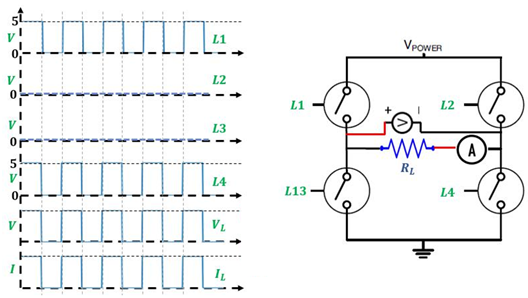
In the figure shown above, what is the amount of current in the DC motor?
The correct answer is B.
The amount of current is mentioned in the figure below. Since the duty ratio is 50%, therefore the current is also 50% of the maximum value which is V/R. Therefore, B is the correct choice.
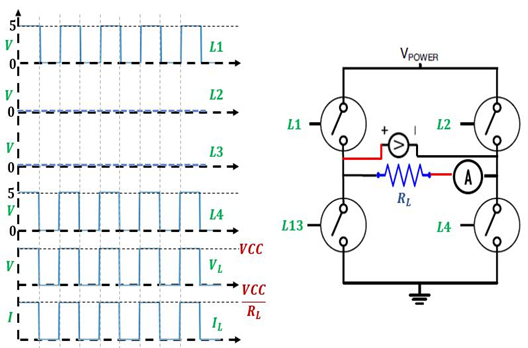
Direct current (DC) circuits follow Ohm's law: the current through a load equals the voltage across it divided by its resistance (I = V/R). In this circuit the motor is not powered continuously. The supply switches on and off in pulses, and the share of each cycle that the voltage is on is called the duty ratio. The average current is the full-on current multiplied by the duty ratio.
To solve the question:
- Find the full-on current. While the pulse is on, the voltage V is applied across the load resistance R, so the current is V/R.
- Read the duty ratio. The figure shows a 50% duty ratio: the pulses are on for half of each cycle.
- Multiply the two: 0.5 × V/R = V/2R, which is answer B.
Watch out for answer A. V/R is the current only while the pulse is on, not the average over the whole cycle.
Question 2 - Hand Tools and Power Tools
Try the question below, which asks how to apply force when pulling out a nail. Hand Tools and Power Tools questions cover basic hand tools and how they are used.
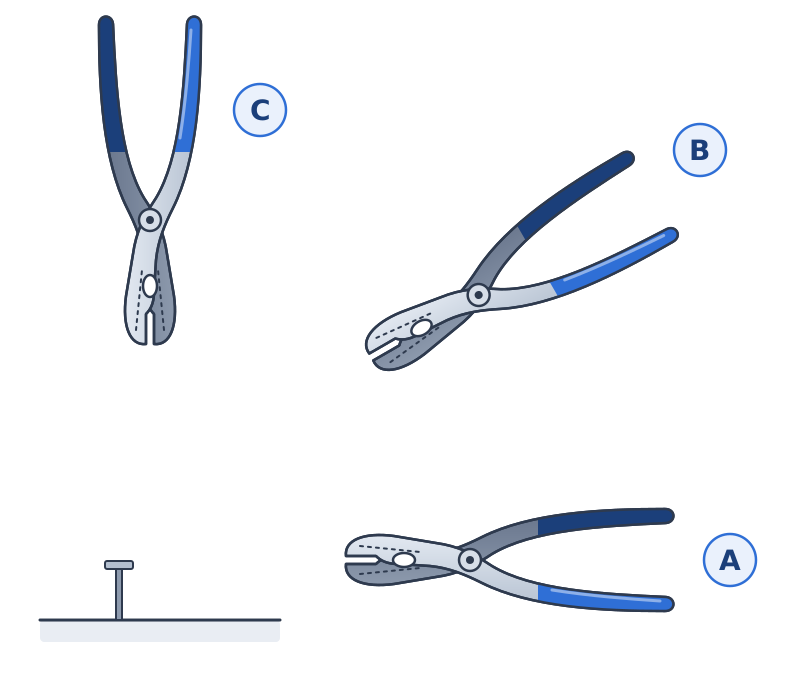
In which direction should the nail be pulled out?
Hand tool questions test how a tool is used as well as what it is called, and many come down to the direction of the force you apply. When you pull a nail, the force that does the work is the part pointing straight along the nail. Any sideways part is wasted and tends to bend the nail.
To solve the question:
- Compare how much of each arrow points straight up, along the nail, and how much points sideways.
- Direction A is purely horizontal, so it bends the nail instead of pulling it out.
- Direction B pulls up and sideways. It can pull the nail out, but it bends it and wastes part of the force.
- Direction C is straight up, so all the force goes into pulling the nail out. That makes C the answer.
Question 3 - Rule Reading
Try the question below, which asks you to read dimensions from a floor plan, find two differences, and compare them. Rule Reading questions ask you to read standard measurements and make measurement calculations.
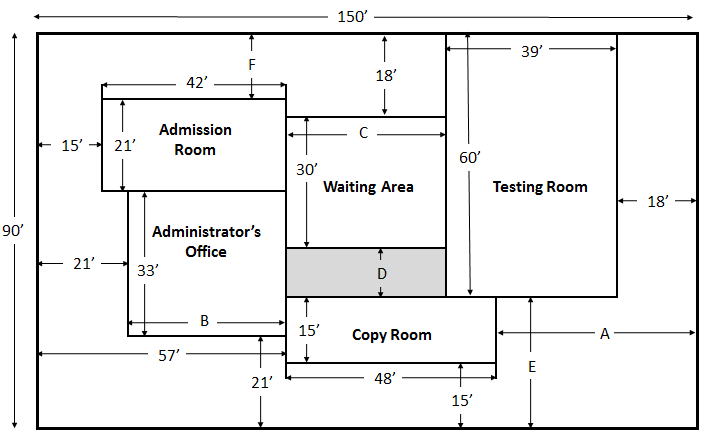
- All measurements are in feet
The difference between the width (top to bottom) and length (left to right) of the testing room _____ the difference between the length and width of the admission room.
Rule Reading questions give you measurements, from a ruler, a tape, or a labeled drawing, and ask you to add, subtract, or convert them. Here every measurement is in feet, so no unit conversion is needed. The challenge is reading the right labels and subtracting in the order the question states.
To solve the question:
- Find each room's width (top to bottom) and length (left to right) from the labels. The testing room is 60' wide and 39' long. The admission room is 21' wide and 42' long.
- Follow the question's order. For the testing room, subtract length from width: 60 - 39 = 21'. For the admission room, subtract width from length: 42 - 21 = 21'.
- Compare the results. Both differences are 21', so they are equal. The answer is D.
Writing out both subtractions before choosing an answer keeps you from picking a "times greater" or "times smaller" option by estimate.
Question 4 - Tools and Precision Measurement
Try the question below, which asks what an instrument's output graph tells you about how it responds to its input. Tools and Precision Measurement questions test your knowledge of measuring instruments.
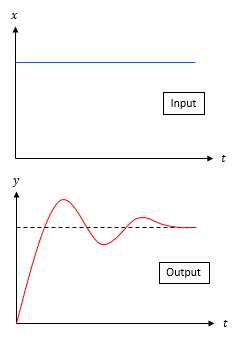
Consider an input signal x(t) that needs to be measured by a measuring instrument. Based on the input signal, the instrument produces an output signal x(t). Considering the output graph we see, what is the system response order of the instrument?
The response order of a measuring instrument describes how its output reacts when the input changes suddenly, and comparing the output graph with the input is the quickest way to tell. A zero-order instrument follows the input instantly. A first-order instrument, such as a thermometer, rises gradually and levels off without overshooting. A second-order instrument overshoots the true value and oscillates around it before it settles, like the needle of an analog weight scale.
To solve the question:
- Look at the input. It is a constant signal, a steady value applied at once.
- Look at the output. The curve overshoots the dashed line that marks the final value, then oscillates above and below it before settling.
- Overshooting and oscillating means the instrument is second order, so the answer is C.
The questions above are a sample of what to expect, but the real SKAT Electrical test runs approximately 2 hours across all four sections, and that kind of stamina is hard to build by reading alone. Our PrepPack™ includes 12 practice tests with 358 questions, including 4 tests of 1 hour or longer on electrical knowledge, tool identification, and measurement reading, so test day is not the first time you work through the material for that long.
Inside the Prep Course - Preview
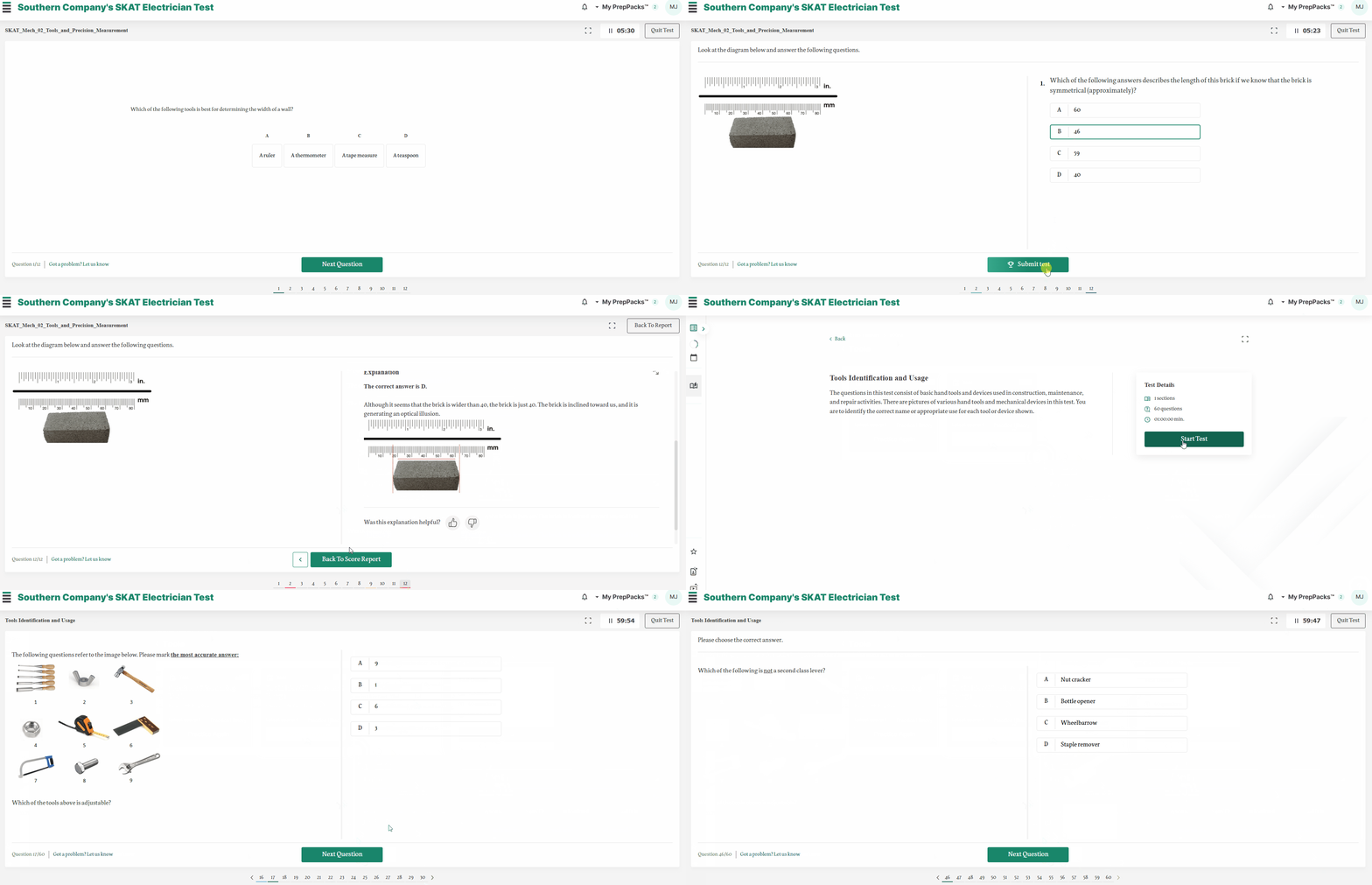
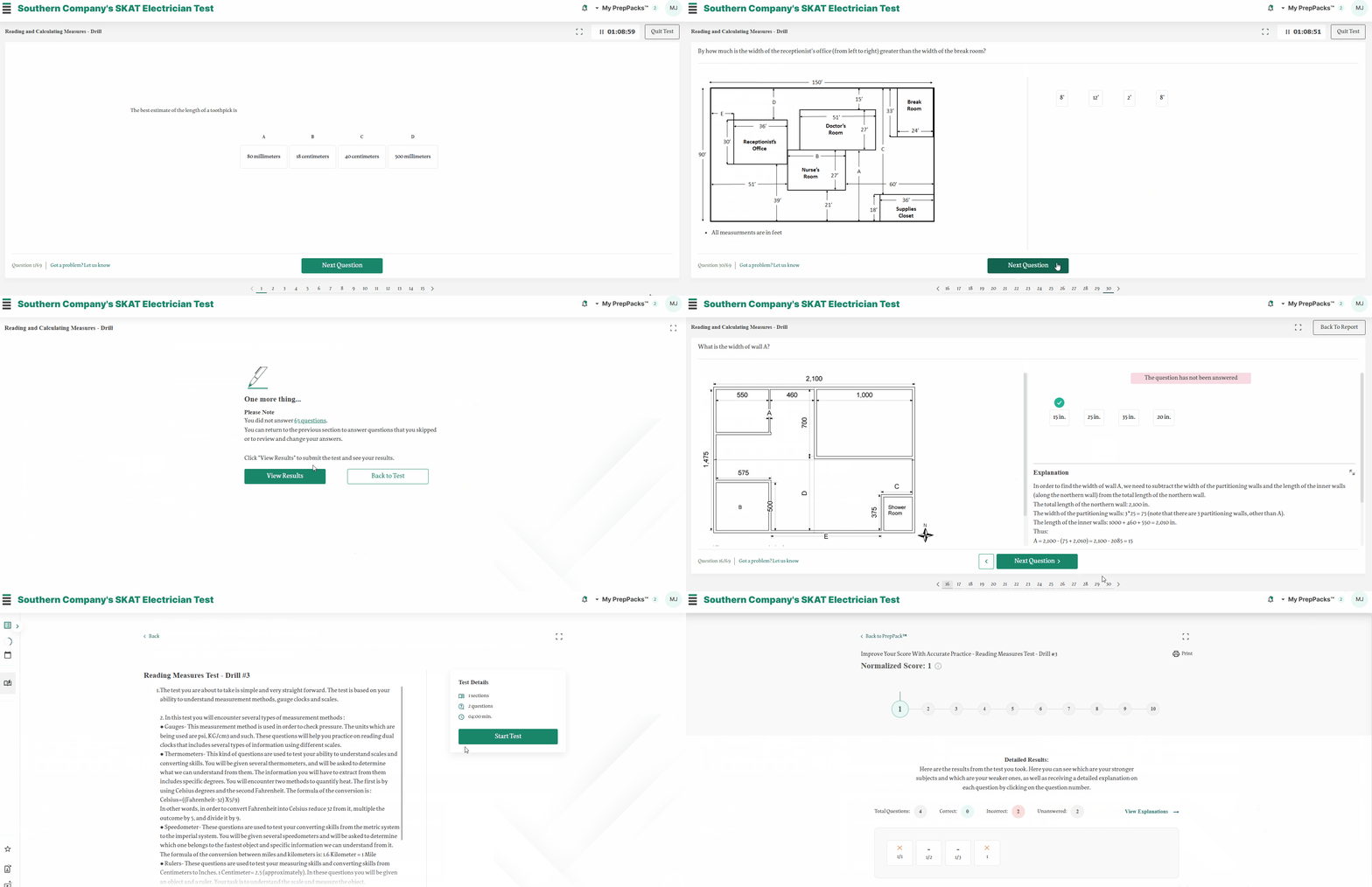
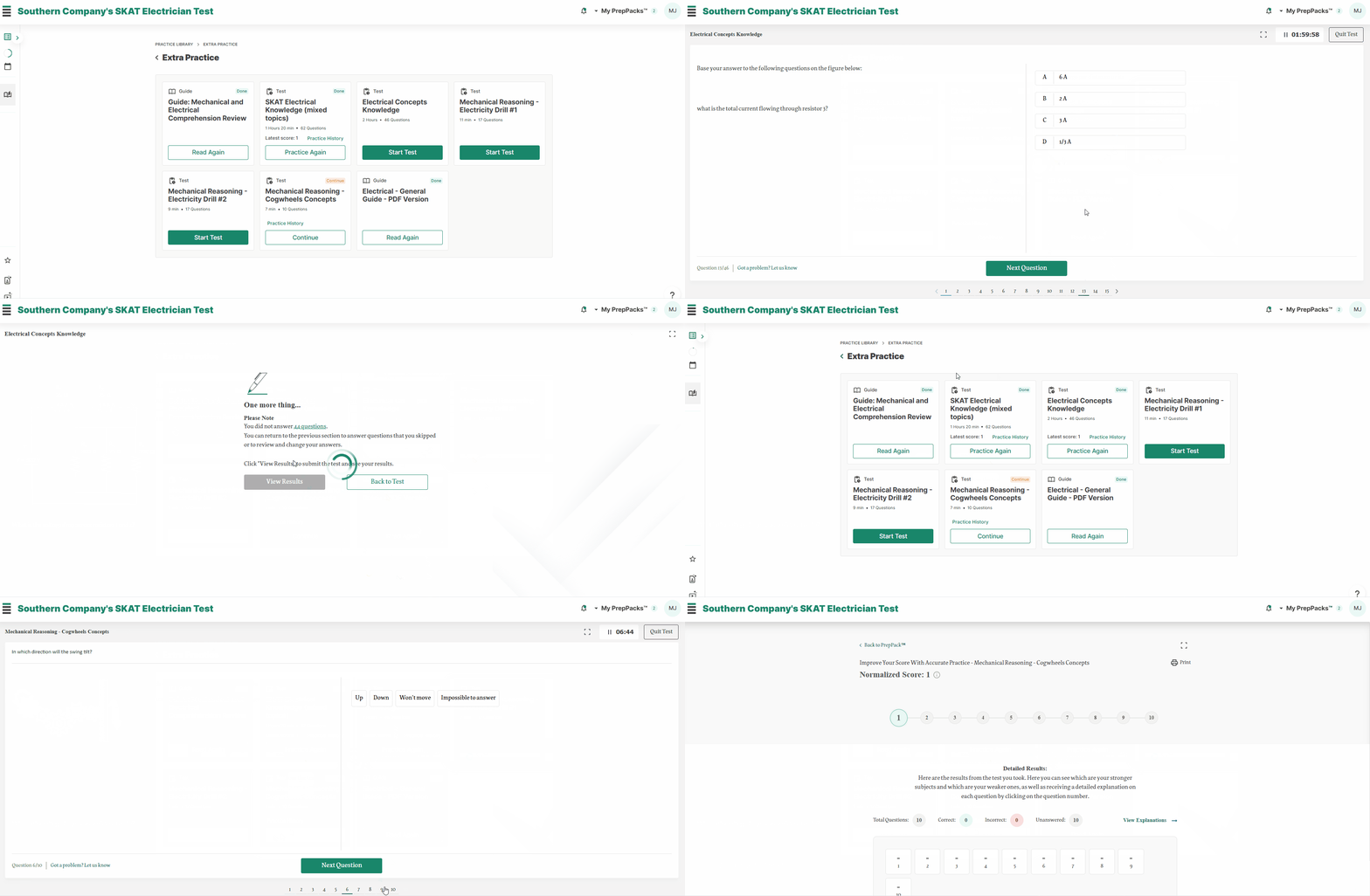
We've created a comprehensive SKAT Electrician PrepPack designed to help you succeed. It includes 12 practice tests with 358 questions and 2 study guides covering all 4 sections of the test, with multiple-choice questions, diagrams, and answer explanations, like the real test. Your scores and practice history show which topics need more work, so you can focus on your weaker areas and feel confident and ready on test day.
Why preparation matters: The SKAT Electrical test lasts approximately 2 hours and covers electrical knowledge, hand tools and power tools, rule reading, and tools and precision measurement, and Southern Company doesn't publish a passing score or the number of questions. Calculators and a formula sheet are provided, so the challenge is knowing the concepts, which formula applies, and how to read measurements correctly. Our practice tests build that knowledge section by section, with answer explanations that show how each problem is solved, so the questions on test day feel familiar.

What’s Inside Our SKAT PrepPack
Using our SKAT Electrician PrepPack, you get:
- 12 practice tests with 358 questions across all 4 sections follow Southern Company's own study guide: 4 Electrical Knowledge tests, 1 Hand Tools and Power Tools test, 5 Rule Reading tests, 1 Tools and Precision Measurement test, and a cogwheels drill for extra mechanical practice.
- Long-form electrical practice includes a 46-question Electrical Concepts Knowledge test (2 hours), a 62-question SKAT Electrical Knowledge test with mixed topics (1 hour 20 minutes), and 2 electricity drills.
- In-depth measurement and tools practice includes a 60-question tools identification and usage test, a 12-question precision measuring tools test, a 69-question reading and calculating measures drill, a 53-question conversions test, and 3 short reading measures drills.
- Detailed explanations show not just the correct answer but the reasoning behind it, so you understand the method, not just the result.
- 2 study guides include a Mechanical and Electrical Comprehension Review and a general electrical guide (PDF version), so you can review the fundamentals before you start practicing.
- Progress tracking shows your scores and practice history for each test, so you can see which sections need more work.
- Designed by experts who took the real exam. The PrepPack is designed and prepared by human experts who have taken the real Southern Company exam, backed by JobTestPrep's 30+ years of assessment prep experience.



Which Southern Company Jobs Require the SKAT Electrician Test?
Southern Company's study guide names two Georgia Power positions that use the SKAT Electrical test: Apprentice Electrician and Apprentice Rotating Equipment Repairman. Georgia Power's postings for these roles also require qualifying on the Construction and Skilled Trades (CAST) test to be considered for an interview. Both are union-covered training positions: apprentices learn the trade on the job and in the classroom while working alongside journeymen.
Repair Shop Apprentice Electricians, based in Forest Park, Georgia, repair and recondition distribution and transmission equipment such as transformers, reclosers, mobile substations, and breakers, and learn to operate an oil processing station. Their daily work involves hand tools along with cranes, forklifts, saws, drill presses, and pneumatic tools, and the position requires the ability to work shifts around the clock, including holidays, and to respond to emergency callouts. The training program lasts 4.5 years, followed by automatic progression to Journeyman Electrician.
Substation Apprentice Electricians maintain Georgia Power's substations. They operate, maintain, repair, troubleshoot, and time power circuit breakers, service large power transformers, install and commission new substation equipment, and train in trades such as rigging, welding, and calibration, including live line work in substations. The job involves working outdoors in all climate conditions and at significant heights, responding to callouts within 45 minutes, and working assigned storm duty. Candidates must be willing to relocate, and the posting expects a Class A commercial driver's license (CDL) or permit, or the ability to earn the CDL within 6 months of hire. The training program lasts about 3 to 4 years, after which apprentices can bid on Journeyman Electrician positions as they open.
Apprentice Rotating Equipment Repairmen, also called Electric Motor Winders, work in the Repair Shop in Forest Park repairing and reconditioning motors and generators. Their tasks include disassembling, cleaning and inspecting, rewinding, balancing, assembling, and painting rotating assemblies, using equipment such as overhead cranes, forklifts, ovens, a VPI tank, and balance machines. The program lasts 3.5 years, followed by automatic progression to Journeyman Rotating Equipment Repairman.
Starting pay for these positions is set by the wage schedule in the agreement between Georgia Power and IBEW Local 84 and is not negotiable, and union membership is optional. Recent Repair Shop postings listed $6,218 per month ($35.87 per hour, about $74,600 a year) for both Apprentice Electricians and Apprentice Rotating Equipment Repairmen. A recent Substation Apprentice Electrician posting listed $5,724 per month (about $68,700 a year), with an increase every 6 months until the top of the job classification and a cost-of-living increase every July.
Southern Company's benefits summary lists the following, and notes that for employees covered by a collective bargaining agreement, certain benefits may not apply or may differ under the agreement:
- Health coverage includes 3 medical plan options with preventive care paid at 100%, 3 dental plan options, and spending accounts such as a Health Savings Account.
- Retirement includes a pension plan and a 401(k) to which Southern Company contributes 5.1% when you contribute 6%.
- Time off includes 80 to 200 hours of vacation per year depending on years of service, up to 12 company-paid holidays, and up to 80 hours of personal or sick time.
- Income protection includes company-paid life insurance equal to your base pay, up to $150,000.
- Career growth includes tuition reimbursement of up to $5,250 per year and access to internal job postings.
- Performance pay may be available to eligible employees through the Performance Pay Program, a cash bonus tied to company and individual goals.
SKAT Electrician Test FAQs
Georgia Power's job postings spell it out as the Skills, Knowledge, and Aptitude Test (SKAT). Older Southern Company materials call it the Skills, Knowledge, and Abilities Test. Either way, the electrician version is the SKAT - Electrical test.
The test lasts approximately 2 hours, according to Southern Company's current study guide. Some older sources list 2.5 hours, so rely on the current guide.
Southern Company doesn't publish the number of questions or a breakdown by section. Its study guide states only that the test has 4 sections, is multiple choice, and lasts approximately 2 hours.
It depends on your background. Southern Company doesn't publish pass rates, but the test is built from knowledge that Georgia Power's job experts identified as critical for new hires, and its questions test whether you can apply that knowledge. Georgia Power's postings prefer candidates with technical training or electrical or mechanical maintenance experience, so those candidates will find the content more familiar. If you don't have that background, spend extra time on electrical theory, wiring diagrams, and measurement reading, and practice all 4 sections before test day.
Southern Company doesn't publish a passing score. Candidates retrieve their results through Southern Company's employment test results line, and qualified results stay valid until the position requirements or the test change.
Yes. Calculators are permitted and will be provided, along with a formula sheet. An older Southern Company information sheet said no calculators were allowed, but the current study guide says otherwise. Even with a calculator, you need to know which formula applies and how to convert feet and inches, so practice both.
After a recruiter selects you to test, you receive an invitation by email, register electronically, and attend a test session. The test is multiple choice and lasts approximately 2 hours. Some questions show diagrams, schematics, drawings, or charts, and some require calculations, with a calculator and formula sheet provided. You can retrieve your results afterward through Southern Company's employment test results line. For the full application steps, see our Southern Company hiring process guide.
To retake the test, you must apply for a new position that requires it and be selected and invited by email. If you qualified but weren't selected, your results stay valid until the position requirements or the test change.
For some Apprentice Electrician postings, yes. Georgia Power's postings say candidates must pass CAST before they are eligible to take the SKAT, and that both tests are required to be considered for an interview. Other postings list both tests without stating an order.
No, we don't recommend practicing with AI-generated tests. Tools such as ChatGPT can't see the real SKAT Electrical test, because Southern Company doesn't publish its questions beyond a handful of samples. They work from limited public information, which is how they end up inventing topics, miscalculating answers, or mixing SKAT content with other exams, and you can't tell which questions to trust. Our SKAT PrepPack is designed and prepared by human experts who have taken the real Southern Company exam, and it covers all 4 official sections with answer explanations. JobTestPrep has prepared candidates for employer tests since 1992.
No, we don't recommend practicing with free PDFs. They're often copies of older materials, and you can't confirm who wrote them or whether they match the current test. For example, an older Southern Company information sheet still in circulation says no calculators are allowed and the test takes 2.5 hours, while the current guide says calculators are permitted and the test takes approximately 2 hours. Free PDFs also tend to have only a handful of questions, no timed practice, and little or no answer explanations, so you can't practice all 4 sections or learn from your mistakes. Southern Company's own study guide is worth reading for the format, but it's an overview with a few samples, not practice. Our SKAT PrepPack is designed and prepared by human experts who have taken the real Southern Company exam, and it includes 12 practice tests with 358 questions, 2 study guides, and answer explanations.
Start with Southern Company's free study guide to learn the 4 sections and question types. Then practice each section: identify hand tools and precision instruments, read rulers and convert measurements to feet and inches, and work through electrical theory, wiring diagrams, and DC and AC problems. Our free sample questions show one question per section with explanations, and the SKAT PrepPack adds 12 practice tests with 358 questions and 2 study guides.
After completing your payment, you will receive two emails: a payment receipt and a login link with your account details. Once you log in and reset your password, you will have instant, unlimited access to your PrepPack.
You can start practicing immediately with tailored questions and detailed explanations, tracking your performance along the way. Your progress is saved, allowing you to revisit previous attempts as many times as you like. If you need more time, you can extend your subscription by contacting c.serv@jobtestprep.com.
Looking For A Different Power Utility Prep Course?


