Free Ramsay Electrical Sample Test: Practice Questions & Answers (2026)
The Ramsay Electrical Test, officially the ElecTest, is a 60-question, four-option multiple-choice assessment published by the Ramsay Corporation (current version: Form A5). It's a proctored, journey-level exam covering 8 content areas — Motors and Drives, Digital and Analog Electronics, Schematics and Control Circuits, AC/DC Theory and Electrical Maintenance, Computers/PLCs and Test Instruments, Power Supplies, Power Distribution, and Mechanical/Hand Tools — and is used by employers including Amazon, Walmart, UPS and USPS to screen candidates for electrician and electrical maintenance roles. There is no official passing score; each employer sets its own threshold.
Below are practice questions organized by content area, each with a full explanation of the correct answer, followed by more detail on what the test covers, how it's scored, and how to prepare. Once you've worked through the practice test, we invite you to check out the Ramsay Electrical Test course by JobTestPrep for more in-depth practice.


The Ramsay Electrical Test, officially called the ElecTest, is a pre-employment knowledge assessment published by the Ramsay Corporation, a Pittsburgh-based test publisher that has produced pre-employment assessments for the skilled trades and industrial sectors since 1973. The current version of the test is Form A5, available in both online and paper formats, with an alternate form (B2) used for retesting.
The ElecTest measures the electrical knowledge required for skilled electrical and industrial maintenance roles. It is a knowledge test, not an aptitude test — it assumes you already have electrical training or experience, and evaluates what you know rather than your potential to learn. For that reason it is classified at journey-level, and is not the assessment used for entry-level or trainee positions.
The ElecTest consists of 60 multiple-choice questions, each with four answer options. Questions are drawn from 8 official content areas:
Ramsay does not publish an official time limit for Form A5; test sessions administered by employers typically run about one hour.
All Ramsay tests must be proctored, whether taken on paper or online, either in person at the employer's site or a testing centre, or via remote proctoring. You will not take the ElecTest unsupervised at home, and reference material, notes or a calculator are not permitted unless the employer specifically allows them.
There is no official passing score. Ramsay Corporation does not recommend cut scores, stating that a passing score depends on the labor market and the specific job requirements, and that it cannot advise on one without a formal validation study for that employer. Each employer sets its own threshold.
Ramsay does publish normative data: on a sample of 3,238 applicants, the average ElecTest score was 29 out of 60, with a standard deviation of 8.6. Scoring in the high 30s places a candidate well above the average applicant, and a score around 40 sits near the top 10% of test takers.
The ElecTest is content-validated — built with input from job experts to reflect the actual knowledge electrical and maintenance roles require — and Ramsay's own research found ElecTest scores to be significantly correlated with manager performance ratings. That correlation is why employers such as Amazon, Walmart, UPS, USPS and Cummins use it as a primary screening tool rather than relying on interviews or resumes alone.
The real Ramsay Electrical Test is proctored and scored, with no official passing score published by Ramsay Corporation. Each employer sets its own threshold. You can answer our sample test at your leisure to get a general sense of your preparedness, or simulate real exam conditions by clicking on the timer below (set at 12 minutes) and reviewing your score when you finish.
These questions cover motor operation and control — how starters, terminals and rotation direction work — alongside the digital and analog electronics fundamentals used in control systems, including logic gates and number systems. Approach motor questions by tracing what physically happens when a connection changes; approach electronics questions by working the logic or conversion step by step rather than guessing from the answer shape.
Interchanging two of three terminals in a motor will cause it to:
The ladder shown below represents a/an _________ gate.
The correct answer is C.
The ladder shown in the image represents an AND gate. The ladder logic for NOT and OR are shown below as well.

What is the binary value of the hexadecimal number 0xA2?
The correct answer is A.
A hexadecimal number has a base of 16 numbers starting from 0 to 9 and then A to F. Any number with “0x” before represents a hexadecimal number, and “b” after the number represents a binary number. Each hexadecimal number is represented by four binary bits. Since there are 2 hexadecimal numbers, the resultant binary of the given number will be 8 binary bits. Follow the figure provided below:


Don't try to intuit the output from the diagram alone. Write out each input combination and trace it through the gate one step at a time — for an AND gate, the output is only true when every input is true; for an OR gate, one true input is enough. Working it row by row removes the guesswork that causes most mistakes on these questions.
This is the largest content area on the real exam, combining ladder logic and control circuit interpretation with core AC/DC theory. Read the diagram or circuit fully before looking at the answer options, and for calculation questions, write out the relevant formula (Ohm's Law, parallel current summation) before solving — these questions are designed to reward a methodical approach over quick pattern-matching.
Use the following PLC program to answer the question below:
Identify the statement which is NOT true for this program:
In a 110V electrical system, there are three appliances: appliance A (550W) appliance B (770W) and appliance C (330W). Given that all appliances operate simultaneously, what is the minimal required fuse rating?
The correct answer is B.
The minimal fuse rating should be higher than the normal operating current of the system. Since an electrical system is connected in parallel, the total current in the system when all three appliances are working is the sum of all three.
The current consumption of each appliance is calculated by:

Where:
P = Power [Watt]
V = Voltage [Volt]
Therefore, appliance A consumes 550/110 = 5A
Appliance B consumes 770/110 = 7A
Appliance C consumes 330/110 = 3A
The total current in the system is 5 + 7 + 3 = 15A
In order to withstand normal working conditions, the minimal fuse amperage rating must be greater than 15A, thus 20A.
If a voltage applied between Node A and B is 100 V, how much voltage is dropped in every resistor?
When a circuit has multiple resistors, don't apply Ohm's Law to the whole thing at once. First combine resistors into series and parallel groups until you're left with one equivalent resistance, then solve for total current, and only then work back out to find the voltage or current at the specific point the question asks about.
These questions test whether you can apply test instruments and basic power supply theory to a real circuit — where to place a voltmeter, what a rectifier does to an AC waveform, when to choose a solid-state component over a mechanical one. Picture the physical circuit as you read each question, and eliminate answer options that are correct in general but don't fit the specific circuit shown.
Use the following diagram to answer the question below:
Where should a voltmeter be connected to when checking the fuse only?
The correct answer is C.
The symbol of the fuse is shown in the figure below. There is a 10A fuse in the circuit, and it is used to protect the circuit. If the cooling fan tries to draw more than 10A, the fuse will blow and the circuit will stop working. In order to check the fuse, the voltmeter should be placed between C and G as shown in the figure below.

Which of the following statements is true regarding the following transformer, assuming no power losses?
The standard connector used for serial communication is ____________.
Instead of memorizing which side has more turns, remember that an ideal transformer conserves power: Vp × Ip = Vs × Is. If the diagram shows more turns on one side, that side has the higher voltage and the lower current. Use that relationship to check each answer option rather than guessing from the picture alone.
This section covers the practical side of electrical work — wiring, grounding, and correct tool selection and use. These questions tend to be less about calculation and more about knowing the standard practice or purpose behind a component. If a question describes a scenario, focus on what the described element is actually for before matching it to an answer.
Wiring Duct The enclosure which is used to safely route the wires in industrial setups is called a ____________.
The purpose of a grounding conductor in an electrical distribution panel is to ____________.
Which tap contains a smaller number of threads at the chamfer region of the tap?
The correct answer is B.
Taps are used to create threads in a workpiece. There are three main types of taps: taper tap, plus tap, and the bottoming tap as shown in the figure below. The main difference between these types is the number of threads in the chamfer region as shown. The taper tap contains the least number of teeth and is generally used at the beginning of the threading process. The plug tap contains more teeth than the taper tap and is used for repairing a threaded hole. Whereas the bottoming tap contains an almost uniform number of teeth throughout the length of the tap and is used to tap the bottom of the hole generally. Bottoming tap is the last tap to be used in the tapping process. Since taper tap contains the least number of teeth at the chamfer edge, choices A, C, and D cannot be true, and B is the correct choice.

A grounding conductor is a safety path, not a working path. If a question describes normal, fault-free operation, the ground conductor isn't carrying current at all — it only activates during a fault. Ruling out any answer that describes normal operating current flowing through the ground will eliminate most wrong options quickly.


Using our Ramsay Electrical Test (ElecTest) PrepPack, you get:

Every question in the PrepPack uses the same four-option multiple-choice format as the real ElecTest, and each one comes with a full written explanation — showing why the correct answer is right and why each of the other three options is wrong.
Questions are grouped by content area, so you can work through the topics your employer's test covers and see immediately which areas need more attention. Diagram-based questions — schematics, control circuits, print reading and motor wiring — are presented visually, the way they appear on the actual exam.
Your scores are saved after each attempt, so you can retake any test and track your improvement over time.
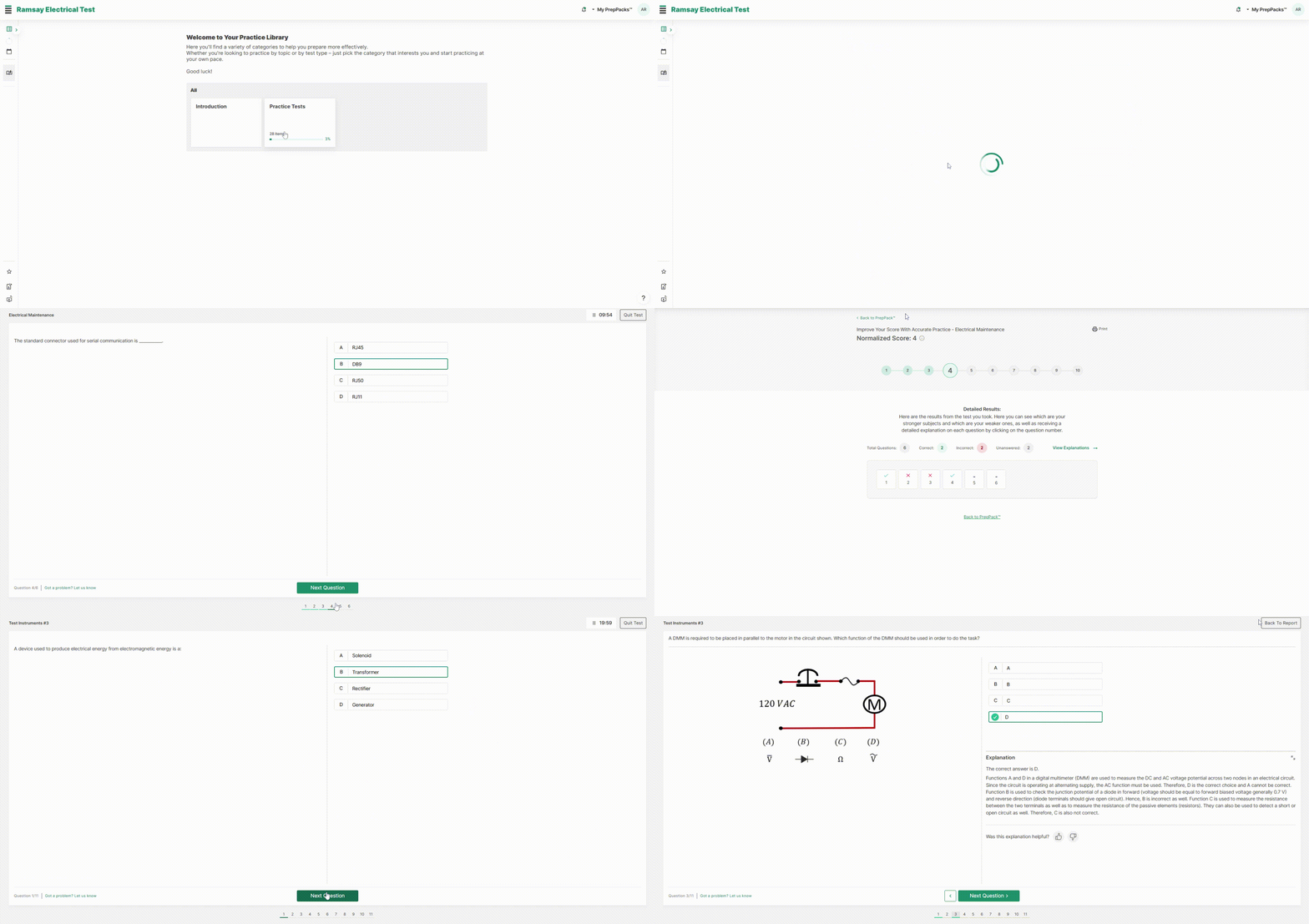
JobTestPrep's Ramsay Electrical Test Prep has recently been upgraded based on expert research and user feedback in order to ensure that you receive the highest quality practice available. You can rely on our experience and expertise to provide you with the tools you need to get the high score you need.

At JobTestPrep, we've helped thousands of candidates pass competitive hiring assessments since 1992. Our materials are designed by psychometric experts and updated based on real candidate feedback to reflect the latest test formats.

The Ramsay ElecTest is used across a wide range of industries wherever electrical and industrial maintenance skills are essential to operations — logistics and distribution, manufacturing, package delivery, postal services, and industrial manufacturing. Employers include Amazon, Walmart, UPS, USPS, Cummins, Goodyear and Honeywell, all of which rely on skilled electrical maintenance staff to keep automated equipment, conveyor systems, HVAC, and production machinery running.
These organizations use the ElecTest as a screening tool rather than relying solely on resumes or interviews, because a resume can list years of experience without confirming actual working knowledge. A content-validated test gives every candidate the same objective measure, and Ramsay's own research found ElecTest scores to be significantly correlated with subsequent manager performance ratings — which is why the score plays a meaningful role in hiring decisions rather than being a formality.
The ElecTest is typically one step within a broader hiring process, not a standalone hurdle. A common sequence looks like:
Because there is no universal passing score, a strong result doesn't guarantee an offer on its own, and a below-average result doesn't automatically disqualify a candidate — each employer sets its own threshold and weighs the score alongside experience and interview performance. That said, since Ramsay's data shows the average score sits around 29 out of 60, performing meaningfully above that average is what tends to move a candidate forward.
Passing the ElecTest is generally associated with journey-level roles such as electrician, electrical maintenance technician, and industrial maintenance technician — positions that assume existing electrical training or experience rather than entry-level trainee roles. From there, common progression paths include senior maintenance technician, controls or automation technician, and roles specializing in PLC programming or industrial electrical systems.
According to the U.S. Bureau of Labor Statistics, electricians earned a median annual wage of $62,350 as of May 2024, while electrical and electronics installers and repairers — a category closer to industrial maintenance technician roles — earned a median of $71,270, with the top 10% earning over $109,300. Electrician employment is projected to grow 9% from 2024 to 2034, roughly three times the average for all occupations, driven largely by data center construction, EV infrastructure, and grid modernization.
Wage data source: U.S. Bureau of Labor Statistics, Occupational Outlook Handbook, May 2024. Figures represent national medians and vary by employer, location, and experience level.
There is no single universal passing score — each employer sets its own threshold. Ramsay's published norms show an average score of 29 out of 60, so scoring meaningfully above that is a more useful benchmark than any fixed percentage.
The ElecTest is considered challenging for candidates without structured preparation. Questions span both theoretical knowledge - AC/DC theory, digital electronics, binary and hex conversions - and applied skills such as reading schematics, PLC ladder logic, and fault diagnosis using test instruments. Candidates who rely only on general electrical knowledge often find the question format and topic range unfamiliar on test day. Practicing specifically across all 8 sections is the most effective way to prepare.
Yes. The current version is Form A5, and Ramsay also publishes an alternate form, Form B2, with different questions covering the same 8 content areas. Employers commonly use the alternate form when retesting a candidate, so a retake will not necessarily present the same questions you saw the first time. A scrambled version of Form A5 also exists, which reorders questions and answer choices for test security in group testing settings.
Not exactly — the ElecTest remains Ramsay's core electrical knowledge assessment. However, Ramsay has also introduced a separate test, the Industrial Electrician assessment, designed to measure knowledge of more current electrical technology. Employers choose which test fits their role, so if you were told you're taking "a Ramsay electrical test," it's worth confirming with your employer whether it's the ElecTest or this newer assessment, since the two are not identical.
It depends on the format. If you take the ElecTest online, your responses are typically scored automatically as soon as you submit, and the employer administering the test can access your results right away. If you take a paper version, scoring is done manually by the administrator, which can take longer. Either way, Ramsay does not send results directly to candidates — your results go to the employer or organization that scheduled your test.
Most Ramsay prep resources online are static PDF files -a list of questions with an answer key at the end. They tell you whether you were right or wrong, but nothing more. Note that Ramsay Corporation itself does not sell or endorse any preparation materials, meaning there is no "official" study guide — preparation quality depends entirely on the provider you choose.
JobTestPrep's interactive practice tests go further: every question includes a full explanation of why the correct answer is right and why the alternatives are wrong, building genuine understanding rather than answer memorization. You also practice under timed, exam-like conditions across all 8 ElecTest sections - so neither the content nor the time pressure catches you off guard on test day.
No. The ElecTest itself - its questions and 8 content areas - is standardized by Ramsay Corporation and does not change based on which employer administers it. What does vary by employer is how the score is used: the passing threshold, how heavily it's weighted against interview performance, and whether it's used alongside a separate technical or trade-specific assessment for that role.
Yes. As with most standardized pre-employment assessments, candidates who need accommodations — such as extended time, a reader, or an accessible testing format — should raise the request with the employer or organization administering the test before the scheduled date, rather than with Ramsay Corporation directly. Accommodation policies and lead times vary by employer, so requesting early is important.