


SKAT Meterman Test (Southern Company) - Free Practice and Study Guide
 SKAT Meterman Test (Southern Company) - Free Practice and Study Guide
Updated: October, 2026
The SKAT Meterman Test (officially the SKAT Meter test) is the pre-employment test Southern Company uses to select Meterman candidates at Georgia Power. Passing it qualifies you to be considered for the next hiring stage.
- The test has 3 sections: Electrical Knowledge (including metering formulas and concepts), Hand Tools and Power Tools, and Rule Reading. It is multiple choice, takes approximately 2 hours, and permits calculators.
- Southern Company doesn't publish a passing score, and to retake the test, you must apply for a new position that requires it.
- Our PrepPack™ includes 11 practice tests with 183 questions and 1 study guide on electrical concepts, tools, and measurement reading.
Try our free SKAT Meterman sample questions, a sample from our complete PrepPack with answer explanations and extra practice.
1-Month Access
-
- 1 Electrical concepts knowledge practice test
- 2 Electricity drills
- 2 Electrical maintenance practice tests
- 2 Tools identification and usage practice tests
- 4 Reading measures drills
- 1 Mechanical and electrical comprehension study guide


What is the SKAT Meterman Test?
The SKAT Meterman Test (officially the SKAT Meter test) is a multiple-choice pre-employment test used by Georgia Power, a Southern Company subsidiary, to screen applicants for Meterman positions. Southern Company publishes a study guide for it.
The test measures the basic knowledge and skills that Meterman positions require. Southern Company's study guide explains that Georgia Power's job experts identified the content as critical for new hires, and that the questions emphasize understanding each subject along with the ability to apply it. The test has 3 sections. Electrical Knowledge covers basic electrical theory and measurement (symbols and formulas, series and parallel direct current circuits, wiring diagrams, one-line diagrams, transformers, troubleshooting, and alternating current) and metering formulas and electrical concepts (power in AC circuits, true power, apparent power, reactive power, and power factor). Hand Tools and Power Tools covers identifying basic hand tools and their applications. Rule Reading covers reading standard measurements and making measurement calculations.
The test is multiple choice, and some questions refer to figures such as diagrams, schematics, drawings, and charts. It lasts approximately 2 hours. Some questions require calculations, and calculators are permitted and provided, along with a formula sheet. Southern Company doesn't publish the number of questions or a passing score.
The questions come in several types: definitions of terms, how two concepts or measurements relate, interpreting a job situation to find what is happening or what is wrong, calculating amounts, measurements, or electrical values, how-to questions about job tasks, and applying concepts on the job. Because the questions emphasize understanding the subjects along with the ability to apply them, working through problems matters more than memorizing facts.
What are the Sections of the SKAT Meterman Test?

Electrical Knowledge
This section measures your understanding of basic electrical theory and the formulas used in metering. Topics include symbols and formulas, series and parallel direct current (DC) circuits, wiring and one-line diagrams, transformers, troubleshooting, alternating current (AC), and metering concepts such as true, apparent, and reactive power and power factor. Some questions ask you to define basic terms, and some refer to diagrams or charts.

Hand and Power Tools
This section measures your ability to identify the basic hand tools and devices used in construction, maintenance, and repair, and to know what they are used for. You're shown a picture of a tool and choose its correct name from the multiple-choice answers, for example choosing the right type of screwdriver for the job pictured.
Rule Reading
This section measures your ability to read a standard measuring tape or ruler and make calculations with what you read. You're shown rulers with arrows pointing to specific marks, asked to add or subtract the indicated measurements, and then asked to convert the total to feet and inches, for example 13 inches plus 5 inches is 18 inches, or 1 foot 6 inches.
SKAT Meterman Practice Test
The real SKAT Meter test lasts approximately 2 hours and covers three sections in one sitting: electrical knowledge (including metering), hand tools and power tools, and rule reading. The questions below sample each of the 3 sections. Work through them the way you would on test day: read each question and any diagram or scale carefully, since questions range from simple definitions to job situations and calculations. Calculators are permitted and provided on the real test, along with a formula sheet, so focus on knowing which formula applies and on reading measurements correctly.

Question 1 - Electrical Knowledge
Try the question below, which asks how the resistance of a resistor changes when its length changes. Electrical Knowledge questions can test basic electrical theory and how it applies to components.
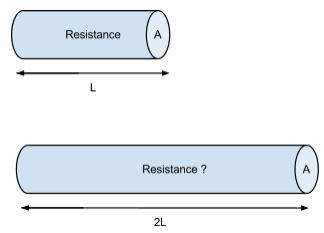
A resistor of length L, cross- sectional area A and a resistance R are represented below. What will be the resistance after doubling the length of the resistor?
Given that the length of the resistor is double, we can consider the question as though we now have two resistor of length L connected in series:
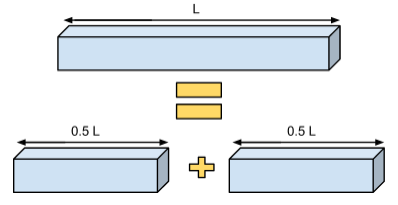
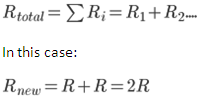
We will calculate the new value of the resistor according to the sum of resistors in series:
The resistance of a conductor depends on its material, its length, and its cross-sectional area (R = ρ × L / A, where ρ is the resistivity of the material). A longer conductor makes the current travel farther, so resistance grows in proportion to length. A larger cross-sectional area gives the current more room, so it lowers resistance.
To solve the question:
- Note what changes. Only the length is doubled, while the material and the cross-sectional area stay the same.
- Picture the longer resistor as two resistors of the original length, each with resistance R, connected one after the other (in series).
- Add the series resistances: R + R = 2R, which is answer C.
Answer A would be right if the cross-sectional area were doubled instead, because a larger area lowers resistance. Make sure you apply the change to the right dimension.
Question 2 - Hand Tools and Power Tools
Try the question below, which shows a tool and asks what it is used for. Hand Tools and Power Tools questions ask you to identify basic tools and know their applications.
Question 3 - Rule Reading
Try the question below, which asks you to read two marks on a pressure scale and find the difference between them. Rule Reading questions ask you to read standard measurements and make measurement calculations.
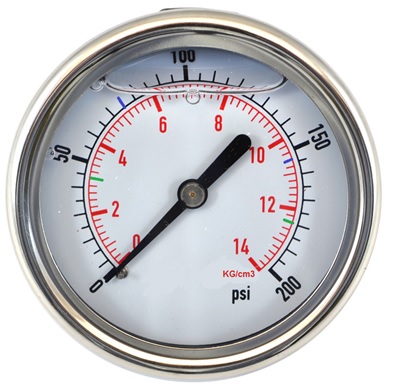
What is the difference between the green lines on the psi scale (approximately)?
Many gauges show the same quantity on more than one scale. A pressure gauge, for example, can show pounds per square inch (psi) on one scale and kilograms per square centimeter (kg/cm²) on another. To read a scale correctly, first work out what each small line is worth, then count lines from the nearest labeled number.
To solve the question:
- Find the value of one small line. On this psi scale, the gap between neighboring black lines is 5 psi.
- Read the first green line. It sits at the black line just before 50, so it reads 50 - 5 = 45 psi.
- Read the second green line. It sits at the fourth black line before 200, so it reads 200 - (4 × 5) = 180 psi.
- Subtract: 180 - 45 = 135 psi, which is answer C.
Because the question says "approximately", you can check your reading with a conversion. 1 kg/cm² is about 14.2 psi, so the green marks at 3 and 12.4 kg/cm² are about 43 and 176 psi, a difference of about 134, which is close to 135.
The questions above are a sample of what to expect, but the real SKAT Meter test runs approximately 2 hours across 3 sections, so knowing the fundamentals section by section matters. Our PrepPack includes 11 practice tests with 183 questions and 1 study guide on electrical concepts, tools, and measurement reading, with answer explanations, so you can build up each topic before test day.
Inside the Prep Course - Preview
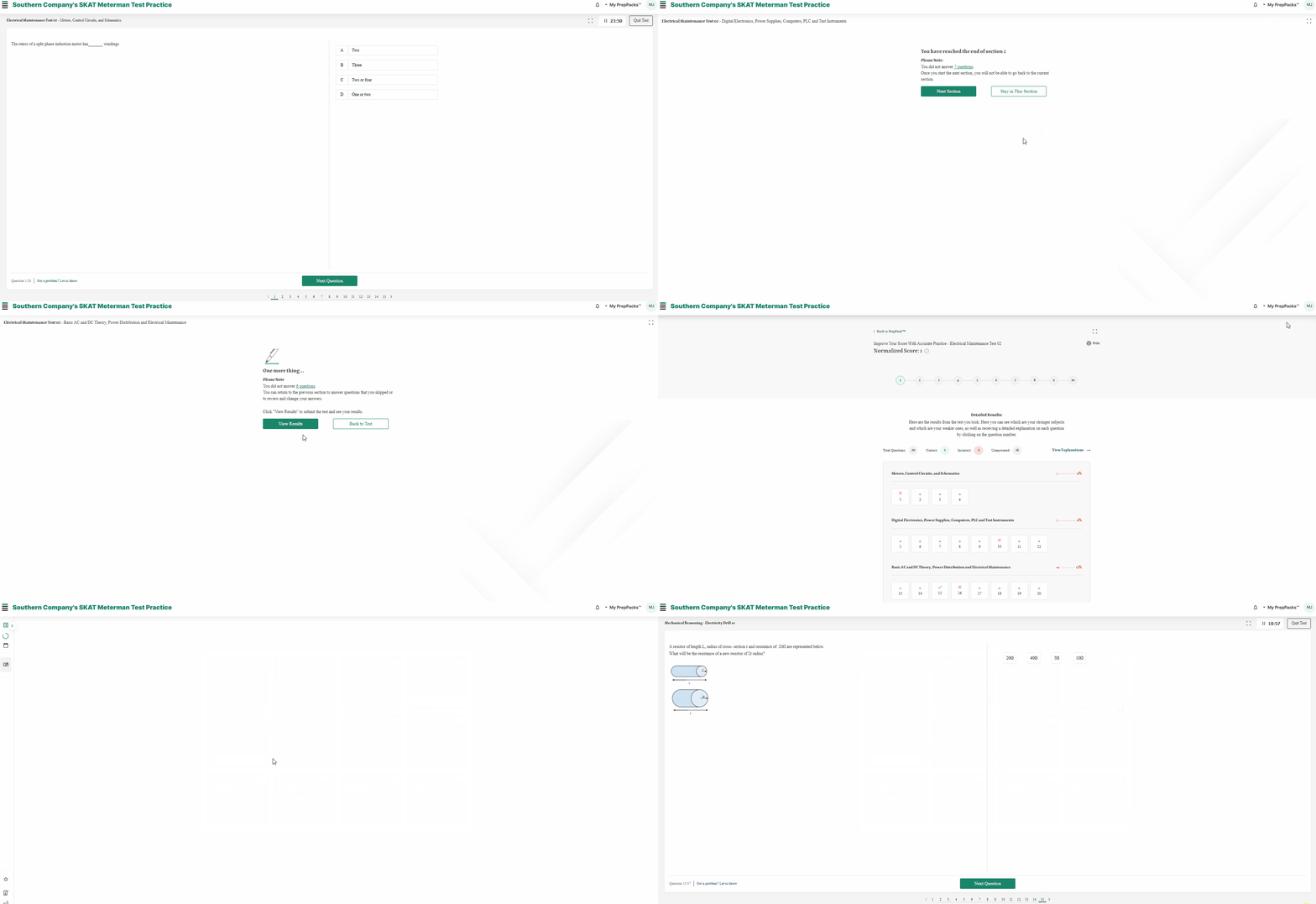
We've created a comprehensive SKAT Meterman PrepPack designed to help you succeed. It includes 11 practice tests with 183 questions and 1 study guide on electrical concepts, tools, and measurement reading, with multiple-choice questions, diagrams, and answer explanations, like the real test. Your scores and practice history show which topics need more work, so you can focus on your weaker areas and feel confident and ready on test day.
Why preparation matters: The SKAT Meter test lasts approximately 2 hours and covers electrical knowledge (including metering), hand tools and power tools, and rule reading, and Southern Company doesn't publish a passing score or the number of questions. Calculators and a formula sheet are provided, so the challenge is knowing the concepts, which formula applies, and how to read measurements correctly. Our practice tests build that knowledge topic by topic, with answer explanations that show how each problem is solved, so the questions on test day feel familiar.

What’s Inside Our SKAT Meterman PrepPack
Using our SKAT Meterman PrepPack, you get:
- 11 practice tests with 183 questions across 3 areas cover electrical knowledge, hand tools, and measurement reading: 5 electrical tests, 2 Tools tests, and 4 Reading Measures drills.
- Long-form electrical practice includes a 46-question Electrical Concepts Knowledge test (2 hours), 2 electricity drills (17 questions each), and 2 Electrical Maintenance tests (23 and 20 questions).
- Tools and measurement practice includes 2 tools identification and usage tests (22 questions each) and 4 short Reading Measures drills (16 questions in total).
- Detailed explanations show not just the correct answer but the reasoning behind it, so you understand the method, not just the result.
- 1 study guide is a Mechanical and Electrical Comprehension Review, so you can review the fundamentals before you start practicing.
- Progress tracking shows your latest score and practice history for each test, so you can see which topics need more work.
- Designed by experts who took the real exam. The PrepPack is designed and prepared by human experts who have taken the real Southern Company exam, backed by JobTestPrep's 30+ years of assessment prep experience.



Which Southern Company Jobs Require the SKAT Meterman Test?
Southern Company's study guide names Georgia Power's Meterman positions as the jobs that use the SKAT Meter test. Georgia Power's postings call the role Apprentice Meter Tech, name the test the Apprentice Meter Tech Skills and Knowledge Test (AM SKAT), and also require the Construction and Skilled Trades (CAST) test to be considered for an interview. It is a union-covered training position in Georgia Power's Metering Department.
Apprentice Meter Techs install, test, and maintain the meters that give hospitals, government agencies, schools, businesses, and individuals reliable electric service and accurate billing. Their work includes installing and maintaining single-phase and three-phase self-contained meters, installing transformer-rated metering systems (sizing instrument transformers, determining multipliers, and programming solid-state meters), field testing mechanical and electronic meters, maintaining pulse metering systems, and installing and programming multifunction meters. The job requires frequent work outdoors in inclement weather and coordination with other Georgia Power departments, customers, electrical contractors, and electrical inspectors.
The training program lasts 2 years and has 4 modules, each combining classroom training with on-the-job training and an evaluation you must pass. When you complete it, you are promoted to Meter Tech A as vacancies open, and that vacancy can be anywhere in Georgia, so candidates must be flexible about work locations. Recent postings list locations such as Atlanta, Lawrenceville, Jonesboro, Smyrna, Macon, Valdosta, Savannah, and Columbus, and they offer no relocation assistance.
Georgia Power's postings prefer a 2-year technical degree in electronics, electrical, or telecommunications, military training, or at least 4 years of related meter experience, and they require detailed knowledge of electrical theory and mechanical principles and strong math calculation skills. Candidates must be able to lift and drag equipment weighing 60 pounds or more, be available for storm duty, overtime, and out-of-town work, and hold a valid driver's license with the ability to obtain a commercial driver's license (CMV) for vehicles over 10,000 pounds.
Starting pay is set by the wage schedule in the agreement between Georgia Power and IBEW Local 84 and is not negotiable, and union membership is optional. A recent posting listed $7,120 per month ($41.07 per hour, about $85,400 a year) for all hires, regardless of prior experience or skills.
Southern Company's benefits summary lists the following, and notes that for employees covered by a collective bargaining agreement, certain benefits may not apply or may differ under the agreement:
- Health coverage includes 3 medical plan options with preventive care paid at 100%, 3 dental plan options, and spending accounts such as a Health Savings Account.
- Retirement includes a pension plan and a 401(k) to which Southern Company contributes 5.1% when you contribute 6%.
- Time off includes 80 to 200 hours of vacation per year depending on years of service, up to 12 company-paid holidays, and up to 80 hours of personal or sick time.
- Income protection includes company-paid life insurance equal to your base pay, up to $150,000.
- Career growth includes tuition reimbursement of up to $5,250 per year and access to internal job postings.
- Performance pay may be available to eligible employees through the Performance Pay Program, a cash bonus tied to company and individual goals.
Southern Company SKAT Meterman FAQ
Georgia Power's postings for this role call it the Apprentice Meter Tech Skills and Knowledge Test (AM SKAT), and Southern Company's study guide calls it the SKAT Meter test. Elsewhere, Southern Company spells SKAT out as the Skills, Knowledge, and Aptitude Test or the Skills, Knowledge, and Abilities Test.
The test lasts approximately 2 hours, according to Southern Company's study guide for the SKAT Meter test. It has 3 sections: Electrical Knowledge (including metering), Hand Tools and Power Tools, and Rule Reading.
It depends on your background. Southern Company doesn't publish pass rates or a passing score, but Georgia Power's postings require detailed knowledge of electrical theory and mechanical principles and strong math calculation skills, and they prefer a 2-year technical degree, military training, or at least 4 years of related meter experience. Candidates with that background will find the content more familiar. If you don't have it, spend extra time on electrical theory, wiring and one-line diagrams, and metering concepts such as true, apparent, and reactive power and power factor, and practice all 3 sections before test day.
Yes. Calculators are permitted and will be provided, along with a formula sheet. Even so, you need to know which formula applies to each problem and how to read measurements correctly, so practice both.
We advise against it. The SKAT Meter test mixes diagrams, scales, and calculations, and AI tools can't see the real test, so the questions they write can have unchecked answer keys, misread figures, or topics the test doesn't cover. If a practice question is wrong, you only find out on test day. Our SKAT Meterman PrepPack is prepared by human experts who took the real Southern Company exam, and it offers 11 practice tests with 183 questions and 1 study guide on electrical concepts, tools, and measurement reading, with answer explanations.
After completing your payment, you will receive two emails: a payment receipt and a login link with your account details. Once you log in and reset your password, you will have instant, unlimited access to your PrepPack.
You can start practicing immediately with tailored questions and detailed explanations, tracking your performance along the way. Your progress is saved, allowing you to revisit previous attempts as many times as you like. If you need more time, you can extend your subscription by contacting c.serv@jobtestprep.com.
Looking For A Different Power Utility Prep Course?
Customer reviews


