The FBI Polygraph Test: Why It's Not the Exam Most Candidates Think It Is
Updated: July 27th, 2026 | 5 min read
Every candidate who makes it through the FBI application for special agent positions and the interviews and assessments that follow eventually reaches the same milestone: the FBI polygraph. This is by far the part of the hiring process that generates the most anxiety, and often the least accurate expectations. A conditional offer of employment from the FBI depends on completing a full background investigation, which includes a personnel security interview, drug test, and a polygraph examination, and that investigation typically takes around six months, or even more according to some candidates. For a process built on rigor, the polygraph is the single step candidates are most likely to misunderstand.
This article breaks down why the FBI keeps using a tool that has faced decades of scientific criticism, what actually triggers a follow-up interview, and why the candidates who struggle are rarely the ones with the most complicated pasts.
The short answer is yes. The FBI (still) requires a polygraph examination for nearly every position, from special agents to intelligence analysts, language specialists, and professional staff, because most FBI employees can eventually access classified material or investigative files.
The exam is administered as part of the background investigation, after a candidate has already received a conditional offer, and results feed into the broader suitability determination alongside the security interview and drug screening. It typically runs on a track parallel to other milestones like the FBI physical fitness test, so candidates are often managing more than one requirement at the same time.
For candidates weighing whether the effort is worth it, it helps to zoom out to the broader career opportunities in the FBI that the background investigation is protecting.
The polygraph exists because of what comes after it, not despite it.
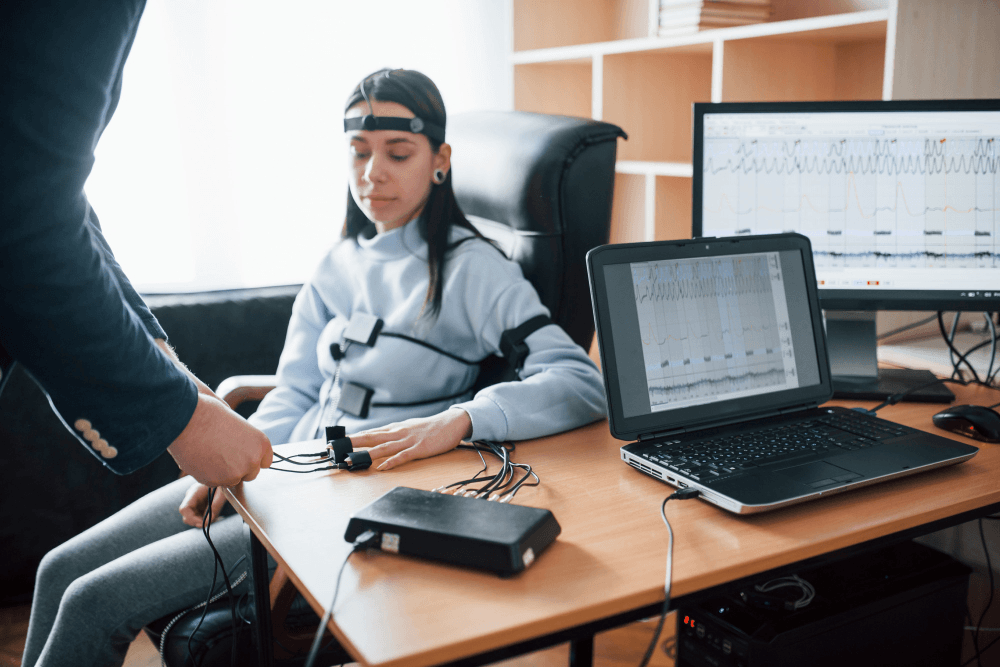
Here's the part most candidates don't expect: the scientific community has never fully endorsed the polygraph as a lie detector. A landmark 2003 review by the National Academy of Sciences concluded that polygraph accuracy is limited, and that the tool's usefulness for screening low-base-rate populations, meaning groups where very few people are actually lying about the thing being tested, carries a real risk of false positives and false negatives. Follow-up analyses over the next fifteen years reached similar conclusions, finding that polygraph accuracy claims made by proponents have consistently outpaced what the underlying research supports.
So why does the FBI, an agency built on evidence and investigative rigor, keep a tool with that track record?
The FBI doesn't treat the polygraph chart as a standalone verdict. It uses the examination process primarily as a structured disclosure mechanism.
The value of the FBI lie detector questions isn't the machine's readout alone. The emphasis lies mostly (pun not intended!) on pre-test interview, where every question is reviewed with the candidate in advance, and the post-test conversation, where inconsistencies get discussed openly. A polygraph specialist reviews the physiological data, but the exam's real function is to create a structured moment where a candidate has every opportunity, and every incentive, to be forthcoming. The chart supports a broader suitability picture; it isn't used in isolation to make a pass or fail call.
This is also why the FBI's process includes a second layer of review before any result is finalized. The examiner reaches only a preliminary read; a separate reviewer validates the chart before anything moves forward. That built-in check is the Bureau's own acknowledgment that a single polygraph reading isn't the final word.
|
Phase |
What happens? |
Purpose |
|
Pre-test interview |
Every question is reviewed with the candidate in advance No surprise questions |
Sets expectations and gives the candidate a chance to disclose anything before the chart is ever recorded. |
|
In-test interview |
The physiological data is recorded as the candidate answers the reviewed questions |
Generates the actual polygraph chart the examiner will analyze. |
|
Post-test interview |
Any inconsistencies or reactions in the chart are discussed openly with the candidate. |
Gives the candidate the opportunity to explain a reaction rather than treating the chart as an automatic verdict. |
Most candidates assume a follow-up interview means they're in trouble. In practice, follow-ups are a routine part of the process, and they tend to cluster around a small set of topics:
Drug history. The FBI's current policy allows candidates to apply after one year of abstinence from marijuana, while use of harder drugs generally requires ten years of abstinence to be eligible. Follow-up questions usually aim to confirm dates and details, not to catch someone in a lie about whether they ever used anything at all.
Gaps or inconsistencies on the application. Your Standard Form 86 (SF-86), the national security questionnaire submitted through e-QIP/e-App, is compared line by line against what comes up during the personnel security interview. A mismatched date, an unlisted past employer, or an omitted detail is far more likely to trigger clarifying questions than the underlying event itself.
Financial history. Undisclosed debt, unresolved judgments, or patterns that suggest financial vulnerability can prompt more questions, since financial pressure is a documented factor in insider-threat cases.
Foreign contacts and travel. Given the national security stakes of the role, unreported foreign relationships or unexplained travel patterns commonly generate clarifying questions.
Prior conduct that wasn't disclosed upfront. This is the single biggest driver of extended interviews, and it's worth its own section.
Follow-up interviews are rarely a response to what happened. They're a response to what wasn't said.
This is the point that changes how most candidates should think about the entire process: a flawed history is survivable. An undisclosed one usually isn't.
The FBI's own investigative guidelines are explicit that when a candidate fails a polygraph on a drug-related issue and cannot account for the deceptive result, the matter escalates for further review, and if withheld information caused the failure, the consequence is typically permanent ineligibility, not a retest. Compare that to a candidate who disclosed the same conduct upfront: the same underlying fact, evaluated under a completely different set of assumptions about the candidate's honesty.
Attempting to manipulate the exam, sometimes called a countermeasure, is itself treated as a disqualifier and can trigger a deeper investigation. That's a telling detail. The FBI isn't primarily screening for a spotless record. It's screening for candidates who can be trusted to disclose difficult information voluntarily, because that's precisely the judgment call every special agent has to make in the field. Sound judgment under pressure is one of the core FBI agent skills the Bureau is evaluating long before anyone reaches the polygraph room, and the polygraph is really just an early test of that same trait.
The FBI isn't hiring people with no past. It's hiring people who don't hide theirs.
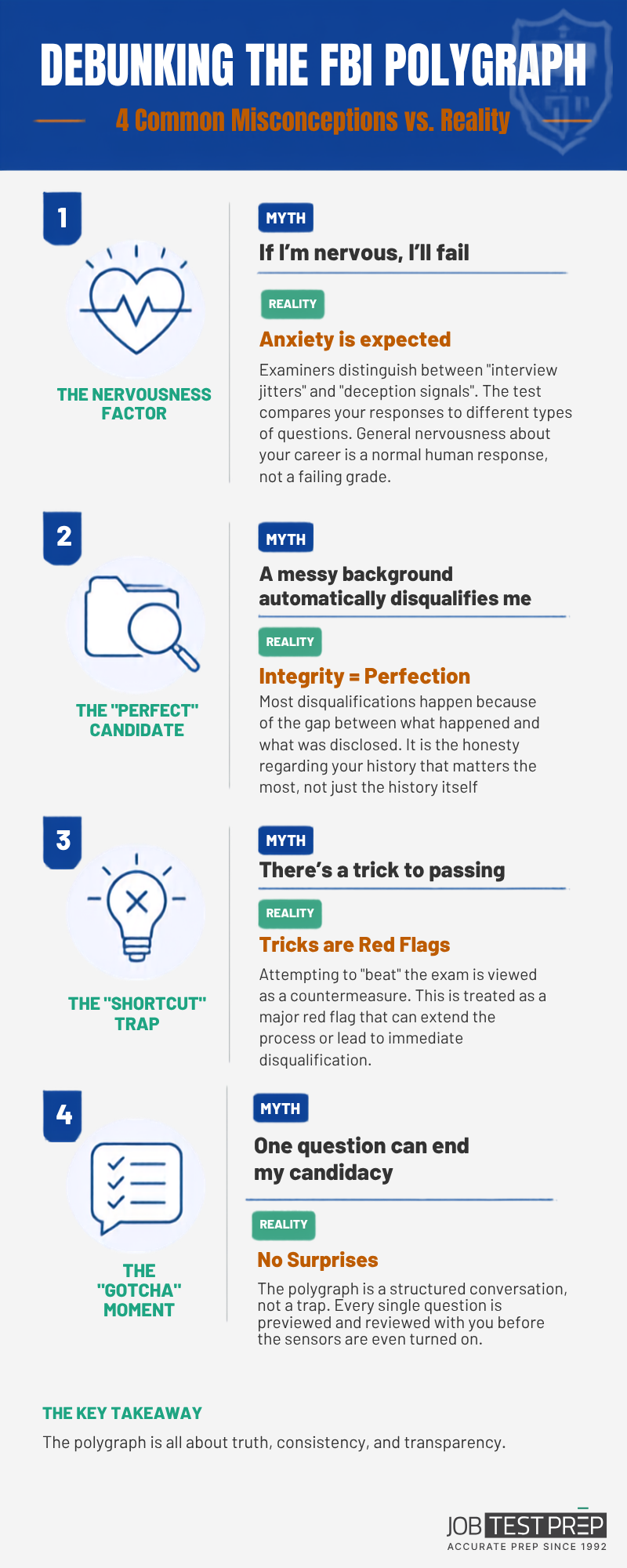
This is the most common fear candidates bring into the room, and it's built on a misunderstanding of what the exam measures. The polygraph technique the FBI uses compares a candidate's physiological response to relevant questions against their response to comparison questions designed to provoke a reaction in nearly anyone. General nervousness about a high-stakes interview isn't the signal examiners are looking for. Being anxious about your career on the line is a normal human response, not evidence of deception, and examiners who conduct these interviews for a living are used to seeing it.
As covered above, most disqualifications trace back to the gap between what happened and what was disclosed, not the severity of the conduct alone.
Anything framed as a way to defeat the exam is treated as a red flag rather than a shortcut, and it can extend the process rather than shorten it.
The exam is designed around a structured conversation, not a single gotcha moment. Every question is previewed before the test begins, so there are no surprises in the room.
The goal isn't to "beat" the exam. It's to walk in with nothing left to disclose and nothing left to remember on the fly.
Review your own paperwork before the interview. Reread your SF-86 and any prior statements so your account is consistent, not because you're rehearsing a story, but because accurate recall reduces avoidable inconsistencies.
Disclose proactively, even for details that feel minor. A candidate who raises an issue before being asked about it is in a fundamentally stronger position than one who waits to be caught.
Get a full night's sleep and eat beforehand. Fatigue and stress amplify physiological responses across the board, which can make an honest answer look more reactive than it is.
Expect the pre-test conversation to take time. The session typically runs two to four hours, most of it spent reviewing questions and context before any chart is recorded. Treat that time as an opportunity to get on the same page with the examiner, not as a delay tactic aimed at you.
Separate the outcome from your self-worth. A follow-up interview is a normal part of a rigorous process, not a verdict on your candidacy.
If you're still navigating earlier hiring steps like the FBI phase 1 exam or the FBI phase 2 interview, building a consistent preparation routine early can help ease general process anxiety by the time the polygraph is scheduled. Practicing the same reasoning and situational judgment skills the Bureau evaluates earlier on, whether through how to pass FBI pre employment tests or FBI test tips by our experts, helps reinforce the disciplined mindset you'll need all the way through the background investigation.

Anyone applying across federal law enforcement or the intelligence community should expect this step to show up more than once, since the FBI polygraph isn't an outlier. It's part of a much broader federal practice.
The DEA polygraph works much the same way: a "significant response" (deception indicated) makes an applicant ineligible for hire for three years under current DEA policy, per a Justice Department Inspector General audit.
The NSA polygraph test is tied to its security clearance process, since an NSA offer depends on being granted clearance first, with a heavier focus on counterintelligence given the classified access involved. Across the FBI, DEA, NSA, and agencies like the CIA and CBP, the same principle applies: the polygraph is one input into a larger suitability decision, not a stand-alone pass/fail gate.
An inconclusive result can usually be retested. A failure tied to undisclosed information, however, is treated far more seriously and is generally not something a retest resolves. This is the practical reason disclosure upfront matters more than damage control after the fact: by the time a chart shows deception on a topic the candidate never raised, the issue is no longer just the underlying conduct, it's the credibility of the candidate.
It comes after a conditional offer, as part of the background investigation, alongside the personnel security interview and drug screening.
Sessions generally run two to four hours, including the pre-test interview, the in-test phase, and time for the examiner's review.
Every question is reviewed with the candidate beforehand, so there are no surprise questions. Topics typically cover drug use, honesty on the application, financial history, and foreign contacts, framed around the same information already covered in the background investigation.
The core logic is shared: disclosed conduct is treated very differently from undisclosed conduct across every agency that uses pre-employment polygraphs, including the DEA and NSA. Specific policies, such as drug abstinence periods and disqualification lengths, vary by agency.
General nervousness about the process isn't the same signal examiners are trained to evaluate. The technique relies on comparing responses across different question types, not on flagging anxiety alone.
An inconclusive result may be eligible for a retest. A failure connected to withheld disqualifying information is treated more seriously and typically ends with a candidacy rather than delaying it.
Independent reviews, including the National Academy of Sciences, have found the underlying science limited for high-stakes screening decisions. The FBI uses the exam as one part of a broader investigation rather than as a stand-alone determination.
Preparation should focus on accurate recall and proactive disclosure, not scripting responses. Because every question is previewed before the test, there's no advantage in rehearsing a performance.

I am Kemi Cohen, Personality Test Developer and Personality Expert at JobTestPrep. I hold an MSc in Organizational Psychology. My role includes developing assessment questions and providing expert strategies for our PrepPacks.