


FBI Phase 2 Test (2026): Written Assessment, Interview & Practice
 FBI Phase 2 Test (2026): Written Assessment, Interview & Practice
Last Updated: November, 2026
The FBI Phase 2 Test is the second major assessment in the FBI Special Agent hiring process. Once you pass Phase 1 Test, you will be invited to complete a 150-minute written assessment followed by a structured interview conducted by a panel of FBI Special Agents.
Unlike Phase 1, which focuses on cognitive abilities, professional judgment, and personality, Phase 2 evaluates your ability to analyze information, communicate clearly, and demonstrate the core competencies expected of an FBI Special Agent.
On this page, you'll learn exactly what to expect in each part of the FBI Phase II Test, explore realistic FBI sample questions, and discover how to prepare effectively for both the written assessment and structured interview.
Candidates who do not successfully complete Phase 2 receive only one additional opportunity to retest after the required waiting period, making thorough preparation especially important.
Looking for FBI Phase 1 preparation? Visit our FBI Phase 1 Special Agent Exam page.
FREE Access to our Interview PrepPack
+ With the Premium plan, you can add 2 additional PrepPacks of your choice
★★★★★
- 5 Full Writing Simulations with AI-Powered Feedback (timed, two-question format matching the real exam)
- Full Writing Assessment Guide (with examples, tips, and strategies for better writing)
- Written Communication Practice
Get job-specific interview feedback powered by AI.

24hr support

Money-back

SSL secured

What Is the FBI Phase 2 Test?
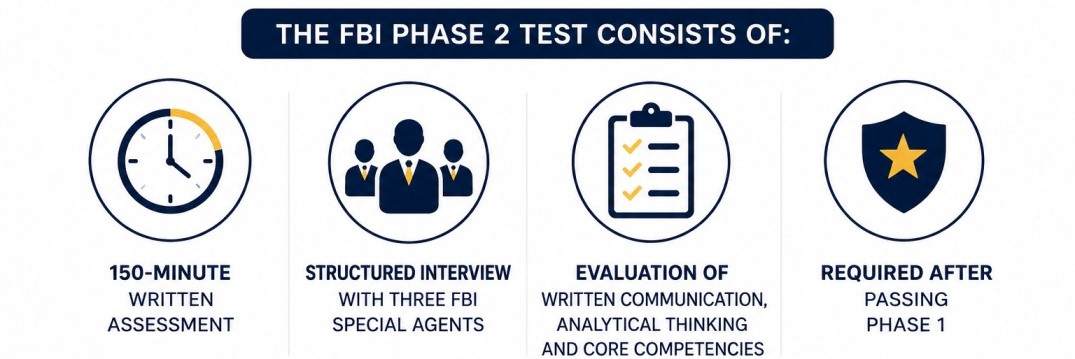
The FBI Phase 2 Test is the fourth stage of the FBI Special Agent hiring process. If you successfully pass the FBI Phase 1 Test and your application progresses through the FBI's internal review, you will be invited to complete Phase 2. The assessment consists of two parts:
- Phase II (a): A 150-minute written assessment that evaluates your ability to analyze information and produce clear, well-structured reports.
- Phase II (b): A 1-hour structured interview conducted by a panel of three FBI Special Agents that assesses the FBI's Core Competencies.
You must pass the written assessment before you can progress to the structured interview. Candidates who successfully complete Phase 2 continue to the Physical Fitness Test (PFT) before receiving a conditional job offer.
What to Expect on the FBI Phase 2 Written Assessment?
The FBI Phase 2 Written Assessment is a 150-minute computer-based exercise that measures your written communication and analytical abilities.
You will receive a hypothetical investigative scenario supported by multiple sources of information, such as witness statements, notes, and other case materials. Using only the information provided, you must analyze the evidence and prepare two clear, objective written reports.
Strong responses will:
- Identify relevant information
- Organize facts logically
- Write clearly and professionally
- Use correct grammar, spelling, and punctuation
- Produce accurate, objective reports under time pressure
Watch: The FBI Phase 2 Written Assessment, Explained
FBI Phase 2 Writing Practice Test Sample
Once you are invited to take the FBI Phase 2 Test, you will have 14 days to complete the written assessment at a designated PSI testing center.
During the 150-minute assessment, you will be presented with a hypothetical scenario supported by multiple sources of information, such as witness statements, notes, or other case materials. Using only the information provided, you will analyze the evidence and produce two clear, well-organized written reports.
Your responses are assessed on your ability to:
- Analyze and organize information logically
- Write clearly, accurately, and objectively
- Produce well-structured reports
- Demonstrate strong grammar, spelling, and punctuation
- Support your conclusions using only the facts provided
Because spelling and grammar tools are not available during the assessment, proofreading your work is an important part of the process.
Below is a realistic practice question that reflects the style and level of difficulty of the FBI Phase 2 Written Assessment:
How the FBI Phase 2 Written PrepPack™ Works
Being comfortable under pressure doesn’t automatically translate into the structured, evidence-based reports Phase 2 requires, and few candidates have written in this exact format before. To close that gap, JobTestPrep’s FBI Phase 2 Written PrepPack™ now includes 5 full writing simulations, each timed at 150 minutes and built around two questions, for ten practice reports in total, matching the structure of the real exam.
After each simulation, you receive AI-powered feedback that scores your response against the criteria above and shows you specifically where to improve. You can then retake the simulation and rewrite your answer accordingly, so each attempt builds directly on the last one. The scoring runs on an algorithm built and continually refined by JobTestPrep’s own test experts.
The PrepPack also includes a full Writing Assessment study guide and targeted practice in grammar, spelling, punctuation, and information presentation, the mechanics the real exam penalizes directly since no spell-check is available.
Sample FBI Phase 2 Written Assessment Question

Tips for a strong answer
- Use formal, objective language.
- Organize facts logically, avoiding personal opinions or speculation.
- Focus on consistency and clarity.
- Avoid grammar or spelling errors—mechanics matter.
What to Expect in the FBI Phase 2 Interview
The FBI Phase 2 Interview is a 60-minute structured interview conducted by a panel of three FBI Special Agents. Unlike a conversational job interview, this is a standardized assessment designed to evaluate whether your previous experiences demonstrate the qualities required of an FBI Special Agent.
The interview follows a performance-based format, meaning you'll answer questions by describing real situations from your professional, academic, military, volunteer, or personal experience. The FBI recommends using the SAR (Situation, Action, Result) method when structuring your answers.
What Does the FBI Evaluate During the Interview?
Throughout the interview, the panel assesses how well your experiences demonstrate the FBI's eight Core Competencies, including:
- Collaboration Communication
- Flexibility and Adaptability
- Initiative
- Interpersonal Ability
- Leadership
- Organizing and Planning
- Problem Solving and Judgment
Your answers should clearly explain what the situation was, what actions you personally took, and what results you achieved, while highlighting your individual contribution rather than your team's.
FBI Phase 2 Interview Questions and Answers
The FBI Phase 2 Interview is a structured, performance-based interview conducted by a panel of three FBI Special Agents. During the interview, you'll answer questions about real situations you've experienced throughout your professional, academic, volunteer, or personal life. Your responses are evaluated against the FBI's Core Competencies, so preparation is essential.
When answering each question, the FBI recommends using the SAR (Situation, Action, Result) format:
- Situation: Briefly describe the context.
- Action: Explain the specific actions you took.
- Result: Describe the outcome and what you accomplished.
Sample FBI Phase 2 Interview Questions
Tips for the FBI Phase 2 Interview
- Prepare several examples from your professional, academic, volunteer, and personal experiences.
- Structure every response using the SAR (Situation, Action, Result) format.
- Focus on your individual contribution, even when discussing team projects.
- Be honest and provide enough detail for the interview panel to understand your actions and decision-making process.
- Avoid jargon, exaggeration, and unsupported claims.
Take advantage of our FREE AI-Driven Interview Prep on the FBI Phase 2 Test Premium Plan
FBI Phase 2 FAQs
The test consists of two parts: a written assessment and a structured panel interview. The written portion tests your ability to summarise investigative information clearly and professionally. The interview evaluates your behavioural competencies through scenario-based questions.
The interview can be challenging because every answer is evaluated against clearly defined competencies rather than general impressions. Strong candidates don't simply describe what happened, they explain why they made certain decisions, how they handled challenges, and what outcome they achieved.
Preparation is essential. Reviewing your past experiences, practicing structured responses using the SAR format, and understanding the FBI's Core Competencies can help you communicate your qualifications more clearly and confidently.
The FBI Phase 2 Written Assessment lasts approximately 150 minutes (2.5 hours). During the assessment, you'll analyze information from multiple sources and write two well-structured, comprehensive reports using only the facts provided. Strong grammar, organization, and analytical reasoning are essential, as spelling and grammar tools are not available during the test.
It’s a structured, in-person interview with three Special Agents, lasting about 60 minutes. Questions are based on the FBI’s core competencies and require you to give detailed examples from your experience using the STAR method (Situation, Task, Action, Result).
The FBI does not publish an official Phase 2 Test pass rate. However, unofficial sources estimate that approximately 50–60% of candidates fail this stage of the hiring process.
Because each Phase 2 assessment can only be attempted twice, thorough preparation is strongly recommended.
The best way to prepare is by practicing both parts of the assessment.
Improve your analytical writing with realistic report-writing exercises and prepare structured SAR (Situation, Action, Result) responses for the interview. JobTestPrep's PrepPack™ includes realistic writing assessments, sample reports, interview questions, and expert guidance to help you prepare with confidence.
Customer reviews


