FBI Careers in 2026: Which Path Fits You?
Updated: August, 2026
Most people who search for FBI careers are picturing one job: Special Agent. That's only one door into the Bureau. The FBI defines a set of Core Competencies, including Collaboration, Communication, and Problem Solving and Judgment, that apply to every role at the agency, not just Special Agents, which is the Bureau's own way of saying the work is broader than the exam that gets the most attention online.
This guide breaks down the real FBI career opportunities landscape: the three main tracks, what a Special Agent career actually looks like day to day, which of your existing skills map to which track, and what it takes to get in the door. If you're deep in exam prep already, you're in the right place for the bigger picture; for the test itself, we'll point you to the dedicated guides as they come up.
The FBI hires across three broad categories, and knowing which one you're aiming for changes how you should prepare.
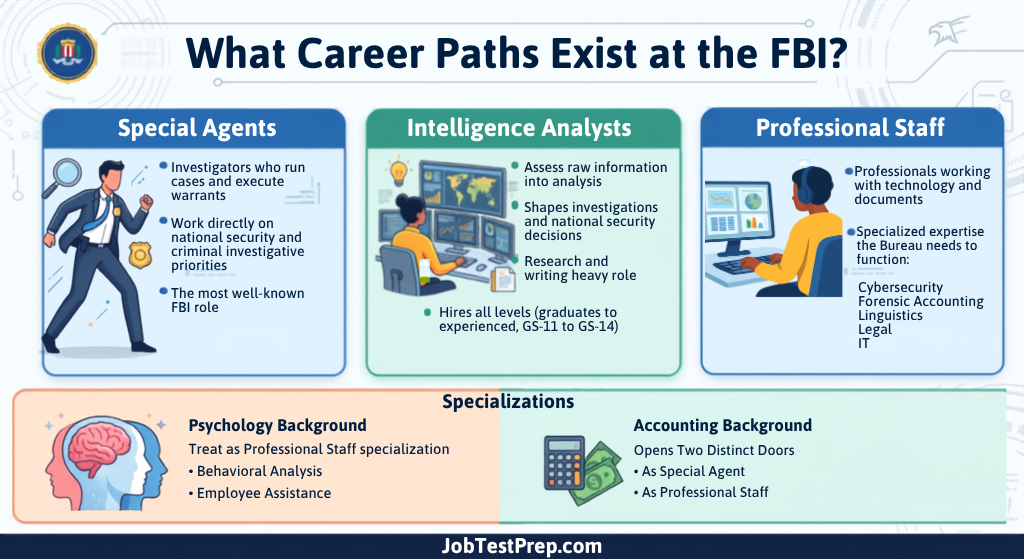
Special Agents are the investigators: the people running cases, executing warrants, and working directly on the FBI's national security and criminal investigative priorities. This is the role most FBI careers content online focuses on almost exclusively, which is part of why it's easy to assume it's the only one.
Intelligence Analysts assess raw information and turn it into the analysis that shapes investigations and national security decisions, spanning threat analysis, collection management, domain analysis, targeting analysis, and reporting. It's a research and writing heavy role suited to people who want to be close to the mission without carrying a badge and a gun. The FBI hires Intelligence Analysts at every career stage, from recent graduates to experienced professionals, into positions ranging from GS-11 to GS-14, through a selection process that runs entirely separate from the Special Agent track: an eight-phase evaluation of its own.
Professional Staff cover the specialized expertise the Bureau needs to function: cybersecurity, forensic accounting, linguistics, legal, IT, and dozens of other fields. This is the track most likely to fit someone with a specialized degree who wants FBI mission relevance without necessarily becoming a Special Agent or analyst.
A psychology background points toward Professional Staff and specialized analytical roles rather than a standalone hiring track of its own. Two areas where the FBI draws directly on psychology expertise are behavioral analysis work supporting active investigations and employee assistance functions that support agents and staff. If FBI careers in psychology is what brought you here, treat this as a Professional Staff specialization to research on FBIJobs.gov rather than a separate application path.
An accounting background opens two distinct doors. As a Special Agent, it points toward financial crimes and white-collar investigative squads. As Professional Staff, it points toward forensic accountant roles that support investigations without requiring the Special Agent hiring process at all. FBI accounting careers is one of the highest-fit searches for this page's core audience: accounting is one of the specific backgrounds the Bureau's own applicant profile calls out as a strong fit for the Special Agent track.
The FBI hires across three main career tracks: Special Agents (investigations), Intelligence Analysts (threat evaluation), and Professional Staff (specialized technical expertise). Each track maintains its own application and testing process.
This is the question most FBI careers content skips past on its way to exam tips, and it's the one candidates weighing a career switch actually need answered.
Special Agents aren't generalists doing the same job in every field office. The FBI's own overview of the role highlights work like leading investigations, disrupting domestic and international drug trafficking, and countering cyber actors and terrorist organizations. A background in computer science points toward cyber-focused investigative work, while a background in accounting or law fits financial crimes and white-collar investigations. On the other hand, language skills open assignments tied to specific foreign counterintelligence or international priorities.
Special Agents enter the GL-10 pay grade. As of the 2026 federal Law Enforcement Officer pay tables, GL-10 starts at $59,999 in base pay before locality adjustments. On top of base pay, federal law fixes Law Enforcement Availability Pay at 25 percent of base salary for criminal investigators in the Special Agent's job series, and locality pay applies on top of both during training at Quantico and afterward.
From there, the path is defined rather than open ended: Special Agents can advance to GS-13 in a nonsupervisory field role, then qualify for supervisory, management, and executive positions at GS-14 and GS-15, as well as the FBI's Senior Executive Service.
New agents sign a mobility agreement accepting the possibility of transfer as a condition of employment. In practice, current guidance has new agents receiving a field office placement before Basic Field Training Course begins at Quantico, and some may have the option to serve at their processing field office afterward. Once placed, agents are generally not transferred again unless they request it, apply for a management position, or a critical Bureau need arises. Relocation, in other words, is real, but it isn't constant.
Most “which FBI career is right for me” content boils down to a generic personality quiz. Here's an alternative, and more grounded way to think about it. As we explained before, the FBI itself defines eight Core Competencies that it says apply to every role at the Bureau, not just Special Agents. The tracks don't lean on all eight equally, and matching your strengths to the track that uses them most is a better starting point than guessing.
This mapping is our own analysis of how the tracks' day-to-day demands differ, not an FBI-published ranking, so treat it as a starting point for self-assessment rather than a formal classification.
| Career Path | Core Competency | What it Looks Like in Practice |
| Special Agent |
Flexibility and Adaptability
|
Field investigations shift direction without warning, so agents need to adjust their approach mid-case rather than follow a fixed plan. |
| Special Agent | Interpersonal Ability | Building rapport with informants, witnesses, and partner agencies often determines whether an investigation moves forward at all. |
| Special Agent | Problem Solving and Judgment |
Agents weigh incomplete information under time pressure and have to reach sound conclusions before every fact is in. |
|
Intelligence Analyst |
Communication |
Analysts turn raw intelligence into reports that decision-makers act on, so precision in writing carries as much weight as the analysis behind it. |
|
Intelligence Analyst |
Problem Solving and Judgment |
Spotting the patterns that actually matter across scattered, sometimes contradictory pieces of information is the core of the job. |
|
Professional Staff |
Collaboration |
Specialists such as forensic accountants and linguists work inside investigative teams they don't lead, so their expertise only has impact once it's shared clearly. |
|
Professional Staff |
Initiative |
Fields like cybersecurity and forensic accounting change constantly, and staying current usually falls on the individual rather than a formal training track. |
|
All Three Tracks |
Leadership |
The Bureau expects employees to mentor others and take ownership of outcomes even without a formal title, a habit that becomes directly relevant once GS-14 and GS-15 promotions come into play. |
Before you go further, confirm you meet the baseline criteria. FBI careers entry level / careers in FBI entry level requirements differ by track, but the Special Agent baseline is the most well documented:
Intelligence Analyst and Professional Staff roles have their own age, degree, and experience criteria rather than inheriting the Special Agent baseline above, which is worth checking directly on FBIJobs.gov before assuming you don't qualify.
Every one of these tracks runs through its own multi-stage screening, and the Special Agent path is the most well documented: a cognitive and judgment assessment, a written and interview stage, and a physical fitness evaluation, layered on top of a background investigation and medical review.
It is important to understand this process in detail before you commit time to it. For the full stage-by-stage timeline and what causes delays, check our article on the complete FBI hiring process timeline. To start preparing for the Special Agent exam itself, read more on how to become an FBI special agent.
An FBI career asks for real trade-offs: a hiring process that can take the better part of a year, a mobility agreement that puts relocation on the table for your entire career, and a background investigation that reaches into your finances, associations, and history in a way most private-sector hiring never will.
What it offers in return is specific, not generic: work tied directly to national security and federal law enforcement priorities, a defined pay and promotion structure through GS-13 and beyond, and long-term stability that's harder to find in a first career built around a single employer. Neither side of that trade-off should be oversold. The washout rate through testing and screening is high, making a transition into federal law enforcement a decision that requires clear long-term commitment.
The FBI hires Intelligence Analysts and Professional Staff across fields like cybersecurity, forensic accounting, linguistics, psychology, and law, in addition to Special Agents. Each track has its own eligibility requirements and testing process.
Specialization assignments are shaped by the Bureau's needs, your background, and your performance through training and early assignments, rather than chosen upfront the way a college major is. The FBI doesn't publish a fixed formula for how individual squad assignments are made, so treat any specific claim about “guaranteed” specializations elsewhere online with caution.
Special Agent applicants need a bachelor degree from an accredited U.S. institution [7], though the field doesn't have to match a specific list. Professional Staff roles, by contrast, often require a specific degree tied to the specialty, such as accounting, computer science, or psychology.
Progression runs through the GS scale rather than a generic promotion ladder: agents advance to GS-13 in a nonsupervisory field role, then can move into supervisory, management, or executive positions at GS-14, GS-15, or the Senior Executive Service.
Special Agents conduct investigations directly; Intelligence Analysts evaluate information and produce the analysis that supports those investigations, through a separate hiring process with its own GS-11 to GS-14 grade structure. Both are full FBI careers, not a junior and senior version of the same job.
Special Agents start at the GL-10 pay grade, which begins at $59,999 in base pay under the 2026 federal Law Enforcement Officer pay table, before locality pay. Law Enforcement Availability Pay adds a fixed 25 percent of base salary on top of that, and pay increases as agents progress through the GS-13 to GS-15 range described above.

I am Kemi Cohen, Personality Test Developer and Personality Expert at JobTestPrep. I hold an MSc in Organizational Psychology. My role includes developing assessment questions and providing expert strategies for our PrepPacks.

Related FBI Blog Articles: