How to Successfully Pass FBI's Phase 1 Test
Updated: July 21st, 2026
The FBI Phase 1 test eliminates the vast majority of Special Agent applicants before they even reach the interview stage. If you're preparing for the FBI entrance exam, understanding why most candidates fail is your first step toward success.
Did you know that of the thousands who apply to become FBI Special Agents each year, around 70% never make it past the Phase 1 Test? Their careers end before they begin, not because they lack talent, but because they fall into common pitfalls that can be avoided through proper preparation with an FBI practice exam.
The FBI Phase 1 exam is unlike other FBI assessments. It's a three-hour marathon that tests your logical reasoning, pattern recognition, personality fit, and professional judgment all at once. Only a few candidates pass on their first attempt. Fail twice, and your application is terminated. You become permanently ineligible for the Special Agent position.
The stakes couldn't be higher. So why do so many qualified candidates fail the FBI Phase 1 test? After analyzing official FBI guidance and preparation resources, we've identified the five most common-and most costly-mistakes that doom candidates before they even start.
Here's the trap many candidates fall into when taking the FBI Phase 1 practice test: You think the FBI wants to hear certain answers, so you craft responses to match what you believe they're looking for. You emphasize leadership in one section, then contradict yourself by choosing passive responses in the situational judgment questions.
Why this destroys your score: The FBI's algorithm specifically checks for consistency across all five test sections. If you claim to value "attention to detail" in the personality assessment but then rush through decisions in the situational judgment section, the system flags you as dishonest. Remember that integrity and accountability are core FBI values. The FBI Phase 1 exam is designed to catch candidates who misrepresent themselves.
The solution: Be consistent and align your responses with FBI values. Before test day, spend time on the FBI's official website understanding what they look for in Special Agents. Learn their core values—integrity, respect, accountability, leadership, diversity, excellence, and teamwork—and reflect on how these align with your own work style.
When practicing with an FBI practice exam, make sure your answers would make sense together if someone read them all at once. If you emphasize being detail-oriented in one section, your situational responses should reflect thoroughness and careful consideration. The key is presenting a coherent profile that matches what the FBI needs in an agent.

Most candidates spend their prep time worrying about personality questions. Meanwhile, the Logical Reasoning section (90 minutes, 40-50 questions) sits waiting to eliminate them.
The reality: You have approximately 2 minutes per question to read a paragraph, analyze the logic, and select the correct inference from five options. These aren't simple reading comprehension questions on the FBI Phase 1 test. They test your ability to distinguish between "all," "some," "none," and conditional "if-then" statements under time pressure.
This section alone separates the prepared from the hopeful. The FBI only provides limited sample questions, leaving most candidates unprepared for the actual difficulty level and question variety they'll encounter on the FBI Phase 1 exam.
The solution: Start preparing for logical reasoning well before your test date using a comprehensive FBI Phase 1 practice test. Focus on understanding the different types of logical statements: universal ("all"), existential ("some"), negative ("none"), and conditional ("if-then"). Practice reading passages carefully and identifying what can be definitively concluded versus what's merely suggested. Time yourself on practice questions to build speed without sacrificing accuracy. The more patterns you recognize through FBI practice exam materials, the faster you'll move through this section

Nine questions. Visual patterns. Shapes rotating, colors shifting, elements disappearing and reappearing. Sounds simple? It's not.
The Figural Reasoning section of the FBI Phase 1 test assesses your ability to identify complex visual patterns and predict the next sequence. Many candidates walk in cold, having never practiced abstract reasoning tests, and find themselves staring blankly at symbol matrices they can't decode.
Why this matters: This section measures the analytical thinking required for FBI investigative work—spotting patterns in evidence, connecting disparate pieces of information, seeing what others miss.
The solution: Train your brain to recognize visual patterns before test day using an FBI Phase 1 practice test. Start with basic pattern recognition exercises: look for rotations (clockwise or counterclockwise), color changes, shape additions or subtractions, and size variations. Many patterns follow multiple rules simultaneously, so practice identifying when two or three things are changing at once. Abstract reasoning improves dramatically with exposure, so the more sequences you work through in your FBI practice exam preparation, the better you'll perform.
Three hours. Five sections. No bathroom breaks. No second chances if you run out of time.
Candidates consistently underestimate the mental endurance required for the FBI Phase 1 exam. They start strong but fade during the personality assessment's 100 statement pairs. They rush through the final sections, making careless errors. They don't practice under actual test conditions and discover too late that maintaining focus for 180 minutes is exhausting.
The killer detail: Time limits are strictly enforced on the FBI Phase 1 test. When time expires, you stop, even if you're mid-question. Incomplete sections mean automatic failure.
The solution: Build your mental stamina gradually using a timed FBI Phase 1 practice test. Don't wait until the week before to take your first practice test. Start with 30-minute sessions working on individual sections, then move to 90-minute blocks, and finally complete full three-hour practice runs. Take your FBI practice exam sessions in realistic conditions: no breaks, no phone, timed sections. Track where your concentration drops and work on maintaining focus during those periods. Physical preparation helps too. Get good sleep the week before, stay hydrated, and eat a solid meal before the test.
The FBI isn't just testing your intelligence through the FBI Phase 1 exam. They're assessing whether you embody their core values: integrity, respect, accountability, leadership, diversity, excellence, and teamwork.
Every situational judgment question on the FBI Phase 1 test is designed to reveal how you prioritize these values. Do you take shortcuts when pressured? Do you blame others when things go wrong? Do you prioritize results over ethics?
Candidates who don't understand these values—or who haven't internalized them—reveal themselves immediately. They choose responses that seem "strong" but actually contradict FBI principles. They demonstrate poor judgment in scenarios that test ethical decision-making.
The solution: Study the FBI's seven core values thoroughly. Understand what each one means in practice. When faced with situational judgment questions in your FBI practice exam preparation, ask yourself which value is being tested. Does this scenario require demonstrating leadership or teamwork? Is it about accountability or respect? Your responses should consistently reflect these values. Read through the FBI's mission statement and recent press releases to understand how the Bureau applies these principles in real situations.
While the FBI Phase 1 test is critical, it's important to understand where it fits in the complete Special Agent selection process. After passing the first round of examinations, successful candidates move on to FBI's Phase 2 assessment, which includes a written test and an interview. Afterwards, applicants also have to pass the thorough FBI fitness test.
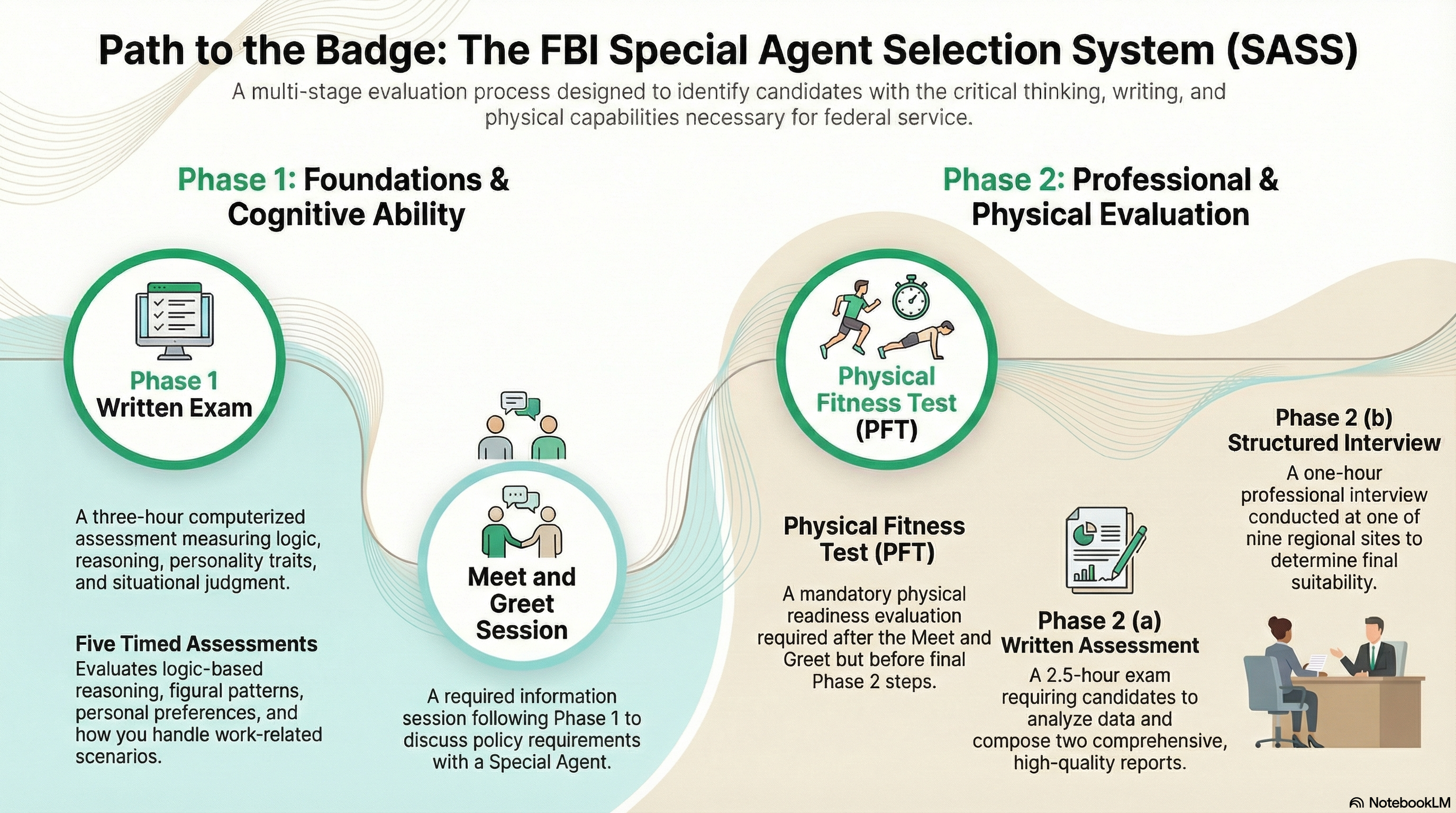
The FBI fitness test (Physical Fitness Test or PFT) evaluates your physical readiness for the demands of being a Special Agent. While it's administered later in the process, smart candidates begin fitness training early, knowing that physical preparation takes time. The FBI fitness test includes sit-ups, a 300-meter sprint, push-ups, and a 1.5-mile run—all with strict time and repetition requirements.
Many successful candidates prepare for both the cognitive demands of the FBI Phase 1 practice test and the physical demands of the FBI fitness test simultaneously, recognizing that both require consistent, strategic preparation.
Here's what makes these mistakes so costly: You get 21 days to schedule your FBI Phase 1 test after receiving the invitation. If you fail, you might get a retest opportunity 90 days later, but it's not guaranteed. Fail twice, and your application is terminated. Your Special Agent application becomes permanently ineligible.
Compare that to the candidates who pass the FBI Phase 1 exam: They prepared strategically. They practiced under real conditions using comprehensive FBI practice exam materials. They understood the test format, the timing pressures, and what the FBI actually values. They didn't leave their dream career to chance.
The difference between the 70% who fail and the 30% who succeed isn't talent. It's preparation. Every candidate who fails the FBI Phase 1 test walked in believing they were ready. They weren't.
You now know the five mistakes that end most FBI careers before they start. But knowing what to avoid is only half the battle. You need to practice under real conditions with materials that mirror the actual FBI Phase 1 exam format and difficulty.
Our FBI Phase 1 and Phase 2 preparation materials are built specifically for candidates who refuse to be in the 70%. Here's what sets them apart:
The FBI Phase 1 test is beatable, but only if you prepare the right way. Don't be part of the 70% who underestimate what it takes.
How long is the FBI Phase 1 test?
The FBI Phase 1 exam is a three-hour assessment that includes five sections: logical reasoning, figural reasoning, personality assessment, preferences and interests, and situational judgment.
What happens if I fail the FBI Phase 1 test?
If you fail the FBI Phase 1 test, you may receive one retest opportunity 90 days later, though this is not guaranteed. Failing twice results in permanent ineligibility for the Special Agent position.
Where can I find an FBI Phase 1 practice test?
Quality FBI Phase 1 practice test materials are available through specialized test preparation providers. Look for materials that offer full-length timed tests, detailed explanations, and content that mirrors the actual exam format.
Is the FBI fitness test part of Phase 1?
No, the FBI fitness test (Physical Fitness Test) is part of Phase 2 of the application process. However, candidates should begin physical training early, as the fitness standards are rigorous.
How can I prepare for the FBI practice exam effectively?
Effective FBI practice exam preparation includes: studying FBI core values, practicing logical and figural reasoning questions under timed conditions, taking full-length practice tests, and ensuring consistency across all personality and situational judgment responses.