LAFD FCA Test Prep - Complete Practice Course [2026]
Updated: April, 2026
The Firefighter Candidate Assessment (FCA) is a 4-hour, computer-based exam used exclusively by the Los Angeles Fire Department (LAFD) to screen entry-level firefighter candidates. It evaluates five areas: video-based reasoning, listening comprehension, written comprehension, basic arithmetic, and a self-description survey covering biographical data, work attitudes, and situational responses.
Key facts about the LAFD FCA exam:
* The LAFD FCA is developed and administered by PSI, a third-party assessment vendor contracted by the City of Los Angeles Personnel Department. The exam tests learning ability and reasoning under pressure - no prior firefighting knowledge is required or relevant. Every candidate starts from the same baseline.
1-Month Access
Each practice test question includes full answers and explanations
Simulated Test-Like Practice
Focused Practice
Study Guides

The LAFD FCA is a 4-hour, computer-based exam with 5 sections. No firefighting knowledge is required - the test measures how quickly you learn new material, reason under pressure, and process written and audio information.
| Section | What It Tests |
|---|---|
| Video-Based Reasoning | Watch a video about fictitious equipment (max. 2 viewings), take notes, answer comprehension and reasoning questions |
| Listening Comprehension | Process and recall audio information under timed conditions |
| Reading Comprehension | Read on-screen passages and answer questions about what you read |
| Basic Arithmetic | Adding, subtracting, multiplying, and dividing — no advanced math |
| Self-Description Survey | Biographical data, situational responses, and work attitude questions |
The section most candidates underestimate is the video. You can watch it up to two times - but once you advance to the questions, you cannot go back. Candidates who haven't practiced this format consistently lose points here regardless of their overall aptitude.
Time management is critical across all sections. The 4-hour limit feels generous until you're in it.
Each of the sections of the full LAFD practice test will start with an instruction video followed by questions that will challenge you on what you just saw; here is an example of what you'll find in the prep.
Watch the training video below and answer the question. Make sure your headphones or speakers are on.
If power is cut to a smoke detector, what will you see displayed on the system monitor for that detector?
According to the video above, what does this sound indicate?
Read the following passage and answer the question below
RX-2000 Operating Course
Dear Candidate, after passing the screening process and entering the RX-2000 Operating Course, you are now about to go through your first exams in the training. These exams will test your knowledge and familiarity of the small model of the RX-2000, apart from the medium and big models. The following information must be memorized and understood.
1.0 The small RX-2000
1.1 The height of the small RX-2000 is four feet, while its width and length are three feet each. Although this model is relatively small, it is stationary as the other two models, and unlike them, it is screwed to a working table.
1.2 There are four models of this kind in the factory, working in accordance with customer demand.
2.0 Production
2.1 The small model of the RX-2000 can produce nuts and four sizes of screws. The production speed varies from one product to another:
Smallest screws: five screws a minute
Largest screws: two screws a minute
Second smallest and second largest: three screws a minute
Nuts: ten nuts a minute
2.2 Due to a manufacturing error in all the machines, after 50 minutes of work, they shut down and can only be turned on after ten minutes. This shutdown is not a complete shutdown and no warming up process will be needed when the machine is turned on again.
3.0 Essential Procedures
3.1 When first approaching the RX-2000, some precautions must be considered in the following order: clean the area around the machine, check the table is stable and balanced, and finally, the operator’s chair must be unfolded and stationed. Only then should you turn on the machine by pressing the red button.
3.2 After the machine finished its warming up process, which will take about 12 minutes, you can operate it. The machine has many levers and buttons that their functions will be covered before the mid-training exams. For now, you need to know that, during the work process, you must inspect every nut and screw, tossing the imperfect ones into the red basket near the chair.
3.3 Shutting down the machine is the most crucial part of the operating process. Not following the exact protocol can harm the machine and cost the company thousands of dollars. Before you turn the machine off by pressing the red button, you must first remove all the metals from the machine, then press the blue button that cleans the machine from inside. After you shut down the machine, you must retake the steps mentioned in clause 3.1 taken before turning on the machine.
In what order do the following events occur to a potential RX-2000 operator?
Click the correct answer:
Read the scenario and then answer which statement you feel is MOST APPROPRIATE and which answer you feel is LEAST APPROPRIATE
You are midway through a 24-hour shift when your captain assigns you to operate a specialised piece of hydraulic rescue equipment during a live incident. You have never been trained on this equipment. The equipment is needed urgently and your captain appears under significant pressure, coordinating multiple elements of the response simultaneously.
A. Attempt to operate the equipment as best you can, reasoning that you can work it out and that raising the issue now will slow down the response.
B. Refuse to engage with the equipment at all and step back from the incident until a qualified operator is confirmed.
C. Clearly and calmly inform your captain that you have not been trained on this equipment, ask who on the crew is qualified, and offer to assist that person or take on another task immediately.
D. Begin attempting to familiarise yourself with the equipment on site while waiting for further instruction, without informing your captain of your lack of training.
Passing with a 70 gets you on the eligible list — it doesn't get you an interview.
Only the highest-ranked candidates advance, so your score is your hiring position.
Our FCA prep is built by cognitive specialists and updated regularly to make sure your practice matches the real exam.
To be eligible for hire as a firefighter with the Los Angeles Fire Department, you must successfully complete these administrative and testing phases in the following order:
One of the most important aspects of the test is the video comprehension section because you can only watch the video 2 times before moving on to the questions, you must be very good at taking notes so you can be ready for any question that will be thrown at you.
Here are a few effective strategies for optimal note-taking:
Document Critical Information: When watching the training video, pay close attention to significant details or facts that are essential to remember and do not appear in the written material.
Avoid Transcription: It's crucial not to attempt to transcribe the entire training video word-for-word. This approach is not only time-consuming but also distracts you from understanding and absorbing the material. Focus on capturing only the most important points.
Maintain Organization by combining video and written material: When taking notes, ensure they are noted down in relation to the related points in the written material (AKA ‘Training Guide template’) that has been provided. Take notes in the appropriate sections to prevent confusion.
JobTestPrep practice prep questions include both videos and a training guide template to simulate real test conditions.

Using our LAFD FCA PrepPack, you get:

We've created a comprehensive LAFD Firefighter prep course designed to help you succeed. Our course closely mimics the actual test conditions and platform, allowing you to identify and improve your weaker areas. With this focused preparation, you'll be confident and ready to excel on test day.
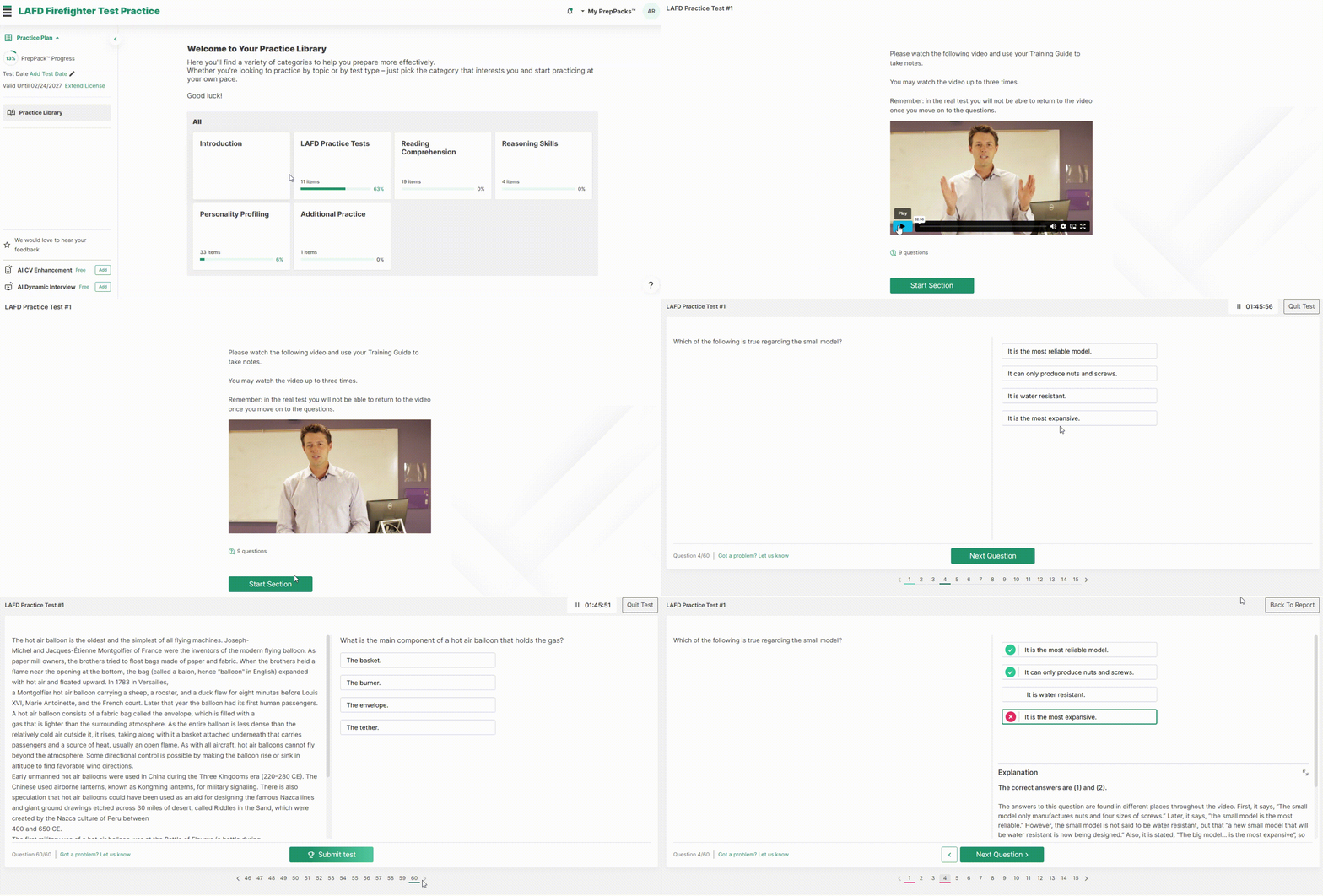
JobTestPrep's LAFD FCA firefighter test prep has recently been upgraded based on expert research and user feedback in order to ensure that you receive the highest quality practice available. You can rely on our experience and expertise to provide you with the tools you need to get the high score you need.

At JobTestPrep, we've helped thousands of candidates pass competitive hiring assessments since 1992. Our materials are designed by psychometric experts and updated based on real candidate feedback to reflect the latest test formats.

The LAFD written test has a minimum passing score of 70, but this is an extremely competitive examination and only those candidates with the highest scores will continue in the selection process. Passing gets you onto the eligible list - it does not get you an interview. LAFD then uses stratified random sampling to select candidates from that list based on hiring needs, meaning hundreds of candidates who pass the FCA assessment never advance. The practical target is as high as possible, not just 70. For a department that receives many thousands of applicants for a few hundred positions, your FCA score is effectively your hiring rank.
Yes - and this catches many candidates off guard. The 4-hour total is not one continuous block of time you manage yourself. Each of the 5 sections has its own separate timer. Within each timed section, you first get time to review the Training Guide and watch the video, then a separate time limit kicks in for the questions. If you haven't started the questions when the review period ends, the exam moves you forward automatically after 30 seconds. There is no flexibility between sections.
Yes. Several question types on the FCA require you to select multiple correct answers, and you only receive full credit if you identify all of them. A common mistake is treating every question as single-answer multiple choice and moving on after picking one option. The official PSI preparation guide for the FCA explicitly notes this - particularly for the video-based sections where candidates must select all actions required in response to a status message, for example. Our FCA practice test includes multiple-response questions in the correct format so you are not encountering this mechanic for the first time on test day.
An FCA test PDF or a set of static firefighter test questions and answers can show you what the content looks like - but the FCA is a timed, computer-based, video-driven assessment that cannot be replicated on paper. The video comprehension sections require you to watch footage, take notes in a physical booklet, and answer questions under strict time pressure without being able to rewind. No PDF captures that. No static FCA practice test replicates the drag-and-drop question format, the audio questions delivered through headphones, or the real time pressure across 4 hours. Our FCA test prep is built around full simulations that mirror the exact interface, timing, and question types of the real assessment - because familiarity with the format is as important as knowing the content. An FCA study guide is a starting point; a timed simulation is what actually prepares you.
No. The FCA arithmetic section requires you to type your answer directly into a field with no calculator and no multiple-choice options to fall back on - though scratch paper is permitted for working through calculations.
The FCA does not test firefighting knowledge because LAFD teaches you that in the academy. What it tests is how quickly you learn new information, process it under pressure, and apply it accurately - which is exactly what every shift demands. The LAFD responds to approximately 1,368 emergency incidents every day across 106 fire stations covering a 468-square-mile jurisdiction. On every one of those calls, firefighters receive new information in real time - verbal instructions, changing conditions, equipment status updates - and must act on it correctly with no second attempt. The video-based reasoning section of the FCA directly simulates this: watch, absorb, take notes, answer without replay. The self-description section, which is worth 50% of your final score, measures the behavioural traits - conscientiousness, adaptability, teamwork - that determine whether someone performs under the conditions firefighting actually involves. No prior firefighting knowledge is required or relevant - the FCA is a learning ability test, not a knowledge test.
The LAFD is one of the largest fire departments in the United States, with 3,246 uniformed fire personnel across 106 neighbourhood fire stations. Academy recruits start at $87,883 per year with full medical, dental, vision, and pension benefits from day one. After probation the salary rises significantly, and top earners with overtime and specialized roles can exceed $231,400 annually. Firefighters work 24-hour shifts and, once probation is completed, can pursue specialized roles including Fire Inspector, Scuba Diver, USAR, Swift Water Rescue, Helicopter Pilot, and Arson Investigator. The competition for these positions is intense - thousands of candidates apply each cycle for a few hundred spots, which is exactly why investing in proper FCA test prep rather than relying on a free FCA test PDF matters so much. One attempt, one window, one shot at the eligible list.
After completing your payment, you will receive two emails: a payment receipt and a login link with your account details. Once you log in and reset your password, you will have instant, unlimited access to your PrepPack.