 The FEAST Test for Air Traffic Controllers - Free Practice and Guide
Last Updated: Mar 16th, 2026


The FEAST Exam is no small undertaking, yet it is the gateway to air traffic control in Canada (where it's known as the In-Person assessment), much of Europe, and several other areas of the world.
To help you surmount this challenge, we've put together this informational explainer page, which features sample questions that mimic the FEAST I, details about the assessment, and success tips.
We've also created a complete FEAST I prep course, which has so far been used sucessfuly by candidates from around the globe. It is the only FEAST I practice pack that allows you to practice both for both FEAST I and the online screening assessment that precededs it- NAV Canada Online Assessment in Canada and the Hudson A-RAT 3R in Europe.
FEAST Test Online Preparation
One Month's Access to:
- A diagnostic test to plan your practice
- 24 FEAST 1 practice tests
- Full-Length FEAST Simulation Test
- 3 study guides with exclusive tips


About the FEAST Eurocontrol Test Structure
The FEAST (First European Air Traffic Controller Selection Test) is a challenging screening test for Air Traffic Controller applicants, provided by Eurocontrol. Like the ATSA Test, the FEAST measures essential abilities expected of ATC candidates:
- FEAST 1 - A series of timed aptitude tests that require high attention and accuracy.
- FEAST 2- Two simulations (the DART and the Multipass Test) that assess multitasking in an ATC-related environment.
- FEAST 3- A personality questionnaire.
The number of FEAST tests you receive may change depending on your Air Navigation Service Provider (ANSP). In addition, you may be asked to complete additional tests, like the Wonderlic Assessment given by Nav Canada.

FEAST II
FEAST DART Test and FEAST Multipass Test
The second test is about double in length as the first one and takes about 4 hours to complete. Round two includes two work samples: the Dynamic ATC Radar Test (DART) and the FEAST Multipass Test.
Both these tests are sophisticated and require an acute ability to multi-task; however, they require no specialized knowledge and are replete with detailed instructions to ensure that every faucet is fully clarified before beginning.
About to take the FEAST2 test? please feel free to contact us with any questions, we will be happy to help.
FEAST III
FEAST Personality Questionnaire (FPQ): This segment of the test aims to measure your personality traits and behavioral characteristics. You are presented with phrases and scenarios and need to answer them on a scale of 1-5 (agree - not agree.) The test takes about 35-40 minutes to complete.
The Last Stage- Medical Examination
The last stage is the medical exam, the only part of all FEAST tests that you cannot prepare for. The medical review is conducted according to national regulations.
If you pass all these tests, you will be well on your way to becoming an air traffic controller!
FEAST I Free Sample Test
The FEAST 1 is a series of 11 aptitude test sections that assess logical reasoning, attention to fine detail, memory, spatial orientation, and knowledge of the English language.
As mentioned, this test takes 2.5 hours- you will have a 10-minute break between each test session. On the real test, these short breaks will be invaluable for you, since questions can drain you out.
For example, on memorization question you'll have as little as 6 seconds to memorize complex numbers and variants:
Gauges Memorization - Part 1
Observe the following gauges, try to commit them to memory as best you can:
Got it? Great!
Scroll to the next question. We'll get back to this.
Try the following sample question from the Cube Folding test, an infamous part of the FEAST that many candidates find very difficult:
Cube Folding
This is a test of your 3D Visual-Spatial Ability. Observe the following flat cube:
Which of these diagrams represent the above cube after it has been folded?
If you rotate cube (C) 180 degrees clockwise so the purple facet is above the red facet, you can see that the green facet is to the left of the red facet, as it is on the unfolded cube.

Answer (A) is incorrect because the red and dark blue facets are on opposite sides and can’t touch.
Answer (B) is incorrect because the purple and light blue facets are on opposite sides and can’t touch.
Answer (D) is incorrect because in the unfolded cube when the red facet it above the light blue facet, the green facet is to the left of the red facet and not to its right like in cube (D).
Did you spot the correct answer? On the FEAST test, you'll have 1 minute to answer each of the questions in this section.

TIP:
A good way to inuit the answer is to remember that on the flat layout, two adjacent faces cannot end up on opposite sides of the cube. This will help you eliminate any answer that doesn't follow this rule.
More tips for solving cube questions are available in our FEAST Preparation pack.
Next, let's look at a conflicting paths question. Here, you will see triangles, representing airplanes pointing in different directions.
You'll then have to determine whether any two triangles are in a collision course..
This test measures your visual perception and ability to quickly recognize any possible conflicts ahead, an extremely important ability of Air Traffic Controllers. Note that in the actual FEAST test, the design and procedure may differ slightly.
Conflicting Paths Sample Question
Determine whether there is a pair of triangles facing each other in a conflicting path.
Answer: B. No conflict
This may feel counterintuitive, as certain pairs of triangles do appear to be headed for collision:
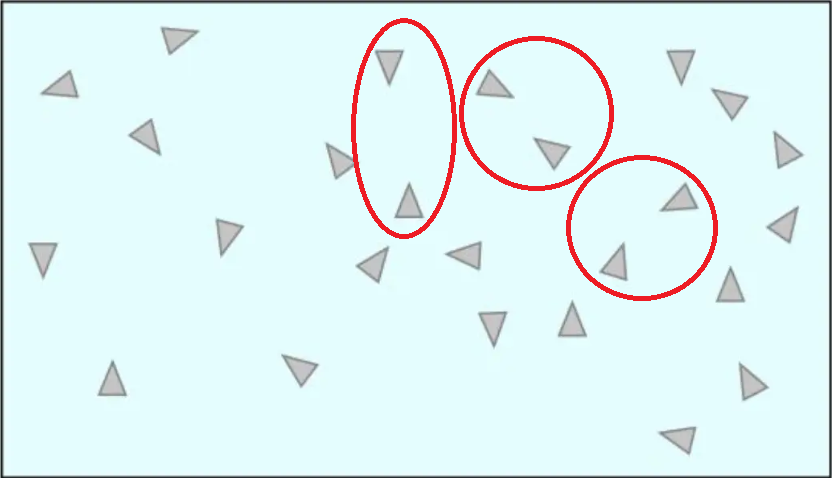
However, the FEAST definition for conflicting paths is any two aircraft in a headed for a direct, head-on collision, like this:
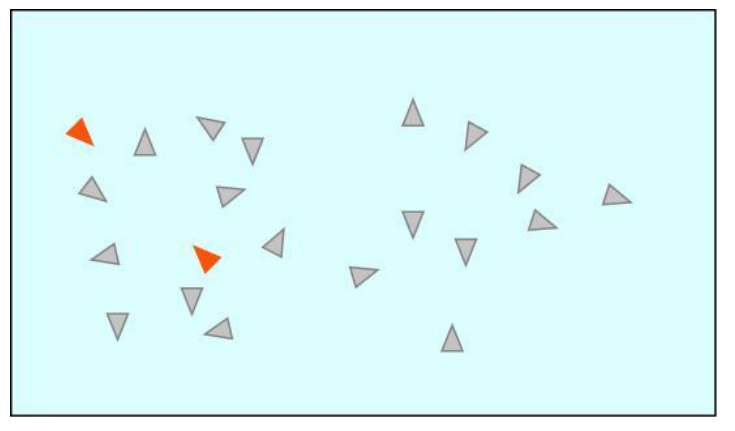
So this test isn't meant to be an accurate depiction of what counts as a collision risk in the real world. Rather, it is a measure of your attention to detail. The trick is being able to identify a pair of triangles pointed directly at each other, inside a cluster of other triangles, and within a very limited amount of time.
TIP:
Even though this may look easy, on the actual test, you will have 5-7 seconds per question. Scanning the whole screen and making a decision within that time is no easy task. Practising these questions helps cut down the time it takes to scan and recognise whether there is a conflict.
Next. We'll look at a spatial orientation question. This section is all about perspective-taking. You will need to determine the location of an object relative to a figure on the screen, rather than from your own perspective.
Spatial Orientation Sample Question
The character could be placed in different orientations, so you'll have to picture the shape as the character sees it.
Memory is one of the core cognitive abilities measured in FEAST by several sub-tests. Here, you'll be tested on your ability to remember highly detailed gauges.
Gauges Memorization - Part 2
Remember the first image on this page? Try to recall which of these images appeared in it:
TIP:
Success in these questions relies not only on memory but on attention to detail. When you see the original images, don't just try to remember the general shape or direction of the pointers.
Look at the specific number they are pointing to, or the closest number. Then try to commit these numbers to memory in a specific order.
Moving on to the next question type: Flight Strategy Questions will test your ability to organize flight paths based on the provided diagrams and constraints. Here's an example of a flight strategy question from our full preparation pack:
Flight Strategy Test Sample Question
Look at thefollowing diagram:
In what order will the flights land?
Other FEAST Sections
Symbols Memorization
This is yet another test of your memory, but this one introduces an additional challenge: distraction and set-shifting.
Between being presented with 12 symbols to memorize and being asked to reproduce those symbols, you will solve 15 math questions. The purpose of these is to prevent you from keeping the symbols in your working memory by forcing you to be occupied with a different type of task.
Number Recall
This task involved memorizing a different kind of information - auditory information.
You will listen to a spoken statement which includes a number. This may be a short number or contain up to 7 digits. You will then have to remember what that number was.
Several more test sections examine your ability to remain highly attentive, react fast, and split your attention between several tasks:
- Ball on the Wall (Multitasking)
- Reaction Speed
- Correlative Orientation
- Follow the Dot
Practice Feast Simulations to Take the Test at Your Best
Even though many candidates believe they cannot practice for ATC tests, these tests rely on processing speed, attention, and spatial abilities, which can all be easily and quickly improved using accurate practice materials.
Our FEAST I Practice Pack is expertly curated to accurately match the FEAST I test questions and time limit. Its goal is to familiarize you with the assessment, reduce testing anxiety, and help you hone the skills measured by the real FEAST I.
A sneak peek into our FEAST Course
FAQs
If you fail the FEAST, you'll have to wait at least two years before being able to take it again, in some countries (like Hungary) you can only take it once.
Yet, you might feel hesitant to take the FEAST test for the second time, since some argue that people who failed the FEAST are less likely to do well on the rest of the ATC training. This is completely false- many certified Air Traffic Controllers took several attempts to get in or get a license.
Keep in mind that ATCs go through a training program to get certified - A huge part of this job is the ability to learn and improve core spatial, multitasking, and other skills. The more effort you dedicate to practice, the more these skills improve, allowing you to understand and solve new situations more quickly.
So, if you want this job, you already have what it takes to get it. Just put in your best effort and practice cognitive questions that work on those skills.
Sharpen your cognitive skills with our free Cognitive Ability Practice Test!
The test is applicable for ATC and FSS positions, among them, are several positions and specialties that encompass air traffic control, including:
NAV Canada Air Traffic Controller (ATC):
- Area Controllers (IFR) – In this position, you will use sophisticated equipment to ensure the safe flight of multiple aircraft across multiple routes. For instance, if a plane is travelling too fast or if there is not enough distance between two aircraft, it is your job to warn the pilots.
- Tower Controllers (VFR) – These guys are in charge of making sure that runways and taxiways run smoothly and that the air space in and around the airport is orderly. Depending on the airport, you may have to work in large groups, so teamwork is crucial.
- Flight Service Specialists (AAS) – These specialists are tasked with providing pilots with crucial information, including which runway to choose. Some also need to keep remote airports updated with information like emergency landings and more.
- Flight Service Specialists (FIC) – These guys are like in-flight weather forecasters, plus they help lead rescue search efforts in the event flights go off course or missing.
Looking for a different test? Check out our Civil Service Exam and get the most accurate preparation for your exam!
Navigate Through JobTestPrep's Aviation Category


