The Long Wait to Quantico: Why the FBI Hiring Process Takes So Long
Updated: July, 2026 | 6 min read
Navigating the FBI Special Agent hiring process requires long-term planning. Due to Top Secret (TS/SCI) security clearance reviews, field office background checks, and academy seating constraints, the timeline typically spans 12 to 18 months. This guide outlines the exact Special Agent Selection System (SASS) pipeline, pinpoints major background check bottlenecks, and explains how to stay competitive while awaiting your class date.
There is no single fixed number, but there is an honest range. While some baseline estimates cite six months as a floor, official FBI Special Agent hiring guidelines indicate the process typically spans 12 to 18 months, largely driven by the depth of Top Secret (TS/SCI) clearance background checks and field office investigations. Candidates applying for specialized roles or those whose background checks touch multiple states, employers, or countries often land on the longer end of that range.
The FBI hiring process is not a single assembly line. It is a series of independent reviews, run by different teams, each with its own workload and its own standard for “done.” A fast phase can't make up for a slow one, because every candidate has to clear all of them, which is the main driver behind the wide timeline range.
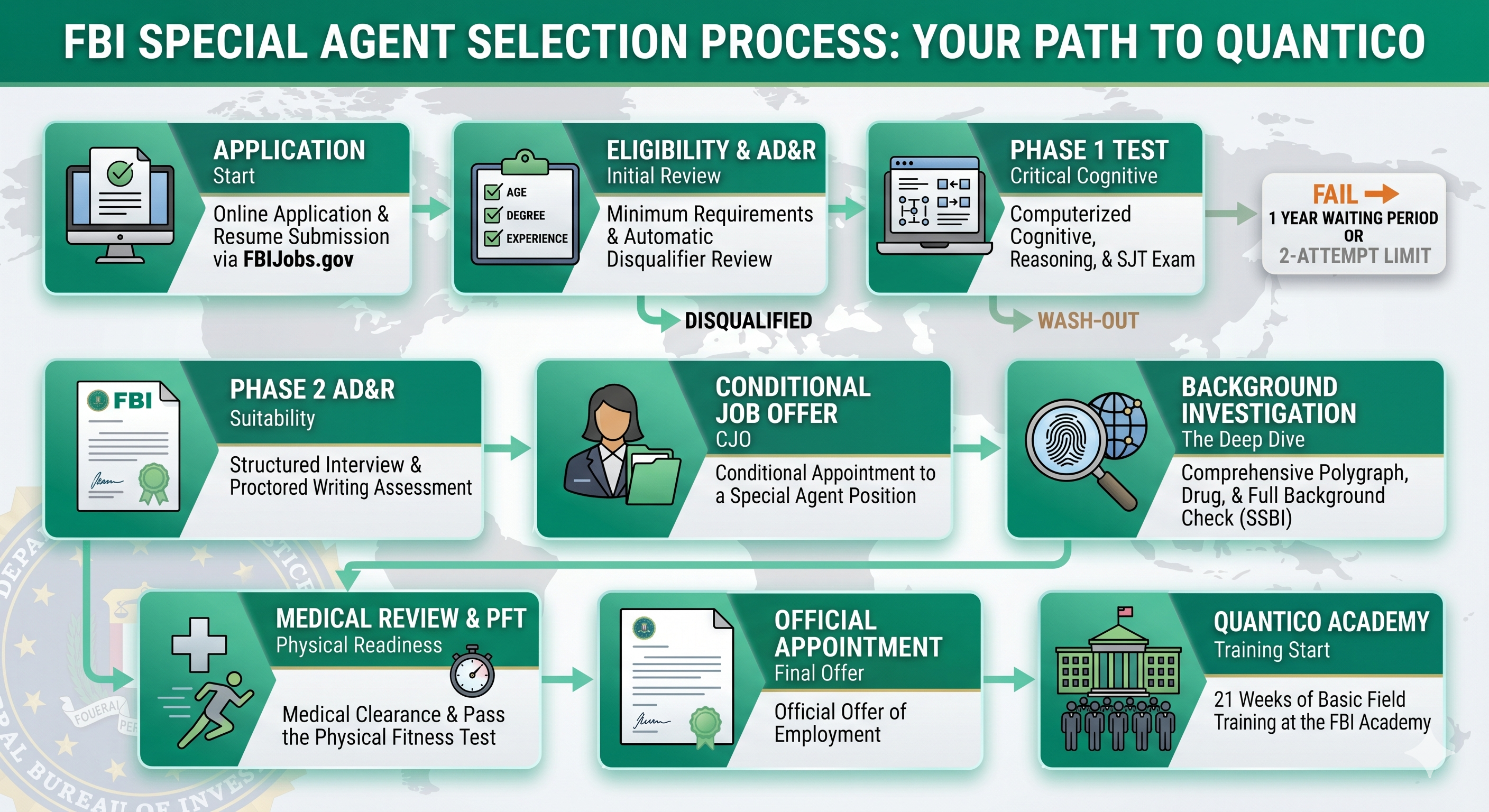
Understanding why the wait feels so long starts with seeing the full shape of the process.
Each of the first few steps (application, Phase I, Phase II) has a relatively predictable turnaround because they are scheduled and self-contained. The slowdown almost always starts after the conditional offer, when the background investigation, medical review, and clearance process begin running in parallel. That is where most of the “long wait” candidates describe actually happens, and it is worth understanding why.
If you have not yet reached the Phase I or Phase II stage, the Special Agent Selection System overview breaks down the scoring criteria and format for each of those exams.
| Stage | Typical Timeframe | What's Happening |
| Application & Screening | 2 to 4 weeks | Eligibility verification and preliminary qualifications review |
| Phase 1 Assessment | 2 to 4 months | Cognitive testing, Meet & Greet session |
| Phase 2 Written Assessment |
14 days after Meet & Greet completion |
Writing evaluation |
| Official Physical Fitness Test (PFT) |
30 days after Meet & Greet completion 2 additional attempts within 6 months of Meet & Greet completion date |
In-person evaluation of core physical readiness standards |
| Phase 2 Interview |
Within 90 days after invitation is sent |
In-person, structured interview with 3 special agent assessors |
| Conditional Offer & Security Onboarding |
1 to 2 months |
COA issuance, e-QIP (SF-86) submission, and polygraph scheduling |
| Background Investigation & Adjudication |
6 to 12+ months |
Field office background checks, financial audits, polygraph exam, and TS/SCI clearance review |
Note: These ranges are approximate and can shift based on FBI hiring volume and a candidate's individual background, so treat them as a general shape of the process rather than a guarantee.
A security clearance is not a background check in the casual sense. It is a structured review of a candidate's entire adult life: financial history, foreign contacts, past travel, social media activity, associations, and any pattern that could create a vulnerability once someone holds access to sensitive information. Because agents are trusted with classified material from day one, there is no shortcut version of this review.
Every additional year of adult history adds more ground for investigators to cover!
A 24-year-old applicant with one employer and no international travel will typically move faster than a 34-year-old applicant with multiple past addresses, several employers, and time spent living abroad. That is not a penalty against experienced candidates, it is simply more material to verify.
Your background investigation is not run entirely out of FBI Headquarters. Much of the legwork, including interviews with neighbors, past employers, and personal references, along with scheduling of the polygraph examination, is coordinated through field offices local to where you have lived and worked. If your history spans multiple regions, your file may need coordination across several field offices at once, each working through its own caseload alongside yours.
The background investigation is often the single biggest source of timeline unpredictability, because it depends on the availability of people outside the FBI's direct control: former supervisors who are hard to reach, references who take weeks to respond, or records requests from other agencies and institutions.
The fit for duty medical review is a required step before a final placement, and it exists to confirm a candidate can safely perform the physical demands of the job and academy training. It is common for this review to trigger a request for additional documentation, a follow-up with a specialist, or clarification on a past injury or condition. None of this means a candidate is being disqualified. It usually means the file needs one more piece of paperwork before it can be closed out, and that single request can add several weeks to the timeline on its own.
Staying in strong physical condition throughout the wait matters here too.
Our physical fitness test guide covers what the standards actually look like so you are not caught off guard at this stage or the pre-Quantico retest.
Even once a candidate clears every review, they still have to wait for an open seat in a New Agent Trainee class at Quantico. Class sizes are limited, and scheduling depends on the FBI's current hiring needs and academy capacity, not on any single applicant's file. Interview panels, examiners, and processing field offices also operate on their own calendars, and a candidate's file simply waits its turn alongside everyone else's in that office's queue.
A candidate who has fully cleared every stage can still wait for the next available class. This is one of the most misunderstood parts of the process: a delay at this point is not a red flag, it is a capacity issue.

This is the question that matters most once you have submitted your paperwork and the process moves out of your hands. There are still things you control.
Treat the wait as a preparation window, not a delay to survive. Candidates who use the months between stages tend to arrive at each next step more ready than those who simply wait for a notification.
If you are early in the process, focus first on a Phase I exam free practice and understand the general career opportunities so you know what the FBI is evaluating at each checkpoint. If you are pursuing a role such as intelligence analyst, the requirements and testing structure differ from the Special Agent track, so it is worth confirming which pipeline applies to you early rather than assuming.
If you are past the conditional offer and into the background investigation, your best use of time shifts toward staying consistent: fitness, financial stability, and responsiveness to any investigator requests. There is no way to speed up an investigation that depends on outside references, but there is a way to make sure your file is never the one sitting because of a missing document on your end.
Some delays are unavoidable. Others are self-inflicted. The most common ones include missing a deadline to schedule a test or fitness evaluation, failing to report a change in address or employment, and giving inconsistent information across different parts of the application. Investigators cross-reference details across your file, and inconsistencies, even minor ones, usually require a follow-up before your file can move forward. The most frequent errors at the earliest stage, including how candidates misjudge the Phase I scoring format, are broken down in common Phase 1 mistakes.
Official FBI Special Agent hiring guidelines indicate the process typically spans 12 to 18 months, though individual timelines vary based on background complexity, TS/SCI clearance depth, and current hiring capacity.
Background investigations depend on outside references, past employers, and coordination across field offices local to where a candidate has lived, which means the pace is not fully within the FBI's control.
Yes. Intelligence analyst roles follow a different testing and evaluation structure than the Special Agent Selection System, so timelines are not directly comparable.
Not directly, but keeping your information accurate and current, and responding quickly to any investigator requests, prevents avoidable delays on your end.
The polygraph is one part of the broader background and suitability review. For details on what to expect, see our FBI polygraph guide.
Different roles go through different screening and evaluation tracks, so scheduling, testing requirements, and background review scope can vary between them.
Physical fitness, structured writing, and situational judgment are all retested or reassessed at later stages. Our FBI agent skills guide breaks down what to focus on.
Unreported life changes, financial red flags, and inconsistencies discovered during the background investigation are the most common causes of delay, and in more serious cases, can affect an offer.
The FBI hiring process is long because it is thorough, not because any one candidate is being slowed down on purpose. Security clearance reviews, field office coordination, the polygraph examination, medical review, and academy scheduling all move on their own timelines, and they add up to a process that typically spans 12 to 18 months. The candidates who come out of that wait strongest are the ones who treat it as preparation time. If you are still ahead of your Phase I or Phase II testing, that is the best place to start.

I am Kemi Cohen, Personality Test Developer and Personality Expert at JobTestPrep. I hold an MSc in Organizational Psychology. My role includes developing assessment questions and providing expert strategies for our PrepPacks.
Related FBI Blog Articles: