 Amazon OA: The Complete SDE Online Assessment Guide [2026]
Updated: June 4, 2026
The Amazon Online Assessment (OA) is Amazon's pre-employment screening test for Software Development Engineer candidates. Depending on the role, it can include coding challenges, work simulations, system design exercises, and work style assessments.
Many candidates focus their OA preparation almost entirely on coding. That's a mistake.
While coding is an important part of the Amazon OA, it's only one piece of the puzzle. You'll also need to make sound engineering decisions, prioritize competing tasks, and demonstrate the work style Amazon looks for in its software engineers.
Our Amazon SDE OA PrepPack helps you prepare for every part of the assessment with:
- Full-length Work Simulation and System Design practice tests with detailed explanations
- Interactive coding questions with step-by-step feedback and solution walkthroughs
- Work Style Assessment training based on Amazon's Leadership Principles
- Role-specific preparation for Intern, SDE I, and SDE II positions
Note: If you're applying for a non-SDE role — such as AWS, management, MBA, warehouse, or finance — your Amazon online assessment may be structured differently. See our broader Amazon Assessment Test guide for those roles.
Amazon SDE OA PrepPack
30 days of access to:
- Complete Prep for Every Amazon OA Section
- Work Simulation & System Design Practice Exams
- 6 Full-Length Coding Simulations (all levels)
- OA-Specific & General Work Style Training
- Covers Intern, SDE I & SDE II Roles
- Score Reports & Detailed Explanation based on Amazon's Leadership Principles


What’s Inside the Amazon SDE OA PrepPack
Our Amazon SDE OA PrepPack is designed to help you prepare for every part of the assessment, from Coding Questions and System Design to Work Simulation and Work Style Assessments.
The package combines realistic practice tests, detailed explanations, and role-specific preparation for Intern, SDE I, and SDE II candidates.
Always up to date: Amazon regularly updates its hiring process and assessment formats. We continuously review official Amazon resources, candidate reports, and customer feedback to ensure our preparation materials remain relevant and aligned with the latest version of the Amazon OA.

Customer Reviews

Why Trust JobTestPrep?
For more than 25 years, JobTestPrep has helped candidates prepare for hiring assessments used by employers around the world. Our preparation materials are developed by assessment experts, reviewed regularly, and updated to reflect changes in real hiring processes.
Our goal is simple: provide realistic practice that helps candidates understand what to expect and prepare with confidence.

About the Author

David Meshulam


Amazon OA Structure: What to Expect in 2026
The exact structure of the Amazon OA varies by role, but most SDE candidates can expect a combination of coding, work simulation, system design, and work style assessments.
Here's a quick breakdown by role:
| Role | Coding | Work Simulation | System Design | Work Style |
| Intern | ✓ | – | – | ✓ |
| SDE I | ✓ | ✓ | – | ✓ |
| SDE II | ✓ | – | ✓ | ✓ |
Each section measures a different skill set and requires a different preparation strategy. Use the links below to jump directly to the section you want to learn more about, including sample questions, scoring criteria, and practice resources.
 Section 1: Coding Assessment
 Section 2: Work Simulation
 Section 3: System Design
 Section 4: Work Style Assessment
Amazon OA Coding Assessment
The Coding Assessment is the most technical part of the Amazon Online Assessment. Regardless of the role, you'll be asked to solve two coding questions in an online coding environment using the programming language of your choice.
The exact format depends on the role you're applying for:
| Role | Coding Questions | Time Limit |
| Intern | 2 | 70 |
| SDE I | 2 | 70 |
| SDE II | 2 | 90 |
Not all Amazon OA Coding Assessments are the same. Use the tabs below to see what to expect for your role.

Amazon Coding Assessment for Intern and SDE I roles
For Intern and SDE I candidates, the Amazon Coding Assessment focuses on core programming skills, data structures, algorithms, and problem-solving ability.
Amazon uses this assessment to evaluate how effectively you can solve technical challenges while writing correct, readable, and efficient code. In addition to arriving at the right answer, your solution should be easy to understand, maintain, and explain. On top of that, candidates are expected to write, test, and debug their solutions within the time limit (70 minutes).
The Coding Assessment typically covers data structures and algorithms commonly used in technical interviews. While the exact questions vary, candidates frequently encounter problems involving:
- Arrays and Strings
- Hash Maps and Sets
- Linked Lists
- Trees and Binary Trees
- Graphs
- Queues and Stacks
- Breadth-First Search (BFS)
- Depth-First Search (DFS)
- Sorting and Searching
- Sliding Window and Two-Pointer techniques
- Recursion and Divide-and-Conquer
- Basic Dynamic Programming
Note: you can complete the assessment in several programming languages, including C, C++, C#, Go, Java, JavaScript, Kotlin, Objective-C, Python, Ruby, Scala, and Swift.
Because the assessment focuses on problem-solving rather than language-specific expertise, it is generally best to use the language you know most well.
Sample OA Coding Assessement Question - Intern / SDE I roles
A conveyor belt scanner produces a sequence of SKU IDs. A priority restock request requires certain minimum quantities of some SKUs.
Given the scanned sequence and the required quantities, find the length of the smallest contiguous window that contains at least the required quantity of every requested SKU. If no such window exists, return -1.
Input format
- The first line contains an integer n, the number of scanned SKUs.
- The second line contains n integers scan[0], scan[1], ..., scan[n-1].
- The third line contains an integer m, the number of distinct required SKUs.
- Each of the next m lines contains two integers: sku_id and required_count.
Output format
Print one integer: the minimum valid window length, or -1 if no valid window exists.
Constraints
- 1 <= n <= 200000
- 1 <= m <= 200000
- 0 <= scan[i] <= 10^9
- 1 <= required_count <= n
- All sku_id values in the requirement list are distinct.
Sample input
8
5 1 2 1 3 2 1 4
3
1 2
2 1
3 1
Sample output
4
Explanation
The smallest valid window is [1, 3, 2, 1], which contains:
- SKU 1 twice
- SKU 2 once
- SKU 3 once
No shorter contiguous window satisfies all requirements.
Sample input
5
7 7 2 7 8
2
7 2
9 1
Sample output
-1
Hints
- You do not need to track counts for every SKU in the stream, only for SKUs that appear in the requirement map.
- Use a sliding window with two pointers.
- Keep track of how many required SKU types are currently “satisfied”.

Amazon Coding Assessment for SDE II Roles
The Amazon SDE II Coding Assessment is designed for experienced software engineers and places greater emphasis on optimization, technical decision-making, and code quality than the assessments used for Intern and SDE I candidates.
While the coding questions are generally more challenging, the biggest difference is not necessarily the difficulty of the algorithm itself. Amazon also evaluates how well you justify your decisions, optimize your solution, and balance efficiency with maintainability.
According to Amazon's engineering team, successful candidates are evaluated across five key areas:
| Amazon Evaluates | What It Means |
| Problem Understanding | Can you identify the requirements, constraints, and edge cases? |
| Coding Ability | Can you produce correct, readable, working code? |
| Data Structure Selection | Did you choose the most appropriate tool for the problem? |
| Runtime Complexity | Can you analyze and optimize your solution when necessary? |
| Simplicity | Is your solution easy to understand, maintain, and explain? |
Note: One of the biggest misconceptions about the SDE II Coding Assessment is that the most complex solution is always the best one. In practice, Amazon often prefers solutions that are clear, efficient, and easy to justify over implementations that are unnecessarily complicated.
A practical way to approach coding questions is to work through them systematically:
- Read the entire problem before writing any code.
- Identify the requirements, constraints, and potential edge cases.
- Determine the expected inputs and outputs.
- Select an appropriate data structure.
- Build a working solution.
- Review the solution for correctness and efficiency.
Following a structured process can help you avoid common mistakes and make better use of the limited time available during the assessment.
Candidates can choose from a wide range of programming languages, including C, C++, C# , Go, Java, JavaScript, Kotlin, Objective-C, Python, Ruby, Scala, and Swift. As with other Amazon coding assessments, using the language you are most comfortable with is usually the best strategy.
Sample OA Coding Assessement Question - SDE II roles
You must deliver packages to n fulfilment centres in fixed route order. Centre i requires orders[i] packages and has a flag fragile[i]:
- fragile[i] = 0 means the centre is normal.
- fragile[i] = 1 means the centre is fragile.
You may use at most m trucks.
Each truck must serve one contiguous block of centres. If a truck serves only normal centres, it can carry up to C packages. If a truck serves at least one fragile centre, then p units of capacity are consumed by special packaging, so it can carry only C - p packages of actual orders on that block.
Find the minimum integer capacity C that allows all centres to be served using at most m trucks.
Input format
- The first line contains three integers: n, m, and p.
- The second line contains n integers: orders[0..n-1].
- The third line contains n integers: fragile[0..n-1], each either 0 or 1.
Output format
Print one integer: the minimum feasible capacity C.
Constraints
- 1 <= n <= 200000
- 1 <= m <= n
- 0 <= p <= 10^12
- 1 <= orders[i] <= 10^9
- fragile[i] is 0 or 1
- Use 64-bit integers for sums and bounds.
Sample input
5 2 3
4 2 6 3 5
0 1 0 0 1
Sample output
15
Explanation
If C = 15, then any truck that touches a fragile centre can carry up to 12 actual orders.
A valid split is:
- Truck 1 serves centres [4, 2, 6], total 12, contains a fragile centre
- Truck 2 serves centres [3, 5], total 8, contains a fragile centre
So 15 works.
If C = 14, then any truck touching a fragile centre can carry only 11, and no 2-truck partition works.
Sample input
4 3 5
7 2 4 9
0 0 0 0
Sample output
9
Hints
- If a capacity C is feasible, then every larger capacity is also feasible.
- That monotonicity suggests binary search on the answer.
- For a fixed C, greedily take the longest valid contiguous block for each truck.
Master the Entire Amazon OA
Strong coding skills are important, but they won't prepare you for the Work Simulation, System Design, and Work Style sections that many candidates overlook.
Our Amazon SDE OA PrepPack provides comprehensive preparation for every stage of the assessment, including coding challenges (in Python or Java) with step-by-step explanations, realistic workplace scenarios, and Leadership Principles training.
Looking for even more coding practice? Amazon's official Coding Challenge training environment can be an excellent supplementary resource alongside your Amazon OA preparation pack.
Amazon OA Work Simulation
The Amazon Work Simulation places you in the role of a Software Development Engineer and asks you to work through a series of realistic workplace situations.
Rather than solving coding problems, you'll navigate project-related challenges, review information from different sources, and decide how to respond to requests from colleagues, managers, and stakeholders. The goal is to assess how you approach decisions and prioritize work in an Amazon engineering environment.
Sample Question - Amazon OA Work Simulation
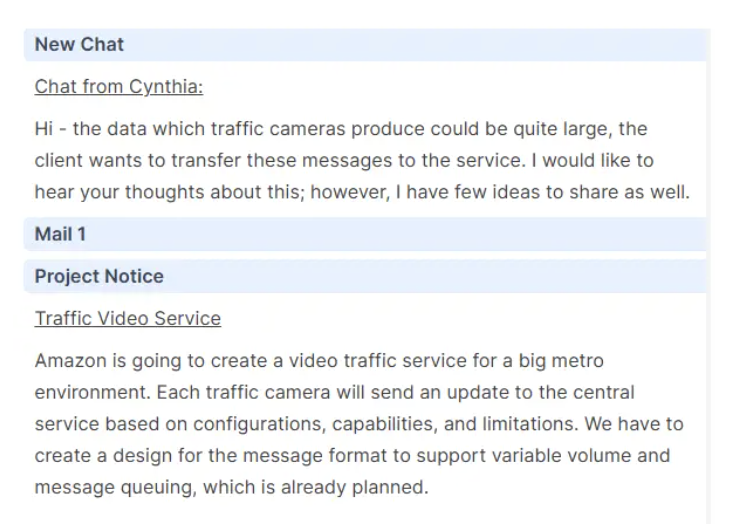
Throughout the assessment, you'll receive information gradually and may need to consult multiple resources before deciding how to respond. Some scenarios involve competing priorities, while others require balancing customer needs, technical considerations, and project deadlines.
In this example, you've just received an e-mail:
"Hi,
Thank you for joining us for this project. Our team’s responsibility is to develop the first version of the product for the messaging system. We have the following requirements from the product manager:
- Create a versioning system for the message format.
- Implement a serialization system or binary data for individual components within the messages.
- Develop a support system for messages with different motives.
- Timestamp messages and checksums
I would appreciate hearing about the actions you think would be appropriate in order to comply with the requirements..
Seo-jun"
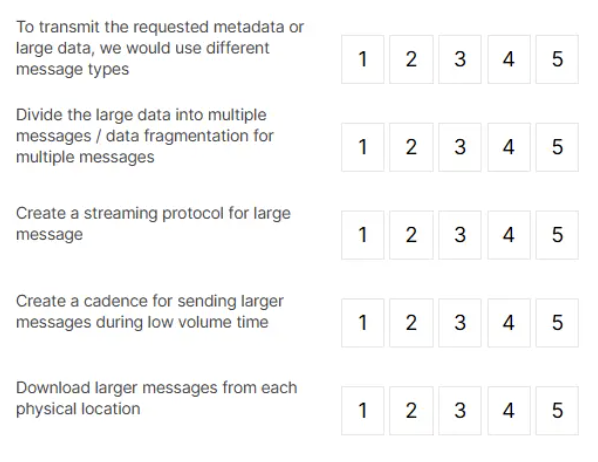
Based on all of the information received, rate each approach for its effectiveness.
1 = Extremely Effective
2 = Very Effective
3 = Moderately Effective
4 = Slightly Effective
5 = Not at all Effective
Because the assessment is designed around situations that software engineers regularly encounter, many candidates describe it as the closest thing to experiencing a typical day on the job before joining the company.
Practice a Realistic Amazon Work Simulation Before Test Day
Many candidates focus entirely on coding and underestimate the Work Simulation section. You shouldn't. Failing this section means failing the entire OA, regardless of your Coding Assessment results.
Our Amazon SDE OA PrepPack includes realistic Work Simulation scenarios, detailed answer explanations, and practice designed to mirror the format used in the real assessment. You'll learn how Amazon evaluates your decisions and gain confidence navigating the workplace situations that Software Development Engineers encounter during the OA.
Amazon OA Work Style Assessment
The Amazon Work Style Assessment is an untimed personality assessment that measures how closely your workplace preferences align with Amazon's culture and Leadership Principles.
Unlike the Coding Assessment, there are no technical questions. Instead, you'll be presented with statements and workplace scenarios designed to evaluate how you make decisions, collaborate with others, handle challenges, and approach your work.
Your responses help Amazon determine whether your natural work style is a good fit for the expectations placed on Software Development Engineers.
The Amazon Work Style Assessment for SDE candidates consists of two separate surveys:
Sample Question - SDE Work Style Assessment
When you're brought into a project midway through, which of the following methods are you most inclined to take?
- Create my own project plan so that I’m able to comprehend the next steps.
- Consult with end-users on a regular basis to ensure that product requirements are fully understood.
- To catch up, complete as much work as you can on your own.
- Look for areas where my personal abilities may contribute value to the process
Sample Question - General Amazon Work Style Assessment
Which statement is more like you, and to what extent?

Don't Guess What Amazon Wants to Hear!
Many candidates approach the Work Style Assessment by trying to pick the "perfect" answer. The challenge is that Amazon evaluates patterns and consistency across your responses, not individual questions in isolation.
Our Amazon SDE OA PrepPack includes realistic Work Style practice tests, detailed answer explanations, and guidance on Amazon's Leadership Principles so you can understand the logic behind the assessment before test day.
Amazon OA System Design Assessment for SDE II
The System Design Assessment is unique to the Amazon OA for SDE II candidates. Unlike the Coding Challenge, which focuses on algorithms and data structures, this section evaluates how you approach larger engineering problems and make technical trade-off decisions.
During this part of the assessment, you'll be presented with realistic engineering scenarios and asked to evaluate potential solutions. Rather than writing code, you'll need to demonstrate sound architectural thinking and an understanding of scalability, reliability, and maintainability.
All System Design questions are multiple-choice and this part of the OA takes about 15 to 20 minutes.
Common topics include, but are not limited to:
- Horizontal vs. vertical scaling
- SQL vs. NoSQL databases
- Caching strategies
- Content Delivery Networks (CDNs)
- Load balancing approaches
- Message queues and event processing
- Fault tolerance and resiliency
- Rate limiting and traffic management
Tip: You don't need to design an entire distributed system from scratch. Focus on understanding the strengths, weaknesses, and trade-offs of common architectural patterns. Most questions are designed to assess decision-making rather than memorization.
Prepare for System Design Questions
The decision-making skills assessed in Amazon's SDE II System Design section are integrated throughout our Work Simulation practice tests, helping you build confidence before test day.
FAQs
The Amazon Online Assessment (OA) is a pre-employment assessment used to evaluate Software Development Engineer candidates before the interview stage.
The exact format depends on the role. Intern and SDE I candidates typically complete a Coding Assessment, Work Simulation, and Work Style Assessment. SDE II candidates complete a Coding Assessment, System Design Assessment, and Work Style Assessment.
The purpose of the OA is to evaluate not only your coding ability, but also your decision-making, problem-solving approach, and alignment with Amazon's Leadership Principles.
No. While all candidates complete a coding assessment, the overall structure varies by role. For example, SDE II candidates complete a System Design Assessment, while Intern and SDE I candidates complete a Work Simulation. The time limits and assessment components may also differ.
The difficulty varies by role and assessment version. Intern and SDE I candidates typically encounter questions covering common data structures and algorithms, while SDE II candidates can expect a stronger focus on optimization, scalability, and engineering judgment. Many candidates compare the coding questions to medium-level technical interview problems.
In most cases, you should select the programming language you are most comfortable using. Amazon evaluates your problem-solving ability and code quality rather than your knowledge of a specific language.
For Intern and SDE I coding assessments, Amazon allows candidates to access publicly available programming references and documentation. However, private repositories, collaboration tools, and resources that require login credentials are not permitted. Browser activity may be monitored during the assessment.
Amazon's Online Assessment is monitored, although the exact level of proctoring can vary by assessment and role. Candidates should assume that assessment activity may be tracked and should follow all instructions provided by Amazon.
During coding assessments, Amazon may permit the use of publicly available programming references while prohibiting private repositories, collaboration tools, and other unauthorized resources.
The safest approach is to complete the assessment independently and rely only on resources that Amazon explicitly allows.
You can take a break after the coding challenge and before you advance to the Work Simulation and Work Style Survey sections.
You don’t need to log out to take a quick break. If, for some reason, you do need to log out, you can click on the ‘Start My Assessment’ link to log back in.
There is no fixed timeline. Some candidates receive updates within days, while others may wait several weeks. Response times can vary depending on the role, hiring team, recruiter availability, and current hiring needs.
Candidates who successfully pass the Online Assessment are typically invited to one or more technical interviews. Depending on the role, these interviews may include coding exercises, system design discussions, and behavioral questions based on Amazon's Leadership Principles.
No. Amazon evaluates multiple parts of the Online Assessment, including coding performance, Work Simulation results, System Design performance (for SDE II candidates), and Work Style Assessment results. Passing all coding test cases improves your chances, but it does not automatically guarantee progression to the next stage.


