Last Updated: May 5, 2026
The AWS Online Assessment is a multi-part test used in the hiring process for roles like Solutions Architect, (Cloud) Support Engineer and Technical Account Manager (TAM).
Many candidates struggle to pass because the test goes beyond technical knowledge alone. It also includes real-world scenarios and behavioral questions to evaluate how you solve problems, make decisions, and align with Amazon’s Leadership Principles.
Our AWS Online Assessment PrepPack helps you prepare the right way. It includes:
1-Month Access
For Solution Architect & TAM roles:
For (Cloud) Support Engineer/Associate roles:
Note: All practice exams include in-depth answer explanations based on Amazon’s Leadership Principles.
24/7 Customer
Service
One-Time
Payment
Developed by
Experts
Our PrepPack is built specifically for the AWS Online Assessment, so you can practice exactly what you’ll face on test day. It includes:
Looking to prepare for an AWS or Amazon Software Development Engineer (SDE) assessment? You can either add our optional SDE module to this PrepPack or explore the full Amazon SDE Assessment PrepPack.
Take a look inside the AWS Online Assessment PrepPack and explore how the practice experience is structured.
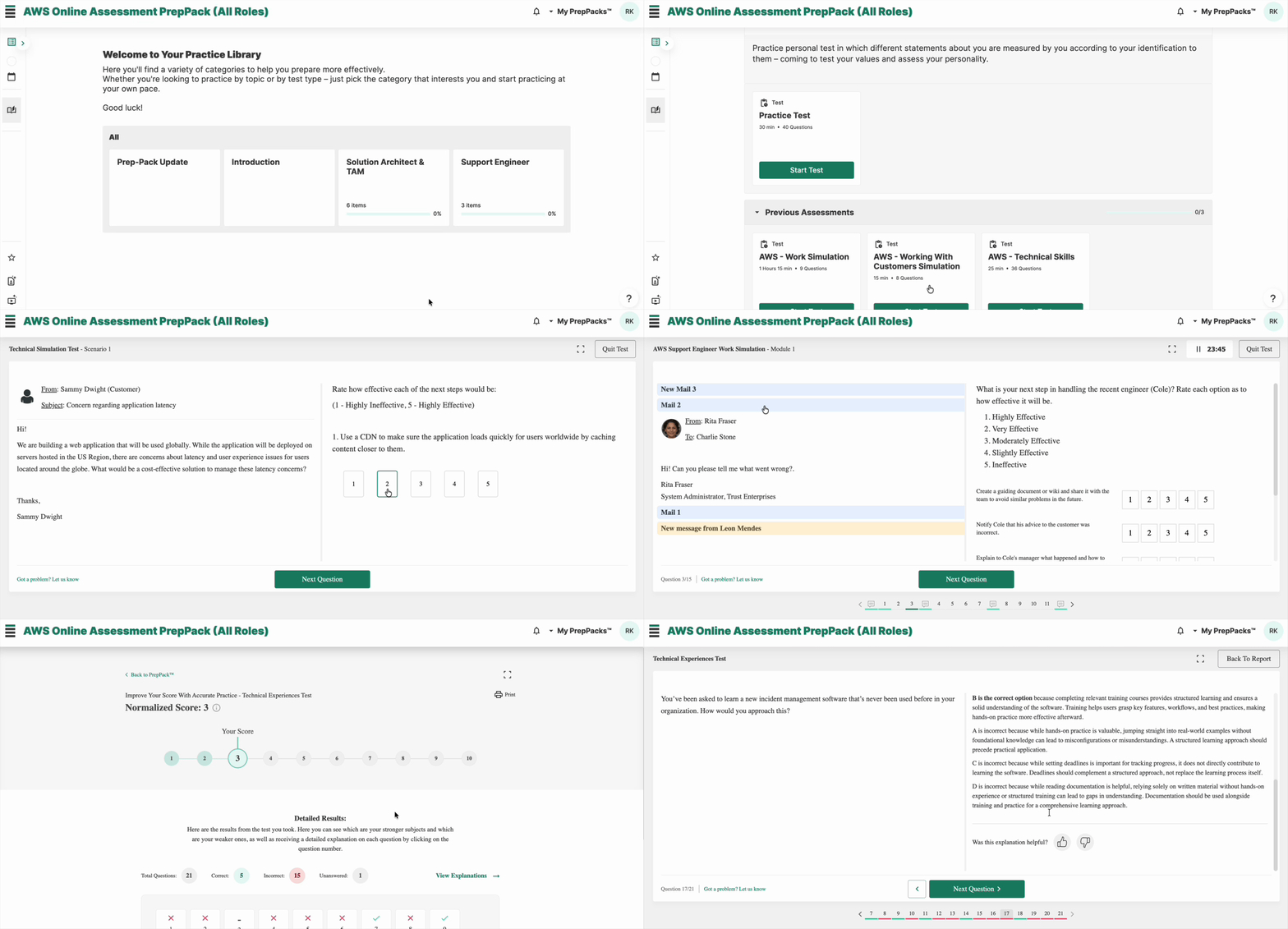
The PrepPack is designed to replicate the actual testing experience, allowing you to move through questions, review explanations, and track your performance in one place. Each part of the practice reflects a different section of the assessment, so you can get familiar with the format before the actual exam.
All materials are regularly updated using expert input and real candidate feedback, so they match the latest AWS assessment formats as closely as possible.
JobTestPrep helps candidates prepare for complex hiring assessments used by leading employers worldwide. All materials are continuously reviewed and updated to stay aligned with current assessment formats and expectations.
David Meshulam is the founder of JobTestPrep and has been working in the field of assessment preparation since 1992. With a background in psychology, he has led the development of practice materials used by candidates across a wide range of roles and industries.
His approach focuses on breaking down the logic behind assessment tests, helping candidates build consistency and confidence in their answers.
For questions, feel free to reach out to David via:
"Sample assessment gave a realistic expectation on what is going to be covered and how to best answer them based on Amazon Leadership Principles."
Eric C.
"Accurate and great preparation tests and mock questions."
Nabila O.
"Superb. Exactly what i saw on the aws online assessment test."
Ademola A.
"Very happy with the exam prep. It was a bit overwhelming at first but the explanations made so much sense that I didn’t forget the reasoning behind them. I remembered everything I learnt when I took the actual assessment. It was worth every penny! I am a happy customer!"
Tatenda M.
"The exam was exactly as seen on the material. Got invited to the interview!"
Cesar H.
"Great material. Very relevant to the AWS OA."
D. S.
The AWS Online Assessment for Solutions Architect and Technical Account Manager (TAM) roles focuses on your ability to make sound technical decisions, communicate effectively with customers, and apply your knowledge to real-world cloud scenarios.
This assessment emphasizes architecture thinking, customer interaction, and strategic problem-solving. You’ll be evaluated on how you handle technical situations, prioritize actions, and align your responses with Amazon’s Leadership Principles.
You can expect the following modules:
In this section, you are evaluated on how you apply your knowledge in practical situations, such as handling system issues, documenting processes, or responding to operational challenges.
Unlike standard knowledge tests, these questions often have multiple plausible answers, but only one reflects the most effective and professional approach.
A junior administrator accidentally ran rm -rf /var/www/html on the production web server, deleting the website content.
What’s the best immediate action?
A. Disable the rm command.
B. Implement least-privilege access controls.
C. Restore /var/www/html from the latest backup or snapshot.
D. Hold a training session on safe shell usage.
E. Set up a more reliable backup strategy.
The correct answer is C.
This immediately recovers your site with minimal downtime.
A. Disable rm: Breaks normal operations and is easily bypassed.
B. Least-privilege: Good for prevention, but doesn’t recover lost data now.
C. Restore from backup: Directly fixes the deletion and restores service.
D. Training: Helps prevent future mistakes but doesn’t fix the current loss.
E. Better backups: Essential long-term, but doesn’t recover what’s already deleted.
You’ve just deployed a new monitoring alert that notifies the team when CPU usage exceeds 80%. How should you document this change?
What’s the best approach to documenting the new alert?
A. Write a brief note listing only the alert thresholds and notification channels.
B. Document the alert thresholds, notification channels, and include examples of when and why it was added.
C. Assume everyone knows the system and only note where the alert lives in the code.
D. Skip documentation—team members can inspect the alert configuration directly if needed.
The correct answer is B.
A. Too minimal: Lists settings but omits context, making it hard to understand its purpose.
B. Complete: Covers the “what” (thresholds, channels) plus the “why” (use cases, history), aiding both new and existing team members.
C. Too assuming: Points to code only, neglecting context and reasoning, which hampers onboarding.
D. Risky: Forgoes documentation entirely, forcing others to reverse-engineer the alert and increasing onboarding time.
The technical simulation test consists of scenario-based questions presented through email and chat interactions with fictional customers and colleagues. For each scenario, you are given five possible responses, which you must evaluate by rating their effectiveness on a scale from 1 to 5. The test is untimed, allowing you to focus on carefully assessing each option.
In every scenario, your task is to determine how well each response addresses the problem while maintaining clear customer communication and strong technical accuracy.
An example:
You received the following e-mail:
From: Genna Case (Customer)
Subject: Scaling for application performance issues and mitigation
"As we prepare for the holiday season, we expect a significant surge in user traffic to our website. What strategies should we implement to prevent downtime and performance degradation and to ensure seamless scalability and reliability?"
Rate how effective each of the following solutions would be:
(1 = Highly Effective, 5 = Highly Ineffective)
Solution 1: Increase the number of servers hosting the application before the surge, then reduce the number after the holiday season ends.
Solution 2: Configure a load balancer coupled with an autoscaling group that responds to the network requests in real time and scales automatically.
Solution 3: Implement a caching mechanism to optimize performance and reduce load on the web application servers.
Solution 4: Customers should upgrade their storage system and hardware to handle increased input/output (I/O) operations.
Solution 5: Work with the customer to allocate more CPU and memory resources for their application.
Solution 1
The correct answer is: 2. Moderately Ineffective
This approach works, but it is manual and not dynamic. An automatic approach would respond in real time to the changing requirements and would be more cost effective and better for performance.
--
Solution 2
The correct answer is: 5. Highly Effective
This is the best, most optimized solution. A load balancer automatically routes traffic to available resources. With a properly configured autoscaling group with scaling policies, new resources are added and removed due to the real-time traffic requirements.
--
Solution 3
The correct answer is: 4. Moderately Effective
A caching solution like AWS Cloudfront or ElastiCache significantly improves the user experience, reducing the load on backend services and optimizing response times. However, it suffers if the requests are highly dynamic and user-specific. Caching is more effective with static and semi-dynamic content.
--
Solution 4
The correct answer is: 2. Moderately Ineffective
Upgrading the storage system and options can help optimize the experience if storage I/O is the reason for the bottleneck. However, this may not be sufficient, as high-traffic requests typically necessitate increased compute and network performance rather than I/O operations.
--
Solution 5
The correct answer is: 2. Moderately Ineffective
This is a standalone, static resolution, and while it is effective, it is not cost efficient. Vertical scaling is more expensive and less dynamic than horizontally adding and removing resources based on usage demand.
The AWS or Amazon Work Style Assessment evaluates how well your working style aligns with Amazon’s 16 Leadership Principles, which guide decision-making and behavior across the company.
The questions are designed to prevent neutral answers, requiring you to choose between options and demonstrate clear preferences. This means your responses need to be both consistent and aligned with the qualities Amazon values.
Because this section is heavily based on the Leadership Principles, understanding them in advance can make a significant difference. Candidates who are familiar with these principles are better equipped to choose answers that reflect the expected mindset and approach.
An example:
Which statement is more like you, and to what extent?
Both of these statements highlight the Leadership Principle: Earn Trust
Disclosing weaknesses, mistakes and failure to colleagues and acknowledging the assistance of others builds teamwork, connection, and mutual respect in the wider organisation and builds foundations of trust. Being self-motivated is required at Amazon rather than a person needing others to prompt them before considering desirable actions such as expressing thanks to others.
MOST or MORE
Interdependence and the building of trust are a strong foundation for building effective and cohesive teams. This is thus a trait worthy of being marked ‘Most like Me’ or ‘More like Me’ depending on whether it is a key personal quality of yours or not. We recommend the answer "more like me"; however, if this is a personal strength, mark it as ‘Most’.
The AWS Online Assessment for Cloud Support Engineer roles focuses on your ability to troubleshoot technical issues, analyze systems, and respond effectively to real-world problems.
This assessment emphasizes hands-on technical knowledge, debugging, and operational decision-making. You’ll be evaluated on how you investigate issues, communicate solutions, and apply best practices under pressure.
The AWS or Amazon Work Simulation is a scenario-based assessment that places you in realistic workplace situations you would encounter on the job. You may be asked to review emails, analyze data, prioritize tasks, or decide how to respond to customers and teammates.
The format varies across scenarios. In some cases, you’ll need to identify the root cause of a technical issue, while in others you’ll be asked to evaluate possible actions, rank responses, or choose the most effective way to handle a situation.
Your answers are evaluated not only on technical accuracy, but also on how well your decisions align with Amazon’s Leadership Principles and expected ways of working.
The following is an example of one type of question you may encounter in the Work Simulation.
In this scenario, you receive a message from a customer reporting a sudden slowdown in their system.
Along with the message, they provide several system metrics for your review.
Carefully review the information in the screenshots below before answering the question.
What has most likely caused this issue? Select the best option.
Wrong
Correct!
Wrong
Wrong
The correct answer is: B) Storage Performance
As the metrics show, the system is experiencing a bottleneck related to storage and input/output operations. The output indicates that many processes are present, but only one is actively running while the majority are waiting. This is reinforced by the extremely high CPU wait time (around 98–99%), which suggests the CPU is idle while waiting for I/O operations to complete.
In addition, the IOPS utilization graph reaches near maximum capacity, indicating that the storage system is under heavy load and cannot keep up with demand. This results in delays across the system and causes the observed slowdown.
Together, these indicators point clearly to a storage performance issue as the root cause.
This section focuses on your practical understanding of servers, networking, and system troubleshooting. It is often the most experience-driven part of the AWS assessment.
You’ll be presented with 24 multiple-choice questions, each designed to test how well you understand core technical concepts and apply them in real-world situations.
Topics commonly include:
Which important information is maintained by a traditional stateful firewall? (Select all that apply)
Wrong
Wrong
Correct!
Wrong
Wrong
The correct answer is C. IP route.
The ip route command displays details of the IP/kernel routing table in Linux, which is essential for understanding how traffic is directed through the network.
Note: This section doesn’t just test textbook knowledge. It often includes commands, concepts, or scenarios you may not have used recently.
Even experienced candidates can struggle here if they rely solely on past experience. Reviewing key topics in advance and identifying weak areas can make a significant difference in your performance.
As part of the AWS Cloud Support Engineer assessment, you will also complete the AWS or Amazon Work Style Assessment, which evaluates how you approach workplace situations.
The questions are based on Amazon’s Leadership Principles and require you to make clear choices between options, rather than selecting neutral answers. Your responses are assessed for consistency and alignment with Amazon’s values, not just individual correctness.
Understanding these principles in advance can help you approach this section more confidently.
Which statement is more like you, and to what extent?
Both these statements highlight the Leadership Principle: Think Big
The ‘Think Big’ principle incorporates attitudes and actions that enable team members to overcoming obstacles with optimism. That doesn't mean that the person is blind or unrealistic rather it means that you keep focused on eliminating your risks and modifying your strategy until it is a strategy about which you can be genuinely optimistic about.
Please note, it is expected that leaders will ask for help when problems and project delays are likely to impact the customer experience. However, it is not acceptable to ask for help as a default first response without digging deep first into your own and your team’s resources.
MOST
Even once you have a strategy that makes sense and holds together from different angles, optimism is essential when trying to do anything difficult because difficult tasks often take a long time. That optimism can carry you through the various stages of strategy development as the long term unfolds and when crises and unexpected events occur.
Watch the following video for 3 additional AWS assessment practice examples (technical experience, technical simulation, and work style), featuring an in-depth analysis of the reasoning behind each question.
Most candidates struggle not because of a lack of knowledge, but because they don’t understand how the test is structured and scored.
To succeed, you need to:
Tips alone won’t get you there. You need practice that reflects the real assessment.
Our AWS Online Assessment PrepPack is built to cover all of this. It includes:
The AWS Online Assessment Test is a set of pre-employment tests used in the hiring process for Amazon Web Services roles. It evaluates your technical knowledge, problem-solving skills, and alignment with Amazon’s Leadership Principles.
The assessment typically takes around 1-2 hours to complete and is required for roles such as Support Engineer, Solutions Architect, and Technical Account Manager (TAM). Passing it is essential to move forward to the interview stage.
The full AWS Online Assessment typically takes around 1.5 to 2 hours to complete, depending on the role and assessment version.
Yes. Many candidates find the AWS assessment challenging because it combines technical knowledge, real-world scenarios, and behavioral questions in a single exam. The assessment evaluates both your technical understanding and how you approach workplace situations (which should align with Amazon's Leadership Principles!).
The AWS Online Assessment is commonly used for technical and customer-facing roles at Amazon Web Services.
Common roles include:
The exact format and difficulty of the assessment vary depending on the position you apply for.
Retake policies may vary depending on the role and region. In many cases, candidates who fail the assessment must wait before reapplying or retaking the test, which is why preparation beforehand is highly recommended.
That depends on your performance on the assessment. All candidates with a good passing score will proceed to a round of interviews and will then take an additional role-specific technical test.
If you only pass with an average score, you'll need to pass an additional phone interview with an AWS employee. He or she will determine if you should advance to the round of interviews.
You’ll get instant access to your PrepPack and all practice tests. Start right away with realistic questions, step-by-step explanations, and built-in performance tracking to help you improve quickly.
After completing your purchase, you’ll receive a confirmation email with your login details and access instructions. Use the link provided to set your password and sign in to your account, where your PrepPack will be available immediately.
No—there’s no limit. You can retake the practice tests as often as you like, with your progress saved in your account. The built-in performance tracker helps you identify weaker areas and focus your practice where it matters most.
Yes, you can extend your practice period. Simply contact our customer success team via c.serv@jobtestprep.com.
Money Back Guarantee
Since 1992, JobTestPrep has stood for true-to-original online test and assessment center preparation. Our decades of experience make us a leading international provider of test training. Over one million customers have already used our products to prepare professionally for their recruitment tests.