POSS Test Practice & Study Guide (2026)
The EEI POSS test is a pre-employment assessment used by investor-owned electric utilities to screen candidates for plant operator roles, covering Figural Reasoning, Mathematical Usage, Mechanical Concepts, and Reading Comprehension.
JobTestPrep offers a free POSS practice test covering all four sections, so you can see the real question format before you buy. Beyond the free questions, our complete POSS test study guide and practice library include timed section simulations, detailed answer explanations, and realistic Plant Operator Selection System test conditions, built to improve your POSS test pass rate on your first attempt.
1-Month Access
PrepPack Includes:

The EEI POSS test, officially the Plant Operator Selection System, is a pre-employment assessment developed by the Edison Electric Institute (EEI), validated through a research program involving over 70 investor-owned electric utilities, and used to screen candidates for power plant operator roles at nuclear, hydroelectric, and fossil fuel facilities.
The test comes in two versions, 118 questions (67 minutes) or 146 questions (77 minutes), depending on the role and utility, and covers four sections: Figural Reasoning, Mathematical Usage, Mechanical Concepts, and Reading Comprehension. Mathematical Usage itself has two forms, a shorter version for operator roles and a longer, more complex version for supervisory positions.
Utilities including Duke Energy, Entergy, Georgia Power, TVA, PSEG, and DTE Energy use the POSS test as part of their hiring process. Since the EEI sets no universal passing score, each utility defines its own minimum requirement, and results are combined into a single index score rather than a simple pass or fail. Some utilities also administer the POSS-C test or a combined POSS/MASS battery, about three hours total, for candidates being considered across both plant operator and maintenance roles.
Here you'll find a free EEI POSS practice test organized into 4 sections: Reading Comprehension, Mechanical Concepts, Mathematical Usage, and Figural Reasoning. Each section includes questions, answers, and helpful tips. The questions are sourced from JobTestPrep's preparation materials and are similar to those on the actual POSS exam.

In the long version of the mathematical usage section, you'll have 17 minutes to answer 46 questions. This test is made up of three parts, including formula conversion problems, algebra problems, and word problems.
X + 14.9 = 7.6, X =?

5 miles/minute = ? feet/second conversion table
6n² + 6 = 60 n = ?
In this section of the POSS test, you'll have 20 minutes to answer 44 multiple-choice questions. There are many different mechanical concepts being tested here, including Centrifugal Force, Gears, Gravity, Levers, Pulleys, and Shapes.
In this section of the POSS exam, you have 10 minutes to answer 20 figural reasoning questions, where you will need to identify patterns to solve problems. The test includes three types of questions: Picture Series, Picture Comparison, and Picture Progression. Here is an example of a Picture Series question.
In this section of the test, you have 30 minutes to answer 36 multiple-choice questions. You are presented with five different passages, and for each passage, you have to answer a number of different questions.
These passages are generally excerpts from power plant operator training and safety manuals.

Using our EEI POSS Test PrepPack, you get:

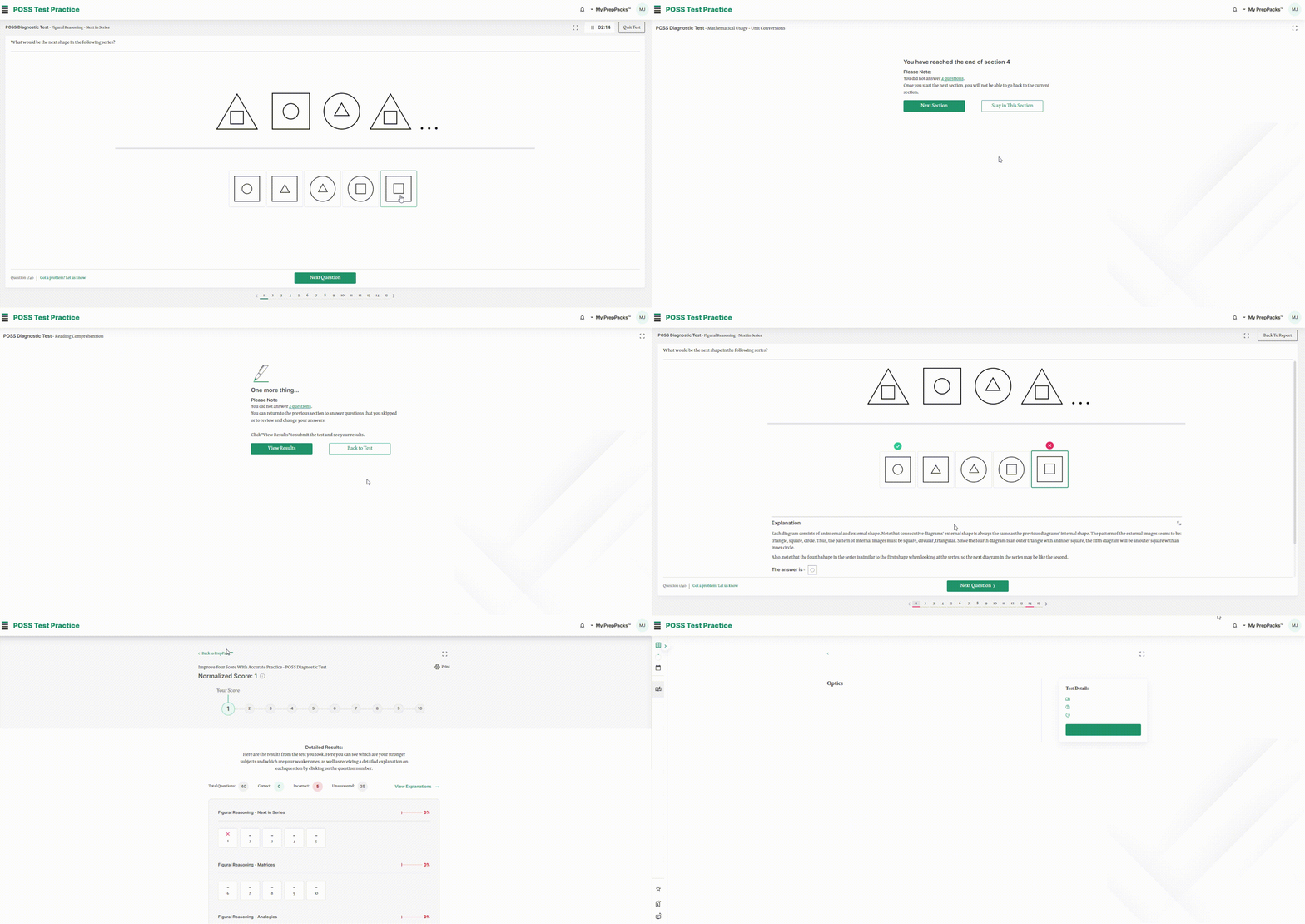
We've created a comprehensive EEI POSS test prep course designed to help you succeed. Our course closely mimics the actual test conditions and platform, allowing you to identify and improve your weaker areas. With this focused preparation, you'll be confident and ready to excel on test day.
Why preparation matters: Most utilities enforce a 30-day minimum waiting period between retake attempts and limit candidates to 2 attempts per 12-month period. There is no second chance to make a first impression - thorough preparation before your first attempt is not optional, it is essential.
JobTestPrep's EEI POSS test prep has recently been upgraded based on expert research and user feedback in order to ensure that you receive the highest quality practice available. You can rely on our experience and expertise to provide you with the tools you need to get the high score you need.

At JobTestPrep, we've helped thousands of candidates pass competitive hiring assessments since 1992. Our materials are designed by psychometric experts and updated based on real candidate feedback to reflect the latest test formats.

There is no universal passing score for the POSS test. Your raw scores across the four sections are combined into an overall Aptitude Index ranging from 0 to 15, where a higher score reflects a stronger predicted likelihood of success in plant operations. Each utility sets its own cutoff independently, and most employers notify candidates of a pass or fail result rather than disclosing the exact score or cutoff threshold.
The POSS test is not difficult in terms of content complexity - the questions themselves are based on high school level mathematics, mechanical principles, and reading comprehension. The real challenge is time. Each section is administered separately with its own strict time limit. The Mathematical Usage section is a particularly high-speed sprint, requiring you to answer 46 questions in just 17 minutes—less than 23 seconds per problem. While a handful of utilities may provide a basic calculator, the vast majority follow the official EEI standard which prohibits them, so you should prepare to solve everything manually. Many candidates do not finish this section. Preparing under timed conditions is the only reliable way to build the speed the test demands.
Retake policies vary by employer - each utility sets its own rules. Duke Energy, for example, requires candidates to wait 90 days between attempts. Entergy enforces a 30-day minimum and limits candidates to 2 attempts per 12-month period. Because retake opportunities are limited and tied to active job applications, there is rarely a second chance on a short timeline. Preparing thoroughly before your first attempt is essential.
No. The POSS (Plant Operator Selection System) and the MASS (Power Plant Maintenance Positions Selection System) are two separate EEI assessments designed for different roles. The POSS evaluates candidates for plant operator positions. The MASS evaluates candidates for maintenance roles such as electricians, welders, pipe fitters, and steelworkers. Some utilities - including PSEG - administer both tests together in a combined POSS/MASS battery for candidates applying across both role families. If your job posting references both, expect a longer testing session of approximately three hours. We also recommend preparing for the MASS test separately.
The Plant Operator Selection System - commonly known as the POSS test or POSS exam - is a standardized cognitive battery created by the Edison Electric Institute (est. 1933) to screen candidates for power plant operator positions at U.S. electric utilities.
Power plant operators are responsible for monitoring and controlling the equipment and systems that generate electricity at nuclear, fossil fuel, and hydroelectric facilities - including boilers, turbines, generators, and reactor systems. The role requires the ability to read and interpret technical materials, perform accurate calculations under pressure, understand mechanical systems, and make fast, reliable decisions in safety-critical environments. A single operational error at a power plant can have serious consequences for grid stability, public safety, and the facility itself.
Because of this, utilities cannot rely on interviews or resumes alone to assess whether a candidate has the cognitive baseline the job demands. The POSS was developed in collaboration with EEI member utilities specifically to predict a candidate's probability of success in plant operations roles - measuring the four abilities most directly tied to job performance: Mathematical Usage, Mechanical Concepts, Reading Comprehension, and Figural Reasoning.
The test is not publicly available and is only administered through a hiring utility as part of an active job application process.
In most current versions of the POSS, your score is based solely on the number of correct answers - there is no penalty for wrong or unanswered questions. This means guessing is always preferable to leaving a question blank if time runs out. However, test administration policies can vary by employer and test version, so always follow the specific instructions given to you on test day.
Results are typically communicated within one to two weeks of testing. Most utilities report outcomes as pass or fail rather than sharing your exact index score or section breakdown. Some employers - including those using on-site test administrators such as AECC - notify candidates of their result immediately after testing.
The POSS-C is a specific version of the Plant Operator Selection System used by certain utilities for particular plant operator classifications. It refers to a variant of the standard POSS battery - the letter designation typically indicates the test version administered by the specific utility rather than a different test altogether. If your hiring utility has told you that you will be taking the POSS-C, prepare using the same four-section format: Mathematical Usage, Mechanical Concepts, Figural Reasoning, and Reading Comprehension.
The core POSS test format and sections are the same regardless of plant type. However, utilities operating nuclear facilities - such as Exelon, TVA, and Dominion Energy - may apply higher cutoff scores given the safety-critical nature of nuclear plant operations. Some nuclear operators also supplement the POSS with additional plant-specific assessments or background screening requirements beyond what fossil fuel or hydroelectric employers require. The preparation approach remains the same: focus on speed and accuracy across all four sections.
POSS practice test PDFs are widely available online but have significant limitations. They are static, unverifiable, and almost always outdated - many circulate versions of the test that no longer reflect current question formats or difficulty levels. More critically, a PDF cannot simulate timed conditions, which is the single most important factor in POSS performance. The Mathematical Usage section gives you under 23 seconds per question. No PDF can train you for that. Effective POSS preparation requires timed, interactive practice tests that replicate the actual test environment section by section - which is exactly what the JobTestPrep POSS PrepPack provides.
After completing your payment, you will receive two emails: a payment receipt and a login link with your account details. Once you log in and reset your password, you will have instant, unlimited access to your PrepPack.
You can start practicing immediately with tailored questions and detailed explanations, tracking your performance along the way. Your progress is saved, allowing you to revisit previous attempts as many times as you like. If you need more time, you can extend your subscription by contacting c.serv@jobtestprep.com.