POSS/MASS Practice Test & Study Guide (2026 EEI)
Some utilities test candidates for the EEI POSS and MASS batteries together in a single session, an administration that takes about three hours combined. This happens when a utility is considering a candidate across both plant operator (POSS) and plant maintenance (MASS) roles at the same hiring event. The two tests share three sections, Mechanical Concepts, Mathematical Usage, and Reading Comprehension, but each has one section the other doesn't: POSS includes Figural Reasoning, while MASS includes Assembling Objects.
JobTestPrep offers free POSS/MASS practice questions covering both the shared sections and each test's unique section, so you can see exactly how the two batteries overlap and where they differ before test day. Since both are often needed together, our POSS and MASS PrepPacks are also available as a bundle, one purchase covers both.


The EEI POSS test (Plant Operator Selection System) and MASS test (Power Plant Maintenance Positions Selection System) are both pre-employment assessments developed by the Edison Electric Institute, but they screen for different roles-
POSS evaluates candidates for plant operator positions, monitoring and controlling plant systems, while MASS evaluates candidates for maintenance positions, electricians, welders, pipefitters, and steelworkers who physically maintain and repair equipment.
The two tests overlap on three of four sections: Mechanical Concepts, Mathematical Usage, and Reading Comprehension test the same core skills on both batteries. Where they differ is the fourth section, POSS includes Figural Reasoning, a visual pattern-recognition section, while MASS includes Assembling Objects, a spatial reasoning section testing how well you can visualize parts fitting together. Some utilities, including PSEG, administer POSS and MASS together in a single combined session lasting about three hours, when a candidate is being considered for either track at the same hiring event.
Below, you'll find practice questions organized to match how the combined POSS/MASS battery is structured.
We'll start with the three shared sections, Mechanical Concepts, Mathematical Usage, and Reading Comprehension, which test the same core skills on both exams.
From there, you'll move into the two sections unique to each test: Figural Reasoning, which appears only on the POSS, and Assembling Objects, which appears only on the MASS.
Practicing in this order mirrors the real combined session, so you build the shared foundation first before tackling what's specific to each role.

Mechanical Concepts questions test whether you can look at a physical system, gears, pulleys, levers, force diagrams, and reason through how it actually behaves, not recall a memorized rule. It's checking whether you can apply basic mechanical logic to a diagram you've never seen before, using the picture itself rather than a formula.

Don't guess based on which option looks more "solid" or intuitive. Work through the diagram itself: where's the weight, where's it anchored, where would tension or pressure build. Follow that logic to its conclusion rather than pattern-matching to a similar-looking question you've seen before.
Mathematical Usage questions test how quickly and accurately you can convert between units, work through formulas, and solve word problems using a reference table you're given on the spot, not values you're expected to memorize. Both POSS and MASS pull from the same skill set here, so the real challenge isn't the math itself, it's reading the table correctly under time pressure.
Please choose the correct answer. If none of the options is the correct answer please choose answer choice e, "N".
Conversion Table
| Unit | Equals |
| 1 meter | 1,000 millimeters |
| 1 bee space | 6.5 millimeters |
| 1 league | 4,828 meters |
| 1 bohr | 52,918 femtometers |
| 1 bohr | 52,918 bicrons |
| 1 klick | 312.5 bamboos |
| 1 bamboo | 320 centimeters |
| 1 oxgang | 0.5 virgates |
| 1 cover | 1.349 jeribs |
| 1 acre | 160 square perches |
| 1 carreau | 1.29 bunders |
| 1 bovate | 6 bunders |
| 1 gal | 1,000 milligals |
| 1 gal | 10 millimeters / square second |
| 1 foot / square second | 30,480 milligals |
| 1 foot / square second | 12 inches / square second |
| 1 yard | 36 inches |
| 1 inch | 2.54 centimeters |
| 1 carreau | 12.9 dekares |
| 1 acre | 4,840 square yards |
| 1 perch | 16.5 feet |
0.25 foot/square second = ? milligals
The correct answer is (B) - 7,620
The conversion needs to be done is as follows:
According to the table
1 foot/square second = 30,480 milligals
0.25 foot/square second is 1/4 of 1 foot/square second.
Therefore, to calculate how many milligrams are 0.25 foot/square second, divide the equation by 4 (or multiply it by 1/4):
1 foot/square second = 30,480 milligals / :4
0.25 foot/square second = 30,480/4 = 7,620 milligals
=> 0.25 foot/square second = 7,620 milligals
Solving tip: Dividing a large number using long division: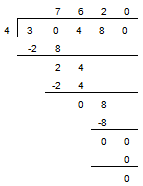
Please choose the correct answer. If none of the options is the correct answer please choose answer choice e, "N".
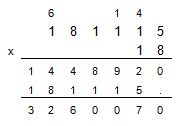
If iron melts at 1,538 degrees Celsius, at what Rankine temperature will it melt?
Please choose the correct answer. If none of the options is the correct answer please choose answer choice e, "N".
4X -9X + 3X = -26 +39 -13
X= ?
Don't scan the whole conversion table looking for a shortcut. Find the one line that connects your starting unit to the next unit in the chain, convert, then repeat with the next line, until you reach the unit the question asks for. Trying to jump straight to the answer is where most mistakes happen.
Reading Comprehension questions test how well you can pull the main idea and specific details out of a technical or work-related passage, and answer based only on what's actually written, not what sounds reasonable or true in general. The trap is answering from outside knowledge instead of the text in front of you.
Read the passage below, then answer the questions that follow based only on the information it contains.
GENERATION WITHOUT FRONTIERS
The current generation of young Europeans is the first to have grown up in a largely borderless and peaceful Europe, with all that implies in terms of mobility, multilingualism, and new cultural and economic opportunities. Whereas their parents and grandparents defined themselves along national lines, many young people today have added a European dimension to that description.
The EU's Youth in Action program aims to inspire a sense of active European citizenship, solidarity and tolerance, as there is still a certain measure of political disengagement among young Europeans. The program promotes non-formal learning and intercultural dialogue among European youth, as well as the inclusion of all young people, particularly those from less-privileged backgrounds. Its main goal is to bring young Europeans closer to the EU decision-shaping process by backing activities that encourage a sense of active European citizenship amongst them. Another important goal is promoting mutual understanding, by giving young people from different countries the opportunity to meet and learn from one another through intercultural youth exchanges. In addition, The Youth in Action program encourages young people's mobility within and beyond the EU borders, thus giving them the opportunity to expand their horizons and gain valuable life and work experiences.
These passages are technical and procedural, safety protocols, operating steps, not narrative. What gets tested is rarely the "main idea," it's a specific condition, exception, or sequence buried mid-paragraph ("do X, unless Y" or "only after Z"). Before you even look at the questions, skim once just to count how many distinct steps or conditions the passage lays out and roughly where each one sits. Then, when a question asks about a specific detail, you're jumping back to "the third condition, near the end" instead of rereading the whole passage from scratch under a ticking clock.
Figural Reasoning questions test how well you can spot a visual rule, a rotation, a shift, a repeating sequence, and apply it consistently, without any verbal or numerical information to lean on. It's not about art or spatial talent, it's about isolating the one thing that's changing from one figure to the next and ignoring everything that isn't.
Listen to the audio instruction and solve the question
Look at how the symbols move and change from one grid to the next, then choose the answer that continues the same pattern.
Each of the objects in the series consists of a 16 square grid containing 4 symbols: a triangle, an X, a circle and a a vertical line. When moving from one object in the series to the next one, each of these symbols moves one step straight, changes its direction (but not its orientation) by 90°, moves another step straight and so forth. For instance, if we look at the circle, we can see that it moves one step up, one step right and one step down. Therefore, in the next step it should move one step to the left.
Following this pattern, we can conclude that the missing object should be 
Note: One could claim that the series follows a different rule, according to which the correct answer is the 2nd option: the symbols move one step clockwise along the frame. This rule correctly describes objects 2-4, but it does not properly explain the first step in the series. For that reason, the rule mentioned above is preferable and option #3 is the correct answer.
Figure out how the first two shapes relate, then apply that same relationship to the third shape to find the matching answer choice.
Look only at the first pair of shapes and describe in your own words what happened between them, rotated, flipped, added a line, before you even glance at the third shape or the answer choices. If you jump straight to comparing answer options, it's easy to talk yourself into a shape that merely looks similar rather than one that follows the actual rule.
Assembling Objects questions test whether you can mentally combine separate, disconnected pieces into a single finished shape, tracking each piece's exact size, angle, and orientation as you go. The trap isn't the assembly logic itself, it's second-guessing a piece's orientation once the answer choices are in front of you.
The letters near the sides of each shape point out where exactly should the different shapes be joined together. Which of the following options shows the joint shape?
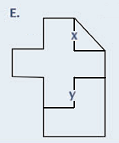
The correct answer is E. The x and y letters mark where each piece connects to the next, so start by matching the x-side of the first shape to the x-side of the second, and the y-side of the second to the y-side of the third, keeping each piece's orientation exactly as shown. Assembling all three pieces this way produces the same combined outline as answer choice E.
The following pattern lacks a segment. Which of the options is the missing segment?
Choose the correct shape

The correct answer is the second option, the parallelogram. Fitting the three loose pieces together edge-to-edge, matching each piece's angles and side lengths without rotating or flipping any piece from its shown orientation, produces a single four-sided shape with two pairs of parallel slanted sides, matching the parallelogram.
Don't try to picture the final shape all at once. Pick one piece, find the edge on another piece that matches it in both length and angle, and join just those two first. Build the shape one confirmed connection at a time rather than guessing at the whole outline from the loose pieces.
The practice test you just finished covers the basics, but the real POSS and MASS exams are timed, and speed under pressure is what actually separates a passing score from a failing one. For full-length simulations, complete section-by-section practice, and detailed explanations for every question, please visit either the POSS or MASS prep pages by clicking on the links below.
If you need to prepare for both, look for the best value option once you're on either page, it includes the combined POSS/MASS PrepPack at no extra cost.
The POSS and MASS tests are used almost exclusively by investor-owned electric utilities to screen candidates for safety-critical power plant roles, POSS for plant operator positions monitoring and controlling plant systems, and MASS for plant maintenance roles like electricians, welders, pipefitters, and steelworkers who physically maintain and repair equipment. These are jobs where a single mistake, misreading a gauge, missing a mechanical fault, misjudging a safety procedure, can shut down a plant or put lives at risk, both for the worker and for the surrounding community relying on that facility. That's why utilities don't rely on interviews and resumes alone: these tests give them a standardized, predictive measure of whether a candidate can read technical diagrams, do accurate math under time pressure, and reason through mechanical and procedural problems before they're ever responsible for a live plant system.
Because each utility administers these tests directly rather than through any central registration system, passing isn't optional, it's a mandatory checkpoint in the hiring process. If you're applying for a plant operator or maintenance role at a utility that uses POSS or MASS, most employers won't move your application forward without a qualifying score. Below is a partial list of major utilities that use the POSS and MASS tests as part of their hiring process:
Yes. A standalone POSS test runs 67-77 minutes and a standalone MASS test runs about two hours, but when a utility like PSEG administers them together as a single POSS/MASS test, the combined session takes approximately three hours, not simply the sum of both, since the shared sections (Mechanical Concepts, Mathematical Usage, Reading Comprehension) are only tested once, not twice.
You receive separate index scores for each test, since POSS and MASS are scored independently even when administered in the same session. A strong POSS score doesn't offset a weak MASS score, or vice versa, so both matter if you're being considered for either role.
This depends entirely on the specific role and utility you're applying to, not something you choose yourself. If a utility is considering you for both plant operator and maintenance positions at the same hiring event, you'll typically be notified in your testing invitation that you're scheduled for the combined battery rather than a single test.
The individual questions aren't harder, but the combined session tests five total sections (three shared, plus Figural Reasoning for POSS and Assembling Objects for MASS) back to back, over roughly three hours. Fatigue becomes a real factor by the later sections, which is why practicing under realistic timed conditions for both tests together, not just each one separately, matters more for the combined battery than for either test alone.
No, calculators aren't permitted on either the POSS or MASS test. As with other EEI pre-employment assessments, all math in the Mathematical Usage section must be worked out manually under timed conditions. This applies whether you're taking POSS, MASS, or the combined POSS/MASS battery, so building manual calculation speed before test day matters as much as knowing the material itself.