What Is a UA Local? Union Plumber and Pipefitter Union Apprenticeships Explained
Updated: August, 2026 | 5 min read
A UA local is the local union through which most candidates access United Association apprenticeship opportunities in their area and trade. The United Association currently represents approximately 407,000 plumbers, pipefitters, steamfitters, welders, sprinkler fitters, HVACR service technicians, pipeliners, and metal trades workers across North America.
If you want to become a union plumber or join a pipefitter union, that local structure matters immediately. You are not applying to one national apprenticeship with one national exam. The local union and its apprenticeship program determine which trades they recruit, when applications open, what selection process you face, and which wage agreement applies. The UA itself directs prospective apprentices to local unions for training and apprenticeship opportunities.
This guide will help you identify the right local, understand what its apprenticeship process can realistically involve, and prepare for the selection steps that can decide whether your application moves forward.

A UA local is a geographically and occupationally organized branch of the United Association. For an applicant, the practical structure is usually: the United Association at the international level, a local union serving a defined jurisdiction or craft, and a local apprenticeship organization or training center that handles training and selection.
The distinction matters because the international union does not run one centralized application for every aspiring apprentice. The UA’s official local finder directs candidates to local unions, where apprenticeship opportunities, training information, and job-related resources are published.
Some programs are operated through a Joint Apprenticeship and Training Committee, or JATC, while others use a training fund or similarly named apprenticeship organization. The name varies, but candidates should treat that local training organization as the authority for current application dates, testing requirements, and entry procedures.
The letters “UA” tell you the union family- Your local and craft tell you which apprenticeship process you actually face.

The United Association identifies eight major trade groups: plumbers, pipefitters, steamfitters, sprinkler fitters, welders, pipeliners, HVACR service technicians, and metal trades workers.
The trade names overlap enough to confuse new applicants, but the jobs are not interchangeable. BLS describes plumbers as workers who install and repair piping systems commonly used for water and other building services. Pipefitters typically work on systems carrying chemicals, gases, and other substances in commercial and industrial settings. Steamfitters specialize in higher-pressure systems. BLS groups all three under occupation 47-2152, but local apprenticeship programs can separate them into different recruitment tracks.
That separation is important when searching for a plumber pipefitter union. A city can have one local recruiting plumbers and another recruiting pipefitters, or a combination local can train several trades under one organization.
Apprenticeship membership practices also differ. Local 393, for example, states that apprentices become members of Local 393 and the parent United Association during their apprenticeship. Local 250 likewise describes union membership as part of its apprentice process. That should not be treated as a universal timetable for every UA program.
The occupational family may be shared. The application route can still be completely different.
For application purposes, UA locals can usefully be grouped into four practical categories: plumbing-focused, fitting-focused, combination, and specialized broad-jurisdiction locals. This is an editorial framework for understanding the system, not an official four-type classification published by the United Association.
Chicago provides the clearest example. Plumbers Local 130 describes itself as a straight-line plumbing local with more than 6,100 members. Pipefitters Local 597 represents approximately 7,000 members in pipefitting, welding, and HVAC-related work. A candidate interested in plumbing and a candidate interested in pipefitting can therefore need different applications in the same metropolitan market.
Local 393 in the San Jose area is a combination example, with apprenticeship pathways that include plumbing, steamfitting, and HVACR. Pipeliners Local 798 illustrates a more specialized model, supplying pipeline welders and related workers to contractors across a broad national work area.
Do not choose a local because its office is nearby. Choose it because its jurisdiction and trade match the work you want to enter.
A JATC is a joint labor-management body involved in operating an apprenticeship program.
Registered apprenticeship programs operate within federal or state apprenticeship systems. This helps explain why apprenticeship selection is local rather than one-size-fits-all. The employers who hire apprentices and the local union that represents workers participate in a program designed for that labor market.
Candidates should also avoid one common assumption: that every entrance exam tests advanced plumbing or pipefitting knowledge. Many selection systems emphasize foundational abilities such as math, reading, spatial reasoning, or mechanical reasoning. Some locals, however, use trade-context math or measurement questions.
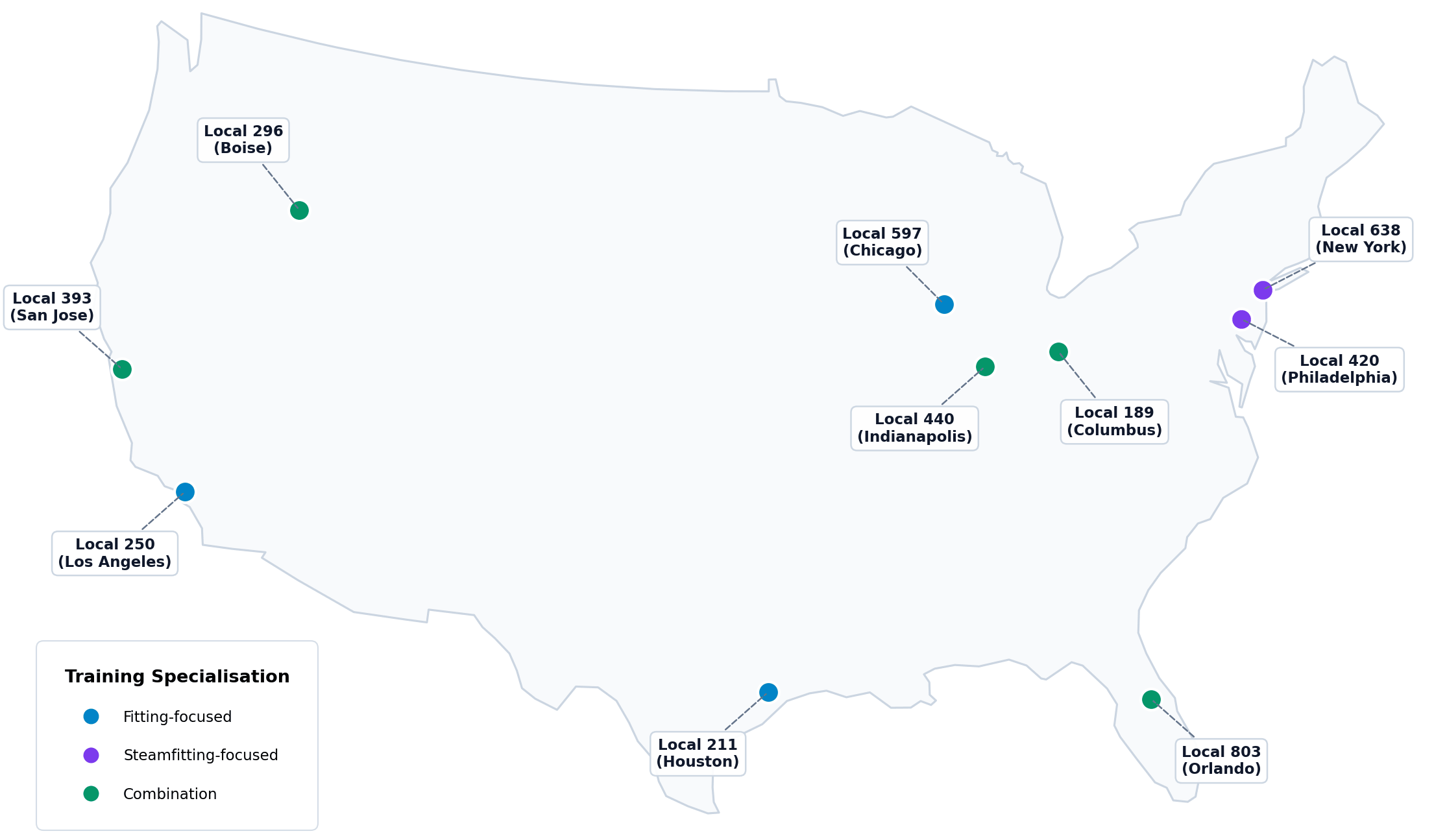
Not every UA local runs the same way. Entrance exams, application windows, and training tracks can vary significantly from one local to the next, even within the same trade. The ten profiles below span major metro markets across the country and illustrate how pipefitters union apprenticeship and union plumbing apprenticeship requirements differ by region - useful context whether you're comparing local chapters or preparing for a specific entrance exam.

| Category | Details |
|---|---|
| Local | UA Local 597 Pipefitters, Chicago |
| Type | Fitting-focused |
| Market | Chicago area |
| Membership | Approximately 7,000 |
| Training | Five-year apprenticeship |
| Exam | Third-party testing administered by GAN, covering numerical reasoning, numerical computation, spatial reasoning, reading comprehension, and mechanical comprehension |
| Application Process | Local 597's training fund publishes specific reservation and application-session instructions rather than a permanent year-round intake |
| Plumbing Counterpart | Plumbers Local 130, a separate straight-line plumbing local with more than 6,100 members |
| Website | https://www.pf597.org/ |
| Category | Details |
|---|---|
| Local | UA Local 250 Pipefitters, Los Angeles |
| Type | Fitting-focused |
| Market | Los Angeles, Orange, Ventura, Santa Barbara, Riverside, and San Bernardino Counties |
| Training | Five-year steamfitter and industrial pipefitter apprenticeship |
| Selection Process | Math examination followed by an oral interview for qualifying candidates |
| Application Status | Applications are currently closed, with reopening expected in early 2027 |
| Pay | $58.28 journeyman rate and 45% first-year apprentice rate, subject to CBA changes |
| Website | https://www.ua250.org/en |
| Category | Details |
|---|---|
| Local | UA Local 393, San Jose |
| Type | Combination |
| Jurisdiction | Santa Clara and San Benito Counties |
| Training | Programs include plumbing, steamfitting, HVACR, and residential plumbing pathways |
| Exam | Applicable tracks currently use a roughly 3.5-hour basic math and mechanical reasoning exam with a 75% minimum; passing scores rank candidates on the waitlist. Candidates may attempt the exam no more than three times |
| Residential Plumbing Note | Residential plumbing follows a different sponsorship route and does not use the same entrance exam |
| Website | https://ualocal393.org/ |
| Category | Details |
|---|---|
| Local | UA Local 638 Steamfitters, New York |
| Type | Steamfitting-focused local with Construction and Metal Trades Service branches |
| Jurisdiction | New York City's five boroughs plus Nassau and Suffolk Counties |
| Training | Five-year steamfitter apprenticeship, with training based in Long Island City |
| Recruitment | Intake-specific; candidates should use the current official apprenticeship announcement rather than assuming a previous application period repeats every year |
| Website | https://steamfitters638.org/ |
| Category | Details |
|---|---|
| Local | UA Local 420 Steamfitters, Philadelphia |
| Type | Steamfitting-focused |
| Chartered | 1903 |
| Work | Members work in mechanical systems, Eastern Pennsylvania gas distribution, and instrumentation |
| Training | Apprentices begin at 40% of the steamfitter hourly rate and move through ten six-month training periods |
| Current Recruitment | The published February 2027 apprenticeship cycle accepts applications from April 24 through October 31, 2026 |
| Plumbing Counterpart | Plumbers Local 690, chartered in 1931, operates a five-year plumbing apprenticeship |
| Website | https://www.lu420.com/ |
| Category | Details |
|---|---|
| Local | UA Local 296, Idaho |
| Type | Combination |
| Training Interests | Current apprenticeship material asks applicants to identify interests including plumbing, pipefitting, welding, and HVAC-related work |
| Application Documents | Current instructions call for a driver's license, high-school transcript or GED documentation, Social Security card, and résumé |
| Accuracy Note | Candidates should use Local 296's latest apprenticeship handbook rather than relying on an older summarized test or wage figure |
| Website | https://www.ualocal296.org/ |
| Category | Details |
|---|---|
| Local | UA Local 189, Columbus |
| Type | Combination |
| Market | Columbus-area jurisdiction covering 11 Ohio counties |
| Membership | 1,821 members |
| History | Traces its organization to 1899 and its formation as Local 189 to January 1900 |
| Application Process | 2026 applications are available on the first Tuesday of each month. Applicants must be at least 18 and meet jurisdiction requirements |
| Exam | Candidates may be required to take the Differential Aptitude Test, Ramsay Aptitude Test, or another validated third-party assessment before an oral interview |
| Website | https://ualocal189.com/ |
| Category | Details |
|---|---|
| Local | UA Local 211 Pipe Fitters, Houston |
| Type | Fitting-focused |
| Market | Houston and a broad Southeast Texas jurisdiction |
| Chartered | 1949 |
| Training | Five-year apprenticeship in areas including pipefitting and welding |
| Selection | Applicants currently need at least 72% on the entrance math examination before advancing to OSHA 10 training and an interview |
| Cost | Tuition is free, with books and materials costing approximately $350 in the first year and around $200 in subsequent years depending on classes |
| Website | https://www.pipefitterslocal211.com/ |
| Category | Details |
|---|---|
| Local | UA Local 440, Indianapolis |
| Type | Combination |
| Trades | Plumbers, steamfitters, and HVACR service technicians |
| Jurisdiction | 24 counties in Central and Eastern Indiana |
| Application Basics | High-school or GED requirements, a valid driver's license, and testing that includes basic math and a journey assessment. The local advertises year-round applications |
| Accuracy Note | Local 440 currently has official pages displaying different program-year references, including 2026-2027 and 2027-2028. Candidates should confirm the active intake directly with the training center |
| Website | https://www.ualocal440.org/en |
| Category | Details |
|---|---|
| Local | UA Local 803, Orlando |
| Type | Combination |
| Market | Lake, Orange, Osceola, and Seminole Counties |
| Membership | More than 700 members |
| Chartered | April 24, 1920 |
| Trades | Plumbers, pipefitters, HVAC technicians, and related piping work |
| Training | Building Trades apprenticeship runs five years, while the Walt Disney World apprenticeship track runs four. Applicants must be at least 18 and submit high-school transcript or GED documentation and a driver's license |
| Application Cutoff | Current official FAQ lists April 30, 2027 as the cutoff for the fall program, with later applications held for the following school year |
| Website | https://localunion803.org/ |
If you're planning to apply for a UA pipefitter or plumber apprenticeship, an entrance exam is almost certainly part of the process. These tests typically cover areas like numerical reasoning, mechanical comprehension, and spatial reasoning. Try the three sample questions below to get a feel for the format and see where you currently stand.

Whichever local you apply to, most UA apprenticeship programs require passing a standardized aptitude test before you can move on to the interview stage. Preparing in advance can make the difference between waiting another year and starting your apprenticeship on schedule.
If you found these questions challenging, or you're not fully confident under exam conditions yet, you're not alone - and a bit of focused practice goes a long way. We've got you covered with:
Use three checks, in this order: geography, craft, application window-
First, use the United Association’s official local finder to identify nearby UA locals.
Second, confirm that the local actually represents the craft you want.
Third, open its apprenticeship or training-center page and verify the current recruitment window.
That sequence matters when searching terms such as “pipefitter union near me,” “JATC plumbing,” “union fitting plumbing,” or “pipefitters and plumbers union.” The closest search result may represent a different craft, and some programs impose geographic or jurisdictional eligibility requirements.
Do not assume you can shop among locals solely for an easier entrance test. Your eligibility can depend on jurisdiction, trade, sponsorship, or other local rules.
Find the local first. Verify the current selection process second. Only then build your study plan.
Yes. Plumbers and pipefitters are both represented within the United Association, but they may belong to different locals or apprenticeship tracks. Chicago’s separate Plumbers Local 130 and Pipefitters Local 597 illustrate the distinction clearly.
Not necessarily. There is no universal entrance test used identically by every UA apprenticeship program. Local 393 currently tests basic math and mechanical reasoning for relevant tracks, while Local 597 publishes a five-area third-party test structure.
The UA has a large network of local unions across the United States and Canada, but candidates should avoid relying on a fixed count when choosing where to apply. The current UA local finder is the more useful source because it identifies active locals by location and trade.
UA refers to the United Association of Journeymen and Apprentices of the Plumbing and Pipefitting Industry of the United States and Canada. The organization was founded in 1889 and currently represents approximately 407,000 members.
Possibly, but eligibility is local-specific. Residency, territorial jurisdiction, sponsorship, and individual program rules can determine whether another local will accept your application. Local 189, for example, publishes a residence-in-jurisdiction requirement.
There is no single UA-wide cost. Local 211 describes its program as tuition-free but estimates books and materials at approximately $350 in year one and around $200 in later years depending on coursework. Other programs can have different costs.
Four or five years is common, but program length varies by trade and local. BLS describes typical plumber, pipefitter, and steamfitter apprenticeships as lasting four or five years. Local 597 runs a five-year program, while Local 803 publishes both a five-year Building Trades track and a four-year Walt Disney World track.
There is no national UA passing score. Current examples include 75% for Local 393’s entrance examination and 72% for Local 211’s entrance math test. Those figures belong to those specific programs and should not be applied to another local.
Start with the part candidates are most tempted to skip: identify your exact local, craft, and current recruitment process before choosing study material.
Then work backward from the assessment. If the official notice emphasizes math, mechanical reasoning, reading, or spatial skills, practice those skills under realistic time pressure. If the process includes an interview after the test, treat the written assessment as one selection stage rather than the finish line.
You do not need to prepare for every aptitude test used anywhere in the United Association. You need to prepare well for the one standing between you and the apprenticeship you actually want.
Once you know your route, make the preparation equally specific: use the Pipefitter PrepPack for a fitting-focused application, the Plumber PrepPack for a plumbing track, or begin with the free pipefitter practice test to identify which tested skills need the most work.

I am Kemi Cohen, Aptitude Test Developer and Trade Exam Expert at JobTestPrep. I hold an MSc in Organizational Psychology. My role includes developing assessment questions and providing expert strategies for our Pipefitter and Plumber Apprentice PrepPacks.