P&G Interview Questions: What to Expect and How to Prepare
Updated: September, 2026
P&G's interview process uses behavioral questions, which means you'll be asked about specific situations from your past rather than hypothetical scenarios. Understanding what to expect and how to structure your answers makes a significant difference in how well you perform.
The stakes are meaningful: only about 1% of P&G applicants receive job offers, and if you don't pass the interview, there's a 12-month waiting period before you can reapply. This guide covers the actual questions P&G asks most frequently and the STAR framework they expect you to use when answering.
For a focused P&G interview prep, click here.
P&G's interview approach is based on a straightforward premise: past behavior predicts future performance. Rather than asking how you would handle a hypothetical situation, they ask you to describe specific times when you actually dealt with similar challenges. This means you need real examples ready, not just good answers to theoretical questions.
The format requires more preparation than traditional interviews because you can't improvise your way through. Each answer needs to be a concrete story from your experience, structured in a specific way, demonstrating the particular competencies found in the P&G assessment process. Without prepared examples, you'll find yourself struggling to recall details under pressure while the interviewer waits.
Here's what most candidates don't realize until they're already in the interview: P&G evaluates every answer against five specific competencies called the PEAK Performance Factors. These aren't just abstract values- they're the foundation of the company's Purpose, Values, and Principles (PVPs), which act as the actual criteria your interviewer is scoring you on."
Lead with Courage means taking ownership of decisions and outcomes, even when the path forward isn't clear or the stakes are high. P&G looks for people who step up rather than wait to be told what to do.
Innovate for Growth focuses on creating new solutions rather than just applying existing ones. This doesn't require revolutionary ideas—it's about identifying opportunities for improvement and acting on them.
Champion Productivity is about maximizing impact with limited resources. Every company faces constraints in budget, time, or people. P&G wants to see how you navigate these constraints creatively.
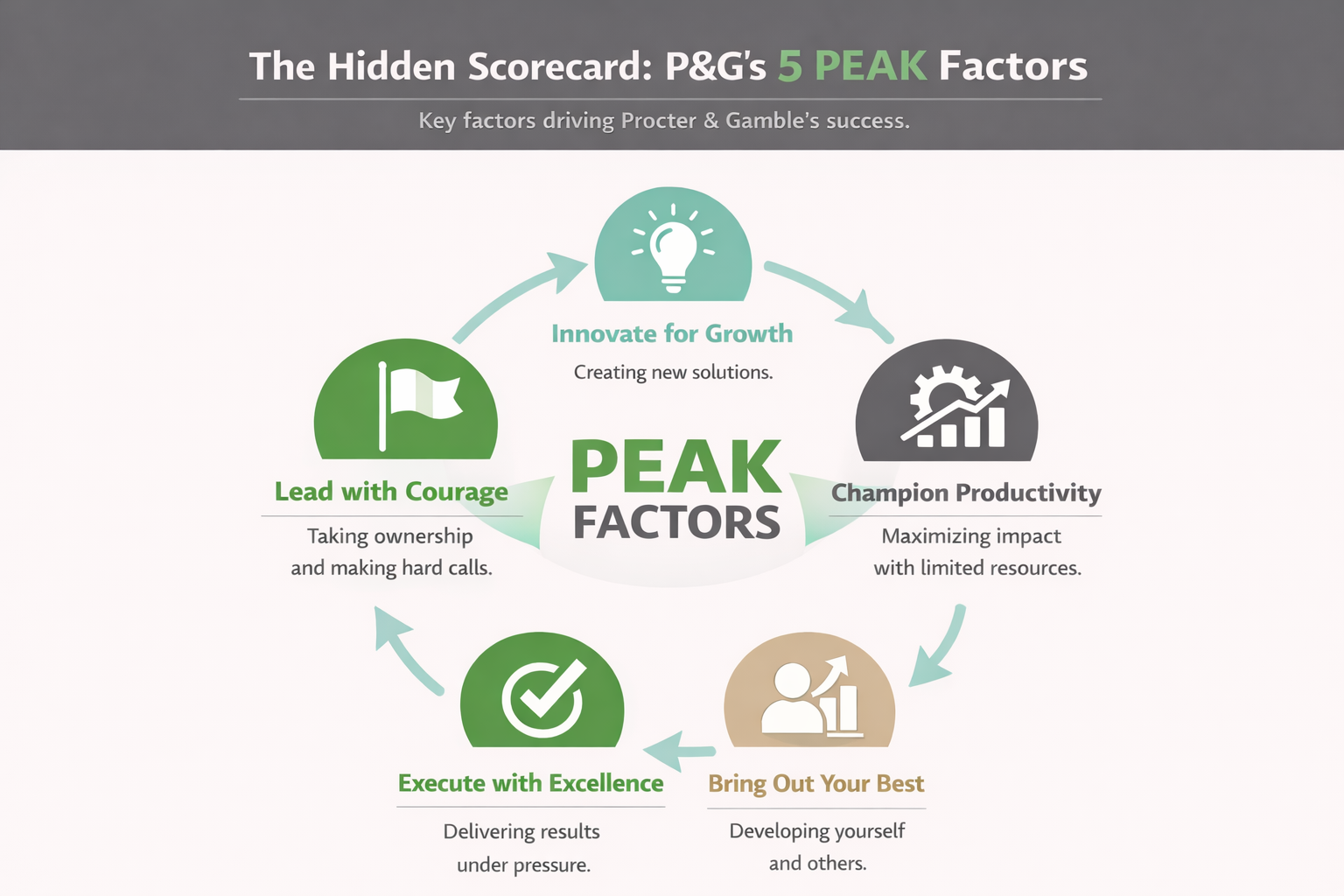
Execute with Excellence means delivering results consistently, especially under pressure. P&G operates on tight timelines and high standards. They need evidence you can perform when it matters.
Bring Out Your Best covers both personal development and helping others succeed. P&G emphasizes collective achievement and building team capability, not just individual performance.
For Example: When they ask "Tell me about a time you led a team," they're specifically evaluating Lead with Courage. When they ask about working with limited resources, they're checking Champion Productivity. Understanding which factor each question targets helps you choose the right stories and emphasize the right details.
Knowing the five factors is not the same as using them well. The most common mistake candidates make after researching P&G is naming the factor in their answer, saying "this shows my ownership mindset" signals that you learned a framework rather than lived it. Your interviewer already knows which factor they're assessing; your job is to supply the evidence and let them score it.
The same logic applies to "why P&G" questions. P&G distinguishes between intrinsic motivation, genuine interest in the work itself, and extrinsic motivation such as salary, prestige, or brand recognition. An answer built around P&G's brands describes the company. An answer built around the category or the part of the job that genuinely interests you describes you, and that's what the interviewer is listening for.
Got the Structure - Now Get the Delivery Right
You've got a P&G interview ahead of you, and it's built around real examples from your own experience, not hypotheticals. That means the only way to actually get ready is to practice telling your stories out loud, under the same pressure you'll face in the room. Our AI-powered P&G Interview Prep gives you a mock interview built around your role, with real feedback on every answer.
P&G explicitly recommends using the STAR method to structure your answers - it's mentioned on their own careers blog. Their interviewers are trained to listen for this format, and answers that don't follow it are harder to score effectively.
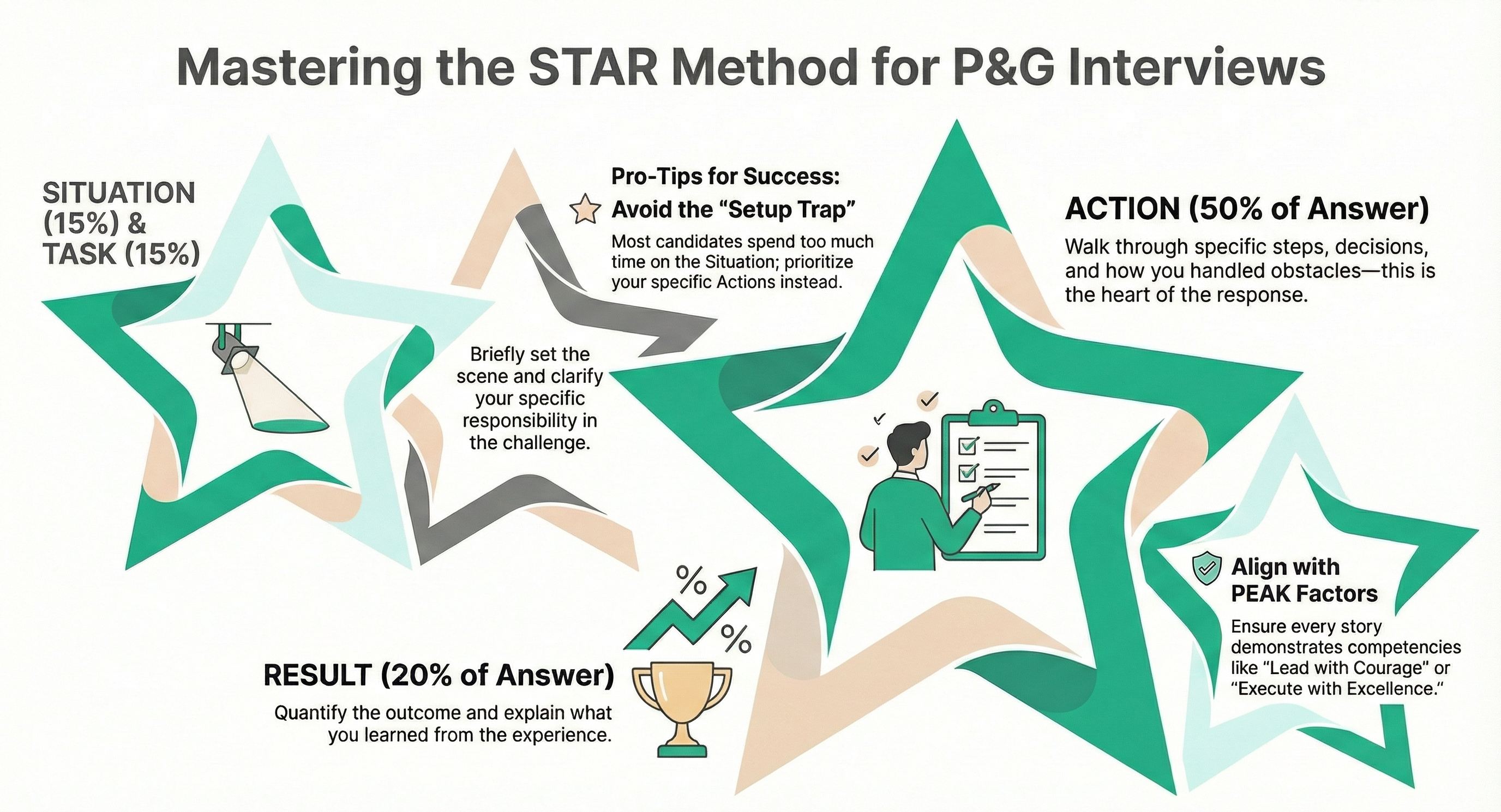
1. Situation (15% of your answer): Provide just enough context for the interviewer to understand the challenge. What was happening? What made it difficult or important? Keep this tight—most candidates spend too much time here.
2. Task (15% of your answer): Clarify your specific responsibility. What did you personally need to accomplish? This is where you establish ownership of the outcome.
3. Action (50% of your answer): This is the heart of your response. Walk through the specific steps you took, the decisions you made, and how you handled obstacles. Be detailed here—interviewers are listening for evidence of the PEAK factors in how you approached the problem.
4. Result (20% of your answer): Quantify the outcome whenever possible. What changed because of your actions? What did you learn? Strong results sections include both immediate outcomes and longer-term impact. For a deeper look at this structured STAR method framework, academic career centers provide excellent rubrics for quantifying your actions
The most common mistake is spending too much time setting up the Situation and rushing through the Action. Interviewers care most about what you actually did, so give that section the space it deserves.
After reviewing hundreds of verified P&G interview reports from Glassdoor and our own candidate data, clear patterns emerge. Here are the questions that appear most frequently:
"Tell me about a time you led a team."
This evaluates Lead with Courage. They're looking for evidence that you can coordinate people, make decisions, and drive outcomes. The scope matters less than your approach—leading a school project counts if you can demonstrate clear leadership behaviors. Focus on how you got people aligned, how you made decisions when there was disagreement, and how you kept the team moving forward.
"Describe a time you worked under significant pressure."
This tests Execute with Excellence. P&G operates on tight deadlines, and they need to know you can maintain quality when the pressure is high. The best answers don't just describe surviving stress—they explain your specific strategies for managing it. Did you prioritize ruthlessly? Break the work into smaller chunks? Communicate proactively about timeline risks?
"Tell me about something new you created."
This addresses Innovate for Growth. You don't need a patent to answer this well. What matters is identifying an opportunity for improvement and following through. A new process that saved your team time, a creative solution to a recurring problem, or a fresh approach that improved results all work. Be clear about what was new and why it mattered.
"How would you handle an underperforming team member?"
This question evaluates Bring Out Your Best. P&G cares about how you develop others, not just how you hold them accountable. Strong answers balance understanding the root cause with maintaining team performance. Would you have a direct conversation? Try to understand what's blocking them? Provide additional support or resources? The key is showing you see developing people as part of your responsibility.
"Describe a time you worked with limited resources."
This tests Champion Productivity. Resources are always constrained—whether it's budget, time, or people—and P&G wants to see how you navigate that reality. The best answers show you achieved strong results specifically because of how you managed constraints, not despite them. Maybe you prioritized differently, found creative alternatives, or leveraged resources others overlooked.

"Tell me about a time you failed" evaluates Lead with Courage—they want to see resilience and learning, not perfection.
"Describe a conflict with a coworker and how you resolved it" tests Bring Out Your Best and your ability to maintain working relationships.
"How do you handle negative feedback?" looks at Innovate for Growth and adaptability.
"Give an example of when you exceeded expectations" checks Execute with Excellence and your standards for your own work.
"Why P&G specifically?" tests cultural fit and whether you understand what makes their environment distinctive.
"Tell me about influencing someone without direct authority" evaluates Lead with Courage and your ability to drive outcomes across boundaries.
Theory helps, but examples clarify. Here's how to answer "Tell me about a time you worked with limited resources" using the STAR framework effectively:
"During my role at a startup, our marketing budget was cut by 60% mid-quarter while our sales targets stayed the same. I was responsible for generating leads that quarter, so I needed to find a way to hit our numbers with less than half the planned budget.
I started by analyzing which channels were actually performing. The data showed LinkedIn was driving three times more qualified leads per dollar than Facebook, so I reallocated everything there. Then I identified a content partnership opportunity with an industry publication—they needed material, we needed exposure, and there was no direct cost. I also built a referral program that offered existing customers early access to new features in exchange for introductions to potential buyers.
We hit 94% of our lead target with 40% of the original budget. The referral program became a permanent channel—it still generates over 20% of the company's leads today. What I learned is that constraints often force better prioritization. If I'd had the full budget, I probably wouldn't have built that referral system."
Notice how this answer works: tight situation setup (budget cut, targets unchanged), clear personal ownership (what I was responsible for), detailed actions with specific decisions (which channels, the partnership, the referral program), and quantified results with both immediate and long-term impact. The whole response takes about two minutes to deliver and clearly demonstrates Champion Productivity.
Here's the part most interview guides skip: most candidates never reach the interview stage. Before any human reviews your application, you need to pass P&G's online assessments—the PEAK Performance Assessment and the Interactive Assessment.
These automated screening tests eliminate 70-80% of applicants before interviews are even scheduled. The Interactive Assessment includes three gamified cognitive challenges, which P&G outlines in their detailed assessment overviews: the Switch Challenge tests pattern recognition with rules that change mid-test, the Digit Challenge requires rapid arithmetic under severe time pressure, and the Grid Challenge combines spatial memory with shape comparisons.
If you've already received your interview invitation, you've cleared this significant hurdle. But if you're earlier in the hiring process, or if you've previously failed the assessments and are approaching the end of your 12-month waiting period, the interview preparation only matters if you can pass this screening first.
This is why structured practice matters. Our P&G assessment practice pack includes full simulations of all three challenges, with adaptive difficulty that increases as you improve. The practice tests are deliberately harder than the actual assessment so the real thing feels manageable by comparison.
We track outcomes from our practice programs. Candidates who complete all four practice simulations are 2.6 times more likely to pass the actual assessment than those who rely on free samples or go in without preparation. That data comes from 12 months of feedback across over 500 P&G applicants.
Note: If you are applying for a Sales role, you will likely face the P&G Sales Virtual Job Preview. This 60-minute test specifically evaluates sales judgment and business analysis."
If your interview is already scheduled, your next step is clear: identify 8-10 strong examples from your past that demonstrate the PEAK Performance factors, map each story to specific competencies, and practice structuring them using the STAR method. Record yourself delivering these answers - the first few takes always feel awkward, but the structure becomes natural with repetition. Our AI-powered interview prep can score that practice for you and tell you exactly where each answer falls short.
If you're still in the assessment phase or planning to apply soon, don't wait until you receive the invitation. P&G typically sends assessment invitations within 24-72 hours of application, and you'll have a limited window to complete them. The assessment covers three cognitive challenges - the Switch Challenge, the Digit Challenge, and the Grid Challenge - plus the PEAK Performance Assessment. Most candidates underestimate how challenging these tests are until they're already in the countdown. Start with our free practice page to see what you're facing, or go straight to the complete PrepPack if you're ready to prepare fully.
If you've already failed once, you know exactly what you're facing. The 12-month waiting period exists because P&G wants candidates who take preparation seriously. This time, you have the advantage of knowing what to expect - and the right preparation to make it count.
Most candidates go through 1-3 rounds depending on the role and location. The typical path includes an initial screening interview (often virtual) and a final interview with hiring managers. Each round lasts 45-60 minutes with 7-10 behavioral questions.
You'll need to wait 12 months before reapplying to P&G. This cooldown period applies to both assessment failures and interview rejections. Given P&G's current hiring environment, which includes ongoing workforce restructuring, this means missing an entire recruitment cycle.
No. P&G explicitly prohibits AI assistance during both assessments and interviews. Their hiring portal states that using AI tools like ChatGPT is grounds for rejection. Interviews are conducted by humans who will notice scripted or generated responses.
From application to offer typically takes 4-8 weeks, though timing varies by role and application volume. Assessment invitations usually arrive within 24-72 hours of applying. Interview scheduling happens 1-3 weeks after passing assessments. Offer decisions come 1-4 weeks after final interviews.
Yes. All three are assessed against the same five factors, but the bar shifts with seniority. Entry-level interviews focus on potential and fit, since P&G hires overwhelmingly at this level and promotes from within. Experienced-hire interviews set a higher bar with sharper questions, since P&G hires externally at this level far less often. Management interviews weigh persuasion, determination, and the ability to motivate others most heavily, since the same factors are assessed but competence alone is no longer enough, the evidence needs to show you do it well and consistently.
It can be either. P&G's own careers site describes the interview as one-on-one or a panel, conducted virtually or in person, depending on your location and the role. For more senior or cross-functional positions, you may meet with several interviewers across different functions, each typically assigned specific competencies to evaluate. Either way, the format is behavioral, not a group exercise, so your preparation doesn't need to change based on which one you get.
Rarely. Unlike interviews built around "what would you do if..." scenarios, almost every P&G interview question asks what you have already done, not what you would hypothetically do. P&G works on the principle that past behavior is the best available predictor of future performance, which is why the interview is structured around the STAR method rather than situational judgment. That kind of scenario-based testing happens earlier, in the Interactive Assessment's cognitive challenges, not in the interview itself.
No. P&G internship candidates go through the same interview process as full-time applicants, assessed against the same five factors using the same behavioral, STAR-based format. The format, difficulty, and expectations are identical regardless of whether you're applying for an internship or a graduate position, so prepare with the same seriousness you would give a permanent role.
For technical, R&D, or IT roles, you can expect additional domain-specific questions on top of the standard behavioral format, covering your technical background and how you've applied it. The underlying structure doesn't change: even technical questions are typically framed around a real situation from your experience, evaluated using the same STAR method and the same five factors as every other P&G interview.