 FRV Firefighter Written Selection Test: Free Practice Exam (2026)
2027/2028 FRV Recruitment Campaign Key Dates: Applications - Closed • 04/05/2026 - 17/05/2026 | Written Selection Test Registration - ACER Portal • 01/06/2026 - 26/06/2026 | Written Selection Test - ACER, Victoria & Remote • 24/07/2026 - 27/07/2026 | Written Selection Test Results - ACER Portal • 27/08/2026 | Further Stages (Group Assessment, Shuttle Run, Personality Profile, Selection Interview) - To Be Confirmed • Updated 30/07/2026
Important Notice
The FRV Testing Window Runs 24-27 July 2026
If your test is just days away, our PrepPack gives you a focused, condensed path through Literacy, Abstract Reasoning, Numeracy, and Mechanical Reasoning, plus a full timed simulation, built to help you pass the WST on your first attempt.
FRV's Firefighter Written Selection Test (WST), administered by ACER (Australian Council for Educational Research) on behalf of Fire Rescue Victoria, is a mandatory stage in FRV's multi-stage Recruit Firefighter selection process. The test is delivered at ACER test centres across Victoria and select interstate venues, or online under live remote proctoring, and runs about 2 hours and 5 minutes in total.
It covers four separately timed components: Literacy (reading comprehension), Abstract Reasoning (pattern and sequence recognition), Numeracy (real-world maths), and Mechanical Reasoning (basic mechanical and physical concepts). You can't bring your own calculator, phone, dictionary, or paper, only an A4 whiteboard and marker, plus the onscreen calculator built into the Numeracy section. Other stages in the same recruitment campaign include a Group Assessment, Shuttle Run, Personality Profile, Selection Interview, and Physical Aptitude Test.
Getting through the FRV WST isn't about luck. It's about knowing exactly what's coming before you sit down at the keyboard. Below are eight real-style questions, two each across Literacy, Abstract Reasoning, Numeracy, and Mechanical Reasoning, worked through step by step, so you can see exactly how FRV candidates are expected to think under time pressure. When you're ready for full-length, timed practice across all four components of the real test, our FRV WST PrepPack is built specifically for this test and includes a full 132-question simulation to help you pass on your first attempt.


What is the FRV Aptitude Test?
The WST is the first major filter in FRV's recruitment process, and the one candidates search for most, since it's the stage where reasoning and reading skills, not fitness, decide who moves forward. The test is not a test of firefighting knowledge. It doesn't ask about hose diameters or fire behaviour. Instead, it measures the underlying cognitive skills FRV has identified as essential to the job: the ability to reason through a mechanical problem, work with numbers and logic under pressure, and extract the right information from a page of text quickly and accurately.
1. Literacy
Tests your ability to read and process written material efficiently, identify key details, and answer questions based on what's written, including some passages with graphs, charts, diagrams, or maps, all under time pressure.
2. Abstract Reasoning
Tests your ability to identify and complete sequences and patterns: recognising the rule governing a series of shapes and applying it to determine what comes next, what's missing, or what belongs in the middle.
3. Numeracy
Tests your ability to work through arithmetic, fractions, percentages, algebra, and measurement in real-world contexts, under a visible timer.
4. Mechanical Reasoning
Evaluates your ability to understand and apply basic mechanical and physical concepts, things like gears, levers, pulleys, wheels, and pressure, and to predict how a mechanical system will behave. You won't need trade-level technical knowledge, but you will need to reason logically about cause and effect, often from a diagram rather than a written description.
The WST is delivered at ACER test centres across Victoria and select interstate venues, or online under live remote proctoring. That means:
- You take the test at a test centre, or on your own laptop or computer with a working webcam if sitting it remotely.
- An offsite or on-site proctor monitors you for the duration of the test.
- No personal calculator, phone, dictionary, or paper is permitted, only an A4 whiteboard and marker, plus the onscreen calculator built into the Numeracy section.
- Each of the four components is timed separately, with a visible countdown, and once a section ends or its timer runs out, you cannot return to it.
- Within a section, you can flag and revisit questions if time allows.
Importantly, FRV requires candidates to meet the minimum standard on all four components to progress, each is scored separately, and it's possible to do well overall while still falling short on one section. The goal isn't a perfect score, it's meeting the benchmark FRV has set for that campaign.
FRV Firefighter Test Sample Questions
Section 1 - Mechanical Reasoning
Mechanical Reasoning questions test whether you can look at a physical system, a bridge, a lever, a set of gears, and reason through how it actually behaves under force. FRV isn't checking for trade experience here, it's checking whether you can apply basic physical logic to a diagram you've never seen before.
Cogs
The diagram shows two fixed cogwheels which can only rotate around their own axis. A rack is inserted between the two cogwheels and is moved in the direction shown by the arrow.
What are the directions of movement and velocities of revolution of the cogwheels?
The correct answer is (D) - Different directions, different velocities.
We will solve in two phases. First we will determine the cogwheels' direction, then their velocity.
Direction
When contact is made between the rack (toothed belt) and the cogwheels a conversion from a linear velocity to an angular velocity occurs. Thus, the location of the point of contact is critical. the relation between the two can be seen in the diagram below: 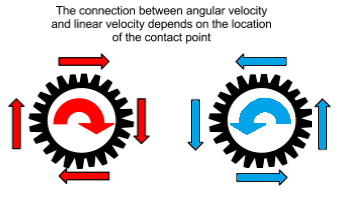
In our case, the rack is moving to the left, and the point of contact between the rack and the red cogwheel is in the lower part of the cogwheel, therefore the wheel turns clockwise (as shown in the red diagram).
In contrast, the point of contact between the rack and the grey cogwheel is in the upper part of the cogwheel, and therefore the wheel turns counterclockwise (as shown in the blue diagram). It follows that the cogwheels rotate in opposite directions.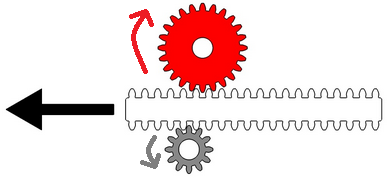
Velocity
The thumb rule: "fewer teeth, faster velocity" which is based on the concept of gear ratio and enables us to conclude without unnecessary calculations that the grey cogwheel rotates faster than the red cogwheel since it has fewer teeth.
Spring Tension and Equilibrium
In which of the following situations will the handle remain in its current place, assuming the spring is pulling? If both situations are possible, choose option 3.
- Identify the difference: the two images differ in where the spring is anchored.
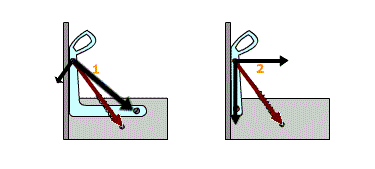
- Analyze image 1: split the spring's pull into a part pointing toward the anchor, which adds no torque, and a remaining part that turns the handle counterclockwise. The wall blocks that motion by pushing back, so the handle stays put.
- Analyze image 2: split the pull the same way; here the remaining part turns the handle clockwise, and nothing blocks it.
- Conclude: the handle stays in place only in image 1. The correct answer is 1.

Equilibrium Tip: Split the Pull Into Two Components
When a force pulls at an angle, like the spring in Question 2, don't judge the outcome by instinct or by which image "looks more stable." Break the pull into two parts: the portion pointing straight at the pivot (which produces zero rotation) and the portion perpendicular to it (which is what actually creates torque). Whichever way that perpendicular part pushes is the direction the object will try to rotate, unless something else is physically blocking it.
Section 2 - Numeracy
Numeracy questions cover arithmetic, fractions, decimals, percentages, and quick mental math, under a visible timer, with an onscreen calculator provided (you just can't bring your own). The questions themselves are rarely advanced, the challenge is doing them fast and accurately.
Geometric Sequences
A toy store chain is growing very fast. During the first year it sells m million dollars of merchandise. Each year thereafter, it sells three times the previous year's sales. After 5 years of fast growth, it has sales of 162 million dollars. What is the value of m?
Number Sequences
144 | 73 | 18 | 10 | 520 | ?
The correct answer is 261.
Every two terms are a pair. The first number is divided by two and then increased by 1 to produce the second term.
Number Sequences Tip: Look for Pairs Before Hunting for One Rule
Not every number sequence runs on a single rule applied term-to-term, like in Question 4, some are built from repeating pairs or blocks, where the operation resets every two numbers. Before testing complicated operations across the whole list, check whether grouping the numbers into pairs reveals a simpler, consistent relationship within each pair, it's often faster than searching for one rule that has to explain every term at once.
Section 3 - Abstract Reasoning
Abstract Reasoning questions are non-verbal, inductive reasoning. You're shown a sequence of shapes or grids and asked to identify the rule governing how they change, then apply that rule to pick what comes next, what's missing, or what belongs in the middle.
Grid Tip: Let One Direction Confirm the Other
When a grid's rule feels ambiguous scanning by row, like in Question 6, switch to columns instead. Well-built grids are usually consistent both ways, so if reading across leaves you stuck between two plausible options, checking down the columns will often isolate the one answer that satisfies the pattern in both directions, faster than re-reading the same row again.
Section 4 - Literacy
Literacy questions test whether you can read a passage under time pressure and apply it precisely, not just recall the general gist. FRV describes this component as reading comprehension across varied text types, some including graphs, charts, diagrams, or maps, identifying key details and answering accurately based on what's actually written, exactly what a question like this is built to measure.
Sentence Completion Tip: Let the Signal Word Choose Your Words First
In sentence completion questions like Question 8, words like "although," "however," "despite," or "because" tell you the logical relationship between the blanks before you even look at the answer choices. If the sentence contains a contrast word, the correct pair has to describe two conflicting ideas, not just two words that individually sound reasonable. Spot the signal word first, then filter the options against it.
Ready For More FRV Test Practice ?
The practice test you just finished covers the basics, but the real FRV Firefighter exam is timed, and speed under pressure is what actually separates a passing score from a failing one. For full-length simulations, complete section-by-section practice, and detailed explanations for every question, please visit either the FRV prep page by clicking on the link below.
How to Become a Firefighter in Victoria?
Becoming a firefighter with Fire Rescue Victoria (FRV) is a competitive, multi-stage process that typically takes 6 to 12 months from application to job offer, not including the 20-week Recruit Training Course itself. FRV recruits in campaigns rather than on a fixed annual calendar, so applications only open when a campaign is announced (the current campaign accepted applications between 4-17 May 2026 to fill recruit courses in 2027 and 2028), and once open, no late applications are accepted.
Eligibility Requirements
Before you can apply, you must meet the following mandatory criteria:
- Australian citizen, permanent resident, or New Zealand citizen who has entered Australia on a valid passport
- Held a driver's licence for at least two years by 1 January 2027 (a green probationary licence is acceptable; a learner's permit is not)
- No more than seven driving demerit points at the time of application and at any stage up to an offer of employment
- Compliance with FRV's Criminal History and Driving History policies, including a nationally coordinated criminal history check
- Medical clearance from your own doctor before the physical assessment stages, followed by a full pre-employment medical from FRV's Brigade Medical Officer before any offer
- A Heavy Rigid licence, obtained after receiving an offer of employment, not before
Unlike some other fire services, FRV does not publish a minimum education requirement or a minimum amount of prior work experience, recruits come from all kinds of backgrounds, and all firefighting-specific training is provided during the course.
The Recruitment Journey, Stage by Stage
Once you apply, every candidate in that campaign moves through the same stages together, in order: online application, Written Selection Test, Group Assessment, Shuttle Run, Personality Profile, Selection Interview, Order of Merit, Physical Aptitude Test (PAT), pre-employment medical assessment, pre-employment checks and uniform fitting, and offer of employment. Candidates who fail the PAT on their first attempt are given one retest, but timeframes can be tight, and missing or failing other stages generally means waiting for the next campaign to try again.
The Recruit Training Course
Candidates who clear every stage are required to complete a 20-week Recruit Training Course at FRV's Training Academy in Craigieburn. Training runs on a rotating four-days-on, four-days-off shift cycle between 7am and 5pm, including weekends, and the course is not a live-in program, recruits generally arrange their own accommodation. The course includes units from PUA20622 Certificate II in Public Safety (Firefighting & Emergency Operations), PUA30622 Certificate III in Public Safety (Firefighting & Emergency Operations), and a Fire Rescue Emergency Medical Response first responder course. Completing every component is mandatory to reach the competence level required to operate safely on shift.
After graduating, recruits can be stationed at any of FRV's 85 fire and rescue stations across Victoria, and being posted statewide is a condition of employment, there's no guarantee of a placement near home.
What Is the ACER Written Selection Test?
When people search for the "ACER Written Selection Test" or "ACER firefighter test," they're referring to the Written Selection Test (WST), the assessment Fire Rescue Victoria (FRV) uses to test Literacy, Abstract Reasoning, Numeracy, and Mechanical Reasoning, delivered on FRV's behalf by ACER (Australian Council for Educational Research).
ACER is an independent, not-for-profit educational research organisation founded in Melbourne in 1930. It's one of the world's leading educational assessment bodies, with offices across Australia and internationally in Dubai, London, and New Delhi, and it's an official UNESCO partner responsible for coordinating Australia's participation in international assessments like PISA and TIMSS. Unlike a large commercial testing-centre network, ACER's reputation comes from decades of educational measurement and psychometric research, government departments, education systems, and organisations like FRV turn to ACER specifically because its assessments are built on that research base, not just delivered at scale.
For FRV's Written Selection Test specifically, you don't need to travel to a Pearson-style test centre in every case, ACER delivers the WST both at test centres across Victoria and select interstate venues, and online in a proctored (supervised) format on your own laptop or computer, with your webcam active for the duration and a remote proctor monitoring the session. You won't be permitted to bring your own calculator, phone, dictionary, or paper, only an A4 whiteboard and marker, plus the onscreen calculator built into the Numeracy section. Each of the four components is timed separately, with a visible countdown, and once a section ends you cannot return to it. Organisations like FRV use a provider like ACER for exactly this kind of high-stakes, large-volume selection testing because it standardises the experience for every applicant regardless of where or how they sit the test, a consistency that matters for a role like firefighting, where the selection process needs to be defensible, fair, and repeatable across thousands of candidates in a single campaign.
How to Prepare for Your FRV Firefighter Exam?
Passing the FRV Written Selection Test isn't just about knowing the concepts, it's about performing under the exact conditions you'll face on test day: a strict, separately-timed countdown per section, a proctor watching (either in person or via webcam), no calculator or notes to fall back on beyond an A4 whiteboard, and four different question types back to back. Most candidates who don't make it through this stage aren't lacking the underlying reasoning skills, they lose marks to time pressure, unfamiliar question formats, or simply not knowing what to expect walking in.
That's exactly why we built a dedicated FRV WST PrepPack, designed specifically around this test rather than adapted from a generic aptitude course. It's built around three principles:
- Time-simulated practice. Full-length practice tests that mirror the WST's actual timing per section, so you walk into the real, proctored ACER assessment already used to the pace, instead of experiencing that pressure for the first time when it counts.
- Expert-checked content. Every question and explanation is reviewed by our team of psychometric test experts to make sure it reflects the actual reasoning style, difficulty level, and format of FRV's Literacy, Abstract Reasoning, Numeracy, and Mechanical Reasoning sections, not just generic aptitude questions with a firefighting theme applied on top.
- Built on the experience of thousands of successful candidates. Our approach draws on patterns we've identified across thousands of candidates who've successfully prepared for firefighter and emergency services entrance exams with us, so the course targets where applicants genuinely lose marks, not just where a textbook assumes they might.
The eight practice questions on this page are a preview of what to expect, but they're not a substitute for full, timed preparation across all four components of the real test.
Fire Rescue Victoria Exam FAQs
FRV recruits in campaigns rather than on a fixed annual calendar. A new campaign opens when there's an operational need for more recruits, so there's no guaranteed yearly intake, and the exact timing can vary from year to year.
Applications for the 2027/2028 campaign ran from 4-17 May 2026 and have since closed. The full schedule of dates for this campaign, including the Written Selection Test window, is shown in the key dates box above. FRV notes this calendar may change due to operational requirements.
Whether you're at a test centre or sitting it remotely, expect about 30 minutes of equipment and identity checks before the timer starts. You'll need a private room, water only in a clear container, and no phone, dictionary, or personal calculator on the desk. If you need to leave your seat at any point, you must message the proctor and wait for permission first.
It's designed to filter a large, general applicant pool, so the individual questions aren't advanced, most people could solve a given Literacy or Numeracy question given unlimited time. The real difficulty is the combination of a strict per-section timer, four different reasoning styles back to back, and no calculator of your own to fall back on. Most candidates who don't progress at this stage lose marks to pace and unfamiliarity with the format, not a lack of underlying ability.
FRV doesn't publish a single fixed cut-off score. Each of the four components is scored separately against a benchmark, and you need to meet the minimum standard on all four to progress, a pass is recorded as "Standard Met." Results are typically available around three weeks after testing, via the ACER portal.
You can't bring or use your own calculator, but an onscreen calculator is built into the WST for the Numeracy section when you need it. The other three sections don't involve calculations, so this only applies to Numeracy.
Nothing beyond what's typically covered by the end of secondary school: whole numbers, fractions, decimals, percentages, ratios, and basic algebra, set in real-world contexts like measurement, tables, and graphs. The challenge isn't the difficulty of the maths itself, it's doing it quickly and accurately under a visible timer, alongside three other very different question types in the same sitting.
A PDF can show you what a Mechanical Reasoning or Literacy question looks like, but it can't put you under the actual conditions you'll face on test day: a live per-section countdown, the pressure of a proctor watching, and no way to pause and think as long as you like. Practising untimed, on paper, with no pressure, builds a false sense of readiness, since the real WST is measuring how you perform when all of that is stripped away. A time-simulated practice test is built to replicate that pressure in advance, so test day is the second time you've felt it, not the first.
Yes. FRV's recruitment process includes a Shuttle Run (the running-based fitness assessment some candidates refer to as a "beep test") and a separate Physical Aptitude Test (PAT), a series of job-simulation tasks. Both are distinct stages from the Written Selection Test, and candidates who don't pass the PAT on their first attempt are given one retest.
Generally, no. The Written Selection Test is tied to the specific campaign you apply in, rather than a stand-alone result with a published validity period. If you don't progress, you'll typically need to wait for the next campaign and sit the WST again rather than carrying a past result forward. Check current guidance from FRV directly before assuming otherwise.
No. The Country Fire Authority (CFA) is Victoria's volunteer fire service, a separate organisation from FRV, which recruits career firefighters. CFA's assessment process and requirements differ from FRV's Written Selection Test, so preparing for one doesn't necessarily prepare you for the other.
Looking for a Different AU Firefighter Exam Course? Find the Right Prep
Customer reviews
4.9
★
★
★
★
★
Based on 12 reviews
Yes
thank you
Recommended.
good
This is extremely helpful tool!! Thanks so much


