Caliper Assessment Test: Prepare For Your Caliper Profile (2026)
Last updated: September 23, 2026 | Trusted by thousands worldwide.
The Caliper Assessment (also known as the Caliper Profile) is a pre-employment test that looks at your personality and cognitive style to see how well suited you are to a specific role.
Unlike a standard aptitude test, there's no single correct answer. Your responses build a behavioral profile compared against your target role, so understanding which traits matter and answering consistently is what actually improves your results. That's why thorough preparation matters.
Our Caliper Profile Test PrepPack gives you realistic simulations, position-specific personality practice, and in-depth study guides, so you can walk into your Caliper assessment fully prepared.
1-Week Access
Your PrepPack includes:

Our Caliper Assessment preparation package covers every part of the real test, with practice built around what employers are actually looking for in your target role.
Our PrepPack gives you realistic, position-specific practice for the exact test you're facing, section by section.
Practice the exact format you'll see on test day, from personality questions to cognitive reasoning, so nothing catches you off guard.
The Caliper assessment is a pre-employment test administered by Talogy that measures 21 personality traits and cognitive abilities to predict how well a candidate will perform in a specific role.
Also known as the Caliper Personality Test or Caliper Profile, it comprises 98 multiple-choice questions across four sections - one cognitive and three personality - and typically takes 60 – 75 minutes to complete.
Let's take a closer look:
The Caliper Cognitive Test consists of 11 abstract reasoning questions, a small section, but one with objectively right and wrong answers, making it the part of the assessment where preparation can most directly improve your score.
The section covers four question types: visual analogies, shape matrices, number series, and shape series.
Each one asks you to spot a pattern or relationship and apply it, rather than draw on anything you'd have studied beforehand.
Candidates who haven't encountered abstract reasoning questions before often find this section the most surprising, which is why familiarizing yourself with the format in advance is so valuable.
Our PrepPack includes dedicated cognitive practice across all four question types, so you can build speed and accuracy before test day.
Think you can spot the pattern? Try this sample Caliper abstract reasoning question:
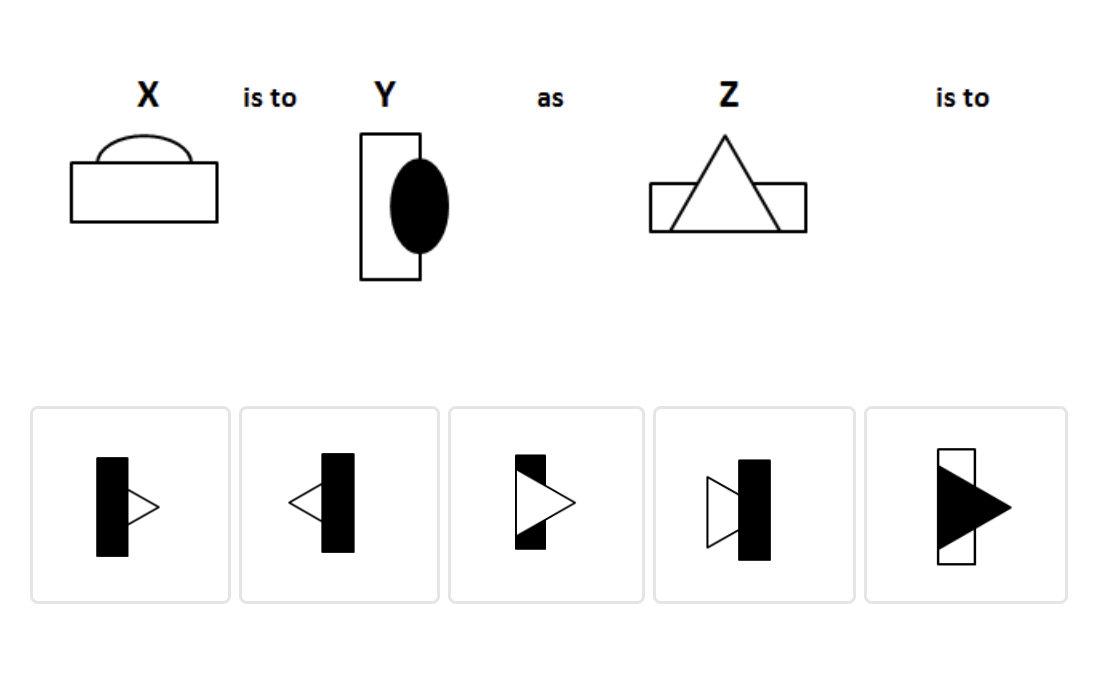
The correct answer is A.
Comparing Figure X to Figure Y reveals two changes happening together: The shape that was behind (the circle, partly hidden behind the rectangle in X) moves to the front and becomes dark, and the entire figure rotates 90° clockwise.
Applying that same rule to Figure Z: The rectangle is the shape positioned behind the triangle, so it should move to the front and become dark, while the whole figure rotates 90° clockwise.
Two of the options can be eliminated because the back shape (the rectangle) never moves to the front at all. Another is eliminated because it shows the figure rotated the wrong direction (counter-clockwise instead of clockwise). A fourth is eliminated because the triangle and rectangle are positioned incorrectly relative to each other.
That leaves the answer that correctly shows the rectangle now in front and dark, with the whole figure rotated 90° clockwise, exactly what's needed to complete the pattern established by X and Y.
At first glance, abstract reasoning questions can seem straightforward, but the Caliper cognitive section rewards careful pattern recognition over quick guessing.
For this type of question, you often need to track more than one change at once. A shape's position or fill might shift, the whole figure might rotate, or both at the same time. The key is to isolate one variable at a time rather than trying to process the whole pattern at once.
Even so, with 11 questions and no room for error, accuracy is everything. Our PrepPack walks you through the exact strategies needed to break down each question type.
The Caliper Personality Test makes up the majority of the assessment, spanning three sections and 87 questions in total. It builds a picture of how you naturally think and behave at work, which employers compare against the specific role you're applying for.
The personality section uses two distinct formats:
What makes the Caliper personality assessment particularly challenging is the need for strategic, consistent responses throughout.
Our PrepPack offers position-specific personality practice, covering General Staff, Sales, Manager, Change Management, Government and Regulatory, and Data, Finance & Analysis roles, so you can tailor your preparation to the job you're actually applying for.
Take a look at this sample Caliper personality test question, focusing on Most & Least:
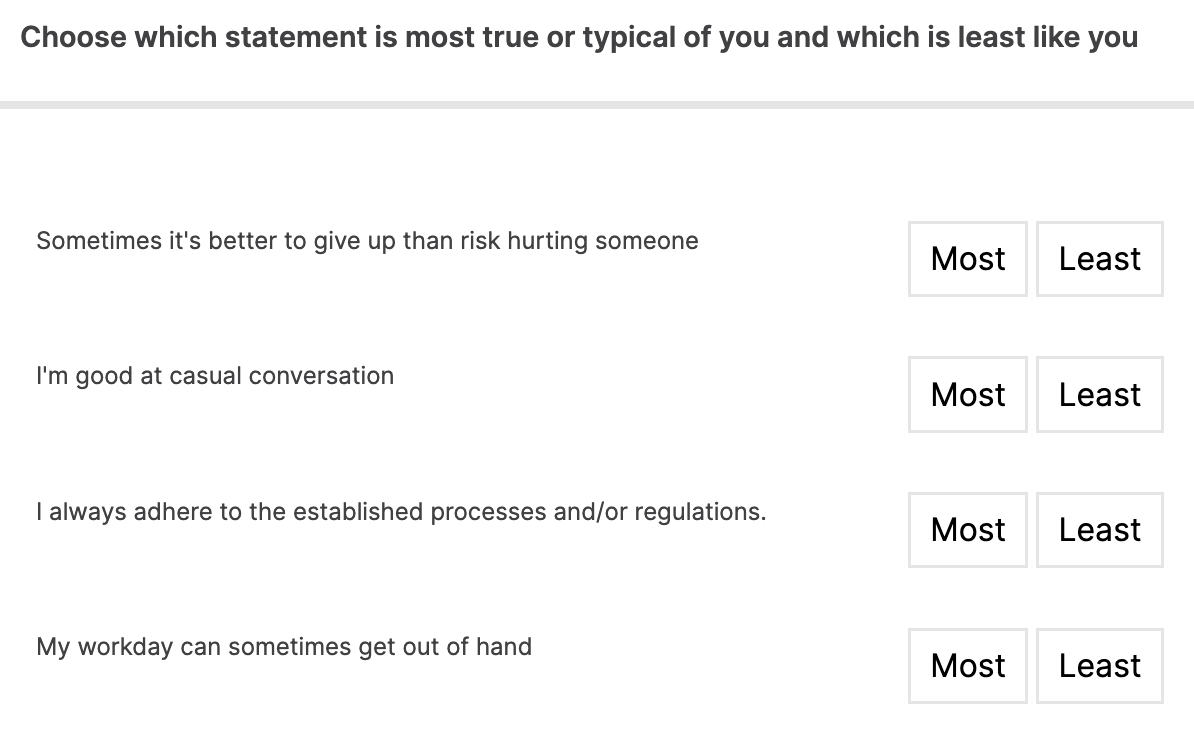
This question may look straightforward, but the Caliper personality assessment is more complex than it appears.
Each set of statements is carefully designed to assess four distinct personality traits simultaneously, meaning there is no universally good answer. The right response depends entirely on the role you're applying for and the competency profile your employer has defined for it.
For most professional roles, a strong choice is:
Most Like Me: I always adhere to the established processes and/or regulations
Least Like Me: My workday can sometimes get out of hand
The other two statements - casual conversation and stepping back to avoid conflict - matter more for people-facing or leadership roles specifically, so how you'd answer them depends heavily on the position you're targeting.
Answering instinctively or too quickly is one of the most common mistakes candidates make. The Caliper assessment is also designed to detect inconsistency, so a single out-of-character response can affect your overall profile.
Our PrepPack includes position-specific practice with detailed feedback, so you learn exactly how each trait maps to your target role and how to respond with both authenticity and strategy.
The Caliper is one of the most widely used hiring assessments across industries in the US and beyond.
Once you complete the Caliper assessment, your results are sent directly to your employer as a detailed competency report. This report maps your personality traits and cognitive abilities against a job-specific model, giving your employer a clear picture of how well you fit the role across key competency areas.
But employers don't just use your results to make hiring decisions. The same report can inform onboarding, identify development opportunities, and help build more effective teams, meaning your profile may follow you beyond the initial hiring process.
Since you'll never see your own results, thorough preparation is what actually shapes the outcome, not last-minute adjustments, but knowing in advance what the test measures and which traits matter for your target role.
And that's precisely where our Caliper Profile Test PrepPack comes in.
Take a look at what some past successful candidates had to say:
The 21 personality traits and cognitive abilities the Caliper test measures are grouped into seven major competency areas:
They're scored against a job model defined by the employer, with each role highlighting 5 - 9 key competencies.
Your overall fit score ranges from 1 - 99, where a score of 80 - 99 indicates an excellent fit, 60 - 79 a good fit with some challenges, 40 - 59 a moderate fit, and 39 or below a low fit for that job model.
For a full breakdown of scoring and results, visit our Caliper Results page.
Passing the Caliper assessment isn't just about knowing yourself - it's about presenting yourself strategically.
Here are four ways to give yourself the best possible chance:
Our Caliper Assessment preparation package is built around exactly these four principles, giving you the position-specific practice, study guides, and expert feedback each one calls for.
Realistic simulations, position-specific practice, study guides, and expert feedback - everything built specifically for the test you're about to take.

The Caliper assessment gives employers a detailed picture of a candidate's strengths, limitations, and behavioral tendencies in the context of a specific role. Beyond hiring, employers also use Caliper results to support employee development, inform promotion decisions, and build more effective teams.
The Caliper assessment is used across a wide range of industries and job functions, from sales and customer success to management and executive roles. Companies that rely on Caliper testing include WellStar, FedEx, Amazon, Russell Reynolds Associates, SoftServe, Kohler, Honda, GIC, Paul Davis Restoration, and Millennium, among many others.
Many candidates find the Caliper assessment more challenging than expected. The cognitive section requires sharp abstract reasoning skills, while the personality sections demand careful, consistent responses across a large number of questions. The combination of both, and the subtlety of the behavioral questions, is what catches most candidates off guard.
You can move between questions within a section freely, but each section must be fully completed, with nothing left blank, before you're able to progress to the next one. Practicing under these same conditions in advance helps you build the pacing and consistency the real assessment requires.
You'll have instant access to your PrepPack, which includes all your practice tests. You can start practicing immediately, working through detailed explanations and guides while a performance tracker highlights which sections and traits need more attention.
After your purchase, you'll receive two emails. The first contains your payment receipt, and the second includes a login link along with information about our general terms, conditions, and refund policy. To access your PrepPack, simply log in and reset your password.
No, there is no limit. Your progress is saved in your account, allowing you to revisit previous attempts. Our performance tracker helps you focus on the test sections that require more attention.
Yes, you can extend your practice period. Simply contact our customer success team via c.serv@jobtestprep.com.
Founded in 1992 by David Meshulam, JobTestPrep has over three decades of experience helping job seekers navigate competitive hiring assessments, including thousands of candidates preparing for the Caliper Profile Test. With over 220 preparation courses and millions of individuals supported worldwide, we offer professionally designed PrepPacks, regularly updated to reflect the latest test formats, as well as advanced AI-powered tools, including our CV Analyzer and Interview Prep platforms. Together, these resources help professionals across the US and globally strengthen their applications, improve their performance, and achieve outstanding results.
If you're preparing for Caliper assessments, you might also find these other resources helpful:
See our full Talogy Assessments guide for more on the company behind Caliper and its other tests.