How to Prepare for the CritiCall Test: 72 Hours, One Week, or Two Weeks
Updated: August 2026
Your CritiCall test may differ from the versions described by other candidates online, and that is normal. CritiCall includes more than 20 different tests, with each hiring agency selecting the combination it considers relevant for its dispatcher or call-taker positions.
That is why effective preparation does not begin with trying to complete every possible module. It begins with a diagnostic that shows where your accuracy, memory, listening, or task-switching performance declines.
Your study plan should also reflect the time remaining. A candidate testing within 72 hours needs to reduce repeatable mistakes quickly. A candidate with one or two weeks can build accurate routines, add pressure gradually, and retest those routines under realistic conditions.
Start with a free CritiCall assessment practice test, identify the condition that affects your performance, and use the appropriate schedule below.
Effective CritiCall preparation starts with evidence about your performance, not assumptions about your strengths.

Complete a timed diagnostic before deciding what to practice. The purpose is to identify whether your main difficulty involves speed, accuracy, listening, memory, navigation, instructions, or recovery after an interruption.
Take the diagnostic in a quiet location. Avoid pausing, restarting difficult sections, or looking up information while you work. You are trying to observe how you respond when you cannot control every part of the experience.
Do not record only your total score. Note:
A correct answer can still reveal a problem. You may have taken too long, checked the same detail repeatedly, or used a method that would become unreliable when another task competes for your attention.
Your diagnostic is most useful when it explains why your performance changed, not simply whether your answer was correct.
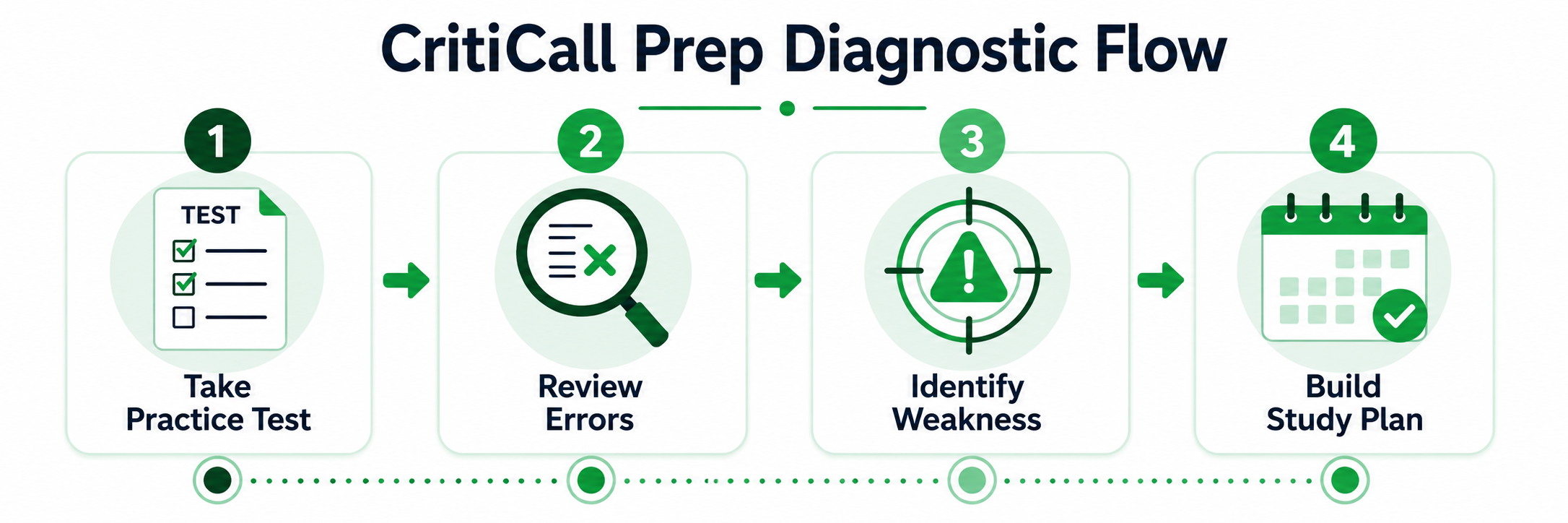
Classify each important error according to its likely cause. This helps you select the correct practice method instead of completing more questions without a clear objective.
Speed errors occur when you understand the task but cannot complete it efficiently.
Accuracy errors include misspellings, transposed numbers, omitted details, duplicated entries, and information placed in the wrong field.
Listening errors occur when you miss, confuse, or incorrectly interpret spoken information.
Memory errors occur when you initially understand a detail but cannot retain it long enough to enter or use it.
Navigation errors include selecting the wrong field, overlooking an on-screen control, losing your location, or returning to the wrong part of a task.
Instruction errors occur when you overlook or misapply the rules supplied for the current section.
Recovery errors happen after your attention shifts. You may resume in the wrong place, forget the last completed step, or rush several later answers.
End the review with one priority statement:
My main test-day risk is losing data-entry accuracy after switching from an audio task.
That statement gives your next session a measurable purpose. “Practice more CritiCall questions” does not.
With 72 hours or less, focus on familiarity, preventable errors, and your largest demonstrated weakness. You do not have enough time to give every possible module equal attention.
Your objective is not to transform every underlying ability in three days. It is to reduce recurring mistakes, become familiar with common test mechanics, and avoid being surprised by timed or combined tasks.
Complete one diagnostic and review it carefully. Choose no more than two priorities.
Your first priority should be the condition producing the most serious or frequent errors. Your second may involve a basic mechanic, such as selecting the correct field, applying a decision rule, or resuming after an interruption.
Also confirm:
Use your agency’s instructions as your source of truth. CritiCall is modular, and agencies can choose their own combination of tests.
Practice your main weakness without a competing demand first.
Establish a controlled and accurate method before increasing the difficulty. Then repeat a similar task under time pressure or with another demand. For example:
The purpose is to preserve your process as the task becomes more demanding.
Accuracy that disappears under pressure is not yet dependable accuracy.
Complete one short rehearsal rather than several exhausting simulations. Review your most common errors and repeat the recovery method you intend to use during the assessment.
Finish by checking your equipment and rereading the agency’s instructions. Avoid practicing until fatigue begins to create careless mistakes unrelated to the skill you intended to improve.
With only 72 hours remaining, correcting two repeatable mistakes is more useful than briefly reviewing every test in the CritiCall library.
One week gives you enough time to diagnose, correct, combine, and retest. Your practice should become progressively more realistic rather than equally difficult every day.
Day 1: Complete a diagnostic.
Record your baseline accuracy, completion time, recurring errors, and recovery after interruptions.
Day 2: Practice your main weakness.
Work on the weakest skill in isolation. Slow down enough to establish a reliable method.
Day 3: Address your second priority.
Focus on the next most important issue, such as listening, memory, map directions, decision rules, or field navigation.
Day 4: Combine two demands.
Practice entering information while listening, making a decision before returning to another task, or switching between written and audio information.
Day 5: Practice recovery.
Introduce deliberate interruptions. Before resuming, identify:
Day 6: Complete a timed retest.
Use a timed CritiCall practice test and compare the result with your first diagnostic.
Look for:
Day 7: Review and prepare your setup.
Study the errors that still repeat, keep the final practice session controlled, and verify the practical details of your appointment.
Do not judge progress only by whether your overall score increased. A small score improvement accompanied by fewer recurring errors may be more meaningful than a faster result produced through rushed answers.
A one-week CritiCall study plan should move from isolated accuracy to controlled performance under competing demands.
Two weeks allows you to build dependable processes before introducing heavier time pressure. You have enough time to test a method, measure its effect, and correct it before the hiring assessment.
Complete an initial diagnostic and identify your two highest-priority weaknesses.
You do not need to study every possible CritiCall test in detail. The official test library includes modules involving computerized data entry, multitasking, oral comprehension, call summarization, memory, cross-referencing, map reading, decision-making, reading comprehension, numerical ability, and other job-related skills. Your agency may select only some of them.
Use the first two days to understand how you perform, not merely what each module is called.
Build accurate routines for your weakest skills before trying to complete them faster.
Your routine might include:
Repeat the method until correct performance becomes more predictable.
Increasing speed before establishing an accurate process often makes the same mistakes happen faster.
Complete a new timed diagnostic. Use unfamiliar material where possible so that memory of previous answers does not distort the comparison.
Ask:
When a problem remains unchanged, adjust the method rather than simply repeating the same exercise.
During days 8 through 11, combine skills that compete for attention. You might listen while entering data, apply a rule before resuming another task, or complete directions under a stricter time limit.
On day 12, complete a longer timed simulation. Use day 13 for targeted correction instead of immediately completing another full test.
On day 14, conduct a light review. Revisit your agency’s instructions, error log, recovery method, and technical setup.
The final day should consolidate the processes you have already practiced. It should not introduce a completely new preparation strategy.
Two weeks gives you time to build a process, test it under pressure, and correct it before the assessment.
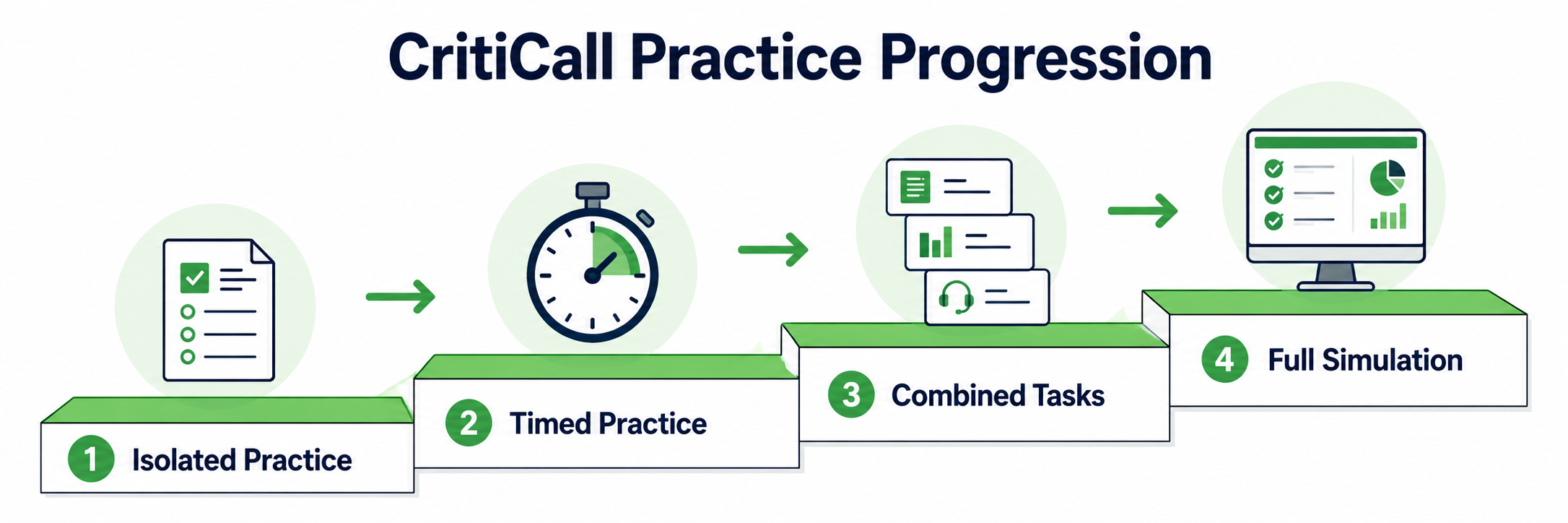
With one month or more, use the additional time to develop skills gradually instead of completing full simulations every day.
Begin with two or three focused sessions each week. Work first on accurate information entry, listening, memory, computer navigation, and any other weakness revealed by your diagnostic. Add stricter timing after you can perform the task consistently. A practical one-month progression is:
Week 1: Establish your baseline.
Complete a diagnostic, classify your errors, and identify two priorities.
Week 2: Build accuracy.
Practice the priorities separately and develop consistent note-taking, checking, navigation, and recovery routines.
Week 3: Combine tasks.
Introduce audio, interruptions, decision rules, and time limits. Observe whether your earlier accuracy remains stable.
Week 4: Simulate and refine.
Complete timed practice, review the remaining error patterns, and reduce your workload as the test approaches.
Do not spend a month memorizing the same practice questions. Use varied material so improvement reflects a transferable skill rather than familiarity with specific answers.
Three months of intensive CritiCall-specific practice is not a necessary default. Candidates with that much time can use the earlier weeks to strengthen general typing accuracy, listening, recall, and computer skills, then move into focused CritiCall practice once the assessment date is confirmed.
More preparation time helps only when it produces better habits, not more repetitions of familiar material.
Prepare for the common performance demands instead of attempting to predict your agency’s private test battery.
The official provider describes CritiCall as a work-sample assessment that simulates a generic dispatch environment without requiring specialized dispatcher knowledge. It also confirms that agencies choose the tests they consider appropriate for their positions.
Focus on abilities that transfer across several modules.
Accurate information entry: Practice entering names, addresses, telephone numbers, vehicle details, and alphanumeric sequences into the correct fields.
Listening and selective attention: Practice identifying important names, numbers, locations, descriptions, and events from spoken information.
Short-term recall: Hold small pieces of information long enough to enter or use them. Avoid trying to memorize an entire narrative as one block.
Rule-based decision-making: Apply the rules supplied by the exercise. Do not replace them with assumptions about what would happen in an actual emergency.
Task switching and recovery: Practice pausing one activity, responding to another demand, and returning deliberately to the correct point.
Computer navigation: The official candidate guide says candidates may need to use a keyboard, mouse, scroll bars, response controls, data-entry fields, and audio equipment. It also explains that practice items may appear at the start of test sections to demonstrate how to respond.
You do not need to know every selected module to practice careful listening, accurate entry, instruction-following, and controlled task switching.
Typing can support computerized data-entry tasks, but CritiCall may also assess oral comprehension, memory, map reading, decision-making, cross-referencing, reading comprehension, and multitasking.
A strong typing result does not show whether you can retain spoken details or recover accurately after an interruption.
Record omissions, transposed numbers, duplicated details, changed information, and entries placed in the wrong field. Faster completion with more mistakes is not reliable progress. Speed becomes useful only when your accuracy remains controlled.
Your agency may use only part of the CritiCall test library, and your own abilities will not be equally weak.
Allocate more time to the condition that causes the clearest decline. Do not divide your preparation evenly simply because a list of modules exists.
A higher score on remembered material may reflect answer recognition rather than stronger performance.
Retaking an exercise can help you apply a corrected method, but use unfamiliar questions when you want to determine whether that method transfers.
The official candidate guide states that practice items may be presented at the beginning of individual sections to help candidates understand how to respond. Scores from those practice items are not included in the final score.
Use them carefully, even when the task looks familiar. Misunderstanding the controls or response format can create errors unrelated to your underlying ability.
Good preparation is not the number of questions you complete. It is the reduction of mistakes that would otherwise happen again.
Use the final 24 hours to confirm logistics and reinforce a small number of reliable habits. Avoid turning your final day into your longest practice session.
Review:
During the assessment, read the instructions for the current section. Do not assume that a rule from an earlier task remains in effect.
After an interruption, use this recovery sequence:
Stop. Locate. Resume.
Stop entering information briefly. Locate the last confirmed detail and the active field. Resume when you know the next required action.
A deliberate pause may feel slower than restarting immediately. It is still more efficient than correcting several connected mistakes.
Free practice is useful for identifying weaknesses and checking whether your performance changes under timed conditions. More structured preparation may become useful when you need additional questions, repeated module-focused exercises, longer simulations, or more opportunities to practice a persistent weakness.
The official CritiCall provider offers candidate guidance and sample keyboarding, proofreading, and spelling resources. It does not provide its protected live CritiCall software to applicants as a downloadable practice version, and agencies choose their own test configurations.
No third-party preparation resource can know every agency’s exact private battery. Preparation should help you become familiar with common task demands without claiming to reveal protected live questions.
Candidates who need repeated, structured practice can review JobTestPrep’s complete CritiCall test preparation. Use it to target a diagnosed weakness rather than completing every available exercise without a plan.
Free practice identifies the weakness. Targeted repetition shows whether that weakness improves.
The most important part is identifying the condition that changes your performance. You may enter information accurately until audio begins.
You may retain details until you must switch fields. You may understand a rule until the timer creates pressure.
Use your remaining time to make that condition more familiar and your response more controlled. Then test your method under realistic conditions.
Start with the free CritiCall assessment practice test, identify your main error pattern, and use the schedule above to plan your next practice session.

One week can give you enough time to understand common test mechanics, diagnose a weakness, and reduce specific errors. It cannot guarantee a passing result. Use the week to move from accurate isolated practice to combined and timed tasks.
No. One month allows you to build accuracy gradually and avoid cramming. Use the early weeks for skill development, then introduce combined tasks and realistic time pressure as the assessment approaches.
A session should be long enough to reveal meaningful error patterns but short enough for careful review afterward. Several focused sessions may be more informative than one extended session completed after concentration and accuracy have declined.
Take notes when the practice format permits them, but use the testing agency’s instructions to determine what will be allowed during the actual assessment. Practice concise note-taking that separates names, numbers, locations, and event details instead of trying to record every word.
Begin with accuracy. Add stricter timing after your process becomes reliable. Speed gained by omitting information, confusing fields, or rushing decisions does not represent useful improvement.
A retake can help you rehearse a corrected method, but it should not be your only measure of progress. Use unfamiliar material when evaluating whether your improvement transfers beyond questions you remember.
Review the mistakes before taking another test. Determine whether the result came from one major weakness, misunderstood instructions, time pressure, or several smaller problems. Then choose one issue for your next focused practice session.