What Skills Does the CritiCall Test Measure in 2026?
Updated: May 2026 | 10-minute read
If you’ve been invited to take the CritiCall test, you’re probably wondering exactly what it covers—and why the invitation gave you so little detail.
So, what does the CritiCall test measure? CritiCall measures the job-related skills that 911 dispatcher and call-taker applicants need before any training begins: typing accuracy, data entry, listening, multitasking, decision-making, memory, and communication. According to Biddle Consulting Group, the developer of CritiCall, the test is scientifically designed so that applicants need no prior dispatch experience or special dispatcher training to succeed during testing.
The test is also modular. Each agency selects the sections it wants, which means no two candidates necessarily sit the same battery. This article breaks down what CritiCall is actually testing, module by module, and how to focus your preparation on the skills that matter most.
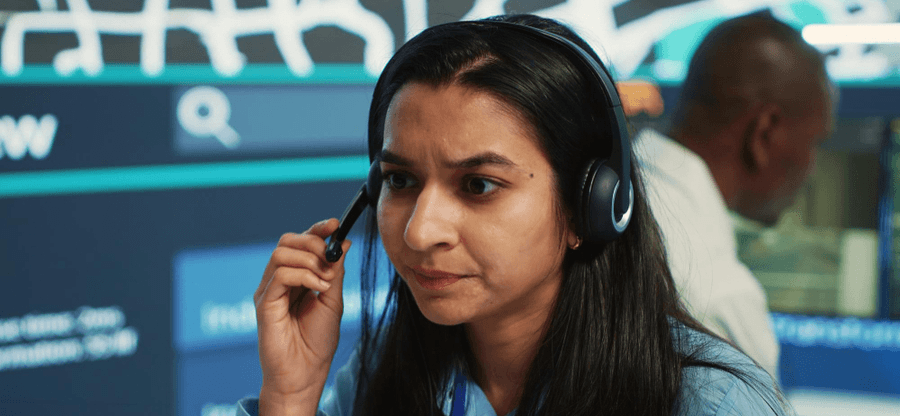

The CritiCall test measures whether 911 dispatcher and call-taker applicants can process information quickly, stay accurate under time pressure, multitask, communicate clearly, make rule-based decisions, and handle job-like emergency scenarios. Depending on the agency, it may include modules for typing, data entry, memory, map reading, call summarization, and decision-making.
Many applicants assume CritiCall is mostly common sense. That assumption is partly right—the tasks themselves are not obscure. The harder part is applying them accurately while typing, listening, reading, and switching between demands all at once.
CritiCall is not asking whether you already know how to be a trained dispatcher. According to the official CritiCall website, many of its modules provide a "miniature replica" of the emergency services job, but the test measures readiness for dispatcher-style work, not existing dispatcher knowledge. The skills it targets are accuracy, attention, calm under pressure, and quick information processing.
The U.S. Bureau of Labor Statistics identifies multitasking, communication skills, decision-making skills, listening skills, and typing skills as important qualities for public safety telecommunicators. CritiCall is designed to screen for exactly those qualities.

CritiCall does not just test whether you know the right answer; it tests whether you can find the right answer quickly while managing pressure.

Both matter, but accuracy is not optional. CritiCall rewards fast work only when it is correct. Small errors in names, addresses, phone numbers, license plate numbers, or incident details are the kind of mistakes that cost real points on the test and real consequences in the actual job.
Consider the difference between entering "P8747936" and "P8747396." Those two strings look nearly identical under time pressure. The data entry and cross-referencing modules are specifically designed to catch that kind of transposition error. Speed helps you finish; accuracy determines your score.

CritiCall often combines tasks rather than isolating them. You may be entering data while an emergency message appears on screen requiring an immediate decision, or listening to an audio recording while simultaneously typing field entries.
This is where many confident candidates get surprised. The individual tasks are not hard in isolation. The challenge is task-switching without losing accuracy on either front. Decision-making pop-ups during the Data Entry module, for example, require you to pause your data entry, respond to an alert, and return to your entry without losing your place.
The hardest part of CritiCall is often not the individual skill, but the way several simple skills are combined at once.
Call summarization measures whether you can listen to a brief call or story, identify the key details, and enter them accurately while ignoring irrelevant information. The goal is not to remember every word; it is to extract what matters.
Relevant details in a dispatcher call typically include the caller's name, the location, the number of people or vehicles involved, the nature of the incident, and any suspect descriptions or direction of travel. Taking notes during audio playback is an important test-taking behavior in this module.
Decision-making on CritiCall is rule-based, not opinion-based. You are given a set of instructions at the start and must apply those rules to determine which emergency service to dispatch: Police, Fire, EMS, or Utility. You are not being asked to guess or rely on personal judgment.
The practical implication is significant: applicants who take time to learn the dispatch rules before the test perform better not because they are smarter, but because they can apply the rules faster. The test does not reward hesitation; it rewards accurate recall under time pressure.
Memory recall on CritiCall is practical. It tests whether you can retain specific details after a distraction, such as hearing a caller say "blue pickup truck" and then selecting that exact detail several steps later rather than confusing it with "dark blue pickup" or "red sports car."
Attention to detail carries across modules, not only in dedicated memory sections. Any module that involves transferring or comparing information is also measuring whether you keep details accurate from source to output.
Some CritiCall batteries include spelling, sentence clarity, reading comprehension, or proofreading. The point is not advanced grammar; it is whether written records and messages are clear and unambiguous.
A typical example involves choosing the sentence that communicates an incident most precisely, where a small wording difference changes the meaning of the report entirely.
The table below outlines the modules candidates commonly encounter and what each one is actually designed to assess. Because agencies configure their own CritiCall battery, the modules listed here represent the full range of what is possible, not a guaranteed list for any specific test.
| Module | What It Measures | What Applicants Often Underestimate |
|---|---|---|
| Typing / Keyboarding | Speed and sustained accuracy | Maintaining accuracy over several minutes, not just a burst |
| Data Entry | Accurate transfer of alphanumeric details | Transposition errors under time pressure (letters, numbers, codes) |
| Call Summarization | Listening, note-taking, key detail extraction | Filtering irrelevant information while retaining what matters |
| Decision Making | Rule-based dispatch judgement | Applying rules quickly without second-guessing |
| Prioritization | Urgency ranking across incident types | Disinguishing life-safety calls from property or non-mergency issues |
| Multitasking | Task switching with sustained accuracy | Responding to pop-up alerts while actively typing or listening |
| Map Reading | Directional reasoning and route logic | Translating written directions into correct north/south/east/west navigation |
| Memory Recall | Short-term retention of specific details | Remembering exact wording after a distraction has occured |
| Cross-Referencing | Matching and verifying information across fields | Similar-looking names, codes, and number sequences |
| Reading / Spelling / Sentence Clarity | Clear and accurate written communication | Small wording differences that change the meaning of a record |
The CritiCall test is modular by design. Each public-safety agency accesses a library of modules and selects the combination it wants to use. According to the official CritiCall website, test modules appear as selected by each agency and are administered one after another until the session is complete.
This means one applicant's battery may be heavily weighted toward data entry and typing, while another's includes map reading and prioritization. The variation is not an error or inconsistency; it is an intended feature that lets agencies screen for the skills most relevant to their specific dispatch environment.
The uncertainty this creates is one of the main reasons applicants feel anxious. The most practical response is to identify what your agency emphasized in the job posting, testing notice, or invitation email, and to prepare broadly across the core skill categories rather than banking on a specific module lineup.
Because agencies choose their own CritiCall modules, the best preparation strategy is to understand the skill categories, not memorize one fixed test.
CritiCall is not a random aptitude screen. Each skill it measures corresponds directly to something a real dispatcher does on shift.
Typing and data entry connect to logging call details accurately in computer-aided dispatch (CAD) systems while a caller is still on the line. Listening and call summarization mirror collecting information from stressed callers who may be unclear, panicked, or providing details out of order. Decision-making maps to selecting the correct agency and response type in real time. Multitasking reflects the reality of handling an active call, monitoring radio channels, and updating records simultaneously. Memory applies to retaining caller details long enough to act on them before a system entry is confirmed.
The U.S. Bureau of Labor Statistics describes public safety telecommunicators as workers who use computers to log important facts such as the nature of an incident and the caller's name, while simultaneously gathering location information and coordinating the appropriate first-responder agency. CritiCall's skill areas reflect that job description closely.
CritiCall is not designed to teach dispatching. It is designed to measure whether a candidate has the trainable foundation for it.
Prioritize the modules with the most impact first. Start with typing accuracy, data entry, call summarization, and decision-making. These appear frequently across agency configurations and cover the broadest range of tested skills.
Do short timed blocks rather than long reading sessions. One 20-minute block for typing and data entry, one for decision-making, one for call summarization gives you practical exposure in a short window. Practice under mild distraction, not only in silence, because the real test will not be silent.
Do not spend most of your available time reading about the test. Spend most of it doing timed practice tasks.
Build a module rotation. Alternate between speed-focused modules (typing, data entry) and accuracy-and-detail modules (memory recall, cross-referencing, call summarization). Track your errors by type and revisit weak areas in subsequent sessions rather than repeating your strongest modules for comfort.
A reasonable practice split: roughly 40% on the most common modules, 30% on your weakest identified skills, 20% on multitasking and combined tasks, and 10% reviewing decision rules and dispatch logic.
After covering the core modules confidently, add map reading, prioritization, and sentence clarity to your rotation.
Do not restart broadly unless you genuinely do not know which area cost you the attempt. Focus on the specific module or error type that caused the problem.
Recreate the pressure: use timed conditions, do not pause audio playback, and practice with interruptions. Review your errors by category: Was it a speed issue? An accuracy issue? A misunderstood rule? A missed detail? A panic mistake under time pressure?
If data entry was the problem, separate your error types into field placement, spelling, number transposition, and missed pop-ups. Each of those requires a different correction.
CritiCall does not measure whether you already know agency-specific radio codes, local protocols, or dispatch software. According to the official CritiCall website, the test is designed so that applicants need no prior dispatch experience or special dispatcher training to succeed.
It does not measure general personality in a broad sense. Where behavioral or situational components are included in a CritiCall 3D battery, they are job-related assessments, not open-ended character evaluations.
It does not measure whether you will enjoy the dispatcher role, though the format will give you a clear sense of what the work feels like. Candidates who find the test format overwhelming without preparation may want to use that feedback as useful information about the job itself.
For many applicants, preparation is not about becoming smarter; it is about making the test format feel familiar enough that anxiety does not distort performance.
Preparation for CritiCall is more about rehearsal than studying. The skills being tested are not knowledge-based; they are performance-based. That means the most effective preparation is timed, module-specific, realistic, and repeated until the format becomes familiar.
The qualities of good CritiCall preparation: it is timed to match actual test conditions, it covers the specific module types you expect to face, it includes feedback on errors so you understand what went wrong, and it is done enough times that surprise is no longer a factor.
JobTestPrep's CritiCall practice test offers free sample questions across multiple modules, and the full CritiCall PrepPack includes over 150 module-specific simulations, including a true-to-source Data Entry simulation with intermittent multitasking tasks, as well as CritiCall call summarization practice, CritiCall decision-making practice, CritiCall map reading practice, and more. The goal of practice is simple: let the test measure your real ability, not your anxiety about an unfamiliar format.
CritiCall measures practical dispatcher readiness: whether you can process information accurately under time pressure, switch between tasks without losing detail, make rule-based decisions quickly, and communicate clearly. The format is the challenge. The individual skills are accessible.
Your next step is to identify the modules your agency is likely to use, practice the most common ones until they feel routine, and then target whichever specific area still feels uncertain. You may already have many of the skills CritiCall tests. Preparation helps you apply them in the format the test actually uses.
CritiCall primarily measures speed, accuracy, multitasking, listening, memory, typing, decision-making, and communication in dispatcher-style situations. No single skill dominates; the test is designed to evaluate how well these abilities work together under time pressure.
Not in any general sense. CritiCall measures practical job-related abilities, specifically how accurately and efficiently you process information and apply rules in a high-pressure, time-limited environment. Prior knowledge of dispatching is not required.
No. Typing may be included, but agencies can also test data entry, call summarization, decision-making, prioritization, memory recall, map reading, cross-referencing, and language skills. Typing speed is a factor; typing accuracy under distraction is closer to what the test is really measuring.
No. CritiCall is modular. Each agency chooses which sections to include and in what order. One candidate's test may differ significantly from another's, even for the same general job title.
Common modules across agency configurations include call summarization, decision-making, typing, and data entry. That said, the exact battery depends entirely on the agency. Preparing broadly across all major skill categories is the most reliable strategy.
Yes. You can prepare by practicing timed, module-specific tasks that reflect the test's format: entering information accurately, listening for key details, responding to decision alerts, applying dispatch rules, and switching tasks without losing accuracy. Repeated timed practice is more effective than passive reading.
Start with the modules most likely to appear and most likely to affect your score quickly: typing accuracy, data entry, call summarization, and decision-making. After those feel solid, add multitasking practice and any other modules mentioned in your agency's testing notice.
No. CritiCall is designed specifically for dispatcher applicants entering the field. According to Biddle