


Elevator Industry Terms Explained
 Elevator Industry Terms Explained
Updated: November 17th, 2026 | 4 min read
If you have started researching how to become an elevator mechanic, you have probably run into a wall of acronyms. IUEC, NEIEP, EIAT, JAC, Locals, NEBA. It can feel like everyone already knows what these mean except you.
This page breaks down every organization and term you are likely to come across, in plain language, so you know exactly who is who before you apply.

Quick Elevator Apprenticeship Glossary Cheat Sheet
| Term | What it is |
| IUEC | The union that represents elevator mechanics, helpers, and apprentices |
| NEIEP | The organization that runs your apprenticeship: recruitment, the EIAT, and your classroom training |
| Locals | Your regional union chapter, the level where recruitment, interviews, and hiring lists actually happen |
| JAC | The committee that interviews and ranks you after the EIAT |
| EIAT | The entry exam you take to qualify for an apprenticeship |
| NEII | The trade association for elevator companies, focused on codes and safety |
| NEBA | The group that negotiates union contracts on behalf of the largest elevator companies |
| ECA | The group that negotiates union contracts on behalf of independent elevator contractors |
| NAEC | A trade association for contractors, best known for the CET credential |
| CET | An optional certification you can earn later in your career |
| QEI | A separate certification for elevator inspectors, not mechanics |
| NAESA International | The organization that trains and certifies QEI inspectors |
| ASME A 17.1 | The national safety code elevators are built and maintained to |
| Helmets to Hardats | A free program that connects veterans with union apprenticeships |
| iCIMS | The website NEIEP uses to manage your application |
The union and your apprenticeship
IUEC (International Union of Elevator Constructors)
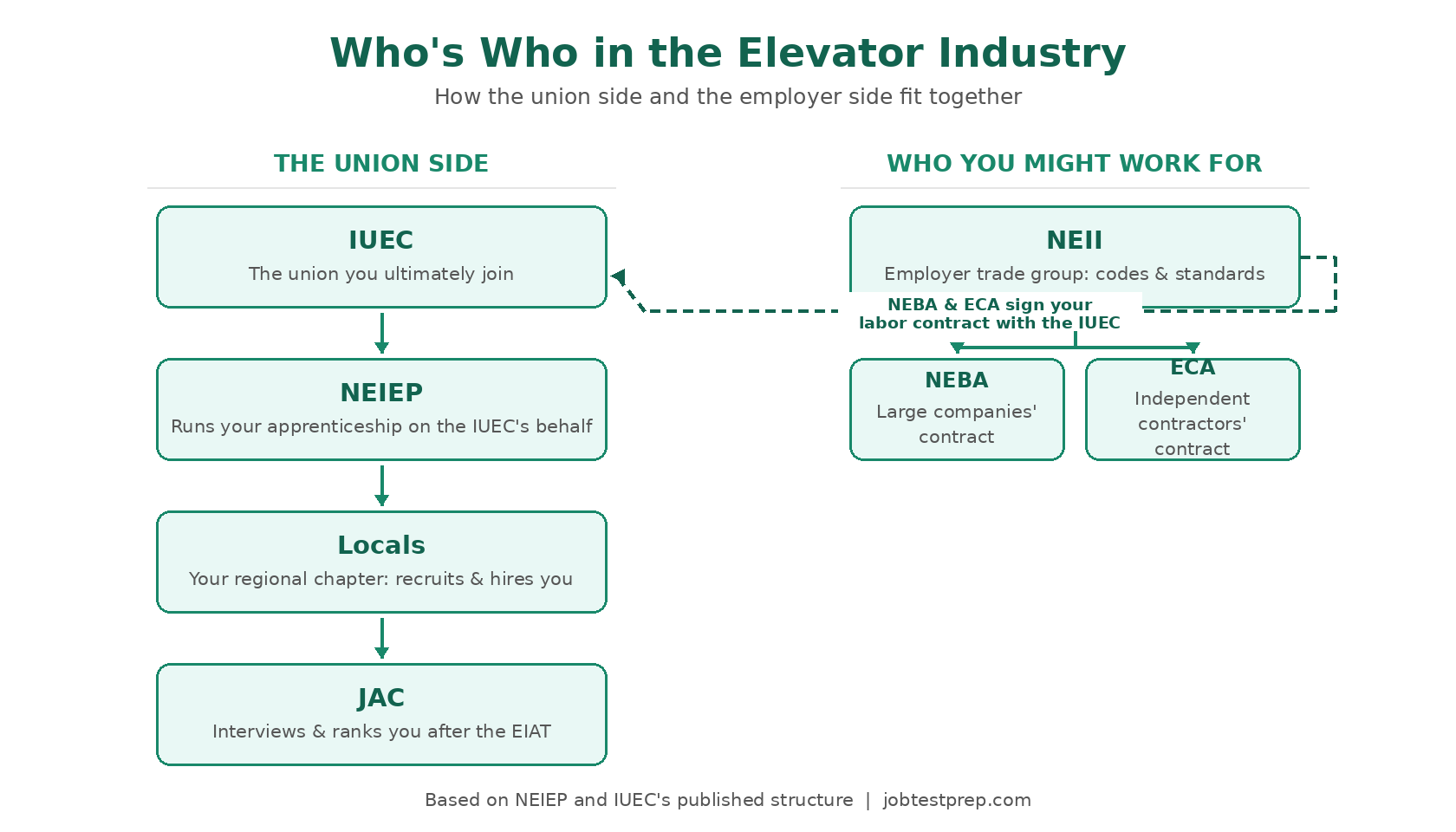
The IUEC is the union that represents elevator mechanics, helpers, and apprentices across the United States and Canada. It was founded in 1901 and today represents tens of thousands of elevator constructors. If you go the union route, the IUEC is who you ultimately join once you complete your apprenticeship.
NEIEP (National Elevator Industry Educational Program)
NEIEP is the organization that actually runs the apprenticeship, from the moment you apply to the day you complete your training. NEIEP posts recruitment openings, manages your application through iCIMS, schedules and administers the EIAT and tool assessment, and delivers your 576 hours of related classroom instruction. If you are applying through the union route, NEIEP is the name you will see most often in emails and on recruitment pages.
Locals
Your Local is your regional union chapter, for example Local 1 in New York City or Local 21. This is where the real, on-the-ground process happens: your Local runs its own recruitment window (roughly every two years), your own Joint Apprenticeship Committee interviews you, and you are hired off your Local's own ranked list. This is also why wait times and recruitment schedules can look completely different from one city to the next. It is not that some Locals are slower or less organized, they are simply on their own independent hiring cycles.
JAC (Joint Apprenticeship Committee)
Your JAC is the two-person interview panel you meet after passing the EIAT, one representative from the union and one from the employer side. They score your interview using the same standardized questions used across every Local, and that score, combined with your tool assessment result, determines where you land on your Local's hiring list.
Who you might work for
NEII (National Elevator Industry, Inc.)
NEII is the main trade association for companies that manufacture, install, and maintain elevators, including Otis, Schindler, KONE, TK Elevator, Fujitec, and Mitsubishi Electric. NEII focuses on safety codes, industry standards, and advocacy rather than day-to-day hiring, but it has a long history of working with the IUEC on shared programs, including the health, pension, and education plans that fund NEIEP.
NEBA (National Elevator Bargaining Association)
NEBA is the group that negotiates the main union contract on behalf of the largest elevator companies. If you work for one of the major national elevator companies as a union employee, NEBA's agreement with the IUEC is what sets your pay scale and benefits, the same nationwide.
ECA (Elevator Contractors of America)
ECA plays the same role as NEBA, but for independent and regional elevator contractors rather than the large multinational companies. It negotiates its own, separate agreement with the IUEC.
Major elevator companies
Otis, Schindler, KONE, TK Elevator, Mitsubishi Electric, and Fujitec are the elevator industry's largest employers. Several of these companies also run their own non-union trainee or apprenticeship programs, which is one route into the trade if you are not going through the IUEC.
Tests and certifications you will encounter
EIAT (Elevator Industry Aptitude Test)
The EIAT is the aptitude test every apprentice candidate takes as part of the NEIEP recruitment process. It covers reading comprehension, mechanical comprehension, and basic math, and you need a passing score to move forward to the tool assessment and interview.
Tool assessment
A separate, shorter assessment where you identify common tools and demonstrate basic measurement skills. It is scored on its own, but the result feeds into your final interview score, so it is worth preparing for specifically.
Ready to start preparing? Try a free EIAT sample test to see where you stand, or go straight to the full PrepPack for complete coverage of both the EIAT and the tool assessment.
CET (Certified Elevator Technician)
CET is a voluntary credential offered by NAEC, not a requirement to work in the trade. Mechanics sometimes pursue it later in their careers, particularly on the non-union side, as a way to formally document their skills.
QEI (Qualified Elevator Inspector)
QEI is a completely separate certification from anything covered on this page so far. It is for elevator inspectors, the people who perform code-required safety inspections, not for mechanics who install, maintain, or repair equipment. If your goal is to become an elevator mechanic, you do not need a QEI. If you are specifically interested in becoming an inspector later in your career, QEI certification (through NAESA International) is the credential to look into.
NAESA International
NAESA International is the organization that trains and certifies QEI inspectors, accredited to do so under a national standards body. It is worth knowing the name mainly so you can tell it apart from NEIEP, since both involve training and testing, but for very different roles.
Codes, safety, and regulators
ASME A17.1 (Safety Code for Elevators and Escalators)
This is the national baseline safety code that governs how elevators are built, installed, and maintained. Most states adopt it, sometimes with their own local amendments, which is part of why licensing requirements can look a little different depending on where you work.
State licensing boards
Most states require some form of elevator mechanic licensing on top of your apprenticeship, but the exact process, exam, and fees vary by state. Always check your own state's licensing or labor department for the current requirements.
OSHA (Occupational Safety and Health Administration)
OSHA is the general workplace safety regulator in the United States. It is not specific to elevators, but its rules apply to jobsite safety practices you will follow as an apprentice and mechanic.
Programs that can help you get in
Helmets to Hardhats
A free, nonprofit program that connects transitioning military veterans with union apprenticeships across the building trades, including the IUEC. No prior construction experience is required, and veterans can use GI Bill benefits alongside apprentice pay. If you are a veteran, this can be a faster on-ramp than applying during a general recruitment window.
iCIMS
iCIMS is simply the software platform NEIEP uses to manage applications and schedule the EIAT. If you get an email from iCIMS during your application, it is coming from NEIEP, not a third party.
Frequently Asked Questions
The IUEC is the union itself, the organization you become a member of once you are a licensed mechanic. NEIEP is the training arm that runs your apprenticeship on the union's behalf, including recruitment, the EIAT, and your classroom instruction. You apply through NEIEP to eventually join the IUEC.
No. QEI certification is for elevator inspectors, a separate career path from installation, maintenance, and repair. You do not need it to complete an apprenticeship or work as a mechanic.
Each IUEC Local runs its own recruitment schedule and its own ranked hiring list. A Local in a large market may recruit and hire more often than a smaller one, so timing depends on your specific Local's activity, not a single national schedule.
No. NEII represents elevator companies (the employers), while the IUEC represents the workers. They negotiate with each other, they are not the same organization.
CET (Certified Elevator Technician) is a voluntary credential from NAEC. It is not required to work as an elevator mechanic, but some mechanics choose to earn it later as an additional resume credential.
Yedidya, EIAT Specialist