Ramsay MultiCraft & Maintenance Test Study Guide [2026]
The Ramsay MultiCraft Test is a pre-employment assessment used by employers in maintenance and industrial sectors to evaluate candidates for multicraft technician roles. It measures mechanical aptitude, electrical knowledge, and troubleshooting ability - and is administered by Ramsay Corporation, one of the leading providers of trade and craft aptitude testing in the US.
The MultiCraft Test covers a wide range of technical domains - including hydraulics, pneumatics, motors, control circuits, welding, and print reading - making it one of the most comprehensive Ramsay variants. Employers such as Amazon, Walmart, UPS, and Cummins use it as a standard part of their maintenance hiring process.
This guide covers what the Ramsay MultiCraft Test contains, how scoring works, and how to prepare effectively.
Looking for a more dedicated breakdown of the Ramsay exams? Visit the following pages:

The Ramsay MultiCraft Test evaluates the technical skills required for maintenance roles in industrial and manufacturing settings. By covering both mechanical and electrical concepts, the test measures your ability to perform a variety of maintenance and repair tasks.
The Ramsay Multicraft Test assesses knowledge across various mechanical and electrical domains, essential for industrial maintenance and troubleshooting. The topics can be grouped into three major categories based on their practical applications:
Understanding mechanical movement and power transfer is crucial for industrial machinery. This includes the operation of hydraulic and pneumatic systems, covering their components such as pumps, valves, and actuators, along with troubleshooting efficiency issues like leaks and pressure loss.
Additionally, power transmission mechanisms such as gears, belts, chains, and couplings play a key role in ensuring machinery functions efficiently.
Proper lubrication methods are also essential to minimize wear, prevent contamination, and maintain smooth system performance.
A critical part of multicraft skills involves welding and rigging, which includes different welding techniques like MIG, TIG, and arc welding, as well as safe material handling through lifting techniques, hoists, and slings.
Alongside fabrication, shop tools and equipment such as lathes, drills, and hand tools are necessary for precise machining and assembly.
Safety procedures—including the use of personal protective equipment (PPE), fire hazard prevention, and proper ventilation—are essential to maintain a secure working environment.
Effective system maintenance ensures longevity and efficiency in industrial settings. This section covers pumps and piping systems, detailing different pump types (centrifugal, diaphragm, and positive displacement) and the selection of appropriate piping materials based on pressure and environmental considerations.
Furthermore, combustion principles are essential for understanding the operation of burners, ignition systems, and fuel types used in industrial applications. Maintenance strategies for these systems focus on alignment, fasteners, and preventative inspections to reduce downtime and optimize performance.
To get a better sense of what our practice tests look like, take this free interactive assessment.
When the transistor in the circuit shown is in an active region, _________.
The correct answer is C.
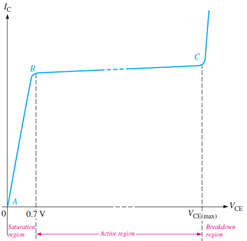
The characteristics curve of collector current is shown in the figure below.
There are three zones: saturation, active, and breakdown. The designer uses these regions of operation of a transistor for different applications. There are two major applications of BJTs: amplifier and switch. As the name suggests, the amplifier gives a particular gain to the input signal. Similarly, the switch term refers to turning on or off the transistor. This means the cut-off and saturation regions are used to control the collector current to be either zero or maximum based on the base current. In this region, the transistor is used as a switch: in which the transistor acts as a short or open. In the active region, the transistor is used as an amplifier. Therefore, A and B are incorrect, and C is the correct choice. The transistor blows in the breakdown region. Thus, D cannot be correct as well.
The circuit shown is a basic BJT (Bipolar Junction Transistor) common-emitter configuration. R1 controls the base current entering at terminal B, which determines which operating region the transistor is in. R2 is the collector resistor connected between the supply voltage V and the collector terminal C.
A BJT operates in one of three regions depending on the base current and voltage conditions:
In the saturation region (VCE below 0.7V), both junctions are forward-biased and the transistor conducts fully - it acts like a closed switch (short circuit). This is why answer A is correct for the saturation region, not the active region.
In the active region (VCE between 0.7V and VCE(max)), the collector current IC rises and stabilizes proportionally to the base current. A small change in base current produces a proportionally larger change in collector current - this is amplification. This is why answer C is correct specifically for the active region.
In the breakdown region (VCE beyond VCE(max)), the transistor exceeds its voltage rating and breaks down - a destructive condition that permanently damages the component. This is why answer D is wrong - breakdown is not a normal operating state.
The collector current characteristics curve (IC vs VCE) illustrates these three zones clearly. Points A and B mark the boundaries of the saturation region, point C marks the onset of breakdown, and the flat portion between B and C - where IC remains relatively constant despite increasing VCE - is the active region where amplification occurs. Answer B describes the cut-off region, where the transistor is fully off and conducts no current, which is not shown in this circuit's operating conditions.
What will the output be in the following logic diagram?
The correct answer is A.
The following diagram depicts the different logical gates and their outputs:
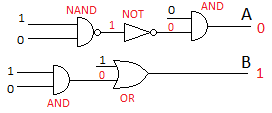
Top: 1 NAND 0 = 1 -> NOT 1 = 0 -> 0 AND 0 = 0 (A = 0).
Bottom: 1 AND 0 = 0 -> 0 OR 1 = 1 (B = 1).
The logic diagram contains two separate circuits, each combining multiple logic gates in sequence. The output of each gate feeds into the next, so you must evaluate them step by step from left to right.
Circuit A (top) uses three gates in series - NAND, NOT, and AND:
Circuit B (bottom) uses two gates in series - AND and OR:
This is why answer A (A - 0, B - 1) is correct. Answers B and D are wrong because A cannot be 1 given the AND gate receives two 0 inputs. Answer C is wrong because the OR gate receiving a 1 input guarantees B cannot be 0.
What is the radius of the hole labeled as X in the drawing?
The correct answer is B.
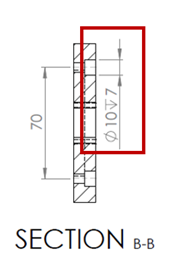
The hole diameter is mentioned in the section view B-B, as shown in the figure below. The radius is half of the diameter. Since the diameter is 10, the radius is 5. Therefore, B is the correct choice.
Print reading is a core skill for maintenance technicians - engineering drawings communicate information across multiple views simultaneously, and you must read them together rather than in isolation.
The main view (front view) shows the overall dimensions and layout of the part, including the position of hole X marked with a red arrow. However, the diameter of hole X is not labeled directly in the main view - this is common practice in technical drawings when a feature is better shown in a section view.
Section B-B is a cross-sectional cut taken along the B-B line marked in the main view. Cutting through the part at that line reveals the internal features in profile, making it possible to dimension holes and depths that would otherwise be hidden. The hatching (diagonal lines) in the section view represents solid material, while the unhatched areas represent holes or voids.
In Section B-B, the hole is labeled Ø10 ▽7. The Ø symbol means diameter, so the hole has a diameter of 10mm. The ▽7 indicates the hole depth is 7mm. This is why the answer is not found in the main view - you must read the section view to find it.
Since diameter = 2 × radius, a diameter of 10 means a radius of 5. This is why answer B is correct. Answer A is wrong because 10 is the diameter, not the radius - a common trap in print reading questions. Answer C (2.5) would only be correct if the diameter were 5. Answer D is incorrect because the information is available in the drawing - it just requires reading the section view rather than the main view.
Passing the Ramsay Test—especially the Ramsay Multicraft exam—requires strong mechanical aptitude, electrical maintenance knowledge, and problem-solving under pressure.
With our expert-designed prep pack, you’ll get comprehensive tutorials, practice tests, and proven strategies to boost your confidence and maximize your score.
Join thousands of successful test-takers who improved their scores and landed high-paying roles.
The Ramsay MultiCraft Test consists of 60 questions with a 60-minute time limit. It covers 8 topic areas: hydraulics and pneumatics, print reading, mechanical knowledge, electrical and electronics, welding and cutting, power transmission, process flow, and preventive maintenance. The test is administered either on-site at the employer's facility or at an assessment center - online at-home testing is rare.
There is no single universal passing score. Each employer sets its own threshold internally and rarely publishes it. As a general benchmark, candidates scoring below the 40th percentile are typically screened out at major employers. At Amazon and Walmart, the competitive threshold for maintenance roles is generally the 60th-70th percentile - meaning you don't just need to pass, you need to score above the majority of other candidates to advance.
Most major employers impose a waiting period before you can retake the test. At Amazon, that is typically 6-12 months per location. At Walmart it is around 6 months, tied to a specific role requisition. Your score is also employer-specific - it does not transfer to other companies, so a low score at one employer closes that application without affecting others.
PDFs give you a static list of questions with no time pressure, no performance tracking, and no feedback on where you're weak. The real Ramsay test is timed - 60 questions in 60 minutes - and time management is one of the most common reasons candidates underperform. Practicing with untimed PDFs creates a false sense of readiness. A simulation that mirrors the actual test format, pacing, and difficulty is a fundamentally different preparation experience.
Yes. If you've worked through this guide and want to test yourself under real conditions, our MultiCraft PrepPack includes full-length timed simulations, topic-specific practice sets, and detailed answer explanations - covering all 8 content areas of the test. It's designed to replicate the actual test experience so that when test day comes, there are no surprises.