


What are the rules in Raven's Matrices, and how do you solve them?
 What are the rules in Raven's Matrices, and how do you solve them?
Last Updated: November 2026 | 7-minute read
Raven's matrices look like abstract puzzles, but they repeat a small set of ideas. Once you can name the idea behind a grid, the missing piece stops being a guess. This guide covers the Raven's progressive matrices rules in full: seven rule types, a diagram for each one, and a step-by-step method you can use on the Standard (SPM) and Advanced (APM) tests.
People call the test a Raven pattern test, a Raven logic test or even a Raven puzzle test, and all three names fit. Every grid hides a rule, and your job is to find it. The sections below show Raven style matrices one rule at a time, so you can practice spotting each pattern before you meet them mixed together on the real test.
When you are ready for real questions, try our free Raven's matrices practice test.
How does a Raven's matrix work?
Every question shows a grid of shapes with one piece missing, usually a 3x3 grid. You pick the piece that completes it from the answer options, and on the online APM-III there are eight. The grids follow rules along the rows and down the columns, so you read both directions. Raven matrices puzzles all share this layout, which is why one method works on every question.
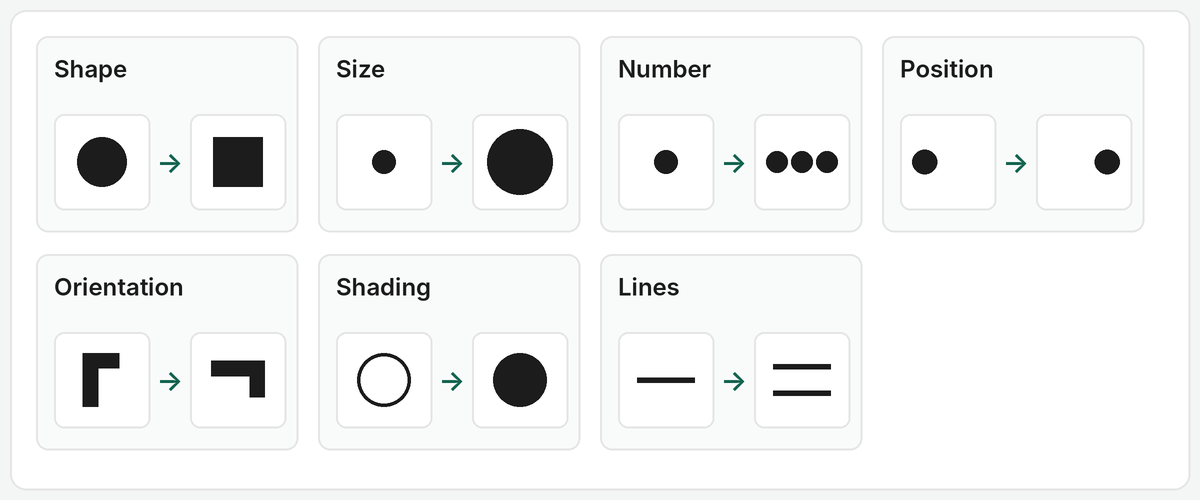
Before you look for a rule, know what can change from one cell to the next: shape, size, number, position, orientation, shading and lines. For format, timing and scoring, see our free Raven's progressive matrices test page.
The 7 rules behind Raven's matrices
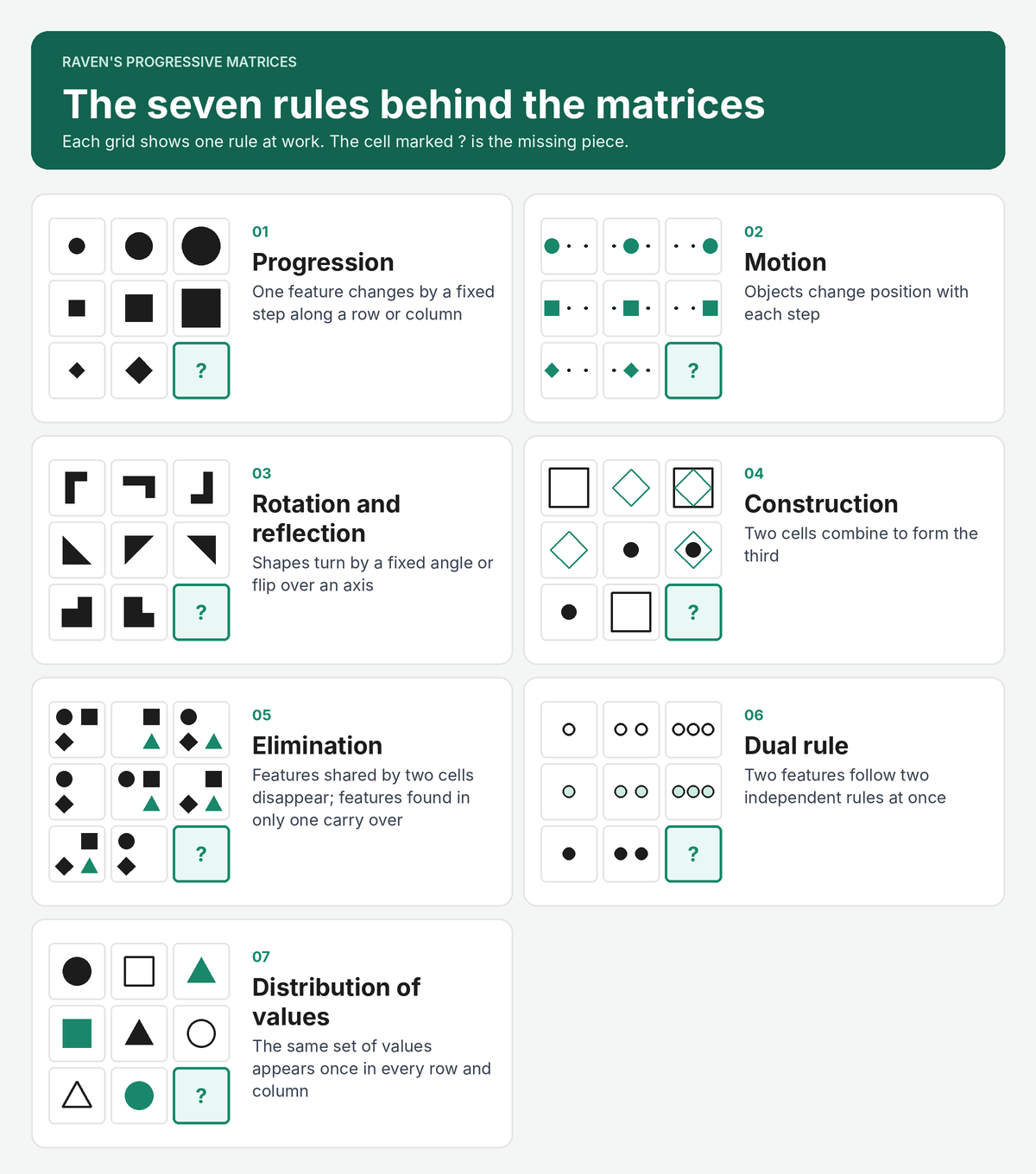
Raven's questions follow a limited set of rules, and we group them into seven rule types. They cover the types of Raven's progressive matrices questions you will meet in the Standard and Advanced tests. Here are the IQ test shapes explained, one rule at a time.
Each rule below uses the same layout: a one-sentence definition, a problem grid, a solution grid, then how to spot the rule and the trap to avoid. Try to name the rule in each problem image before you scroll to the solution. Real questions often combine more than one rule, and we cover that after the seven.
Rule 1: Progression
One feature changes by a fixed step along a row or column.
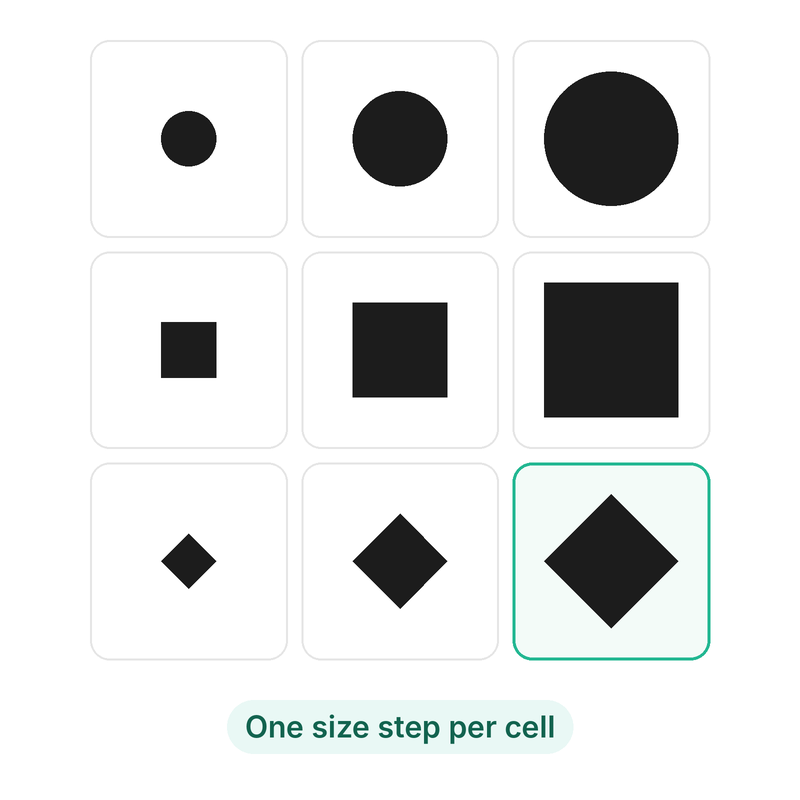
The answer is: a large diamond
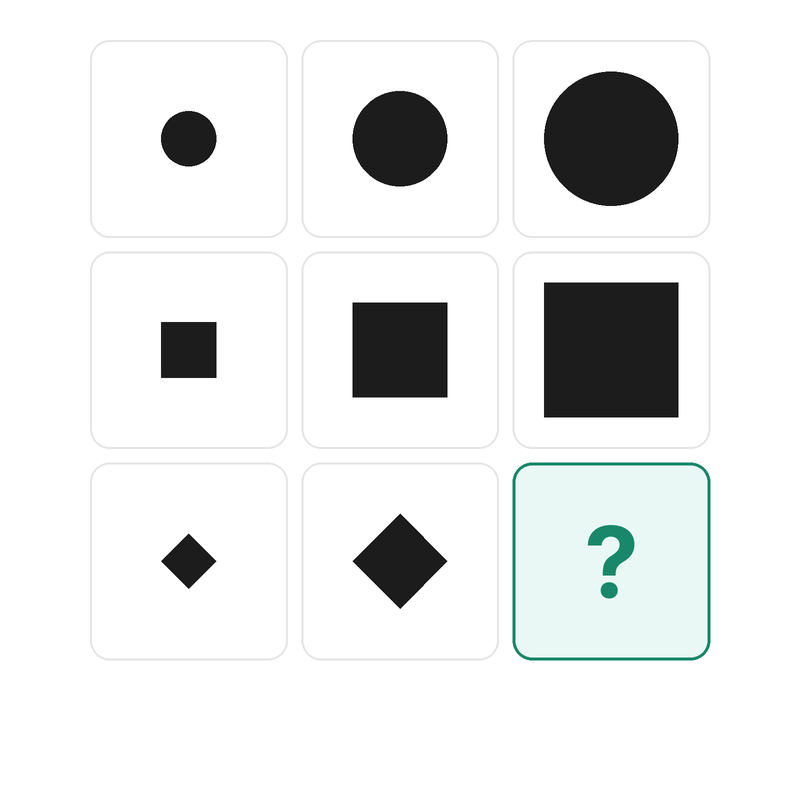
Each row keeps one shape, and that shape grows by one size step from cell to cell. The bottom row holds diamonds, so the third diamond must be the largest. A large diamond completes the grid.
How to spot it: the same shape appears in every cell, but something grows, shrinks or accumulates. Size is the classic case. The changing feature can also be the number of objects, the number of lines, a shading step, or a part added or removed each time.
The trap: the step can run down the columns as well as across the rows, so check both directions before you decide.
Rule 2: Motion
Objects change position with each step.
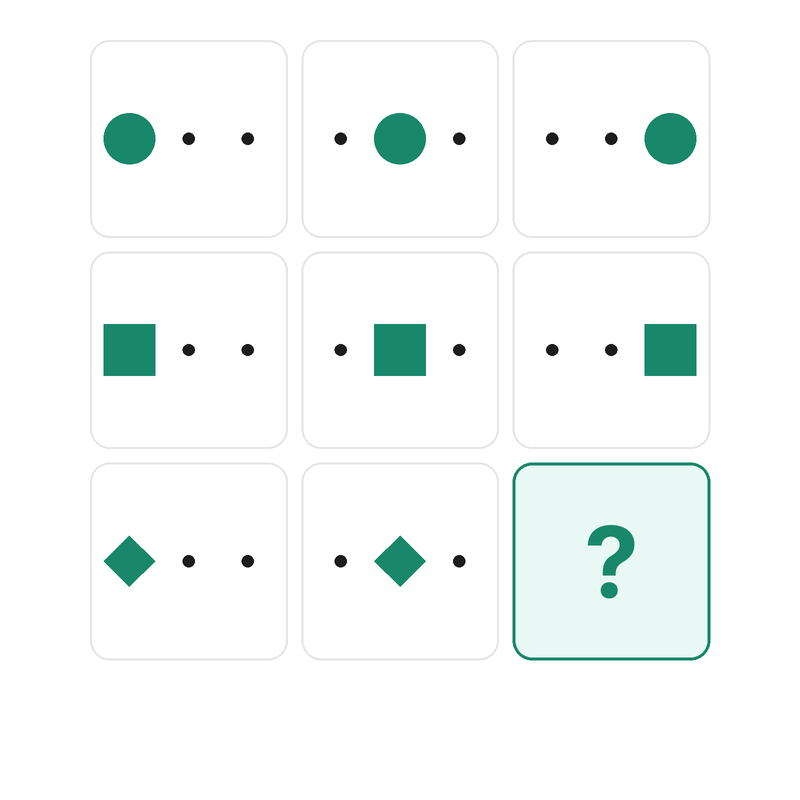
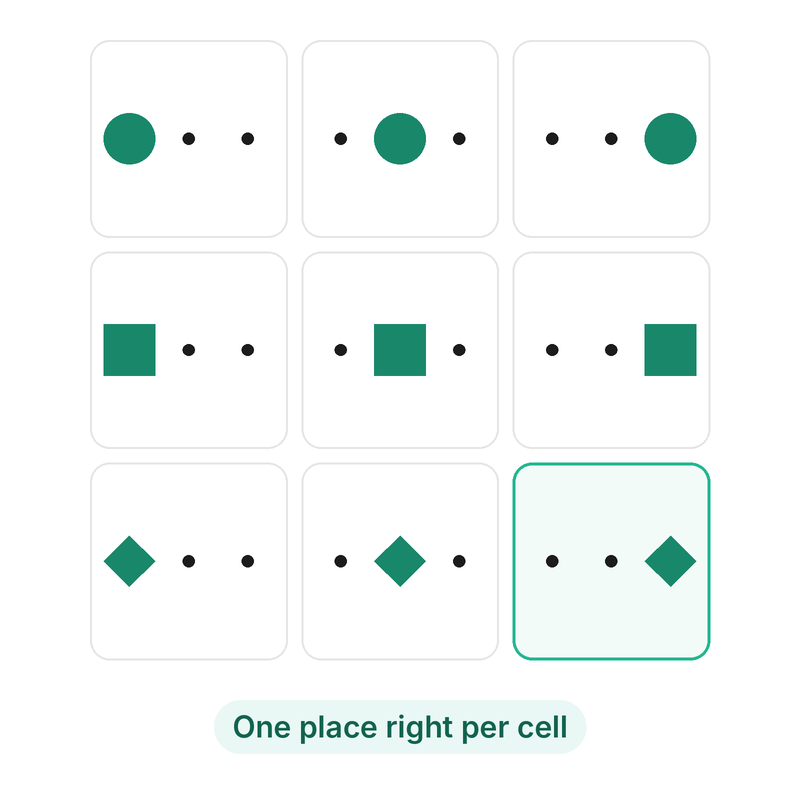
The answer is: the diamond on the right-hand dot.
Every cell holds three small dots in a line, and a filled shape sits on one of them. In the first column the shape sits on the left dot, and in the second column it sits on the middle dot. The bottom row holds a diamond, so in the missing cell the diamond sits on the right-hand dot.
How to spot it: an object keeps its look but sits somewhere different in each cell. It may move along a row, around the grid or clockwise.
The trap: track one object at a time and ignore the rest. Following everything at once is the quickest way to lose the pattern.
Rule 3: Rotation and Reflection
What happens: Shapes turn by a fixed angle or flip over an axis.
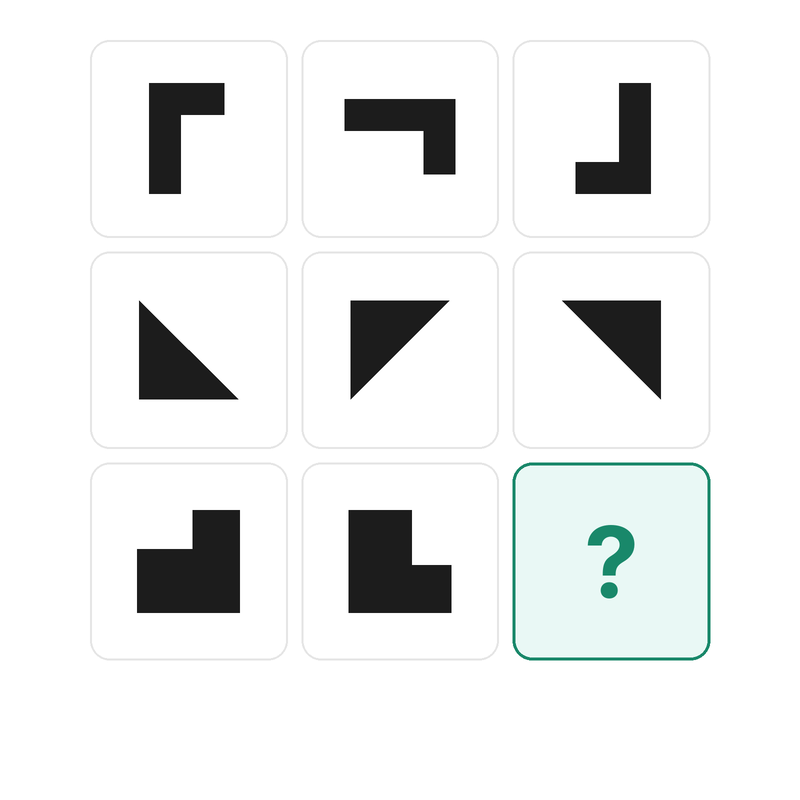
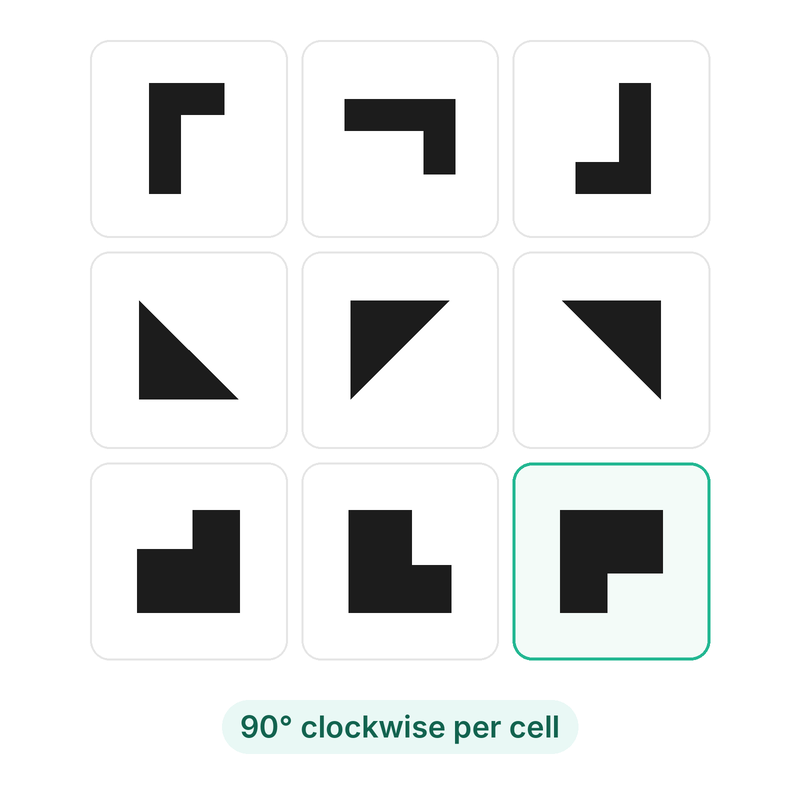
The answer is: the staircase turned 180 degrees
In the rotation grid, each figure turns 90 degrees clockwise from one cell to the next: 0, 90, then 180 degrees. The bottom figure is a staircase that starts upright and turns 90 degrees in the second cell, so the missing cell shows it turned 180 degrees.
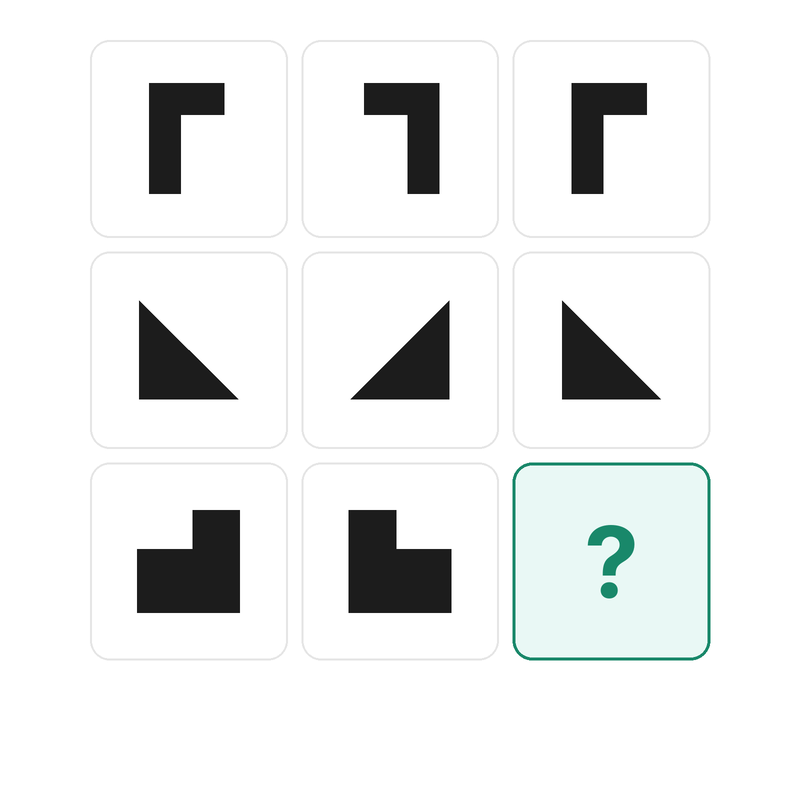
Reflection works differently. The figure does not turn, it flips.
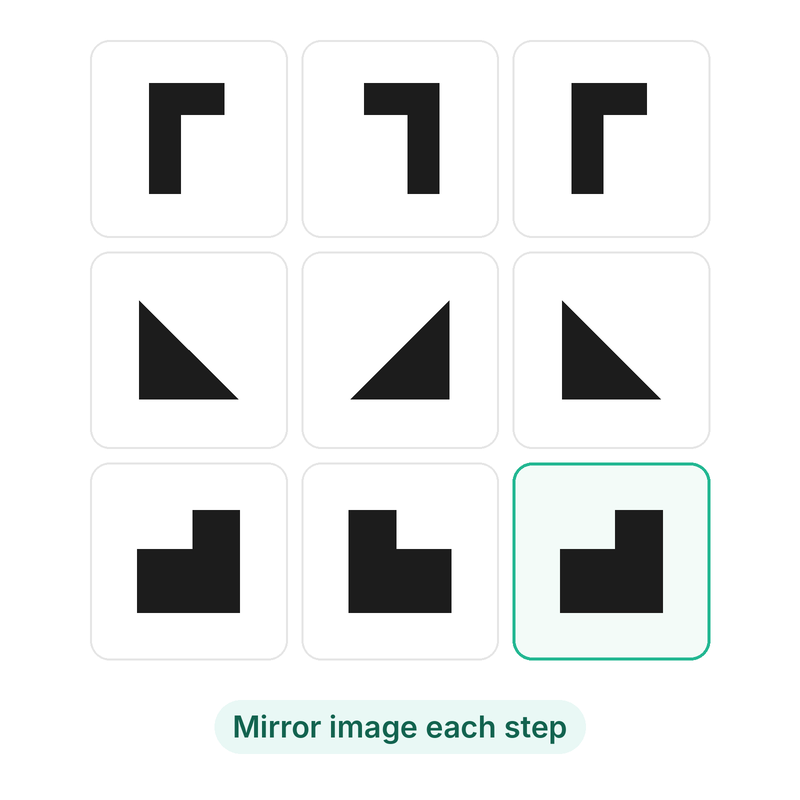
The answer is: the staircase in its original direction
In the reflection grid, the middle cell is the mirror image of the first, and the third cell mirrors the middle one back. The missing cell shows the staircase facing its original way.
How to spot it: the same figure faces a different way in each cell. A fixed turn per step, such as 90 degrees, is rotation. A flip over a horizontal or vertical axis is reflection.
The trap: a mirror image is not a rotation. Follow one corner or hook and ask whether you could turn the shape back into the original by rotating it. If you cannot, it has been flipped.
Rule 4: Construction
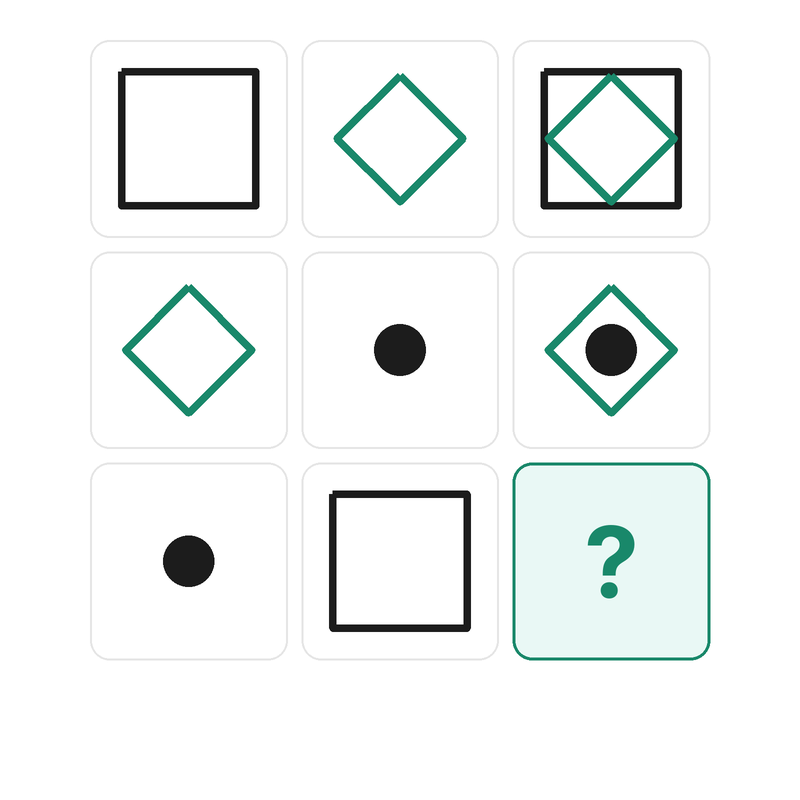
Two cells combine to form the third.
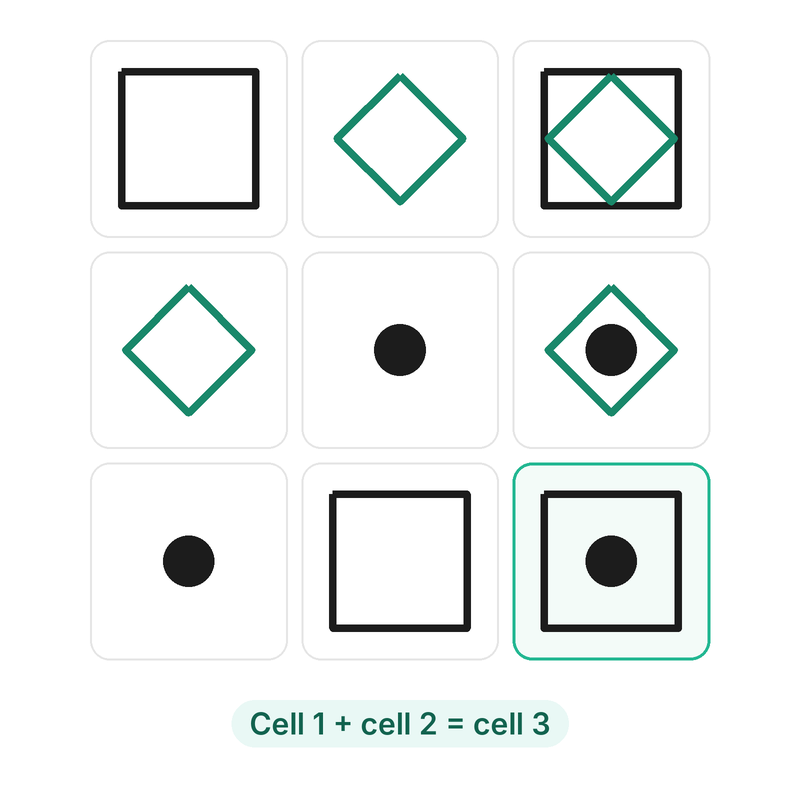
The answer is: a square with a dot in the center
In the top row, a square outline and a diamond outline combine into both shapes laid over each other. In the middle row, a diamond and a dot combine the same way. In the bottom row, a dot and a square outline combine, so the answer is a square with a dot in the center.
How to spot it: the third cell holds the contents of the first two together. The parts can be laid over each other or stacked inside each other.
The trap: check that every part of both cells appears in your answer, not just one of them.
Rule 5: Elimination
Features shared by two cells disappear; features found in only one carry over.
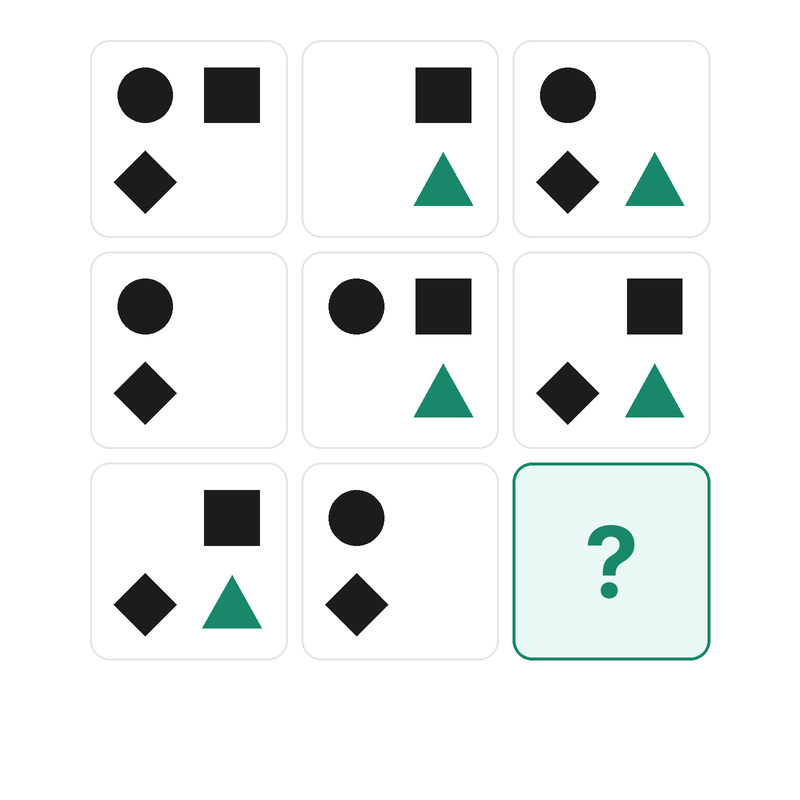
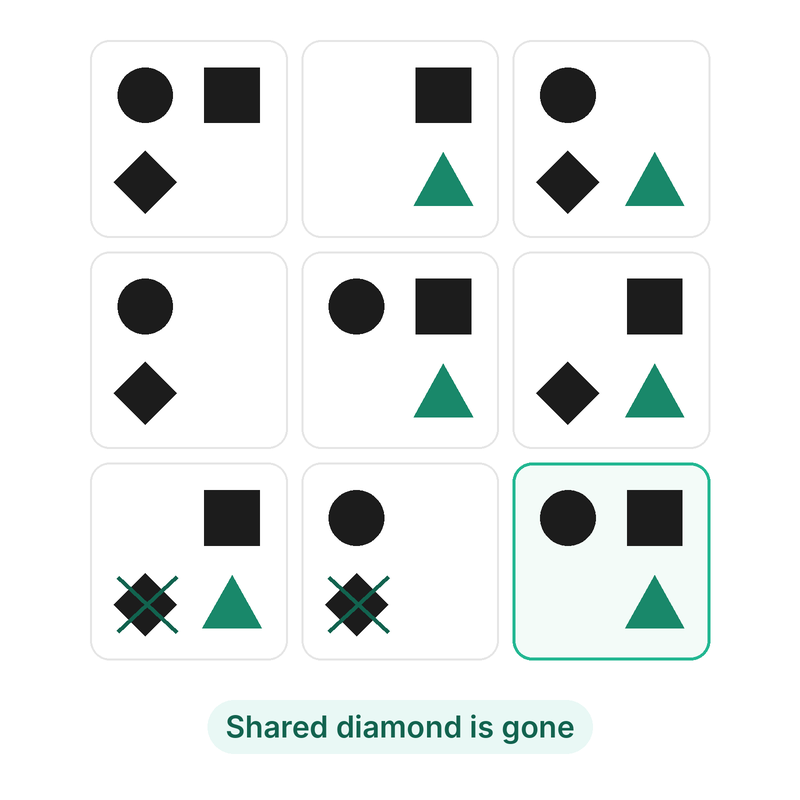
The answer is: a circle, a square and a triangle
Look at the bottom row. The first cell holds a square, a diamond and a triangle. The second cell holds a circle and a diamond. The diamond is in both cells, so it disappears. The square, the triangle and the circle each appear in only one cell, so all three carry over into the answer.
How to spot it: the third cell looks emptier than the first two, and the most obvious shared shape has gone.
The trap: list the parts in the first two cells, cross out every part that appears in both, and keep the rest. Shared parts vanish even when they are the largest or most obvious shapes.
Rule 6: Dual Rule
Two features follow two independent rules at once.
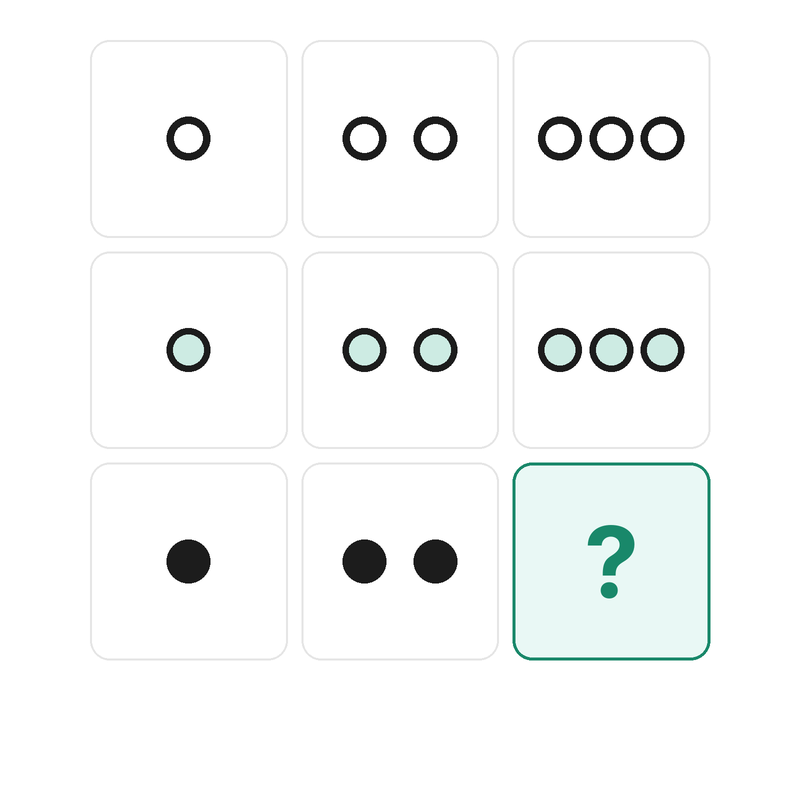
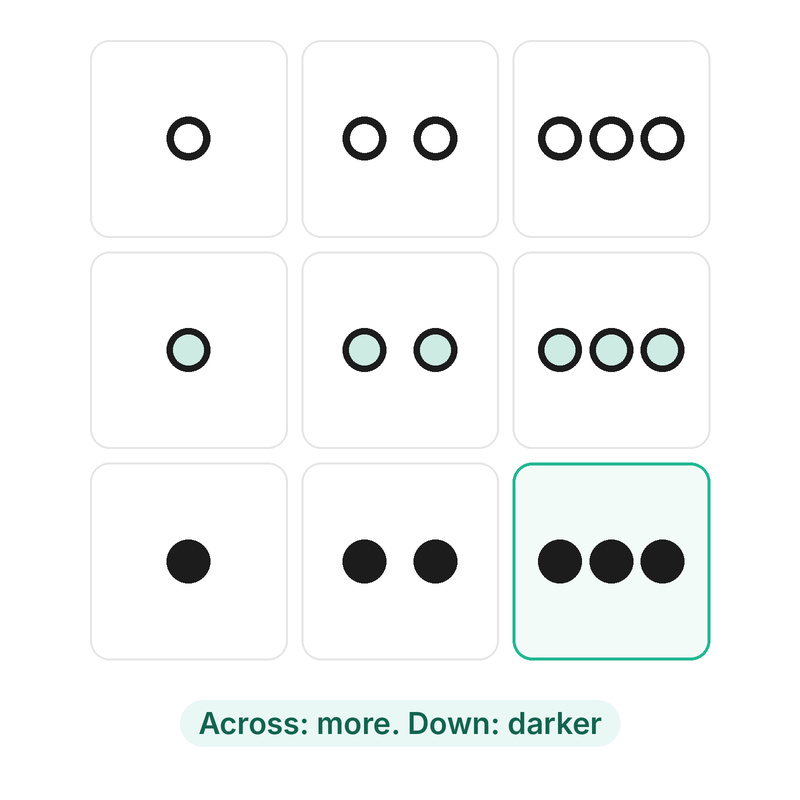
The answer is: three solid circles
The number of circles rises across each row: one, two, three. At the same time, the fill darkens down each column: outline, light fill, solid. The missing cell sits in the last column, which means three circles, and in the bottom row, which means solid. The answer is three solid circles.
How to spot it: one rule explains only part of the change, because something else shifts at the same time.
The trap: solve one feature at a time, then merge the two answers. If you try to hold both in your head at once, you will miss one.
Rule 7: Distribution of Values
The same set of values appears once in every row and column.
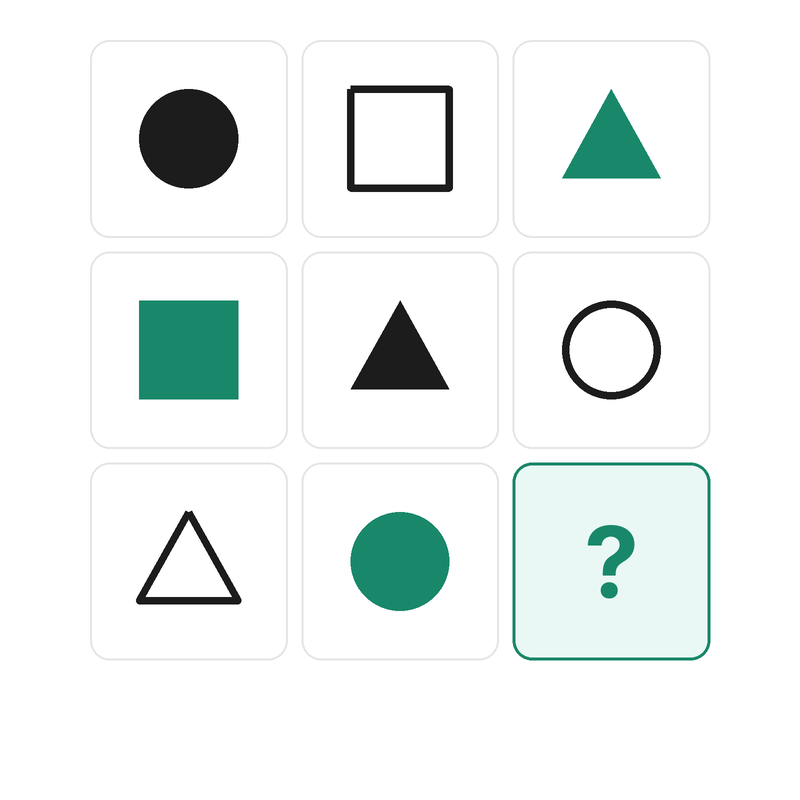
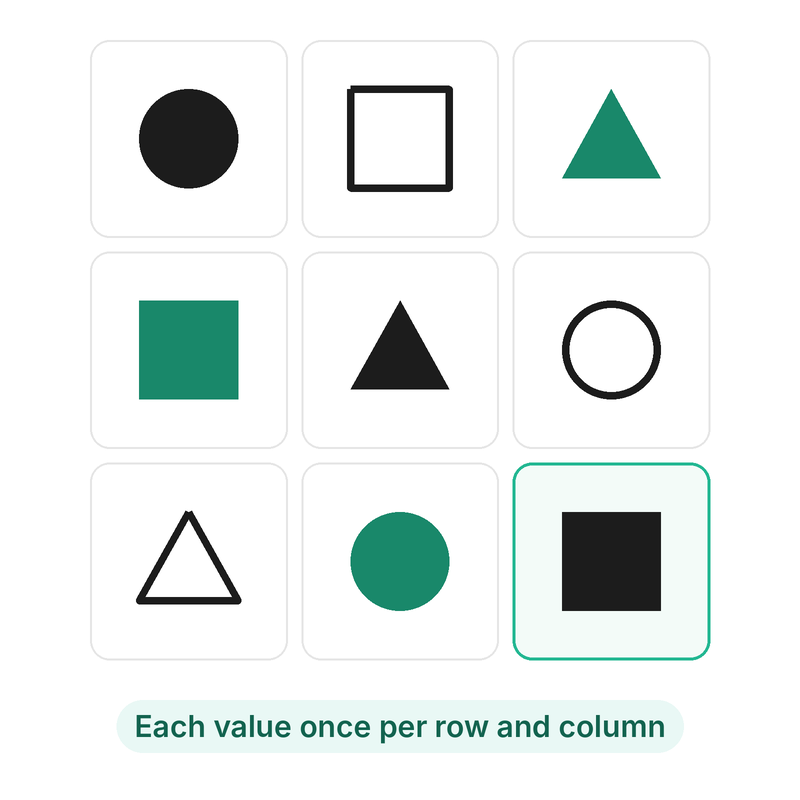
The answer is: a solid dark square
In this grid the values are three shapes (circle, square, triangle) and three fills (solid, green, outline). Each shape and each fill appears once in every row and every column. The bottom row already holds an outline triangle and a green circle, so it needs a square with a solid fill. The last column confirms it.
How to spot it: nothing grows or moves. The same shapes or fills simply reshuffle.
The trap: find the missing value in the row first, then confirm it against the column. The answer has to satisfy both.
When rules combine: why the hardest Raven's questions are hard
Questions get harder as the test goes on, and the reason is usually not a new rule. It is more rules in the same grid. The hardest Raven's progressive matrices questions layer two or three of the seven rules on different features, so no single rule explains everything you see.
The grid below combines two of them. Shapes grow from small to medium to large across each row (progression), and a circle, a square and a triangle each appear once in every row and column (distribution of values). Neither rule gives the answer alone, but together they leave one piece: a large square.
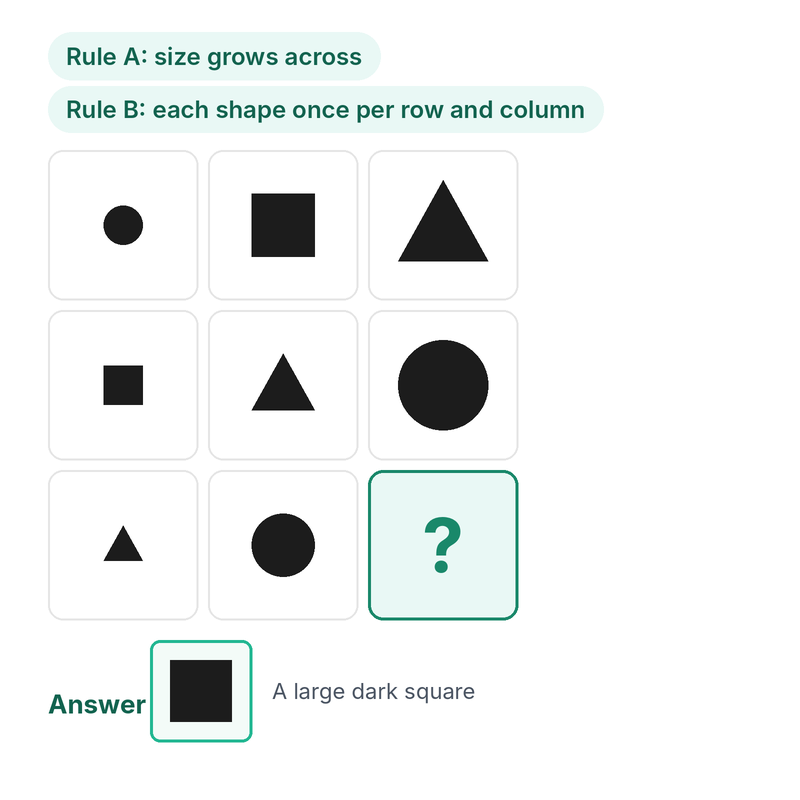
Even difficult Raven's progressive matrices items stay solvable when you separate the features. Pick one feature, such as size, and find its rule. Then pick the next feature, such as shape, and find its rule. Combine the two answers at the end.
If some hard Raven's progressive matrices questions feel impossible, this is usually why: you are trying to solve every feature at once. Solving one feature at a time turns one big problem into two small ones. The same habit carries over to any abstract reasoning test, because those tests also ask you to find a rule in a grid of shapes.
Practice single rules first, then mixed grids, and the layered questions become much easier to break down.
How to solve Raven's progressive matrices: a six-step method
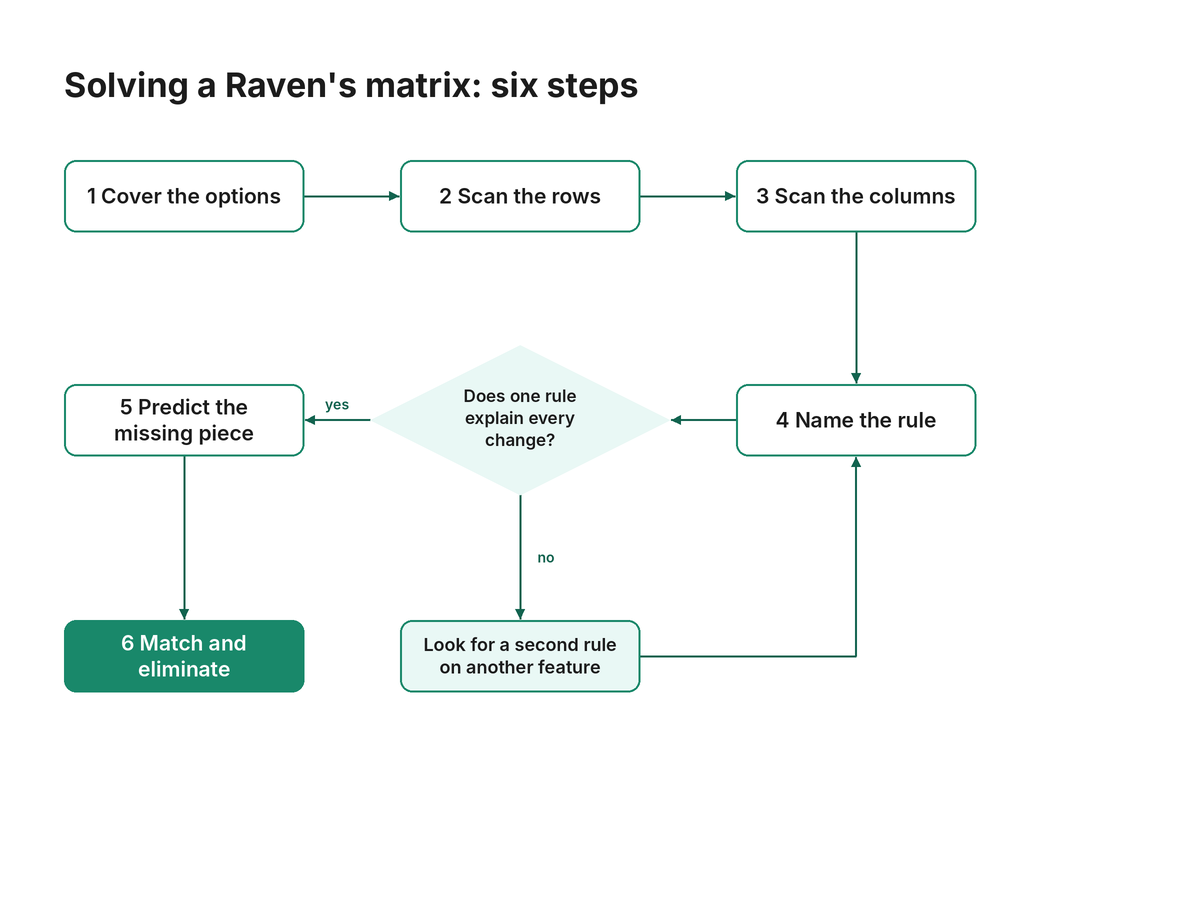
Knowing the rules is half the job. The other half is a routine that gets you to the answer quickly. This method for solving Raven's progressive matrices has six steps and one firm rule: work out the missing piece before you read the answer options.
- Cover the answer options. Look only at the grid. If you read the options first, they can steer you toward a piece that looks right but breaks the rule.
- Scan the rows. Compare the first two cells of the top row, then the middle row. Ask what stays the same and what changes: shape, size, number, position, orientation, shading or lines.
- Scan the columns. Some rules run down the grid instead of across it, so run the same check on the first two columns. If the rows show nothing, the rule is often in the columns.
- Name the rule. Match what changes to one of the seven rules. If one rule leaves a change unexplained, look for a second rule on another feature.
- Predict the missing piece. Apply the rule or rules to the bottom row or the last column and picture the result, or sketch it if you have scrap paper.
- Match and eliminate. Strike out every option that breaks the rule. If two options remain, compare them one feature at a time until only one fits.
Pace matters too. The online APM-III gives you up to 40 minutes for 23 questions after 4 practice questions, which is under two minutes per question on average. Employers choose the format, so check your invitation for the exact version. The six steps take practice before they run that fast, which is why it pays to rehearse them on single-rule grids first.
Common mistakes
Four habits slow candidates down, and each one has a simple fix.
- Reading the answer options first. The options can pull you toward a piece that looks right. Cover them and predict the answer first.
- Locking onto one feature. Shape is the easiest feature to see, so it gets all the attention while size, shading or position carries the rule. Check every feature on your list.
- Checking only the rows. Some rules run down the columns. Scan both directions every time.
- Stopping at the first rule. When one rule leaves something unexplained, the grid has a second rule. Solve each feature separately, then merge the answers.
Fixing these four habits is faster than learning anything new, because the seven rules stay the same from question to question.
How to practice the rules
Reading about the rules helps, but speed comes from practice. Start with our free Raven's matrices practice test. It includes questions of varying difficulty for both the APM and the SPM, and every answer explains the rule behind it. Name the rule first, then check your reasoning against the explanation.
When you want to train every rule under timed conditions, the Raven's Matrices Adaptive PrepPack™ is the best option for any candidate who will undertake this test. It gives you over 700 practice questions that adjust to your answers. Difficulty rises as you answer correctly, and you get a detailed explanation the moment you miss a question, so your time goes to the rules that still slow you down.
FAQs
Cover the answer options and study the grid first. Compare the cells across each row and down each column, and note what changes: shape, size, number, position, orientation, shading or lines. Match the change to one of the seven rules, predict the missing piece, then pick the option that fits. If one rule does not explain every change, look for a second rule on another feature.
Raven's questions repeat a small set of rules. We group them into seven: progression, motion, rotation and reflection, construction, elimination, dual rule and distribution of values. Each describes how the cells in a row or column relate, such as one feature growing by a fixed step, or the same set of values appearing once in every row and column.
Later questions often combine several rules in one grid, so no single rule explains everything you see. You have to separate the features, solve each one and merge the answers. Practice single rules first, then mixed grids, and the hardest questions become easier to break down.
It works like one. People call it a Raven logic test or a Raven pattern test because every grid hides a logical rule, and you find the missing piece by working that rule out. It is a non-verbal test of abstract reasoning and does not rely on language or prior knowledge, so the same method works on every question.
Maya Strauss, Tests Expert Developer