AWS Certified AI Practitioner Exam (AIF-C01) – 2026 Guide & Sample Questions
Last Updated: May 20, 2026
The AWS Certified AI Practitioner (AIF-C01) is a foundational AWS certification focused on AI, machine learning (ML), generative AI, and AWS AI services such as Amazon Bedrock and SageMaker.
Passing the exam demonstrates your understanding of AI concepts and AWS AI tools in practical business scenarios, making it a valuable addition to your resume and professional skill set.
On this page, you'll get a walkthrough of the exam, including:
- Free AWS AI Practitioner practice questions
- A breakdown of the exam topics
- The most important AWS AI services to study
- Difficulty level and passing score information
- Practical study tips and preparation strategies

AWS Certified AI Practitioner Exam Overview
| Exam Detail | Information |
|---|---|
| Certification | AWS Certified AI Practitioner |
| Code | AIF-C01 |
| Level | Foundational |
| Cost | $100 USD |
| Duration | 90 Minutes |
| Total Questions | 65 Questions (50 Scored + 15 Unscored) |
| Passing Score | 700 / 1000 |
| Question Formats | Multiple Choice, Multiple Response, Ordering & Matching |
| Topics | 1) Fundamentals of AI and ML 2) Fundamentals of GenAI 3) Application of Foundation Models 4) Guidelines for Responsible AI 5) Security, Compliance and Governance |
| Recommended Experience | Around 6 months of AWS AI/ML exposure |
| Recommended Prep Time | 2-6 weeks (depending on AWS & AI experience) |
| Coding Required | No |
| Certification Validity | 3 Years |
Free AWS Certified AI Practitioner Practice Questions
The AWS Certified AI Practitioner exam includes questions across a wide range of domains, from AI and machine learning fundamentals to generative AI concepts and AWS AI services in practical business scenarios.
The 5 sample questions below reflect the style and difficulty level of the real AIF-C01 exam and include detailed answer explanations to help you understand what to expect on test day.
Full Prep Course Coming Soon
We are currently developing full-length practice exams and in-depth tutorials for all 5 exam domains.
Interested? Send a quick note to our team with the words “AWS AI” and we’ll notify you as soon as the prep materials go live, including a 30% launch discount.
AWS AI Practitioner Exam Domains
The AWS Certified AI Practitioner (AIF-C01) exam is divided into 5 content domains that together cover the core concepts of AI, generative AI, foundation models, responsible AI, and AWS AI services. Each domain contributes a different percentage to your final exam score, with Domains 2 and 3 carrying the most weight.
The descriptions below provide a high-level overview of the topics and skills you should expect to encounter in each section of the exam.

Domain 1: Fundamentals of AI and ML (20%)
(click to expand)
Domain 1 covers the foundational AI and machine learning concepts that appear throughout the AWS Certified AI Practitioner exam. Questions in this domain focus on common AI terminology, practical AI use cases, different machine learning methods, and the basics of the AI/ML lifecycle.
You should also expect questions about core AWS AI services, model deployment methods, foundation models, model performance metrics, and when AI solutions are — or are not — appropriate for a business scenario.

Domain 2: Fundamentals of Generative AI (24%)
(click to expand)
Domain 2 focuses on the core concepts behind generative AI and large language models (LLMs). You should understand terminology such as tokens, embeddings, prompt engineering, foundation models, diffusion models, and agentic AI systems.
This domain also covers practical GenAI business applications, the advantages and limitations of generative AI, token-based pricing models, and AWS services used to build GenAI solutions, including Amazon Bedrock and SageMaker AI. Questions often focus on selecting the right GenAI approach based on cost, performance, latency, and business requirements.

Domain 3: Applications of Foundation Models (28%)
(click to expand)
Domain 3 is the largest section on the exam and focuses on how foundation models are used, customized, evaluated, and optimized in real-world AI applications. You should understand prompt engineering techniques such as zero-shot, few-shot, and chain-of-thought prompting, along with concepts like Retrieval-Augmented Generation (RAG), vector databases, and AI agents.
You can also expect questions about fine-tuning methods, FM customization tradeoffs, inference parameters, model evaluation metrics, and how organizations measure whether AI applications successfully meet business objectives.

Domain 4: Guidelines for Responsible AI (14%)
(click to expand)
Domain 4 focuses on responsible AI development and the importance of fairness, transparency, safety, and explainability in AI systems. Questions in this domain often cover bias detection, trustworthy datasets, hallucination risks, overfitting, and methods for monitoring AI models responsibly.
You should also understand AWS tools related to responsible AI, such as Amazon Bedrock Guardrails, SageMaker Clarify, SageMaker Model Monitor, and SageMaker Model Cards, along with the legal and ethical risks associated with generative AI systems.

Domain 5: Security, Compliance, and Governance for AI Solutions (14%)
(click to expand)
Domain 5 focuses on securing AI systems and maintaining compliance, governance, and data protection standards in AI environments. Questions in this domain cover topics such as IAM permissions, encryption, audit logging, secure data engineering practices, prompt injection risks, hallucination mitigation, and output validation.
You should also be familiar with AWS governance and security services such as AWS CloudTrail, AWS Config, Amazon Inspector, AWS Audit Manager, AWS Artifact, Amazon Macie, and Amazon Bedrock Guardrails.
AWS Services Covered on the Exam
The AWS Certified AI Practitioner exam includes questions on a broad range of AWS services across AI, machine learning, security, analytics, governance, and cloud infrastructure. Luckily, you are not expected to memorize detailed configurations or implementation steps for every service.
Instead, the exam mainly tests whether you understand the primary purpose, common use cases, and general capabilities of the services listed below in practical business scenarios.
| Category | AWS Services |
|---|---|
| Analytics | AWS Data Exchange, Amazon EMR, AWS Glue, AWS Glue DataBrew, AWS Lake Formation, Amazon OpenSearch Service, Amazon QuickSight, Amazon Redshift |
| Cloud Financial Management | AWS Budgets, AWS Cost Explorer |
| Compute | Amazon EC2, AWS Lambda |
| Containers | Amazon ECS, Amazon EKS |
| Databases | Amazon Aurora, Amazon DynamoDB, Amazon RDS, Amazon Neptune, Amazon DocumentDB, Amazon ElastiCache |
| Developer Tools | Kiro, Strands Agents, Amazon Q |
| Machine Learning & AI | Amazon Bedrock, Bedrock AgentCore, SageMaker AI, SageMaker JumpStart, Amazon Lex, Amazon Rekognition, Amazon Comprehend, Amazon Textract, Amazon Translate, Amazon Transcribe, Amazon Nova, Amazon Personalize, Amazon Polly, Amazon Kendra, Amazon A2I |
| Governance & Monitoring | AWS CloudTrail, Amazon CloudWatch, AWS Config, AWS Trusted Advisor, AWS Well-Architected Tool |
| Security & Compliance | IAM, AWS KMS, Amazon Inspector, Amazon Macie, AWS Secrets Manager, AWS Artifact, AWS Audit Manager |
| Networking & Content Delivery | Amazon VPC, Amazon CloudFront |
| Storage | Amazon S3, Amazon S3 Glacier |
5 Practical Study Tips and Exam Preparation Strategies
The AWS Certified AI Practitioner exam is considered beginner-friendly, but many candidates underestimate the amount of AI terminology, AWS service knowledge, and business-scenario reasoning involved. The tips below can help you prepare more efficiently.
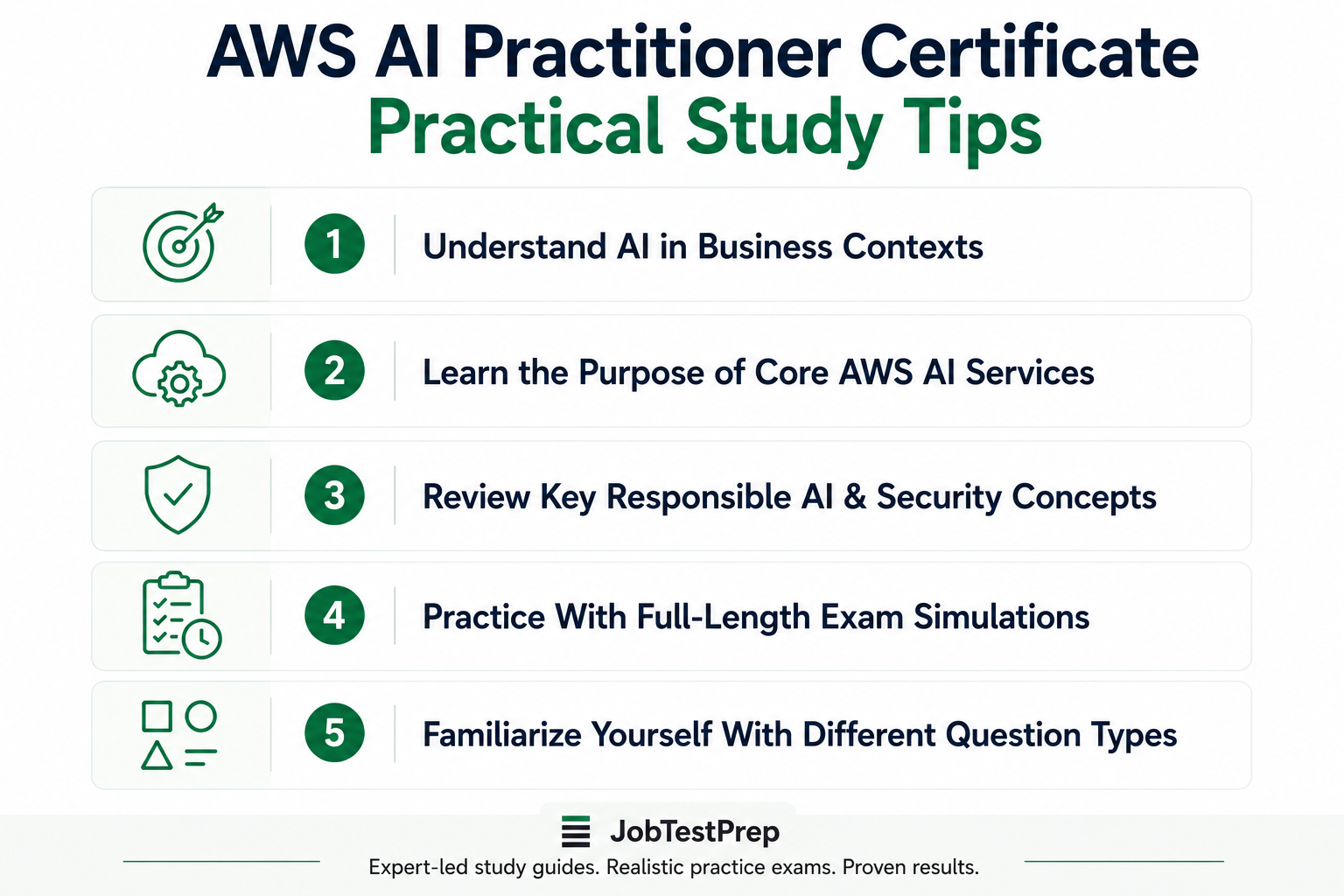
Click here to see more detailed info per tip
Understand AI in Business Contexts
The exam focuses heavily on practical business scenarios. Instead of memorizing definitions, focus on understanding when specific AI approaches, machine learning methods, or AWS services are appropriate for a particular use case.
Learn the Purpose of Core AWS AI Services
You are not expected to memorize complex configurations for every AWS service. However, you should understand the primary purpose, common use cases, and general capabilities of major AWS AI services such as Amazon Bedrock, SageMaker AI, Amazon Lex, Amazon Rekognition, and Amazon Comprehend.
Pay Attention to Responsible AI and Security Concepts
Candidates often focus heavily on generative AI but underestimate topics related to responsible AI, governance, compliance, IAM permissions, hallucination risks, and Amazon Bedrock Guardrails.
Familiarize Yourself With Different Question Types
The real exam includes multiple-choice, multiple-response, ordering, and matching questions. Practicing all question formats beforehand can help reduce mistakes during the actual exam.
Practice With Full-Length Exam Simulations
Many AWS AI Practitioner questions are scenario-based and require careful reading. Practicing with realistic full-length practice exams can help you improve pacing, recognize common question patterns, and become more comfortable with the different question formats used on the exam.
Full Prep Course Coming Soon
We are currently developing full-length practice exams and in-depth tutorials for all 5 exam domains.
Interested? Send a quick note to our team with the words “AWS AI” and we’ll notify you as soon as the prep materials go live, including a 30% launch discount.
FAQs
The AWS Certified AI Practitioner (AIF-C01) is a foundational AWS certification that validates your understanding of AI, machine learning (ML), generative AI concepts, and AWS AI services. The exam focuses on practical AI knowledge rather than advanced machine learning engineering or coding skills.
The certification is designed for non-technical business professionals, early-career cloud practitioners, and professionals who want to better understand AI solutions on AWS. It is especially useful for candidates working, or wanting to work with AI projects, cloud technologies, or generative AI initiatives.
Yes. The AWS Certified AI Practitioner is considered beginner-friendly because it focuses on foundational AI concepts and AWS AI services rather than advanced programming or mathematics. However, proper preparation is still important because the exam covers many AWS-specific services and generative AI concepts.
The AWS AI Practitioner exam is moderately difficult for candidates who are new to AI or AWS. Most candidates find the exam manageable after studying the core AI concepts, AWS AI services, generative AI terminology and practicing with full-length exam simulations.
The passing score for the AWS Certified AI Practitioner (AIF-C01) exam is 700 on a scaled score ranging from 100 to 1,000.
After the exam, AWS provides a score report with section-level performance feedback to help you understand your strengths and weaker areas. You do not need to pass every individual section to pass the certification overall.
If you do not pass the AWS Certified AI Practitioner (AIF-C01) exam, you can retake it after a mandatory 14-day waiting period. AWS does not limit the number of retake attempts, but you must pay the full exam fee each time you take the test again.
As such, practicing for exam is highly recommended.
The AWS Certified AI Practitioner exam costs $100 USD. Additional taxes or testing-center fees may apply depending on your location and testing method.
The AWS Certified AI Practitioner exam contains 65 questions. These include multiple-choice and multiple-response questions covering AI fundamentals, generative AI, AWS AI services, security, and responsible AI concepts.
Candidates have 90 minutes to complete the AWS Certified AI Practitioner exam. This gives most test-takers enough time to carefully review and answer all questions.
The AWS Certified AI Practitioner exam is not limited to standard multiple-choice questions. It can include multiple-choice, multiple-response, ordering, and matching questions.
Some questions require one correct answer, while others ask you to select multiple correct responses or place answers in the correct order.
No. Coding experience is not required for the AWS Certified AI Practitioner exam. The certification focuses on understanding AI concepts, generative AI use cases, and AWS AI services rather than building or programming machine learning models.
The most important AWS AI services for the AWS Certified AI Practitioner exam include Amazon Bedrock, Amazon SageMaker, Amazon Rekognition, Amazon Comprehend, Amazon Lex, Amazon Translate, Amazon Transcribe, and Amazon Q.
The exam covers both AI concepts and AWS services. Candidates are expected to understand foundational AI and generative AI concepts while also recognizing which AWS services are appropriate for different AI use cases and business scenarios.
Most candidates spend between 2 and 6 weeks preparing for the AWS AI Practitioner exam, depending on their previous experience with AWS and AI concepts. Candidates with cloud experience typically require less preparation time.
Yes, especially for professionals looking to strengthen their understanding of AI and cloud technologies. The certification can improve credibility, support career growth, and help candidates demonstrate familiarity with generative AI and AWS AI services.
The certification can strengthen your resume and demonstrate foundational AI knowledge to employers. While it is not typically enough on its own to secure an AI engineering role, it can help candidates qualify for cloud, technical support, sales, consulting, or AI-related business positions.
The certification is most relevant for roles such as cloud practitioner, technical sales specialist, business analyst, AI project coordinator, solutions consultant, and entry-level cloud or AI support positions.
AWS Cloud Practitioner focuses on general AWS cloud concepts, pricing, security, and infrastructure fundamentals. AWS AI Practitioner focuses specifically on AI, machine learning, generative AI concepts, and AWS AI services such as Amazon Bedrock and SageMaker.
Yes. The AWS Certified AI Practitioner certification is valid for 3 years from the date you pass the exam. After that period, candidates must recertify to maintain an active certification status.
David, AWS AI Exam Expert