USPS 955 Practice Test & Study Guide (2026): Free Sample Questions
Updated: September 2026 | Verified against the official USPS Exam 955 (MSS) format
USPS Exam 955, officially the Maintenance Selection System (MSS), is the qualifying exam every candidate must pass to be considered for a USPS maintenance position, such as Maintenance Mechanic, Electronic Technician, Building Equipment Mechanic, Area Maintenance Technician, or Mail Processing Equipment Mechanic. This screening step is one of the first hurdles in the maintenance hiring process, and a passing score keeps your application moving forward.
The exam is administered in two parts:
This page offers a free sample of the question types and topics you're likely to see on the technical portion of Exam 955, helping you start your preparation with confidence. Our practice questions are intentionally written to be tougher than the real exam, so you'll be ready for whatever comes up on test day.
*The Multicraft and Spatial Relations sections make up the proctored technical portion of Exam 955. A score of 70 or higher (excluding Veterans' Preference points) is required to pass, and your result factors directly into which maintenance positions you become eligible for.


Postal Exam 955 is administered through the USPS Maintenance Selection System and consists of two timed parts:
Source: USPS Assessment Information Package, Exam 955
Candidates receive a test invitation from USPS after submitting a job application and clearing an initial eligibility review. The exam is taken in-person at a designated USPS testing center - bring a government-issued photo ID and your assessment login credentials.
Scoring: A score of 70 or higher (excluding Veterans' Preference points) is required to pass. A score below 70 results in an "Ineligible" status and a mandatory 6-month wait before retesting. Veterans' Preference points are added to a passing score only - they cannot convert a failing result.
Many candidates start their prep by searching for a postal exam 955 study guide PDF. A free PDF can give you a basic outline of the topics covered, but it cannot simulate the timed, high-pressure format of the actual test. To build real readiness, pair any study guide with timed practice tests that mirror the Multicraft and Spatial Relations sections.

The test is divided into two major components:
60 Questions | 60 Minutes
Topics Covered:
65 Questions | 60 Minutes
Skills Assessed:
Since the second section is time-sensitive, practicing similar problems beforehand can help candidates improve speed and accuracy.
The questions below reflect the same two sections you'll face on exam day: Mechanical Knowledge & Electronics, followed by Spatial Relations. Work through each question before checking the answer, then read the full explanation even when you get it right, since the reasoning behind each question is what actually transfers to items you haven't seen before. If a topic trips you up, treat that as a cue to go back and study it further rather than something to skip past.
The Electrical section covers three core areas: AC/DC theory, parallel circuits, and test instruments. While these topics may seem familiar, the 955 exam goes deeper than basic knowledge - expect formula application under time pressure, multi-step circuit calculations, and instrument questions that go well beyond simply knowing what a voltmeter does.
In a 110V electrical system, there are three appliances: appliance A (550W) appliance B (770W), and appliance C (330W). Given that all appliances operate simultaneously, what is the minimum required fuse rating?
Click the correct answer:
 Tip:
Tip:When calculating fuse ratings, remember that the total current of devices in parallel is the sum of each device's current. Ensure your fuse rating is slightly above this total to handle typical operating conditions safely.
A fuse's job is to break the circuit before current damages the wiring or connected equipment, so sizing one correctly always starts with finding the actual working current, never guessing from the appliance count or wattage alone.
When loads run simultaneously on the same parallel branch, the source has to supply the sum of every branch's current, even though each appliance only "sees" its own share. Work out each appliance's draw with I = P/V, add them together, then choose the smallest standard fuse rating (5, 10, 15, 20, 25, 30A, and so on) that sits above that total. Going one size too low means nuisance blowing under completely normal load. Going several sizes too high defeats the fuse's purpose, since it will no longer trip before a real fault occurs.
Questions like this test whether you can chain two steps together under time pressure: the current calculation, then the sizing judgment. Missing either half is why this trips up candidates who know Ohm's law but haven't practiced applying it end to end.

The total resistance of the circuit is:
Base your answer to the following question on the figure below:
Tip:Parallel resistance behaves in a way that catches a lot of candidates off guard: the total is always smaller than the smallest individual resistor, not somewhere between them. Every additional parallel path gives current another route, so total resistance keeps dropping as you add branches.
The reciprocal formula (1/RT = 1/R1 + 1/R2 + 1/R3) is the only reliable way to combine them, but the fastest path through it is picking a common denominator that divides evenly into all three values, exactly like using 240 for resistors of 240, 40, and 80. That keeps the arithmetic in whole numbers instead of long decimals, which matters when you're working without a calculator against a countdown clock.
The single most common error here isn't the addition, it's forgetting the final inversion. Candidates correctly compute 1/RT and then submit that fraction as the answer instead of flipping it back over. Get in the habit of asking "is this RT, or 1/RT?" before locking in an answer.
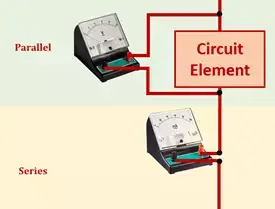
In electrical circuits, the voltmeter is always connected in ____________ and the ammeter is always connected in ____________.
Click the correct answer:
The correct answer is D.
In electrical circuits, voltmeters are always used in parallel to the nodes where the potential is required to be determined. However, ammeters are always connected in series to measure the desired current in the branches. These connections are shown in the figure below.
 Tip:
Tip:Remember, place the voltmeter in parallel to measure voltage and the ammeter in series to measure current. Using them in the wrong positions can cause inaccurate readings or damage to the meter.
Meter placement isn't arbitrary, it follows directly from how each instrument is built. A voltmeter is designed with very high internal resistance so that connecting it barely disturbs the circuit, which is exactly why it goes in parallel across the component you're measuring. An ammeter is built with very low internal resistance so that it can sit directly in the current's path without adding meaningful resistance, which is why it must go in series.
Reversing either one causes real problems, not just a wrong reading. An ammeter wired in parallel behaves like a near dead short across that branch, which can blow the meter's internal fuse or damage the circuit. A voltmeter wired in series adds enough resistance to choke off the very current the rest of the circuit depends on.
For questions like this, don't try to memorize diagrams. Ask what quantity is actually being measured first, voltage always means parallel, current always means series, and the correct wiring follows automatically regardless of how the rest of the circuit is drawn.
The Mechanical Systems section covers hydraulics, pneumatics, and piping - three areas that trip up even experienced candidates. The 955 exam tests both practical knowledge and underlying theory, meaning familiarity with the tools alone is not enough. Expect questions on system components, pressure principles, and material specifications that require solid preparation to get right under timed conditions.
Which type of valve should be used when a precise, low flow is required?
Click the correct answer:
Tip:In hydraulic systems, remember that each valve type serves a unique function. Choose a needle valve when fine-tuning flow is essential, especially in systems sensitive to pressure changes.
Valves are grouped by what they're built to do, and most exam questions are really asking you to match a described need to the valve whose structure fits it, not to recall a list of definitions.
A needle valve uses a long, tapered plunger inside a narrow port, which is exactly what allows fine, precise adjustment of low flow rates, but that same slim design limits how much pressure or volume it can handle. A gate valve does the opposite job well: a flat gate lifts fully clear of the flow path, ideal for unrestricted, high-volume, fully-open-or-fully-closed service, but a poor choice for partial throttling, since a partly raised gate vibrates and erodes quickly. A check valve isn't a flow-control valve at all, its only function is allowing flow in one direction and blocking reverse flow.
When you see a valve question, look for the functional keyword first: precise or fine control points to needle, full unrestricted flow points to gate, and backflow prevention points to check. That keyword, more than any diagram, is usually what the question is actually testing.
Which type of pipe would be most recommended to install deep beneath the ground?
Click the correct answer:
Tip:For underground piping, durability is key—pipes with higher schedule numbers offer the strength needed to endure the weight and pressure from surrounding soil.
Schedule is frequently misunderstood as a size rating, but it's really a standardized wall-thickness rating (from ANSI/ASME B36.10) for a given pipe diameter. Two pipes can share the same outer diameter and still have very different wall thicknesses depending on their schedule.
Common schedules run 10, 20, 40, 80, 120, and 160, increasing in thickness as the number climbs. Schedule 40 covers most general-purpose runs. Higher schedules get selected when the pipe has to withstand greater internal pressure, or in the case of underground installation, greater external load from the weight of soil and anything driven or built above it. A thin-walled pipe buried under that load risks crushing or deforming over time, which is exactly why the heavier schedule 120 is the right call here.
Approach these questions by matching the schedule number to the severity of the condition described, pressure, burial depth, or surface loading, rather than assuming a bigger pipe automatically means a thicker wall.
What is the aim of flexible couplings?
Click the correct answer:
Tip:When connecting shafts, consider flexible couplings to help accommodate slight misalignments, which can reduce wear and tear on machinery over time.
A coupling's job is simple: keep two rotating shafts, like a motor shaft and a pump shaft, turning together. The choice between a rigid and a flexible design comes down to how precisely those two shafts actually line up in the real installation, not in the ideal case.
Rigid couplings assume near-perfect alignment. Any deviation shows up as vibration and accelerated bearing wear, which shortens equipment life. Flexible couplings, like Oldham couplings, jaw couplings, and universal joints, are built to absorb small amounts of angular, parallel, or axial misalignment by design, trading a little transmission efficiency for a lot more tolerance. In real facility maintenance, perfect shaft alignment is the exception, not the rule, which is why flexible couplings show up so often in practice.
On the exam, treat language like "misalignment," "vibration," or "absorb shock" as pointing toward a flexible coupling answer, and language like "precision," "synchronized," or "zero slip" as pointing toward rigid.
The Motors & Controls section covers motor theory and PLC ladder logic - two areas that consistently challenge candidates across all maintenance roles. Motors require both theoretical understanding and practical knowledge of how they behave in real systems, while PLC questions demand the ability to read and interpret control diagrams under time pressure. Neither rewards guesswork. For Electronic Technician candidates in particular, the Motors & Controls section is critical - it covers the schematics, digital electronics, and control systems that make up the core of the USPS Electronic Technician exam.
In induction motors, the difference between the synchronous and asynchronous speed of the rotor is referred to as:
Click the correct answer:
Tip:Understanding the difference between synchronous and asynchronous speed is key. Remember, "slip" is the gap between these two speeds, which allows induction motors to function effectively.
Induction motors are the most common motor type you'll encounter in facility maintenance work, and slip is the single concept that explains how they generate torque at all.
The rotor can never fully catch up to the synchronous speed of the stator's rotating magnetic field, because if it did, there would be no relative motion between rotor and field left to induce current in the rotor, and without induced current there's no torque. Slip is that gap, usually expressed as a percentage: (synchronous speed minus rotor speed) divided by synchronous speed. Under heavier load, slip increases and rotor speed drops slightly as the motor works harder to maintain torque.
Exam questions often place slip next to two similar-sounding distractors on purpose. No-load speed is the rotor's speed with zero mechanical load applied, still a little below synchronous due to friction and windage losses, not a distinct fault. Single phasing is an actual fault condition, one motor terminal disconnected, not a normal operating measurement at all. Being able to tell these three apart, rather than just recognizing the word "slip," is what the question is really checking.
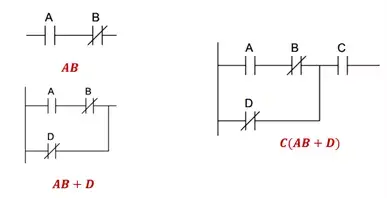
What is the equivalent Boolean expression for the PLC program below?

Click the correct answer:
The correct answer is A.
Below are the steps of analysis:
 Tip:
Tip:Pay attention to how the ladder logic groups elements—this can guide you in identifying the correct Boolean expression quickly.
Ladder logic is the standard language for programming the PLCs that run much of the automated equipment in a mail processing facility, so reading a rung correctly is a practical skill, not just a test format.
Each rung represents one output, and the contacts drawn on it show the conditions required to energize it. Contacts in series on the same path work like an AND, all of them must be true. Contacts on separate parallel paths work like an OR, any one of them being true is enough. To convert a diagram to a Boolean expression, trace one parallel branch at a time: combine the series contacts within that branch by simple adjacency, then join the separate branches with a plus sign for OR.
Work left to right, one branch at a time, rather than trying to absorb the whole rung in a single glance. Almost every mistake on this question type comes from misjudging which contacts actually share a branch versus which ones sit on separate parallel paths.
The Multicraft section covers an unusually wide range of technical subjects, electrical circuits, motors and controls, hydraulics and pneumatics, piping, and power transmission, all within a single 60-minute, 60-question block. That breadth is what makes it difficult: knowing one or two of these areas well isn't enough, you need working recall across all of them, applied quickly under time pressure. The best way to prepare is by practicing questions that mirror that same range and pace. For this purpose, we've built dedicated interactive practice tests that simulate the exact same format, alongside full coverage of the Spatial Relations section coming up next.
Boost your chances and save! Get the Complete USPS 955 Exam Prep Pack and prepare for both sections in one place.
The Spatial Relations section covers three question types: 3D objects, matching parts and figures, and matching shapes. While these may look like visual puzzles, the 955 exam demands more than pattern recognition - expect figures presented at unfamiliar angles, multi-piece assembly questions where small differences are easy to miss, and 3D visualization tasks that require fast, accurate mental rotation under time pressure.

Select from the drawings of objects labelled A, B, C and D the one that would have the given TOP, FRONT, and RIGHT views.
TOP

FRONT

RIGHT

Click the correct answer:
Representing a 3D object with standard top, front, and right views is a convention used throughout technical and maintenance drawings, not just on this exam, so this skill carries over directly to reading real equipment documentation.
Each view shows the object exactly as it would look if you were staring straight at it from that direction, including any hidden edges as dashed lines. A reliable approach is to start with whichever view shows the most distinctive outline, often the front view, then use the top and right views to fill in depth and any features the front view alone couldn't reveal, like a notch or a step.
Rather than fully visualizing all four answer options before comparing, eliminate as you go: check every option against the front view first and discard any mismatches immediately, then repeat with the top and right views on whatever remains. It's faster and less error-prone than holding all four 3D shapes in your head at once.
You are shown six labeled shapes (A-F) and must identify which answer option can be formed by combining two or more of them.You are shown six labeled shapes (A-F) and must identify which answer option can be formed by combining two or more of them. Look carefully at how edges and angles align when pieces are joined - rotating or flipping shapes mentally is key to finding the correct match.

This question type is a step up from basic piece-matching, usually involving more pieces per question and answer options with subtler distortions in size or rotation.
Start by narrowing on total area and angle count rather than trying to mentally assemble the final shape from scratch. That alone typically cuts five options down to two or three. Then check orientation on what's left, since a shape can have exactly the right area and angle count while still being incorrectly rotated or mirrored relative to the original pieces.
Testing each remaining answer option against the given pieces by elimination is faster and more reliable under time pressure than trying to construct the combined shape independently and then searching for a match.
You've now worked through sample questions from both sections of Exam 955, Mechanical Knowledge & Electronics and Spatial Relations. The real exam covers the same ground with the same time pressure, just with far more questions and no explanations waiting on the other side of a click. Closing that gap takes full-length timed practice tests across every topic in both sections, not just a handful of samples.
Boost your chances and save! Get the Complete USPS 955 Exam Prep Pack and prepare for the entire exam in one place.

Candidates who pass the 955 Exam will undergo an interview process with a panel consisting of USPS HR personnel and maintenance management. The interview is structured and typically includes 4-6 behavioral questions.
Follow the STAR Method – Structure responses using Situation, Task, Action, and Result.
Emphasize Safety Awareness – Every response should include references to safety measures and procedures.
Demonstrate Problem-Solving Skills – Explain past technical challenges you have resolved.
Communicate Clearly – Break down your answers so that even non-technical interviewers can understand them.
Describe a situation where you had to troubleshoot a mechanical or electrical issue.
Explain how you ensure safety while working with equipment.
Discuss a time when you had to learn something new to complete a job task.
For Electronic Technician candidates: describe your experience reading schematics or troubleshooting digital electronics and control systems.
For MPE Mechanic candidates: describe your experience maintaining or troubleshooting automated processing or conveyor equipment.
Your interview performance will be evaluated alongside your exam score to determine eligibility.
If selected, you will be required to complete fingerprinting and a background check.
The overall hiring process may take two months or longer from the initial application to the official start date.
A USPS Maintenance employee keeps postal facilities and equipment running - from building systems and hand tools to mail processing machinery. Entry-level positions such as Maintenance Mechanic handle preventive and corrective maintenance, plumbing, HVAC, and basic electrical and mechanical repairs, while higher-graded roles such as Building Equipment Mechanic, Area Maintenance Technician, and Electronic Technician take on more specialized diagnostic and repair work. Both the Multicraft and Spatial Relations sections of Exam 955 are designed to test the kind of hands-on, technical reasoning this role requires.
Training - New Maintenance employees complete prescribed training courses before their first assignment, along with hands-on instruction from experienced maintenance staff. Career employees can also access free training for other maintenance positions throughout their career, making it possible to qualify for higher-graded roles over time.
Location - Maintenance employees are assigned to postal facilities nationwide, including post offices, processing and distribution centers, and USPS vehicle maintenance facilities. As with other USPS crafts, you do not choose your facility - placement depends on where positions are open at the time of hiring.
Hours - Maintenance operations often run around the clock to keep mail processing on schedule, so shifts can include nights, weekends, and holidays. Applicants should expect to be available across a range of shifts, particularly early in their career.
Salary - Entry-level Maintenance Mechanics start at Grade PS-05, Step A, currently $62,945 annually (about $30.26 per hour), rising with step increases to $78,695 at the top step. Employees who qualify for higher-graded roles, Building Equipment Mechanic, Area Maintenance Technician, or Mail Processing Equipment Mechanic (Grade PS-09), and Electronic Technician (Grade PS-10), start between $75,836 and $79,651 annually, rising to $85,124-$90,691 at the top step. Step increases follow the national agreement's fixed schedule: every 36 weeks for PS-05, every 30 weeks for PS-09 and PS-10. (source)
Benefits - Career Maintenance employees receive one of the most comprehensive federal benefits packages available:

According to an APWU report from September 2025, USPS has discussed phasing out Exam 955 and replacing it with a family of role-specific Skilled Maintenance Assessment exams (961-965). No official USPS retirement date has been announced, and Exam 955 remains active. Candidates currently invited to take Exam 955 should prepare for it as normal.
The USPS 955 is a hard exam, as it requires solid theoretical and practical knowledge. The exam covers a wide range of mechanical and electrical topics. Candidates with no experience in these fields will find the test harder. That being said, prior prep can help increase your chances of scoring high.
The USPS 933, along with the 931 and the 932 versions, were previously used to screen candidates applying for maintenance positions. These exams were replaced by the 955, which became the official USPS exam for maintenance applicants.
No - the automotive technician exam (series 943-945) covers vehicle maintenance and is a separate assessment. Exam 955 is the maintenance exam for facilities and equipment roles.
The USPS Maintenance Selection System (MSS) is the structured process USPS uses to fill maintenance craft positions. Exam 955 is the examination component of that system - candidates must pass it before being considered for any maintenance role. Passing the exam is not the final step: qualified candidates proceed to a structured panel interview conducted by USPS HR and maintenance management, and final placement is determined by combining both results. Your Exam 955 score is stored in your eCareer Candidate Profile and automatically applied to future applications for positions requiring the same exam.
Yes - Electronic Technician is one of the job roles filled through the USPS Maintenance Selection System, and candidates applying for this role take Exam 955. The Multicraft section is especially relevant here, since it covers digital electronics, schematics, control systems, and test instruments - the core knowledge areas the Electronic Technician exam draws from. Strong performance on these topics, along with the Spatial Relations section, is what determines eligibility for Electronic Technician positions.
Free PDFs can give you a basic overview of the topics, but they cannot prepare you for how the exam actually feels. Exam 955 is timed, broad, and technically demanding - the Spatial Relations section in particular requires speed and pattern recognition that can only be built through repeated practice under real time pressure. A static document shows you what the topics are; it cannot simulate 60 Multicraft questions in 60 minutes or train your pacing for 65-68 Spatial items. Candidates who rely on PDFs alone typically know the concepts but struggle with execution on test day. Our PrepPack replicates real exam conditions with timed simulations, topic-specific practice tests across every content area, and detailed explanations that build the reasoning skills the exam actually tests.
We'd recommend against relying on AI-generated practice questions for a technical, official exam like this one. General AI tools don't have access to USPS's official Assessment Information Package or real exam item bank, so they can only guess at question style, difficulty, and topic weighting rather than match the actual format. More importantly, AI models can generate technically plausible-sounding explanations that are simply wrong, especially on circuit calculations, formulas, or ladder logic, since the model produces an answer that sounds correct rather than one verified against a real technical reference. On an exam this technically dense, a confidently wrong AI-written explanation can do more harm than no practice at all, since you may walk away having learned the wrong method entirely. Our practice tests are built and reviewed against verified technical sources and matched to the real exam's format, timing, and difficulty, not generated on the fly.
No. USPS never charges a fee for the application, the exam invitation, or taking Exam 955, this is confirmed directly on USPS's own careers site. If any site or email asks you to pay to take the exam or to access your invitation, it's a scam, report it to the U.S. Postal Inspection Service rather than paying.
Apply through the USPS careers website and look for maintenance positions listing Exam 955 under "Examination Requirements." After applying, watch your email - including spam and junk folders - for an invitation from the testing vendor. Add @usps.gov, @psionline.com, and @geninfo.com to your contacts to avoid missing it. Once invited, log into your assessment account to schedule your appointment at a testing center. You can reschedule up to 24 hours before your appointment. On test day, arrive 15 minutes early with a government-issued photo ID and your assessment login credentials - personal items including phones are not permitted in the testing room.
To get hired, you must pass a 5-panel urine drug test. The USPS is strict about this issue and will turn down many qualified applicants because of the drug test, making it their biggest hurdle in finding employees.