 The Complete Fire Lieutenant Exam Prep Course (2026)
Updated: August, 2026
The Fire Lieutenant Exam is a promotional exam used by fire departments and municipalities across the United States to select firefighters for advancement to the rank of Lieutenant. While the exact format varies by department, most Fire Lieutenant exams are built around the company officer knowledge and responsibilities defined in NFPA 1020 and expanded on in IFSTA's Fire and Emergency Services Company Officer training manual.
Key facts about the Fire Lieutenant Exam:
- The exam typically combines a written knowledge test with additional components such as an assessment center, oral board, or practical/tactical simulation, depending on the department's promotional process.
- Common knowledge areas include incident command, strategy and tactics, building construction and fire behavior, company supervision and human resources, communications and accountability, prevention and inspection, and safety and health.
- Unlike a standardized certification exam, the Fire Lieutenant Exam is tied to a specific department's promotional cycle and eligibility list. If you don't pass or place high enough on the list, you'll generally need to wait for the department's next posted promotional exam.
Fire Lieutenant Exam Prep Course
Most Popular
1-Month Access
What's included in our Fire Lieutenant PrepPack?
- Two full-length, timed simulations of the Fire Lieutenant written exam, 100 questions each
- 12 topic-specific practice tests covering Incident Command, Strategy and Tactics, Building Construction, Fire Behavior and Dynamics, Company Supervision, Human Resources, Communications, Accountability, Prevention, Inspection, Health, Risk Management, and Leadership
- Detailed answer explanations for every question
- A quick-reference summary guide to revise the day before your test
- Instant online access, practice on any device, at your own pace


What Is the Fire Lieutenant Promotional Exam?
The Fire Lieutenant Promotional Exam is a competitive assessment used by fire departments and municipalities to evaluate firefighters seeking advancement to the rank of Lieutenant. Rather than a single standardized national test, it's typically a department-run process built around the job performance requirements for company officers defined in NFPA 1020 (formerly NFPA 1021), covering areas such as incident command, supervision, fire behavior, and administrative duties. Most departments center the written portion on a required reading list, often anchored by IFSTA's Fire and Emergency Services Company Officer manual, along with departmental SOPs, local ordinances, and relevant NFPA standards.
A Fire Lieutenant is the first line of company-level supervision, responsible for directing crew operations on the fireground, making tactical decisions during incident command, supervising day-to-day station activities, and mentoring junior firefighters. The role bridges frontline firefighting and department leadership, so the exam is designed to test not just technical fire knowledge but also judgment under pressure, personnel management, and the ability to apply policy and procedure in real scenarios.
While the exact process varies by department, a Fire Lieutenant promotion typically follows a staged structure: candidates first meet eligibility requirements (minimum time in grade, required certifications, and a clean disciplinary record), then sit a written exam covering company officer knowledge areas. Candidates who pass the written portion often move on to an assessment center or oral board, where scenario-based exercises and interviews evaluate leadership, decision-making, and communication skills. Final scores, sometimes combined with seniority points and performance evaluations, place candidates on a promotional eligibility list, from which Lieutenant vacancies are filled as they open.
The Fire Lieutenant written exam generally draws from the same core knowledge areas outlined in NFPA 1020 and IFSTA's Company Officer curriculum: incident command and fireground strategy and tactics, building construction and fire behavior, company supervision and human resource management, communications and accountability, prevention and inspection, and health, safety, and risk management. Departments typically score the written exam as a percentage or scaled score, often requiring a passing threshold (commonly in the 70 percent range, though this varies by jurisdiction) before a candidate can advance to the next stage of the promotional process.
What makes the exam difficult isn't just the volume of material. It's that candidates are tested on applying supervisory judgment to scenario-based questions, not simply recalling facts, and many candidates who excelled as firefighters have never had to think like an officer under exam conditions before. Because promotional exams are typically offered only when a department opens a Lieutenant eligibility list, often just once every few years, there's little room for a do-over: a poor result can mean waiting years for the next opportunity, while placing near the top of the eligibility list can accelerate a career toward earlier promotion, better assignments, and a stronger pension trajectory. Thorough preparation is what separates candidates who are simply experienced firefighters from those who are ready to demonstrate officer-level knowledge and judgment under exam pressure.

Fire Lieutenant Practice Exam
1. Incident Command, Strategy & Tactics
Understanding when ICS applies is fundamental for a Fire Lieutenant, since it organizes every incident, not just major ones. A common misconception is that ICS only kicks in for multi-alarm or federally declared emergencies, when it's actually designed to scale to any incident size. Here's a sample question from the Incident Command, Strategy & Tactics section testing exactly that concept, with a full explanation below.
Complete the following: ICS is designed to be used at:
2. Building Construction & Fire Behavior
Fire behavior knowledge separates officers who can predict how a fire will act from those who are only reacting to it. A common gap among candidates is knowing water works but not understanding why, which matters because the "why" is exactly what promotional exams test. Here's a sample question from the Building Construction & Fire Behavior section testing exactly that concept, with a full explanation below.
Water is an effective extinguishing agent mainly because it:
3. Company Supervision & Communications
Accountability is one of the most heavily tested company officer responsibilities, since a breakdown in tracking crew locations has been a factor in numerous line-of-duty deaths. Many candidates underestimate how immediately an officer is expected to act on a discrepancy rather than treating it as something to sort out later. Here's a sample question from the Company Supervision & Communications section testing exactly that concept, with a full explanation below.
During a working fire, accountability records do not match a crew's reported assignment. The officer should:
4. Prevention, Health & Leadership
Recognizing an IDLH atmosphere is a foundational safety concept every company officer is expected to apply instantly, since misjudging one can cost a firefighter's life. A common mistake is assuming "IDLH" only refers to obviously toxic environments, when the definition is broader and covers anything that threatens escape or causes irreversible harm. Here's a sample question from the Prevention, Health & Leadership section testing exactly that concept, with a full explanation below.
An IDLH atmosphere is one that:
Inside the Fire Lieutenant Exam Prep Course
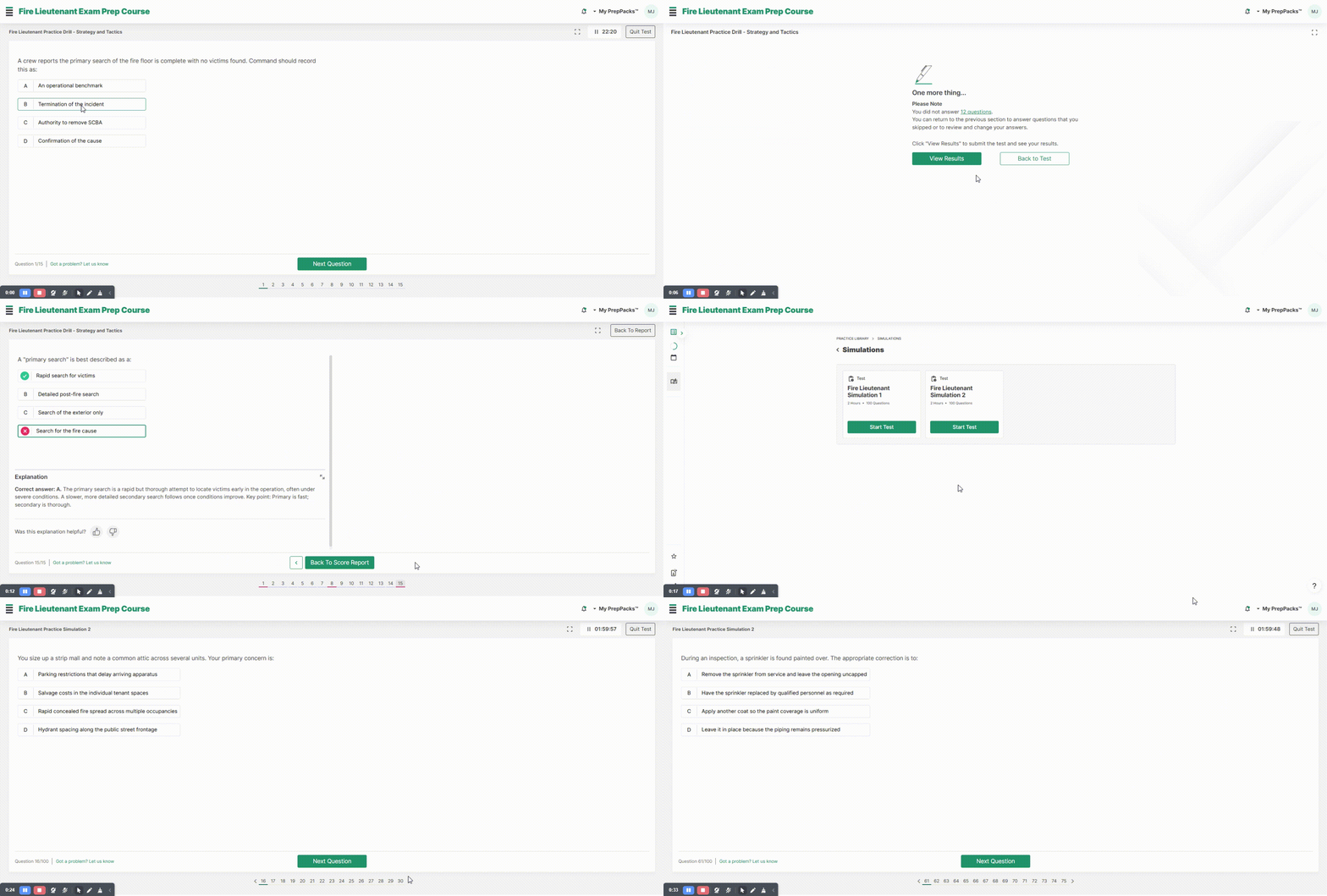
We've created a comprehensive Fire Lieutenant prep course designed to help you succeed. Our course closely mirrors the knowledge areas and question style used in real department promotional exams, allowing you to identify and improve your weaker areas. With this focused preparation, you'll be confident and ready to demonstrate officer-level judgment on test day.
Why preparation matters: Fire Lieutenant exams are typically offered only when a department opens a promotional cycle, often just once every few years, so there's little room for a do-over. The questions test more than recall: you're expected to apply supervisory judgment to scenario-based situations, often under strict time limits. Our practice tests are built around that same scenario-based format, so when test day comes, thinking like an officer under exam pressure won't be something you're doing for the first time.

What’s Inside Our Fire Lieutenant Test PrepPack
Using our Fire Lieutenant PrepPack, you get:
- Two full-length written exam simulations, 100 questions each, calibrated to match the scope, format, and difficulty of a real Fire Lieutenant promotional exam
- 12 topic-specific practice tests, covering Incident Command, Strategy and Tactics, Building Construction, Fire Behavior and Dynamics, Company Supervision, Human Resources, Communications, Accountability, Prevention, Inspection, Health, Risk Management, and Leadership
- Company officer knowledge built on NFPA 1020 and IFSTA's Fire and Emergency Services Company Officer curriculum, the same foundation most department promotional exams draw from
- Scenario-based questions that test supervisory judgment and decision-making, not just recall, mirroring how real promotional exams are written
- Detailed answer explanations for every question, teaching you the reasoning process behind each correct answer
- A quick-reference summary guide to revise the day before your exam
- A proven platform with over 30 years of experience (since 1992) that has helped thousands of candidates prepare for competitive promotional and entrance exams

About JobTestPrep
At JobTestPrep, we've helped thousands of candidates pass competitive hiring assessments since 1992. Our materials are designed by psychometric experts and updated based on real candidate feedback to reflect the latest test formats.

About the Author


What are the Four Sections of the Fire Lieutenant Exam?
Incident Command, Strategy & Tactics
Tests your ability to apply Incident Command System principles, determine appropriate strategy (offensive vs. defensive), and make sound tactical decisions on the fireground. Covers scalability of ICS, span of control, and fireground decision-making under pressure. Question count and time limits vary by department.
Building Construction & Fire Behavior
Tests your knowledge of building construction types, fire behavior, and fire dynamics, including flashover, backdraft, and structural collapse indicators. Covers how construction type and fire behavior affect crew safety and tactical decisions. Question count and time limits vary by department.
Company Supervision & Communications
Tests your ability to supervise crew members, manage personnel issues, and maintain accountability during both routine operations and emergency incidents. Covers human resource management, radio communications, and personnel accountability reports (PAR). Question count and time limits vary by department.
Prevention, Health & Leadership
Tests your knowledge of fire prevention and inspection procedures, firefighter health and safety practices, and company officer leadership principles. Covers hazard recognition, IDLH atmospheres, and the balance of direction and mentorship expected of a company officer. Question count and time limits vary by department.
Is Fire Captain the Next Step in Your Career?
Fire Lieutenant Exam Prep FAQs
Since Fire Lieutenant promotional exams are typically offered only once every few years, we recommend starting as soon as you know your exam date, rather than cramming in the final days. Working through the topic-specific tests first to build your knowledge base, then repeating full-length timed simulations closer to test day, tends to build both accuracy and confidence more effectively than a single pass through the material.
Yes. While every department runs its own promotional process, most Fire Lieutenant written exams are built around the same core company officer knowledge areas defined in NFPA 1020 and IFSTA's Company Officer curriculum. This PrepPack covers those universal knowledge areas, so it applies regardless of which department you're testing for. We recommend also reviewing your department's specific reading list and SOPs alongside this PrepPack.
If your exam is coming up fast, prioritize in this order: Incident Command, Strategy and Tactics first, since fireground decision-making questions tend to carry significant weight on most department exams. Next, Company Supervision, Human Resources, Communications, and Accountability, since supervisory judgment is a major focus of Lieutenant-level testing. Building Construction and Fire Behavior, along with Prevention, Inspection, Health, Risk Management, and Leadership, round out the core knowledge areas and are worth reviewing as time allows. If you have more than a few days, work through all four practice test categories at least once for a baseline, then spend any remaining time on the two full-length simulations.
After your purchase, you will receive two emails. The first will contain your payment receipt, and the second will include a login link along with information about our general terms, conditions, and refund policy. To access your PrepPack, simply log in and reset your password. You can use the prep pack as many times as you want. Your progress is saved in your account, allowing you to revisit previous attempts. Our performance tracker helps you focus on the test sections that require more attention. You can purchase more than one pack. If you are unsure at the time of purchase, you can always upgrade later. Additionally, we offer a Premium Subscription that allows access to up to three PrepPacks at an affordable price. You can also extend your practice period. Simply contact our customer success team via c.serv@jobtestprep.com.


