


What Real ATSA Test-Takers Taught Us for 2027 and How the Right Prep Makes a Difference
 What Real ATSA Test-Takers Taught Us for 2027 and How the Right Prep Makes a Difference
Last Updated: November 2026 | 6-minute read
At JobTestPrep we are always looking to improve its practice material, so we asked ATSA PrepPack™ customers who had already taken the real Air Traffic Control Skills Assessment what matched and what did not.
Here is what they told us, and how we improved our ATSA PrepPack™ for 2027 as a result.
The FAA is aiming to hire 2,300 new air traffic controllers in fiscal year 2027 alone, part of a three-year push toward 12,563 certified controllers nationwide. With that many seats opening, the Air Traffic Skills Assessment is the one gate nearly every candidate has to clear first, which raises an honest question: does ATSA prep actually help you pass the real test? We put that question to our own customers rather than answer it for them.
How We Gathered the Feedback
Between June and August 2026, we asked PrepPack™ customers who had bought the ATSA PrepPack™ to prepare for the hiring window that closed in March 2025, and who had since taken the real ATSA, how our practice material compared to test day.
Respondents rated the PrepPack™, picked which sections, if any, felt different, and described what stood out about timing, pacing, and test structure in their own words.
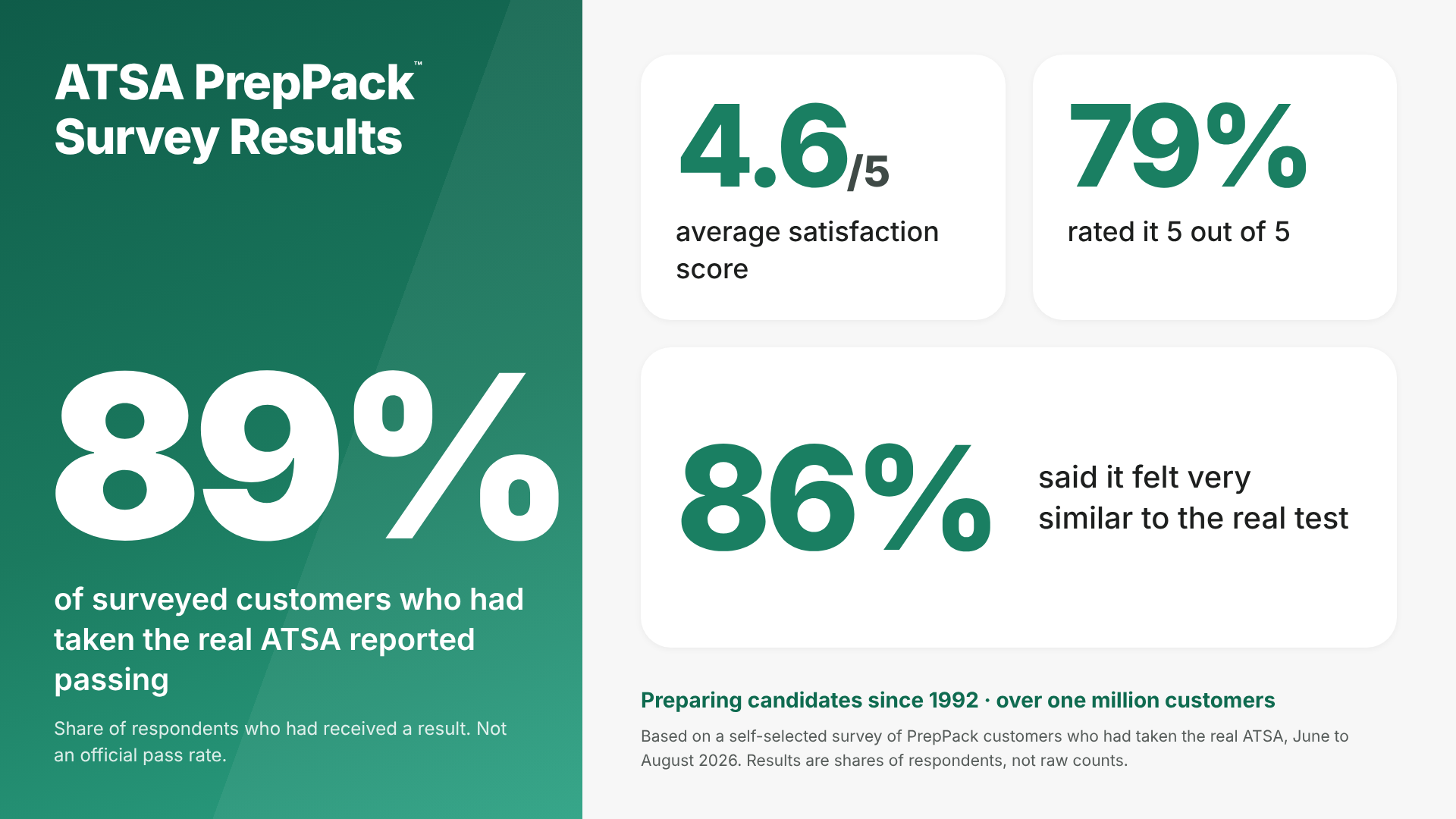
Disclaimer: This survey was a self-selected group of our own customers, not a controlled study, so these findings, including any pass or fail results we reference later, describe what this group experienced rather than ATSA candidates generally or an official pass rate.
We are reporting shares of respondents, not raw counts.
High Realism: What Test-Takers Told Us We're Getting Right
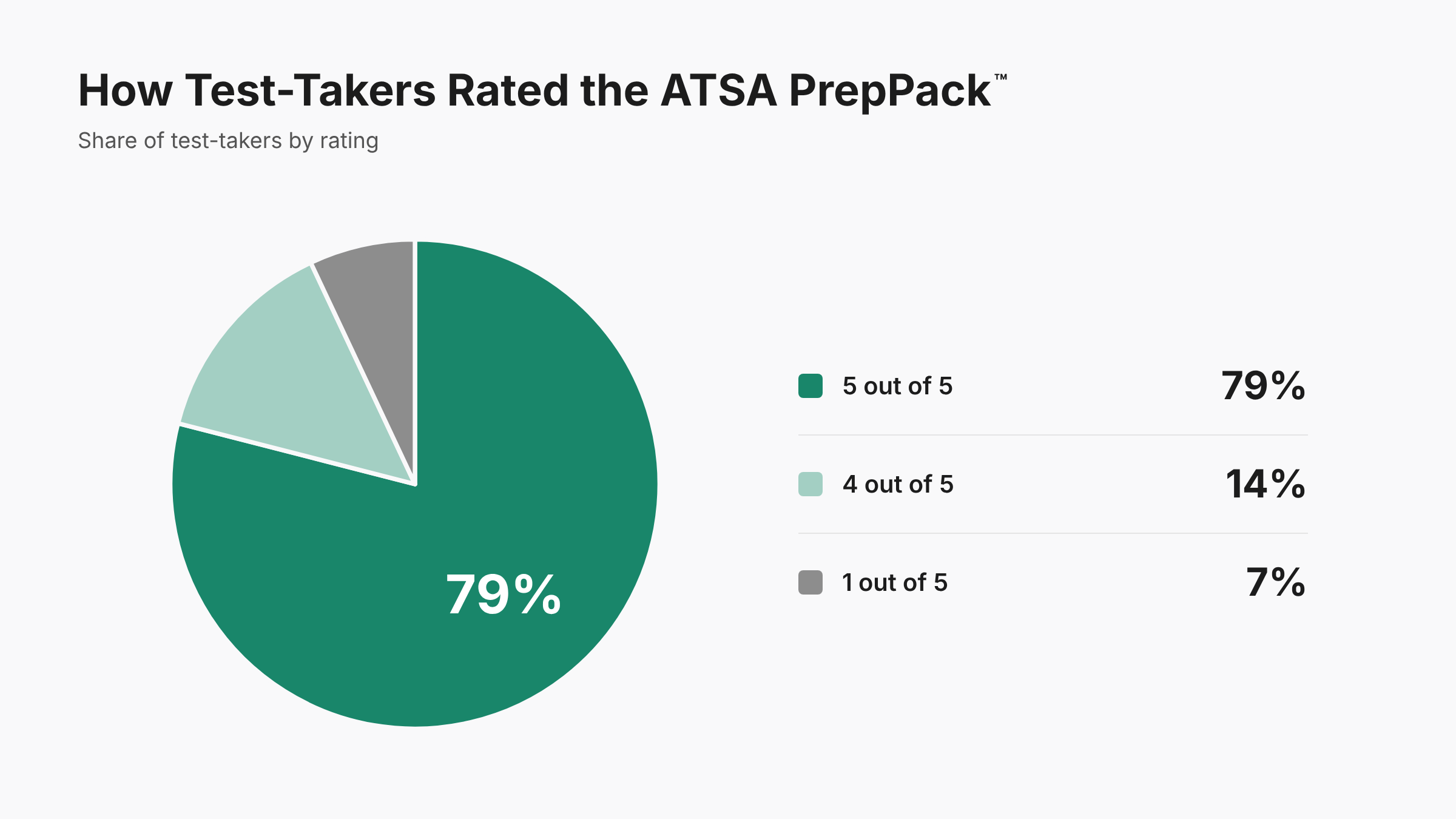
Overall, test-takers are highly satisfied with the PrepPack™. Most respondents rated it 4 or 5 out of 5, with a mean satisfaction score of 4.6. On top of that, the large majority called it very similar to the real ATSA, the clearest sign that the content itself is working.
Respondents most often said the PrepPack™ helped them know what to expect, build speed and reaction time, and feel comfortable with the test format. Specific strengths named included reading comprehension, seating charts, variables, collision avoidance, and the ability to adjust practice speed.
Memory pacing came out just as strong: most respondents said it felt about right, the single clearest validation of any one section in the survey.
What They Really Wanted: One Connected Test
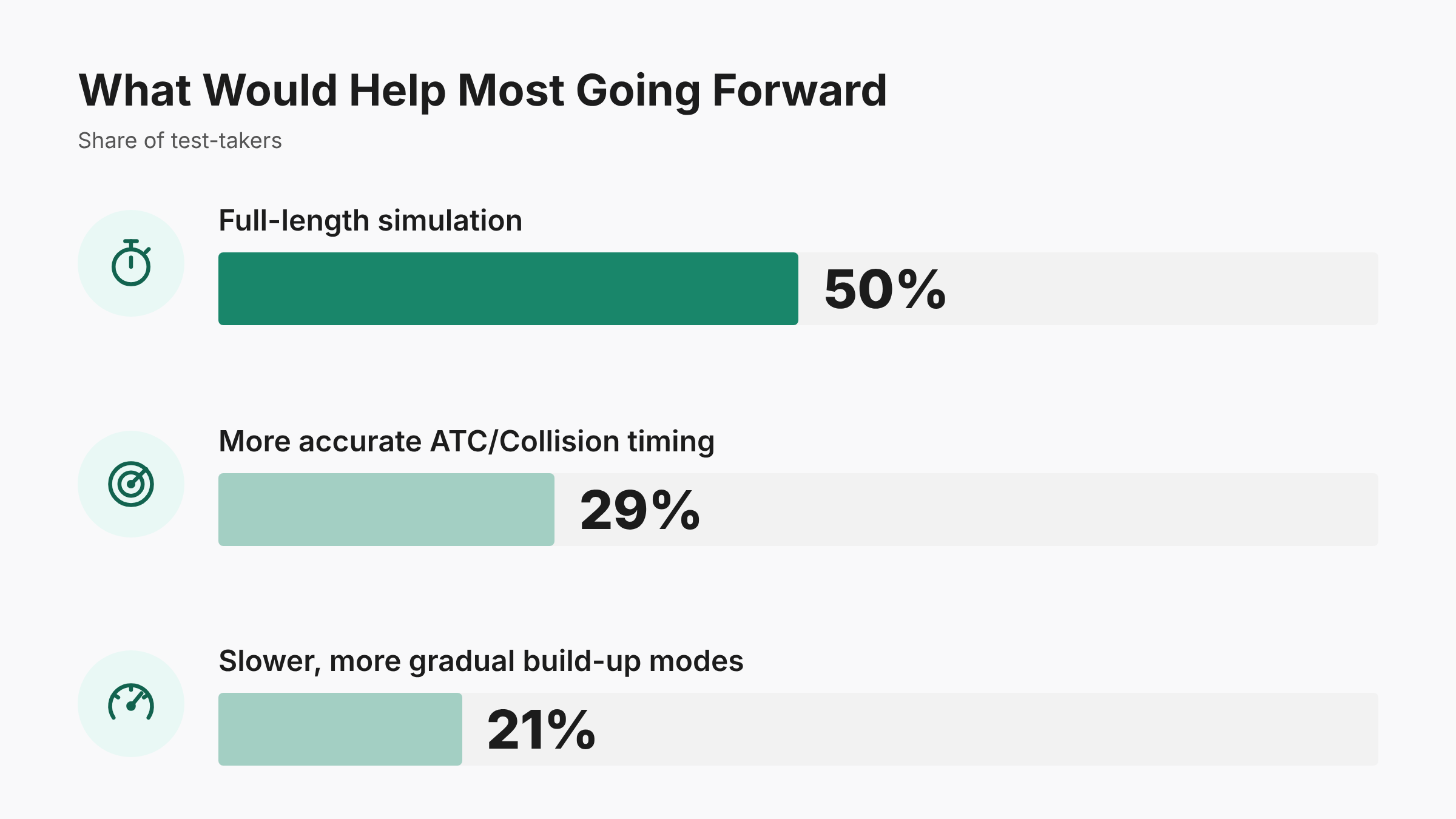
The feedback was not all about individual sections. Many respondents said the real ATSA felt like one connected test, where the PrepPack™ felt split into separate pieces, even though those pieces tested well on their own. About half specifically asked for a full-length simulation that runs in real-test order.
That distinction matters. Real test-takers did not ask for easier ATSA practice test questions. They asked for one that felt as connected and continuous as the real exam. A smaller number of respondents also shared detailed notes on the ATC/Collision and Radar section (aircraft spawn timing, how scoring is handled, input responsiveness). We are tracking those notes, though a full rework of that section is not on the near-term roadmap, so consider this the honest, if less exciting, half of the picture.
JobTestPrep is always keen to hear directly from our customers and from real test-takers, since that feedback is what actually improves the testing and learning experience. Here is what we changed in the PrepPack™ because of it.
What We Built for ATSA 2027
We do not just collect feedback and file it away. We build from it. Every piece below started with something a real ATSA test-taker told us, what felt right, what did not, and what would help them most. Two of these are new for 2027. The other four are proven strengths already in the PrepPack™.
#1 Full-Length Simulation (NEW)
The PrepPack™ now includes a continuous, roughly one-hour simulation that runs the ATSA's main cognitive sections, Memory (specifically the Numbers and Differences test), Spatial/Visual Relationship, ATC Simulation, Logical Reasoning, and Reading Comprehension, back to back and in that order, the way test day actually unfolds. Personality Profiling is left out of this simulation on purpose: it runs considerably longer than the other sections, so it stays a separate, dedicated practice item rather than stretching the simulation past a realistic length. This single feature answers the survey's single biggest request.
#2 Revised Interactive Guide (NEW)
We expanded and updated an existing PrepPack™ guide rather than starting from scratch, giving candidates clearer, more current guidance on what to expect section by section.
The full-length simulation puts you through real test-day conditions: one continuous run across every core section, so you find out whether your focus and accuracy hold up under pressure, not just in short bursts.
The revised interactive guide takes the guesswork out of what comes next, walking you through exactly what to expect in each section before you get there.
#3 Timed Difficulty Tiers
Memory Game 1 moves from untimed practice to timed drills at 2, 6, and 10 minutes, and Spatial-Visual Relationship offers three timed difficulty levels. Candidates can build up speed in stages instead of starting at full test speed on day one, directly answering the respondents who asked for a more gradual ramp-up.
#4 Numpad and Data-Entry Practice
Much of the real ATSA, including the ATC Simulation, is answered without a mouse. A dedicated numpad practice resource lets you get comfortable with that input method on its own, so it is one less thing competing for your attention on test day, a detail that lines up with the input-responsiveness notes several respondents mentioned.
#5 Explanations on Every Question, Plus a Study Guide for Every Category
Every PrepPack™ practice question comes with a full explanation, not just a right-or-wrong marker, and every ATSA category has its own dedicated study guide.
#6 Section-by-Section Practice
This is where respondents rated the PrepPack™ highest, so it stays exactly as it is. If a specific section (Variables, ATC/Collision, or whichever one is giving you difficulty) still needs work, practice it directly, as many times as necessary, without working through the full sequence to reach it. The full-length simulation measures whether you can sustain performance across every section under pressure. Section-by-section practice is where you build that underlying skill before you are tested on it.
So, Does ATSA Prep Help? What the Results Show
89% of surveyed customers who had already taken the real ATSA told us they passed.
On the real test, the FAA sorts every candidate into one of three categories: Well Qualified, Qualified, or Not Referred. Only Well Qualified and Qualified candidates move forward in the hiring process.
Preparing well will not decide your category for you, but it gives you the best shot at landing in the right one.
Why Getting Ready for the 2027 ATSA Matters More Than Ever
The FAA is not hiring quietly. Under its 2026 Air Traffic Controller Workforce Plan, the agency is targeting 2,300 new air traffic controllers in fiscal year 2027 alone, part of a push toward 12,563 certified controllers nationwide by 2028. As of April 2026, about 11,000 controllers were deployed, with roughly 4,000 more in the training pipeline.
That hiring push does not make the ATSA easier. USAJOBS announcement windows stay open for a limited time and can close once the FAA has enough applications, so candidates who wait for a hiring cycle to start before they begin preparing are already behind. The best time to start practicing for the ATSA is before the announcement window opens, not after.
How to Use the PrepPack If You Are Prepping for the 2027 ATSA
Start with the section drills to build the fundamentals, the way most of our respondents did. Once individual sections feel comfortable, run the full-length simulation at least once in one sitting, in order, without pausing to check a guide mid-section. That is the only way to feel the fatigue and task-switching that the real ATSA actually demands, not just the questions themselves.
If timing worries you most, use the timed difficulty tiers to build up speed gradually rather than starting at full pace. And if you have never taken a timed test on a numpad before, do not save that for test day. Practice it now.
In Conclusion
Real 2026 ATSA test-takers told us the content was right but the experience was not connected enough, so we built a full-length simulation to fix exactly that, alongside a revised guide, clearer difficulty tiers, and a few resurfaced strengths worth knowing about. If you are getting ready for the 2027 ATSA, the ATSA PrepPack™ now reflects what actual test-takers said they needed.
Frequently Asked Questions
Most respondents who had already taken the real ATSA rated the PrepPack™ very similar to the actual test, and most who had received a result reported passing. That is encouraging, but it comes from a small, self-selected group of customers, not a controlled study, so treat it as a strong signal rather than a guaranteed outcome.
In our 2026 survey, the large majority of respondents called the PrepPack™ very similar to the real ATSA, with a mean satisfaction rating of 4.6 out of 5. The sections named most often as accurate were reading comprehension, seating charts, variables, and collision avoidance.
A full-length, roughly one-hour simulation that runs the core ATSA sections back to back in test-day order, and a revised, expanded version of the interactive guide that comes with the PrepPack™. We also kept and highlighted existing strengths: timed difficulty tiers, numpad practice, and explanations on every question.
Yes. It covers Memory (Numbers and Differences), Spatial/Visual Relationship, ATC Simulation, Logical Reasoning, and Reading Comprehension, in that order, in about an hour, with Personality Profiling practiced separately since it runs considerably longer.
Among our own 2026 survey respondents who had received a result, 89% reported passing, though that figure describes a small, self-selected group of PrepPack™ customers rather than all ATSA candidates.
Closely, but not perfectly. Most respondents said the pacing felt about right, and a smaller number pointed to specific differences in aircraft timing, scoring, or input response. We are tracking that feedback.
It walks you through what to expect in each ATSA section, built on an earlier version of the guide with updated, clearer content for 2027.
The FAA is targeting 2,300 new controllers in fiscal year 2027 alone, part of a three-year plan to reach 12,563 certified controllers nationwide by 2028 (FAA, 2026 Air Traffic Controller Workforce Plan).
Yedidya Lixenberg, ATSA Test Developer