OET Writing: Referral vs. Discharge Letter Structure
Updated: May, 2026
The primary difference in OET Writing structure between a referral and a discharge letter lies in the Purpose Statement and the Selection of Case Notes. A referral letter focuses on the immediate transition of care for a specific clinical problem, while a discharge letter provides a chronological summary of a hospital stay and future management plans for a community-based provider.
The OET Writing sub-test is a 45 minute assessment designed to simulate real-world clinical communication. Unlike general English tests, you are not being asked to write a creative essay. You are being asked to communicate like a professional healthcare provider using clear, accurate, and well-organized English. The assessment focuses primarily on clinical communication skills rather than independent medical decision-making.
The test provides you with a set of case notes. You must then synthesize these notes into a formal letter. The most common letter types are referral letters and discharge letters. While they share a similar formal layout, their internal organization differs based on what the recipient needs to know.
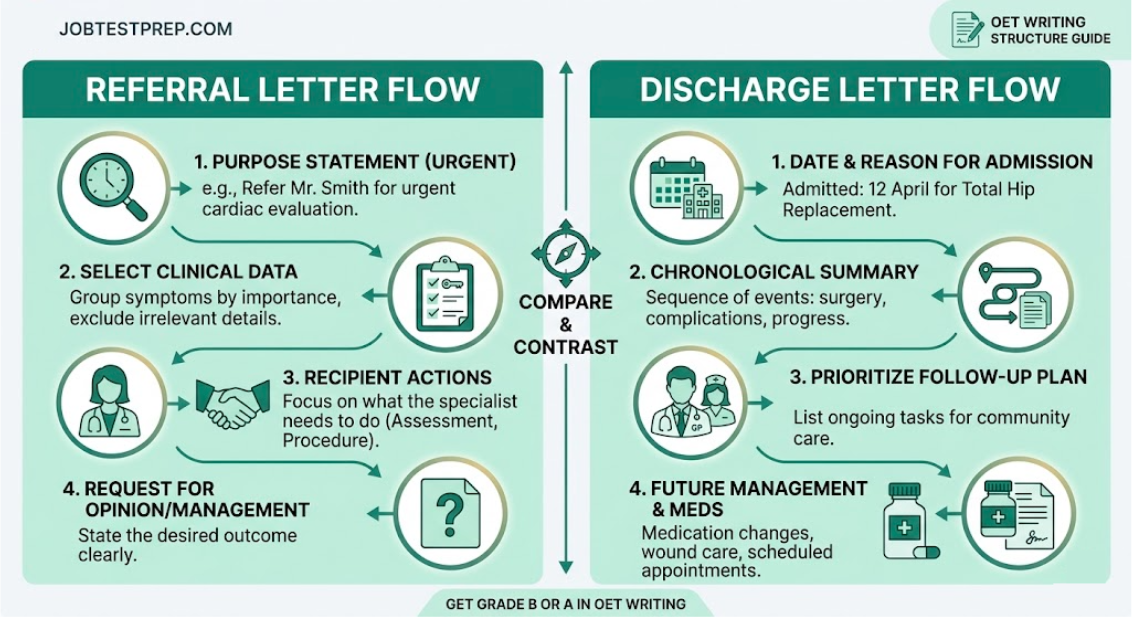
In a referral scenario, you are usually sending a patient to a specialist or another department for further assessment or ongoing care. Importantly, the OET does not test your independent clinical decision-making or medical knowledge. The clinical information, treatments, and recommendations you need will already appear in the case notes. Your task is to organize this information clearly, accurately, and professionally in English.
In a referral letter, your first paragraph must state the "Why" immediately. For example: "I am writing to refer Mr. Smith for urgent cardiac evaluation following a suspected myocardial infarction." The recipient needs to know the level of urgency within the first two sentences.
Candidates are not expected to diagnose patients or create treatment plans independently. However, they should understand the general purpose of the referral or discharge process.
For example:
The exam assesses whether you can recognize the appropriate level of urgency, organize the provided information logically, and communicate effectively with the correct healthcare professional.
When reviewing OET writing questions for referrals, you will notice many historical details in the case notes. For a referral, you should prioritize:
You are not expected to add treatments or recommendations that do not appear in the notes. For example, if a patient with suspected myocardial infarction is being referred, do not add information about catheterization or advanced cardiac management unless it is specifically provided in the task materials.
A discharge letter is typically sent from a hospital setting back to a General Practitioner (GP) or a community health nurse. The recipient already knows the patient but needs to know what happened while they were away.
While a referral letter is often organized by "Clinical Importance," a discharge letter often follows a more chronological OET Writing structure. You should summarize:
The final section of a discharge letter is the most critical for the recipient. You must clearly outline the ongoing management plan. This includes medication changes, wound care instructions, and scheduled follow up appointments.
The OET assessment criteria for "Conciseness and Clarity" depend entirely on your recipient. Before you start writing, ask yourself: "What does this person already know, and what do they need to do?"
|
Recipient Type |
What to Include |
What to Exclude |
|
Specialist (Referral) |
Detailed symptoms, specific test results, and urgency. |
Routine family history, unrelated past medical history. |
|
GP (Discharge) |
Changes to regular meds, hospital outcome, follow-up tasks. |
Basic patient background already known to the GP. |
|
Home Nurse (Transfer) |
Practical care instructions, mobility status, wound care. |
Highly technical diagnostic theories. |
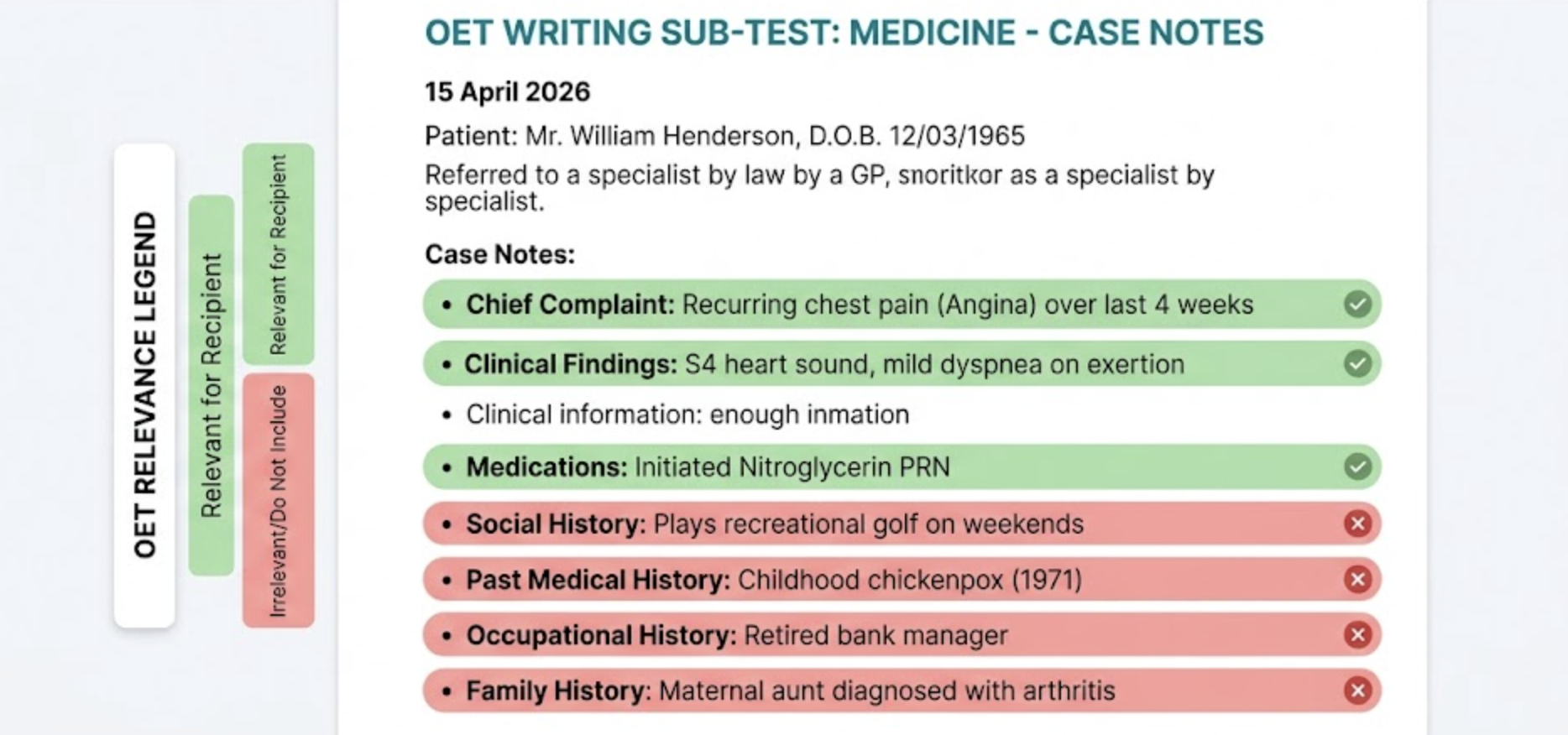
Practicing with OET writing sample questions is the only way to master the art of information selection. In many samples, you will be given 2 pages of case notes but only have a 200 word limit.
This "information overload" is intentional. The examiners are testing whether you can identify and organize clinically relevant information for the recipient.
However, candidates should avoid over-filtering the notes. If you are uncertain whether a laboratory result, investigation, or piece of medical history is important, it is usually safer to include it briefly and clearly rather than omit potentially relevant information.
For example, ongoing laboratory findings showing progression of inflammatory arthritis over time may still be important to include, even if you are not fully familiar with their medical significance. The goal is accurate and coherent communication based on the provided notes.
To get the most realistic experience before your test, we recommend using a structured OET Practice Test and Study Guide that mimics the actual exam conditions you will face.

While there is no automatic penalty for going slightly over, writing too much often leads to including irrelevant information. This negatively impacts your score in "Conciseness and Clarity" and increases the risk of making grammatical errors.
It is generally safer to write out terms in full, such as "Blood Pressure" or "as required," to demonstrate a high level of formal English. However, standard medical abbreviations are sometimes acceptable if they are universally understood by the specific recipient.
Ask yourself if the information is necessary for the recipient to continue the patient's care safely. If the information does not affect the diagnosis, treatment, or management plan by the recipient, it should be excluded. Use the Official OET Assessment Criteria to understand how examiners weigh content selection.
The OET Writing sub-test is a formal letter writing task. While you can occasionally use a list for medications, the majority of your letter should be written in full, cohesive paragraphs to demonstrate your command of English syntax and transitions.
Yes, significantly. For example, the GMC requirements for doctors generally require a Grade B in all four sub-tests. In contrast, the NMC requirements for nurses provide more flexibility, allowing a Grade C+ in the Writing sub-test in specific circumstances if you meet other criteria. Always check the official portal for your specific regulatory body.