How to Launch a Homeland Security Career in 2026 (Navigating the DHS Assessment Process)
Published: May, 2026
The Department of Homeland Security operates with a multi-billion-dollar discretionary budget to secure the nation, supporting over 260,000 federal personnel across its component agencies. This immense operational footprint means that building a sustainable pathway in homeland security careers is highly achievable if you can navigate the complex hiring ecosystem. Many applicants assume that a solid resume in law enforcement, military service, private security, or criminal justice is enough to guarantee a role.
The reality is that thousands of highly qualified candidates are eliminated early in the process because they failed a standardized, computer-based entrance exam. This guide will clarify the exact hiring steps, break down the specific cognitive and situational tests utilized by major agencies, and provide a clear strategy to ensure you are fully prepared when your official assessment invitation arrives.
The us department of homeland security jobs ecosystem is divided into specialized component agencies that handle everything from commercial airport screening to elite presidential protective details. Each agency functions as an independent entity with its own distinct operational structure, mission set, and specialized personnel requirements.
"A career in homeland security is not a singular path; it is a collection of distinct specialized tracks that require entirely different cognitive, analytical, and practical skill sets."
Understanding where your specific background fits best is the first step toward a successful application. Let us look at the four primary agencies actively recruiting candidates who seek professional stability, federal benefits, and long-term career mobility.


The Transportation Security Administration focuses primarily on securing the nation's transportation systems, most notably public airports. Entry-level homeland security positions within the TSA, such as Transportation Security Officers (TSOs), offer an accessible gateway into federal service for individuals with backgrounds in customer service, retail, logistics, or general security.
The hiring process for the TSA relies heavily on automated testing. Depending on the specific airport location, applicants face either the traditional computer-based test (CBT) or the newly introduced TSA TSO Assessment Battery (TAB). The TAB exam updates the traditional pipeline by shifting from older 2D English and X-ray screening questions toward short, intensive 3D object recognition and spatial reasoning modules designed to match modern airport CT scanners.
U.S. Customs and Border Protection is the largest federal law enforcement agency in the United States, managing international borders and ports of entry. Individuals with military experience, logistics backgrounds, or degrees in criminal justice frequently target these homeland security employment opportunities due to their competitive federal pay scales and clear promotional tracks.
The CBP entry exam is highly rigorous, testing logical reasoning, arithmetic, and report-writing capabilities. Candidates must analyze complex blocks of dense text, such as legal statutes or policy parameters, to draw legally airtight conclusions under strict, fast-moving time limits.
The Federal Air Marshal Service deploys armed, undercover federal law enforcement officers on commercial aircraft to detect, deter, and defeat hostile acts against aviation. This branch represents a highly specialized sector of us homeland security jobs that demands a high degree of emotional stability, firearms proficiency, and situational awareness.
Applicants facing the FAMS assessment encounter a multi-part test that measures situational judgment, writing skills, and abstract reasoning. The exam is specifically structured to ensure that candidates can make split-second, high-stakes decisions in confined spaces without relying on constant external supervision or backup.
The U.S. Secret Service carries a dual mandate of protecting national leaders and safeguarding the financial infrastructure of the United States. Securing one of these elite DHS careers requires passing through one of the most comprehensive background and testing pipelines in the federal government.
The Secret Service Assessment Process (SSAP) includes the Special Agent Entrance Exam (SAEE). This test features specialized sections covering detailed report writing, logic-based reasoning, and an intensive memory and observation section where candidates must recall minute visual and textual details from a crime scene scenario after the source material is removed.
The true bottleneck in securing homeland security jobs is not the initial application on USAJOBS, but the mandatory computer-based testing phase. The Department of Homeland Security uses these automated testing frameworks as an objective, cost-effective method to filter out thousands of applicants before a human human resources specialist ever reviews a physical resume.
"The federal hiring bottleneck is mechanical; automated testing panels filter out the majority of applicants long before an interview panel ever evaluates their personal character or real-world experience."
These assessments are specifically engineered to create psychological pressure through strict, fast-paced time limits and unfamiliar question formats. Understanding the internal layout of these tests is vital if you want to protect your application from sudden disqualification.
DHS logical reasoning sections require candidates to read a set of strict rules or definitions and apply them to a specific scenario to determine what must be true or false. These questions do not test general knowledge or personal opinions; they measure your ability to follow rigid legalistic frameworks without making unauthorized assumptions.
A common format involves a paragraph detailing specific customs regulations or airport security protocols. You are then asked a question that can only be answered using the exact facts explicitly stated in that paragraph, penalizing candidates who rely on outside information or common-sense assumptions.
Situational Judgment Tests (SJTs) present applicants with realistic workplace dilemmas, such as resolving a conflict with a coworker or handling an uncooperative passenger at a security checkpoint. For each scenario, you must select both the "most effective" and the "least effective" response from a list of choices.
These exams are designed to identify specific behavioral profiles that align with federal law enforcement values, such as integrity, emotional control, and adherence to the chain of command. An answer that seems perfectly logical in a corporate environment might be marked incorrect if it violates established federal emergency protocols.
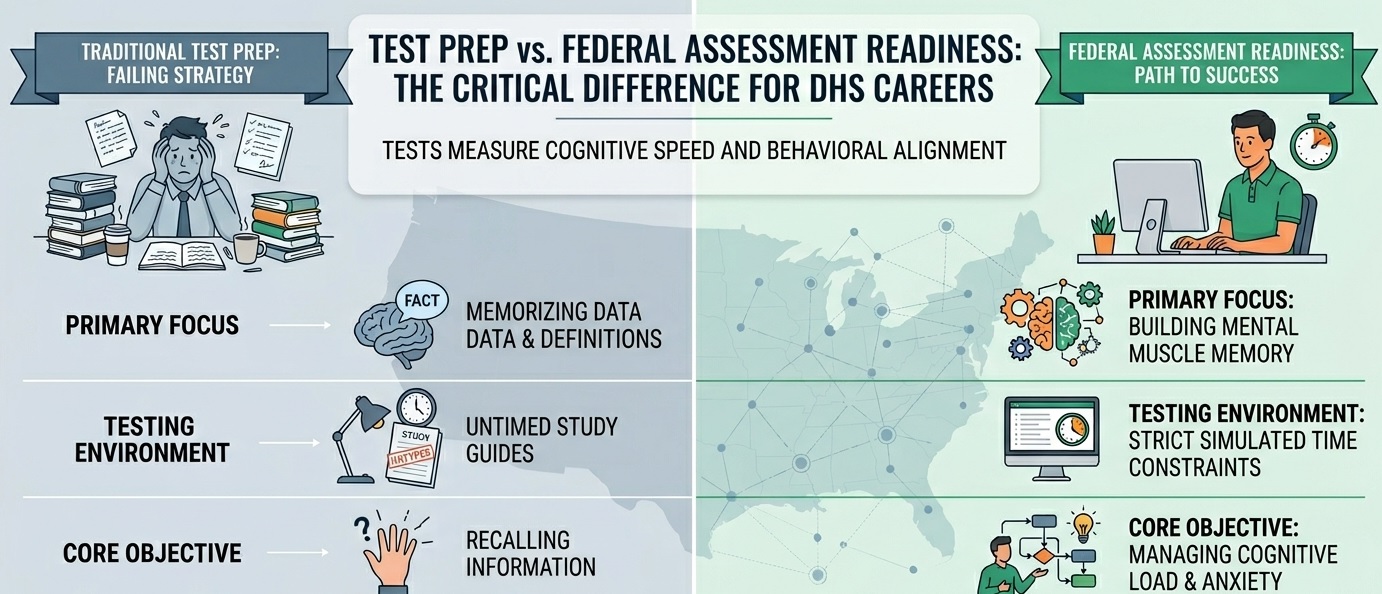
Many applicants approach DHS job openings by treating the entry exam like a traditional college midterm, attempting to cram information the night before. This strategy fails because federal assessments do not measure memorized facts; instead, they measure cognitive processing speed and behavioral alignment.
| Preparation Type | Traditional Test Prep | Federal Assessment Readiness |
| Primary Focus | Memorizing factual data and definitions | Building mental muscle memory for specific question formats |
| Testing Environment | Untimed, casual review of study guides | Strict, simulated time constraints matching the real exam |
| Core Objective | Recalling learned information on test day | Managing cognitive load and anxiety under pressure |
"Success on a computer-based federal exam is dictated by format familiarity; when you eliminate the surprise of the question layout, you free up cognitive energy to solve the problem accurately."
Achieving true readiness means exposing yourself to exact simulations of the automated testing environments used by your target agency. This systemic exposure reduces the cognitive shock that often causes candidates to freeze up during the real, timed evaluation.
The single most destructive error candidates make during homeland security career opportunities pipelines is mismanaging their time during the exam. Many applicants get stuck on a single difficult question, spending several minutes trying to find the perfect answer, which leaves them insufficient time to complete the remaining sections.
"A candidate who cannot manage the ticking clock on a cognitive test will routinely be outperformed by a candidate who understands when to guess strategically and move forward."
Once your application passes the initial screening, you will receive an official email invitation to schedule your exam at a local testing center, usually within a narrow window. This is the moment were intentional, structured preparation must replace general anxiety.
Every component agency under the DHS umbrella utilizes a slightly different testing battery. Your first action must be to identify the exact subtests included in your specific hiring track, whether it is the TSA's 3D spatial recognition test or the Secret Service's SAEE memory section.
Begin your preparation by taking full-length practice sessions that utilize automatic timers. This trains your brain to recognize the precise pace required to answer every question on the exam without rushing or panic.
Do not just check your score and move on. Analyze every incorrect answer to understand the underlying logic of the question, particularly on situational judgment tests where the differences between choices are highly nuanced.
Navigating the entry requirements for DHS jobs requires reliable, realistic diagnostic materials that mirror the current state of federal testing. We offer specialized, agency-specific preparation packages designed to eliminate the mystery surrounding these timed assessments.
Instead of generic reading materials, these prep packages provide interactive simulations of the actual computer-based tests you will face at the official examination facility. Utilizing these resources allows you to build the format of familiarity needed to step into your assessment with calm, measured confidence. Explore the targeted DHS Assessment Prep Pack resources available today to ensure you pass your phase-one exam on the first attempt.
Building a stable, lifelong homeland security career is a realistic goal if you treat the entrance exam as a core requirement rather than a minor administrative step. The automated testing systems used across the Department of Homeland Security are highly predictable once you understand their underlying structures and constraints. By committing to systematic, timed practice, you can ensure that an unfamiliar test format does not stand between you and a meaningful federal career.
The duration of the hiring pipeline varies widely depending on the specific agency, background investigation depth, polygraph requirements, and medical screening schedules. Typically, the process spans anywhere from six months to over a year from your initial application submission to your final job offer.
Yes, but failing an exam carries a mandatory waiting period before you are permitted to reapply. Depending on the specific component agency, this lockout window can last between six months and two years, making it highly advantageous to pass on your first attempt.
No, veterans do not receive waivers for the standardized computer-based assessments. While military veterans often qualify for veterans' preference points that boost their overall standing on hiring lists, they must still achieve a passing score on all mandatory entrance exams.
For most federal law enforcement positions within agencies like the CBP, Border Patrol, and Secret Service, applicants must generally be at least 21 years old and apply before reaching their 37th birthday. However, exceptions exist for preferred categories such as federal law enforcement officers or eligible veterans.
While some initial screening steps may occur via unproctored online portals, the vast majority of official proctored cognitive and situational judgment tests are conducted at secure, physical third-party testing centers to verify candidate identity and ensure testing integrity.

David has over 30 years of experience in the test prep industry, specializing in personality, behavioral, and Situational Judgment tests. He has led the development of most of our preparation courses in these areas.