How to Become a Plumber in 2026 - Complete Step-by-Step Guide
Updated: March, 2026
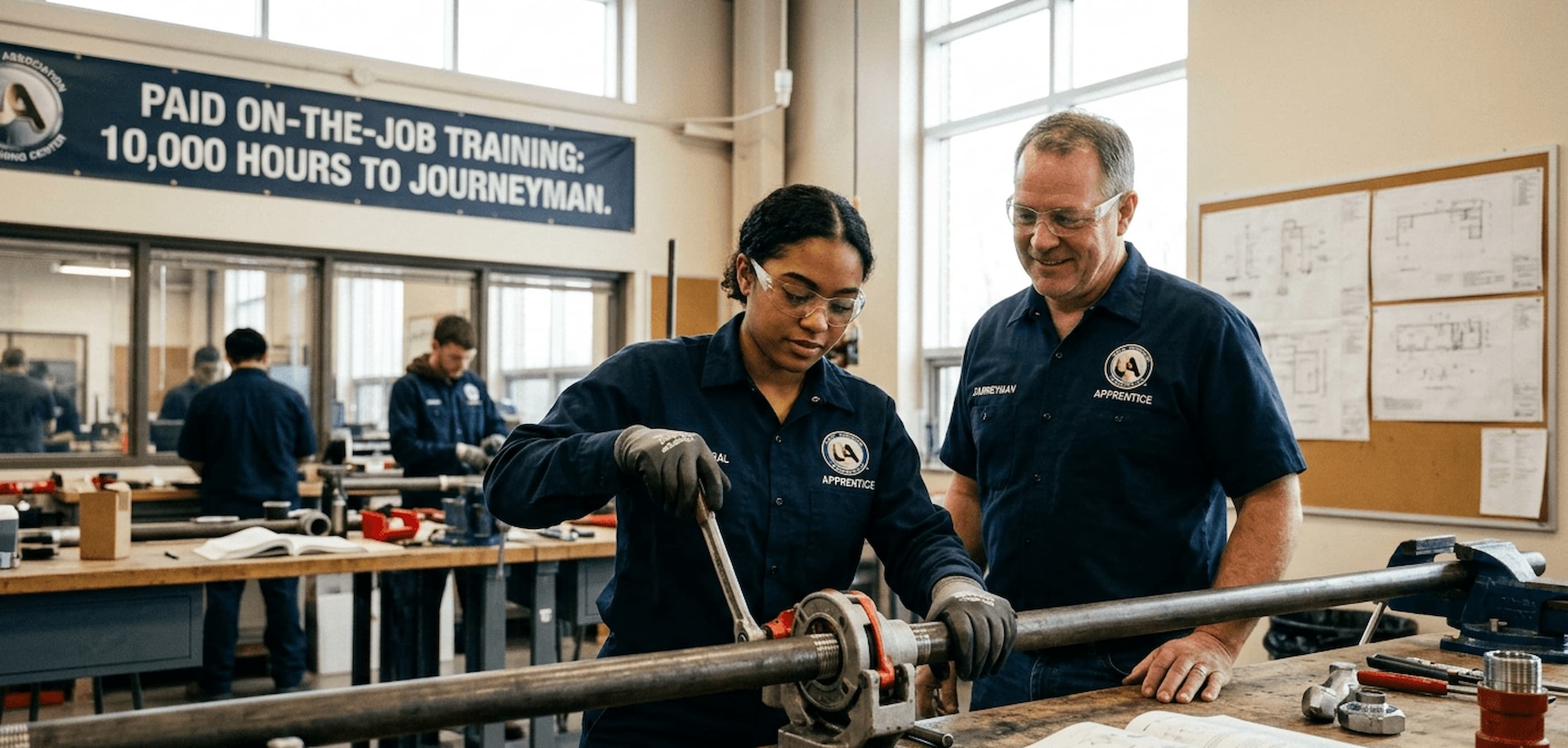
Becoming a licensed journeyman plumber takes **4 to 6 years** and follows a clear path: start as a plumber's helper, enter a registered apprenticeship program through your local United Association (UA) union hall, complete roughly 10,000 hours of paid on-the-job training alongside classroom instruction, then pass your journeyman licensing exam. You earn competitive wages from day one - no student debt, no unpaid internships.
If you are applying for a union plumbing apprenticeship, you will need to pass the **Plumbing Apprenticeship Aptitude Test** (administered by GAN Human Resources) as part of the selection process. This 140-question, 120-minute cognitive exam covers reading, math, mechanical comprehension, and spatial reasoning - and preparation makes a measurable difference in your ranking.
Plumbers install, repair, and maintain the pipe systems that carry water, gas, steam, and other fluids through residential, commercial, and industrial buildings. Day-to-day work includes reading blueprints, cutting and fitting pipe, installing fixtures, testing systems for leaks, and troubleshooting problems.
Specialization paths within the trade include residential service and repair, commercial and industrial construction, pipefitting and steamfitting, fire protection and sprinkler systems, HVACR (heating, ventilation, air conditioning, and refrigeration), and medical gas installation. The UA offers certification programs in all of these areas.
**Job outlook:** According to the U.S. Bureau of Labor Statistics Occupational Outlook Handbook, employment of plumbers, pipefitters, and steamfitters is projected to grow 4% from 2024 to 2034 - about as fast as average for all occupations - with approximately 44,000 job openings expected each year. The median annual wage was **$62,970** as of May 2024, with the lowest 10% earning less than $40,670 and the highest 10% earning more than $105,150.
Most plumbers follow a four-stage progression from entry level to master status. Each stage brings a pay increase, expanded responsibilities, and new licensing requirements.
Timeline: 6 months to 2 years
Pay Range: $15-$22/hour (non-union starting range)
This is the entry point. As a plumber's helper, you work alongside licensed journeymen, learn how materials and tools are used, carry equipment, prepare job sites, and absorb trade knowledge without formal credentials. No license is required at this stage.
This period is also when many candidates apply for a formal union apprenticeship program. If accepted, you move to Stage 2 with an immediate pay increase.
Timeline: 5 years (standard UA program)
Pay: Starts at approximately 40-50% of journeyman wage, with automatic raises every 2,000 hours worked
Training: Approximately 9,000-10,000 hours on-the-job + minimum 216 classroom hours per year
A UA registered apprenticeship is the most structured and financially rewarding path into the trade. According to UA.ORG, apprentices are paid employees from day one, wages increase on a defined staircase tied to hours worked, and the program is registered with the U.S. Department of Labor and Canadian authorities - meaning your credentials transfer across employers.
To enter a UA plumbing apprenticeship you must, per the UA's official requirements:
- Be at least 18 years old
- Hold a high school diploma or GED
- Pass the plumbing aptitude test
- Complete a panel interview with the local Joint Apprenticeship Training Committee (JATC)
- Pass a drug test and physical examination
Timeline: After completing the 5-year apprenticeship
Pay: Full union journeyman wage (varies by local; typically $35-$55/hour in major metro areas)
A journeyman plumber has completed the full apprenticeship program, logged the required hours, and passed a state or local journeyman licensing exam. According to the UA, journeymen can work independently across the full range of plumbing tasks and may supervise apprentices. In most jurisdictions, completing the apprenticeship also means earning a recognized license or certification.
*In Canada, the equivalent milestone is earning the Red Seal certification - the Interprovincial endorsement that recognizes your journeyman plumber qualifications in every province and territory across the country.
Timeline: Typically 7 years of total experience (requirements vary by state)
Responsibilities: Can pull permits, oversee projects, start a plumbing business
A master plumber holds the highest individual credential in the trade. Requirements vary by jurisdiction but typically involve several years of journeyman experience followed by written and practical examinations. For example, the NYC Master Plumber license requires a 100-question written exam and a two-part practical exam administered by CPS HR Consulting.
Search the UA's national directory to locate the Joint Apprenticeship Training Committee (JATC) nearest you. Each local runs its own recruitment calendar and application windows vary. Many locals post openings on their websites or through state workforce agencies.
Per the UA, standard requirements across most UA locals are: age 18 or older at the time of application, a high school diploma or GED, and the demonstrated desire and aptitude to learn a skilled trade. The application process may also include an interview, aptitude test, and physical requirements. A valid driver's license and math coursework (often algebra) are commonly expected - check your specific local's requirements.
Application periods open and close. Missing the window means waiting for the next cycle, which can be several months away. Many locals accept applications online through their JATC websites. Have your diploma/GED, identification, and any required transcripts ready.
After your application is accepted, you will be scheduled for the plumbing aptitude test, administered by GAN Human Resources. Your score is used to rank applicants for available apprenticeship slots. Higher-ranking applicants get priority consideration. The test covers cognitive abilities - reading comprehension, arithmetic, numerical reasoning, mechanical comprehension, and spatial reasoning - not plumbing knowledge.
Shortlisted candidates are called for a JATC panel interview. Questions focus on motivation, reliability, and long-term commitment to the trade. Typical questions include why you want to become a plumber, whether you understand the 5-year commitment, and how you have handled challenges in the past.
Final candidates must pass a drug screen and physical fitness requirements. Requirements vary by local but are standard across UA programs.
Once accepted, you start work as a paid apprentice placed with a signatory contractor. You attend classes at your local UA training center. Your wage increases automatically every 2,000 hours throughout the program.
The UA operates a dedicated program for transitioning military veterans. The UA Veterans in Piping (VIP) Program is a Department of Defense SkillBridge program providing free, on-base training in welding, HVACR, and fire suppression. Graduates are guaranteed job placement with a UA signatory contractor and direct entry into a UA-registered apprenticeship upon completion - with no GI Bill benefits required.
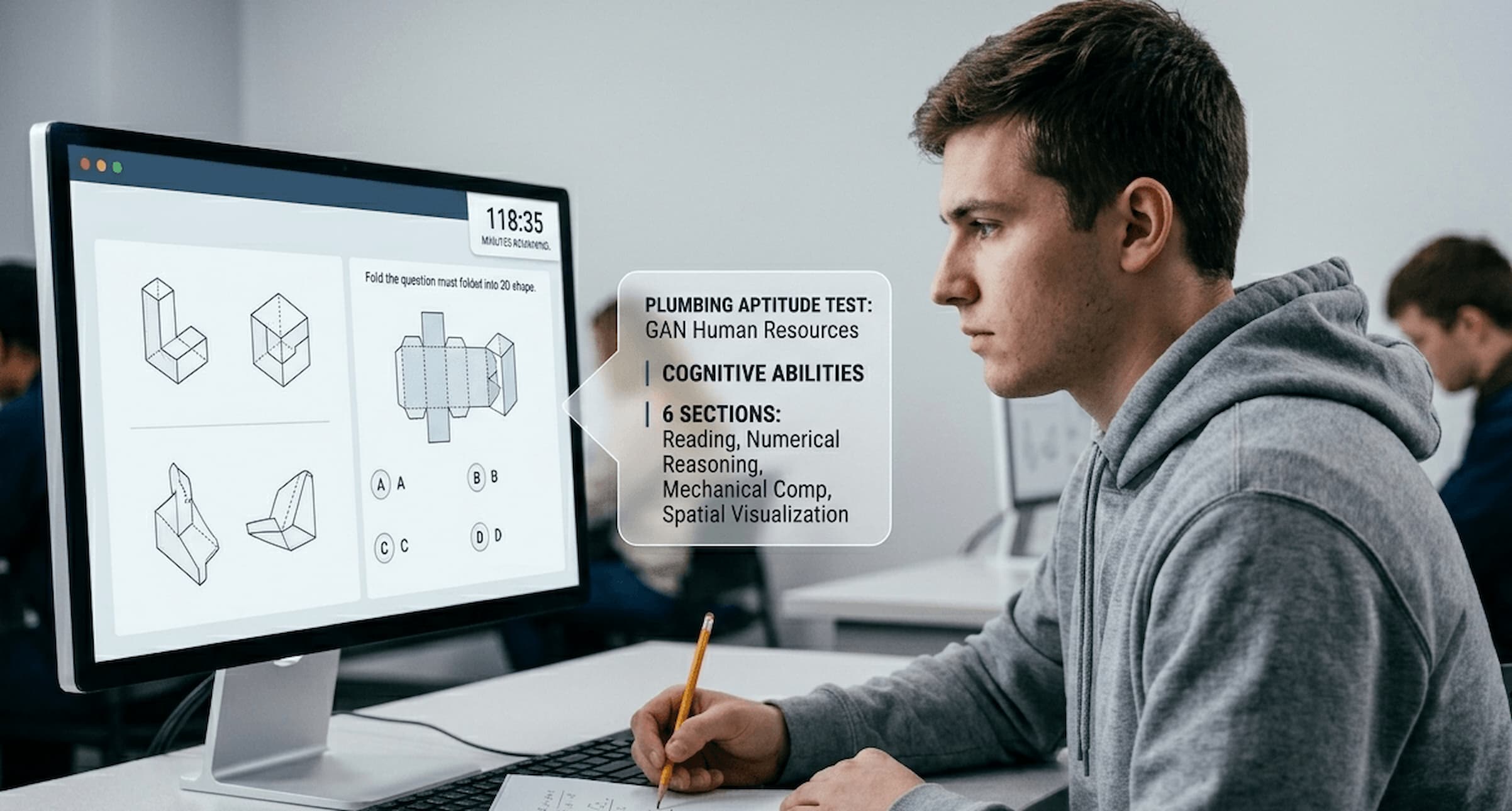
Your score on the plumbing aptitude test determines your ranking in the apprenticeship selection process. The difference between a 75% score and a 90% score can mean the difference between being called immediately and waiting through multiple application cycles.
The test is administered by GAN Human Resources on behalf of local United Association chapters. It is used by plumbing union apprenticeship programs across the United States.
Per our full breakdown on the plumbing aptitude test prep page:
Section 1 - Reading Comprehension (42 questions, 25 minutes)
You will read passages and answer questions testing your ability to draw conclusions, identify key information, and interpret written instructions. Each question has 4 answer choices.
Section 2 - Numerical Computation
Basic arithmetic including fractions, decimals, percentages, and unit conversions. Speed and accuracy matter - practice mental math and operations without a calculator.
Section 3 - Numerical Reasoning
Applied math and logical number problems. You will work through multi-step scenarios and number sequences, applying quantitative reasoning beyond basic computation.
Section 4 - Folding / Spatial Reasoning
Three-dimensional visualization. You will be shown flat patterns and asked what shape they form when folded, or presented with 3D objects from different angles. This section is consistently the one applicants most underestimate - dedicated practice makes a significant difference.
Section 5 - Problem Solving (35 questions, 35 minutes)
Word problems that require converting a written scenario into a math operation. Topics include basic arithmetic, geometry, percentages, and rate problems. Each question has 5 answer choices.
Section 6 - Mechanical Comprehension
Questions about gears, pulleys, levers, springs, force, and basic physics. No engineering knowledge is required - this section tests your intuition about how mechanical systems work.
Your raw score is converted to a ranked position on an eligibility list. When apprenticeship slots open, the local JATC works down the list from the top. Even if you technically pass the 70% threshold, a higher score means better odds of being called and more placement choices.
The plumbing aptitude test does not cover trade knowledge, plumbing codes, tools, or installation techniques. It is entirely a cognitive ability exam. Knowing how to use a pipe wrench does not help on this test - practicing numerical reasoning and spatial visualization does. See our full section-by-section test breakdown and PrepPack.
The JATC panel interview is a structured conversation - typically 15 to 30 minutes - with 2 to 5 committee members. Its purpose is to assess whether you are a reliable, committed candidate who understands what the apprenticeship involves.
Panel members are not testing your plumbing knowledge. Based on guidance from ua.org/join-the-ua, they want to assess whether you understand the commitment (5 years, physical work, evening classes), whether you have a track record of reliability, and whether you can communicate clearly and professionally.
Research your specific local's program before the interview - know the program length, how wages work, and which training center you would attend. Dress professionally. Arrive early. Have documented references from previous employers or instructors ready.
According to the U.S. Bureau of Labor Statistics Occupational Outlook Handbook (May 2024 data), the median annual wage for plumbers, pipefitters, and steamfitters is $62,970 ($30.27/hour). This places plumbers above the median for all construction occupations and roughly 27% above the national median wage for all workers.
Salary ranges by experience level, sourced from ServiceTitan/Payscale 2025 salary projections:
Union plumbers typically earn 15-23% more than non-union plumbers in comparable positions, per ptt.edu salary data. This gap widens when full benefits packages are factored in - healthcare, pension, and defined-benefit retirement that UA members receive as part of their contract.
Union apprentice wages are set by negotiated contracts and increase automatically every 2,000 hours worked per ua.org.
According to Construction Coverage's analysis of BLS OEWS data (adjusted for cost of living, 2024), Illinois leads with an adjusted median of $97,314, followed by Minnesota ($84,620), Wisconsin ($84,331), Oregon ($88,912), and Michigan ($81,787). States with strong union presence and dense construction markets consistently produce the highest plumber wages. For unadjusted BLS mean wages by state, see the BLS OEWS geographic profile for plumbers.
Master plumbers who move into contracting, project management, or business ownership can earn well above six figures. Per ptt.edu, Glassdoor data places the average master plumber salary at approximately $162,623/year. The BLS OOH notes that career opportunities beyond journeyman include project management and owning your own business.
| Union (UA) | Non-Union | |
|---|---|---|
| Entry process | Application, aptitude test, interview | Typically start as a helper and work up |
| Apprenticeship | Formal 5-year registered program, DOL-certified | Varies by employer; may be informal |
| Starting wage | 40-50% of journeyman rate, rising every 2,000 hours | Varies widely |
| Benefits | Healthcare, pension, defined benefit retirement | Varies; often self-funded |
| Credential portability | DOL-registered; recognized nationally | Depends on employer |
| Job security | Union hiring hall dispatches work during slow periods | Subject to individual employer conditions |
| Advancement | Structured, predictable staircase | Varies by employer and performance |
For most candidates who qualify for a union apprenticeship, the union path offers higher long-term earnings, stronger benefits, and more structured skill development. The tradeoff is a competitive application process and an aptitude test that not all applicants pass.
Licensing requirements vary by state and municipality. For state-by-state requirements, visit apprenticeship.gov or your state licensing board. The most common license levels are:
Apprentice license: Issued upon formal registration in a state-approved or union apprenticeship program. Often triggers an immediate pay increase per ua.org/career-paths/apprentice.
Journeyman plumber license: Required in most states to work independently. According to the BLS OOH, most states require plumbers to be licensed. Awarded after completing an apprenticeship and passing a written journeyman examination.
Master plumber license: The highest individual credential. Requirements vary but typically involve several years of journeyman experience. According to the BLS OOH, master-level plumbers on construction jobs may help develop blueprints and must ensure work meets building codes.
NYC-specific licensing (DCAS and DOB): New York City has its own licensing framework. The NYC Department of Buildings issues Master Plumber licenses and Certificates of Competence. The NYC DCAS administers civil service plumber exams (Exam No. 3090) for plumber positions in NYC government agencies. Applications are submitted via OASys at nyc.gov/examsforjobs. If you are pursuing a government plumbing job in New York City, see our dedicated DCAS Plumber Exam preparation page.
If you are pursuing an ICC plumbing certification - as a residential inspector, commercial inspector, or plans examiner - visit our ICC Plumbing Practice Test page for free exam-style questions across all three tracks.
Your score on the GAN-administered plumbing aptitude test determines your ranking in the apprenticeship selection process. A higher score means faster consideration and better placement options when slots open.
JobTestPrep's PrepPack for the plumbing union aptitude test includes:
The PrepPack covers cognitive abilities - not plumbing trade knowledge - because that is exactly what the real test covers.
Start practicing - Plumbing Aptitude Test PrepPack
Money-back guarantee: If the practice materials are not similar to the actual test you take, we will refund your purchase.
The full path from helper to licensed journeyman plumber typically takes 4 to 6 years. A UA registered apprenticeship is a 5-year program combining roughly 10,000 hours of on-the-job training with classroom instruction, per ua.org/education.
No. A high school diploma or GED is the standard requirement. Per the UA, applicants must possess a high school diploma or GED. Algebra or math coursework is often specifically required or preferred by local JATCs.
The BLS puts the entry-level (10th percentile) wage at $40,670/year. Payscale's 2025 data via ServiceTitan projects a $53,900 median for entry-level plumbers. Union apprentice wages increase automatically every 2,000 hours worked per the UA.
The difficulty depends heavily on how recently you have practiced the underlying skills - especially spatial reasoning and calculator-free arithmetic. Candidates who prepare with section-specific practice consistently report higher scores. The folding/spatial reasoning section is the one most applicants underestimate. Our PrepPack covers all 6 sections with full explanations.
A Joint Apprenticeship Training Committee (JATC) is the joint labor-management body that administers the apprenticeship program at the local level. Per the UA, JATCs post instructor openings and oversee curriculum development. They manage applications, testing, placement, training facilities, and curriculum.
A journeyman has completed a registered apprenticeship and passed a state licensing exam. A master plumber has met additional experience requirements and passed advanced written and practical exams. Master plumbers may help develop blueprints and ensure work meets building codes; in most jurisdictions, they are required for permitted plumbing work.